



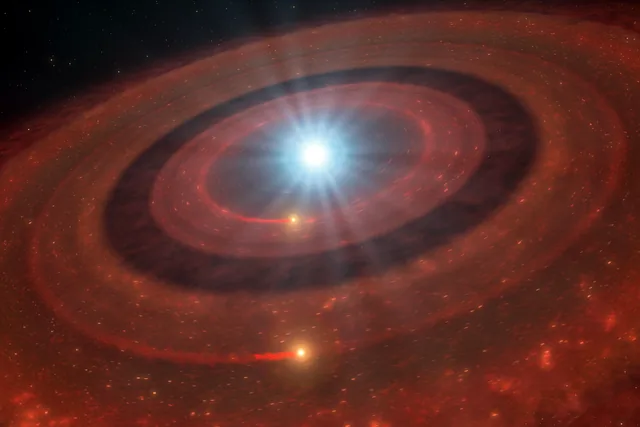
Astronomers using the European Southern Observatory’s Very Large Telescope in Chile discovered a rare system of white dwarf debris organized into two separate concentric rings around the burnt-out star J1328-1450. Located roughly 1,600 light-years from Earth, the dead stellar core hosts a stable double disc separated by an empty gap. Researchers believe this unusual geometry was shaped by two surviving planetary bodies that weathered their host star’s violent expansion, offering a direct forecast of how our own solar system may evolve billions of years from now [2].
Two Distinct Rings Around J1328-1450
The dead star J1328-1450 (cataloged as WD J132800.85-145019.95) was examined by an international team using the X-shooter spectrograph mounted on the Very Large Telescope in Chile’s Atacama Desert. While all 21 previously identified gas discs around white dwarf stars display a standard double-peaked emission signature from a single rotating disc, measurements from J1328-1450 revealed four distinct emission peaks in near-infrared calcium lines. This quadruple-peaked profile confirmed that gas does not form a single continuous sheet, but instead travels in two discrete gaseous rings orbiting at different speeds around the stellar remnant [1].
Measurements showed that the inner ring extends from 0.14 to 0.34 solar radii, while the outer ring spans between 0.54 and 1.93 solar radii. Co-author Felipe Lagos-Vilches of the University of Warwick and Chile’s Universidad Técnica Federico Santa María said: “The structure we see in this system is particularly intriguing because the two gaseous rings are remarkably stable and remain separated by a gap.” [2].
Surviving Planetesimals in White Dwarf Debris
To explain why the two rings do not merge, researchers concluded that two separate surviving planetary bodies orbit inside the disks. The inner object is estimated to be roughly the size of a typical asteroid, spanning a few kilometres in diameter, while the outer object is far larger, comparable in scale to Pluto or Earth’s moon. In their published paper in Nature Astronomy, lead author Nicola Gentile Fusillo and colleagues calculated that these planetary bodies generate enough gas through collisions and sublimation to sustain the rings while gravitationally carving the empty lane between them. Without such active shepherds, viscous forces would quickly cause the swirling cosmic rubble to spread into a single flat disc [1].
Nicola Gentile Fusillo of the University of Trieste and the INAF-Astronomical Observatory of Trieste said: “We have known for some time that planets may survive beyond the transformation of their central star, but this is the first example of a complex system with a double debris disc and potentially two surviving planetesimals.” While astronomers cannot photograph the small bodies directly, their presence within the white dwarf debris fits every dynamical signal recorded by the telescope. The surviving planetesimals act as gravitational anchors that shape the surrounding gas flows. In broader astronomy, evaluating distant gravitational perturbations, such as research investigating the hypothesized orbit of Planet Nine, similarly illustrates how small hidden masses steer surrounding material over long cosmic timescales [5].
Chemical Fingerprints of Disrupted Planetary Bodies
Spectroscopic observations with the Very Large Telescope identified clear atomic signatures of calcium, oxygen, magnesium, and iron within the orbiting gas. The inner ring holds rich concentrations of magnesium gas, whereas the outer ring appears largely stripped of it. This chemical divide provides critical clues about the origins of the feeding material [6].
Astronomers interpret this chemical divide through two distinct scenarios. One possibility is that the rings originated from two separate rocky worlds that formed in different orbital zones with distinct original compositions. The second possibility is that a single differentiated planet broke apart during the star’s dying phase, with crustal rock feeding one ring and the iron-rich metallic mantle supplying the other. Earlier observations tracking debris around white dwarfs show that atomic lines offer a reliable tool to analyze the internal geology of pulverized worlds [4].


How White Dwarf Debris Explains Planetary Survival
When a Sun-like star uses up the hydrogen in its core, it swells into a red giant and swallows closely orbiting planets. The strong stellar heat strips atmospheres and pulverizes rocky surfaces into dust that gradually funnels toward the compact white dwarf. Gentile Fusillo said: “The system is a rare glimpse of the violent, chaotic process by which a planetary system meets its end, and it hints that dead stars can have disc structures far more complex than previously realized.” [3].
Can rocky planetesimals withstand the strong tidal forces that arise as a dying star sheds its outer shell? Theoretical models previously assumed that gas disks around dead stars spread quickly into a smooth cloud. Yet in J1328-1450, surviving planetesimals appear to shepherd orbiting particles and prevent the two rings from diffusing into each other. Examining how host stars govern planetary systems reveals that while inner planets face destruction during stellar expansion, surviving outer bodies continue to reshape local architecture for billions of years [1].
Co-authors Boris T. Gänsicke of the University of Warwick, Christopher J. Manser of Imperial College London, and Detlev Koester of the University of Kiel modeled the system. They confirmed that continuous particle collisions within the white dwarf debris generate volatile vapor, keeping circumstellar disks visible across long cosmic epochs [1].

Gas Giants and Migrating Planets After Stellar Death
Planetary survival after stellar death extends beyond small rocky asteroids. Observations by NASA’s James Webb Space Telescope recently investigated the Jupiter-sized planet WD 1856 b, which circles the white dwarf WD 1856+534 roughly 80 light-years away from Earth. Discovered in 2020 using NASA’s TESS and the retired Spitzer Space Telescope, this massive gas giant completes an orbit every 34 hours at a distance of less than 2 million miles from its Earth-sized stellar host. The close orbit is 50 times closer than Earth is to the Sun. Lead author Ryan MacDonald of the University of St. Andrews said: “The planet is about the size of Jupiter, but the white dwarf it orbits is the size of Earth, so the planet is seven times larger than its star.” In their study published in Nature, researchers noted that surviving planets can migrate inward safely [7].
Because WD 1856 b orbits so close to its dead host, it would have been destroyed if it had occupied that position during the star’s red giant expansion. Instead, Webb’s thermal readings indicated an atmospheric temperature of about 260 degrees Fahrenheit (126 degrees Celsius), which exceeds expectations for an object heated solely by a faint white dwarf. Co-author Christopher O’Connor of Northwestern University determined that this heat stemmed from residual tidal friction during an inward migration that occurred between 3 and 5.5 billion years after the star died. In addition, co-author Victoria Boehm of Cornell University detected traces of methane and clouds in its atmosphere, confirming that large outer worlds can survive stellar death and retain complex chemical signatures while moving into tight orbits [7].
The Far Future of Our Solar System
The architectural clues uncovered at J1328-1450 and WD 1856+534 outline what will happen to our own corner of the cosmos. In approximately 5 billion years, the Sun will exhaust the hydrogen fuel in its core and expand into a red giant for about 1 billion years. As the Sun swells to more than 100 times its current diameter, it will engulf Mercury, Venus, and most likely Earth. Yet more distant planets, including Jupiter, Saturn, Uranus, Neptune, and the icy bodies of the Kuiper Belt, are expected to endure while tidal forces pull stray asteroids into orbiting debris rings [3].
Stellar remnants do not simply keep their debris forever. Observations of the Helix Nebula, located 650 light-years away in Aquarius (the Water Bearer), show how dead stars return their elements to the interstellar medium. Using the MOTHRA instrument with its 1,140 telephoto lenses at El Sauce Observatory in Chile, Pieter van Dokkum of Yale University and Roberto Abraham of the University of Toronto mapped 22 bow shocks across an outer halo extending beyond the nebula’s 5.7 light-year bright ring. Van Dokkum said: “We are seeing material shed near the end of a star’s life being broken apart and returned to the galaxy.” [8].

Astronomers estimate that material ejected into the interstellar medium survives for roughly 10,000 years before fully dispersing. These liberated clouds of carbon, oxygen, iron, and magnesium mix into molecular nurseries where future planetary systems coalesce. Ultimately, studying white dwarf debris around stars like J1328-1450 shows how planetary destruction fuels the ongoing cycle of cosmic rebirth [8].
- ACADEMIC JOURNAL Gentile Fusillo, N. P., Lagos-Vilches, F., Gänsicke, B. T., Manser, C. J., & Koester, D. (2026). A double debris disc around a white dwarf sculpted by two planetary bodies. Nature Astronomy. [Article Link]
- PRESS RELEASE European Southern Observatory. (2026, October 27). Dead star and planetary bodies: astronomers spot unique disc of debris that foretells Solar System’s future (Release No. eso2613). [Article Link]
- ONLINE NEWS Whitt, K. K. (2026, October 29). Is this our solar system’s future? Scientists spot disk around dead star. EarthSky. [Article Link]
- ONLINE NEWS Currie, J. (2026, October 28). Dead Star Offers a Glimpse Into Our Solar System’s Future. Nautilus. [Article Link]
- ONLINE NEWS Cuthbertson, A. (2026, October 28). Dead star discovery shows what will happen to Earth when the Sun burns out. The Independent. [Article Link]
- ONLINE NEWS Knowridge Science Report. (2026, October 28). Two rings around a dead star hint at our solar system’s future. [Article Link]
- ONLINE NEWS McCoy, M., & NASA Webb Mission Team. (2026, July 1). NASA’s Webb Studies How Planet Survived Death of its Star. NASA Science. [Article Link]
- ONLINE NEWS Cooper, K. (2026, August 17). Scientists find dead star that predicts our sun’s future: ‘Broken apart and returned to the galaxy’. Space.com. [Article Link]
APA 7: PerEXP Teamworks. (2026, October 30). White Dwarf Debris at J1328-1450 Reveals Planetary Fate. PerEXP Teamworks. https://perexpteamworks.com/en/white-dwarf-debris-solar-system/


