





When a massive star explodes, its expanding debris cloud carries a chemical record of the nuclear furnaces that powered its final days. NASA’s James Webb Space Telescope has now mapped individual clumps of Cassiopeia A dust across the famous supernova remnant, uncovering clear physical proof that internal elemental layers merged mere hours before core collapse [1]. By isolating mid-infrared spectra from solar-system-sized ejecta knots, Columbia University researcher Tea Temim and her team linked surviving mineral grains to deep convective churning inside the progenitor star [2].
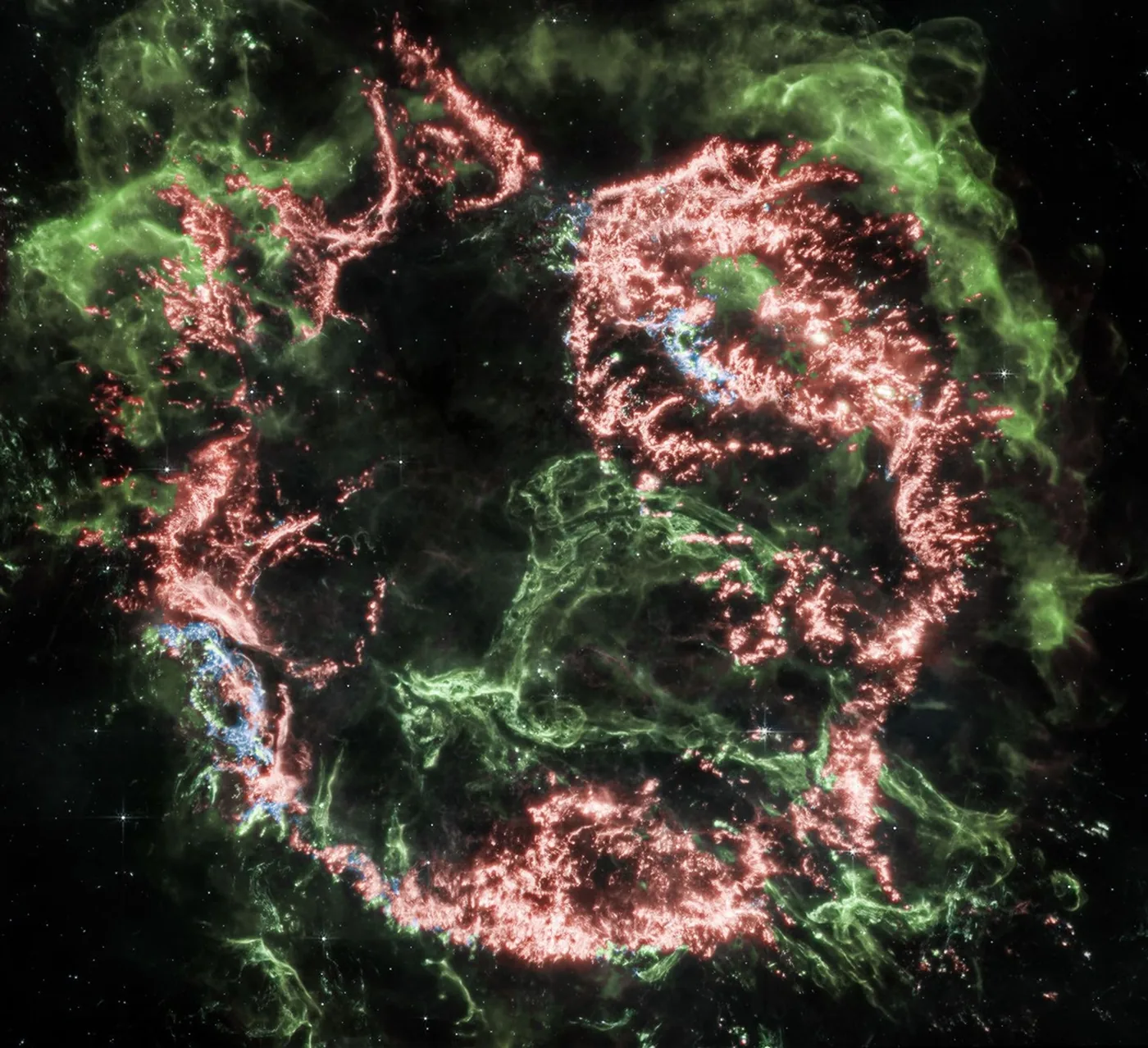
Cassiopeia A Dust in High Resolution
The supernova remnant Cassiopeia A (Cas A) represents the shattered remains of a massive star that blew apart following core collapse. Ground telescopes and orbital observatories spent decades tracking this expanding cloud to learn how explosive nucleosynthesis spreads newly forged elements into interstellar space [1]. Earlier mid-infrared surveys documented how Webb unveils previously unseen features in iconic supernova remnants, yet individual clumps remained unresolved until multi-band mapping isolated their spectra. Now, the Mid-Infrared Instrument on Webb has mapped Cassiopeia A dust at arcsecond scales, resolving fine structures that earlier missions simply could not separate [2]. Mid-infrared detectors provide astronomers with their clearest view yet of individual ejecta knots [1].
Earlier observations from NASA’s retired Spitzer Space Telescope surveyed the remnant and located broad thermal signatures, but its optical resolution was insufficient to distinguish single ejecta clumps. Spitzer pointed out three distinct zones of interest, guiding where Webb should focus its Medium-resolution Spectrometer (MRS) [1]. Dan Milisavljevic, an associate professor at Purdue University in West Lafayette, Indiana, pointed to this leap in optical power: “With Webb, the vast improvement in being able to resolve at the individual clump level helps us do more sophisticated dust chemistry” [2].
How Stellar Shells Form and Fuse
To interpret what the dust reveals, astronomers look back to how massive stars build their internal architecture over millions of years. A cold molecular cloud of hydrogen and cosmic dust collapses under gravity to form an infant protostar. Protostars evolve into full-fledged stars like our Sun once core hydrogen fuses into helium under continuous gravitational compression. Helium fuses next. When core hydrogen depletes, the central core contracts and heats until helium nuclei fuse into heavier elements like carbon and oxygen [1].
Core fusion repeats across successive burning stages, producing an onion-like arrangement of concentric shells around a dense iron core. Lighter elements like hydrogen, helium, carbon, and oxygen fuse in outward-lying shells, while heavier elements fuse in deeper, hotter layers closer to the central core [1]. Iron fusion absorbs energy. Because iron fusion saps energy instead of releasing it, outward radiation pressure fails once iron accumulates at the center of the massive star. The core collapses within seconds. A shock wave rips outward through the surrounding shells, but convective churning can mix those layers before the final explosion [2]. Concentric nuclear burning shells normally remain separated, yet fluid instabilities can blur those elemental boundaries, setting the stage for altered chemical abundances across the expanding ejecta [1].
Evidence for a Pre-Supernova Shell Merger
The study published in The Astrophysical Journal Letters presents observational proof that this tidy shell arrangement broke down prior to the terminal explosion [2]. Webb data confirms that oxygen-burning and carbon-burning shells churned together, creating blended chemical zones before core collapse occurred [1].
Lead author Tea Temim from Columbia University in New York described how this internal turmoil reshapes the star: “Material within these shells churns and circulates, which can cause the shells to merge shortly before the supernova explosion”. She explained that when oxygen- and carbon-burning shells merge, the overall structure changes, which directly alters the chemical abundances seen in the expanding remnant ejecta [1]. The shells merged hours before collapse [2].
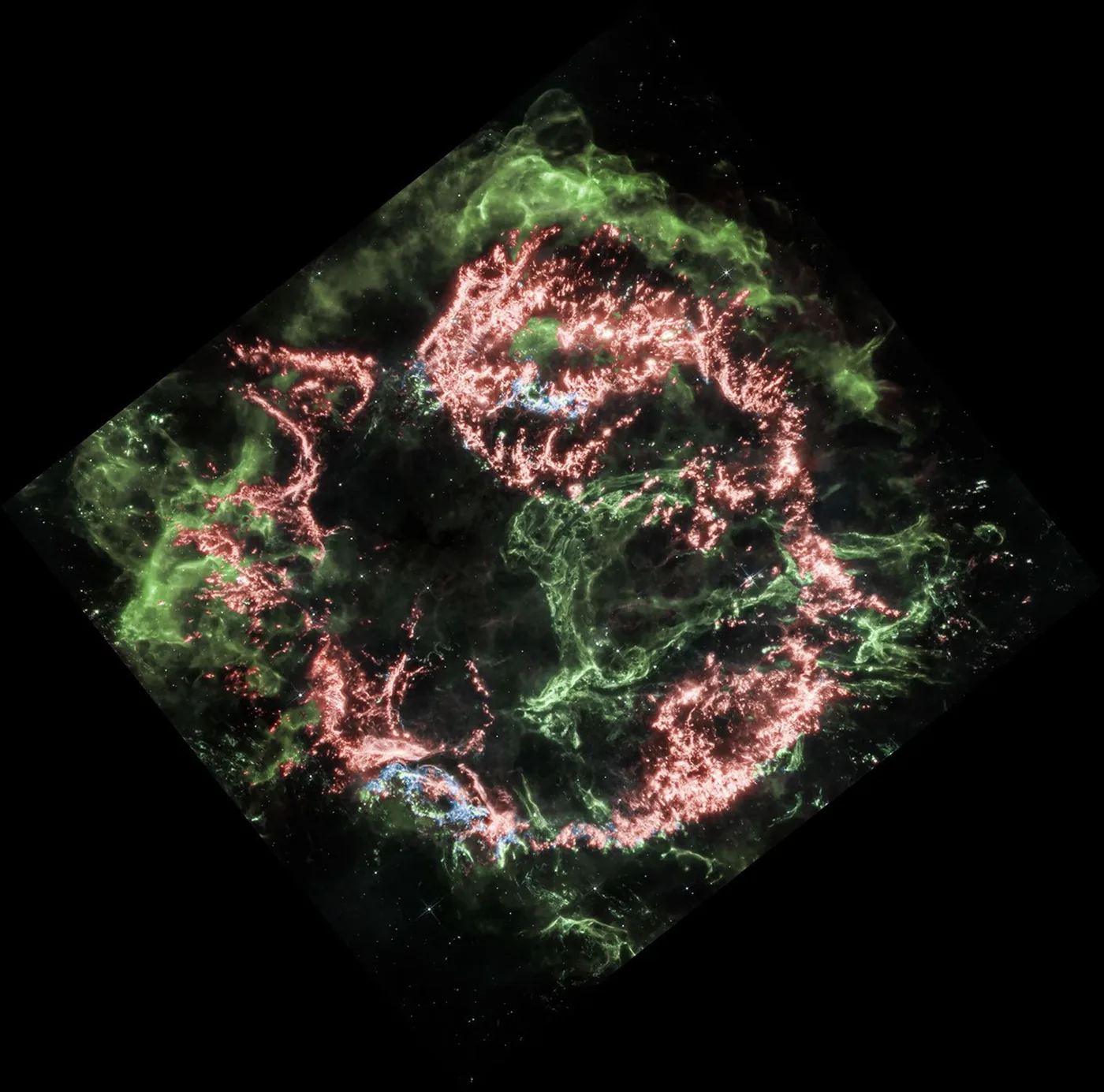
Data from NASA’s Chandra X-ray Observatory and the JAXA-led XRISM mission helped confirm that these merger signatures span the entire remnant [1]. By pairing high-energy Chandra X-ray data with Webb’s infrared maps, astronomers showed that the mixing was not a localized anomaly but a global disruption. How do astronomers verify that this mixing happened before the blast instead of during the explosion? The answer lies in the distinct chemical condensation patterns of the cooled dust grains [2].

Cas A Dust Compositions in Shocked Regions
As the blast wave travels outward, an inward-moving reverse shock wave collides with expanding ejecta [1]. The reverse-shocked environment provides an ideal setting for studying Cas A dust, because shock heating excites infrared emission from grains without immediately vaporizing them [2]. Webb’s Mid-Infrared Instrument measured two separate ejecta targets within this reverse-shocked zone [1].
Silicon dioxide dominates the argon-bright region. In this first target within the reverse-shocked ejecta, Webb spectra reveal that the dust consists mostly of silica (SiO2) grains [2]. Webb detected a pronounced 21-micrometer emission feature associated with SiO2 across much of this reverse-shocked material, proving that oxygen and silicon mingled thoroughly in this section of the debris field [1].
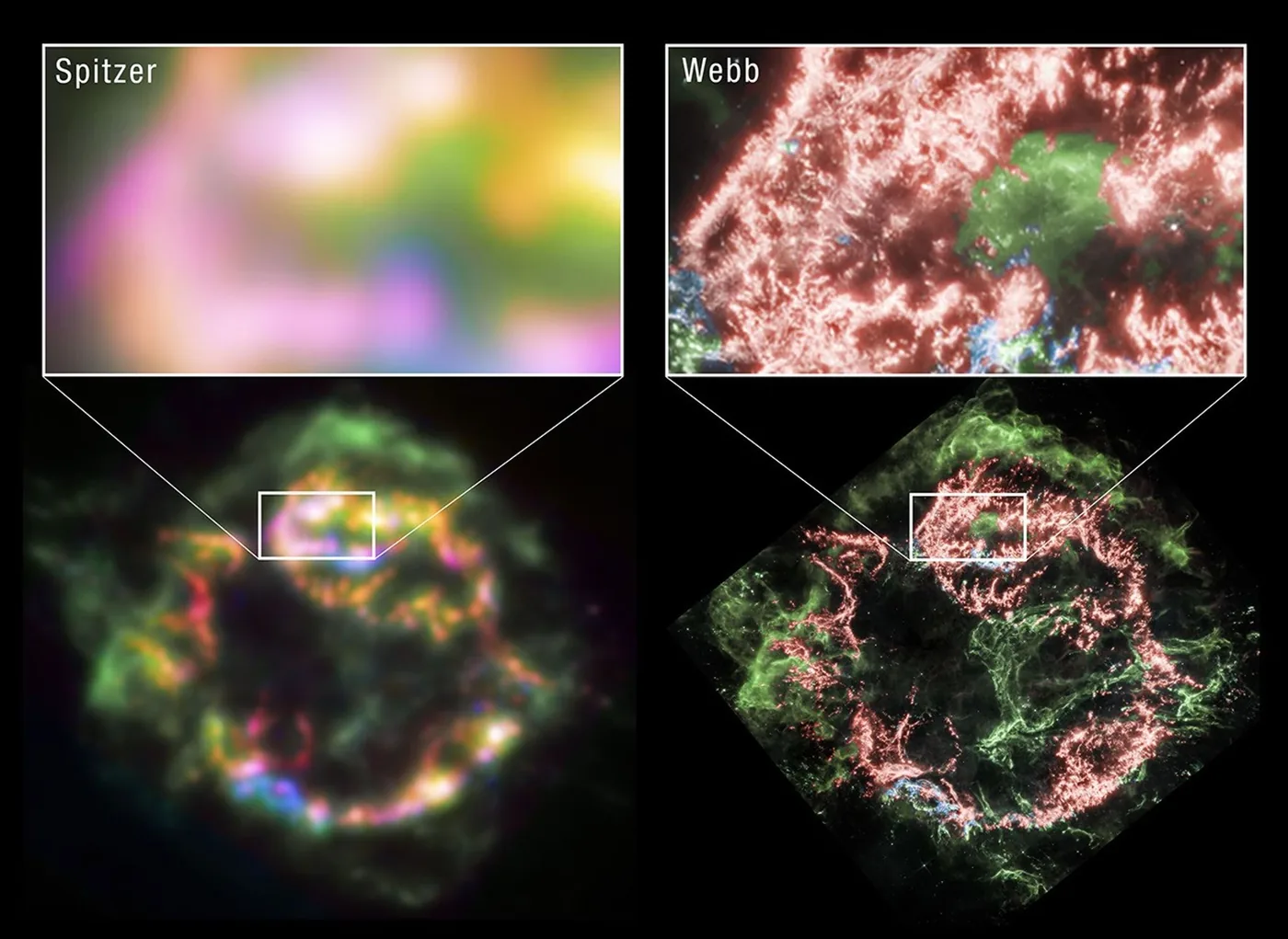
Amorphous carbon dominates the second target. Here, spectra display strong neon and carbon monoxide signatures, with carbon-rich dust concentrated primarily in two neon-rich crescent-shaped regions instead of spreading uniformly across the remnant. Finding adjacent regions dominated by completely different grain chemistries confirms that the ejecta preserves distinct chemical parcels from the disrupted progenitor shells, offering independent constraints on refractory element abundances that gas-phase observations cannot fully capture [2].
The Origin of the Green Monster
The third prominent feature examined by Webb is a web of filaments known as the Green Monster structure within a star’s debris field. First identified in early Webb infrared mosaics, this loop-like formation arcs across the central cavity of the remnant [1]. While scientists initially wondered whether the Green Monster belonged to freshly expelled supernova ejecta, its spectral properties tell a very different story [2].
Webb’s Medium-resolution Spectrometer showed that the Green Monster contains warm magnesium silicates (Mg2SiO4) instead of pure silica or amorphous carbon. The spatial distribution of this magnesium-rich dust matches circumstellar material shed by the star millennia before core collapse [2]. The loop formed before the blast. As the dying giant star pulsed during earlier evolutionary stages, it expelled its outer gaseous envelope into the surrounding void, creating a dense circumstellar shell that later collided with the outward-moving supernova shock wave [1]. Shock heating activated the pre-existing dust grains, confirming that substantial dust reservoirs existed prior to the supernova explosion itself [2].
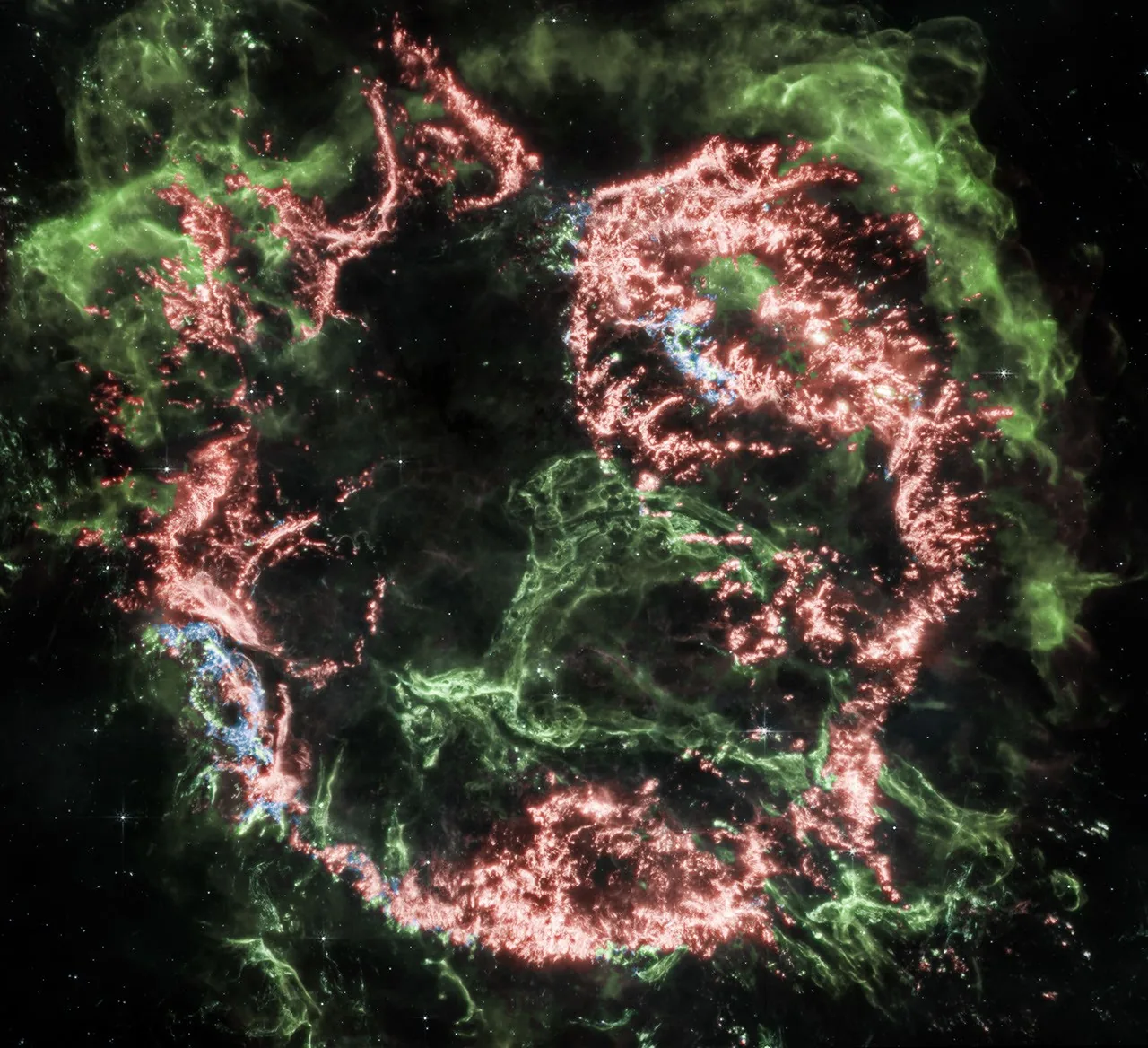
Differentiating circumstellar material from pristine ejecta provides critical boundaries for explosive nucleosynthesis models. Because the Green Monster originated outside the exploding core, it reflects the stellar wind composition of the star during its red supergiant phase [2]. Meanwhile, the silica and carbon clumps reflect the actual interior of the exploding star [1]. Comparing the two regions allows astronomers to separate what the star shed during calm evolutionary phases from what it cast out in its violent death throes [2].
Cosmic Enrichment from Supernova Remnants
The ability to dissect individual dust clumps in Cassiopeia A establishes a practical template for studying other supernova remnants across the local universe. Dan Milisavljevic from Purdue University framed the broader meaning of these measurements: “As a result, we can tie the explosion back to the makeup of the progenitor star hundreds of years afterward. It’s telling us about what was happening, we think, in the hours leading up to core collapse. Understanding this process is essential to explaining which elements the supernova explosion will release into the galaxy and how those elements enrich future generations of stars and planets” [1].
Astronomers study these condensations because dust grains scattered through interstellar space later coalesce into protoplanetary disks, mirroring how extreme debris disks around young stars assemble rocky material. In this way, analyzing surviving Cassiopeia A dust grains lets researchers track how heavy elements travel from stellar cores into new planetary bodies. The James Webb Space Telescope, an international partnership between NASA, ESA, and CSA, continues to observe remnants like Cassiopeia A to reconstruct the cosmic life cycle of matter [1].
- PRESS RELEASE McCoy, M., & NASA Webb Mission Team. (2026). NASA’s Webb Shows How Supernova Dust Chronicles Star Evolution. NASA Science. [Article Link]
- ACADEMIC JOURNAL Temim, T., Arendt, R. G., Milisavljevic, D., Dickinson, D., Laming, J. M., De Looze, I., Fryer, C., Matsuura, M., Orlando, S., Slane, P., Smith, N., Rho, J., Blair, W. P., Fox, O. D., Fransson, C., Janka, H., Kirchschlager, F., Plucinsky, P. P., Priestley, F. D.,. Zimmer, N. (2026). JWST Resolves Dust Emission from Individual Ejecta Clumps in Cassiopeia A: Dominant Grain Compositions Point to a Shell Merger in the Progenitor. The Astrophysical Journal Letters, 1012(2), L26. [Article Link]
APA 7: PerEXP Teamworks. (2026, November 24). Webb Telescope Maps Cassiopeia A Dust to Reveal Star Shell Merger. PerEXP Teamworks. https://perexpteamworks.com/en/cassiopeia-a-dust-webb-telescope/


