






Can advanced dual mode propulsion finally solve the volumetric constraints that have restricted deep-space CubeSat missions? NASA engineers at Marshall Space Flight Center in Huntsville, Alabama, recently completed extensive qualification testing on the shoebox-sized ASCENT (Advanced Spacecraft Energetic Non-Toxic) flight demonstration to validate this hybrid capability. The experimental craft unites high-thrust chemical combustion with low-thrust electrospray thrusters fed from a unified propellant reservoir. The mission is manifested to launch no earlier than October 1 as a dedicated rideshare payload aboard a SpaceX Falcon 9 rocket from Vandenberg Space Force Base [1].
How Dual Mode Propulsion Operates
Conventional spacecraft architectures demand distinct, bulky propulsion systems to execute diverse orbital maneuvers. Spacecraft typically carry a high-thrust chemical engine for rapid course corrections or orbit insertion, paired with low-thrust electric thrusters for gradual, fuel-efficient station keeping. This historical division forces vehicles to incorporate multiple fuel tanks, separate pressurization lines, and cumbersome plumbing networks that consume valuable mass and internal volume. By utilizing a single propellant formulation called ASCENT to supply both engine types from a common fuel tank, NASA eliminates duplicate tanks and simplifies internal fluid distribution. The design preserves crucial payload capacity for scientific instruments on compact satellite platforms [1].
The primary advantage of this integrated approach lies in volumetric efficiency. Small satellites face stringent mass limits during launch. By consolidating the propellant supply into a single central reservoir, engineers recover substantial internal space that would otherwise be lost to structural bulkheads and valve assemblies. While CubeSat platforms have expanded into diverse observational roles, such as how the PolCube mission maps Earth’s atmosphere and oceans, dedicated propulsion remains a limiting factor for small orbital craft. Consolidating thruster plumbing allows compact science craft to pursue ambitious orbital adjustments that previously required full-scale exploration platforms [2].
Engineering Dual-Mode Propulsion Hardware
Developing a spacecraft that balances two fundamentally different combustion physics within a chassis the size of a large shoebox required a coordinated nationwide engineering effort across academic and industrial laboratories. While NASA Marshall Space Flight Center manages the overall flight project, the flight vehicle relies on electrospray thrusters engineered by the Massachusetts Institute of Technology, a specialized chemical propulsion module built by Plasma Processes, and a unified satellite bus integrated by the Georgia Institute of Technology. Integrating these disparate systems into a cohesive flight article demanded relentless cross-institutional collaboration. Nehemiah Williams, the demonstration project manager at NASA Marshall, emphasized the collaborative rigor required to align these independent subsystems: “There are a lot of odds and ends, and a lot of small challenges and some big ones. But ensuring the functionality of the propulsion system across all these different teams is what makes the mission successful” [1].
The collaboration produced a remarkably compact satellite bus. The vehicle packages propellant delivery, guidance sensors, and high-voltage power processing units within a standardized CubeSat frame. Structural survivability during launch vibrations often requires specialized mechanical solutions, echoing principles seen in Swiss engineering designs that cushion spacecraft against severe mechanical loads. Packaging complex electric and chemical thruster components into a miniature frame demonstrates how cross-sector partnerships accelerate the deployment of cutting-edge aerospace systems [1].
Is NASA Testing Today?
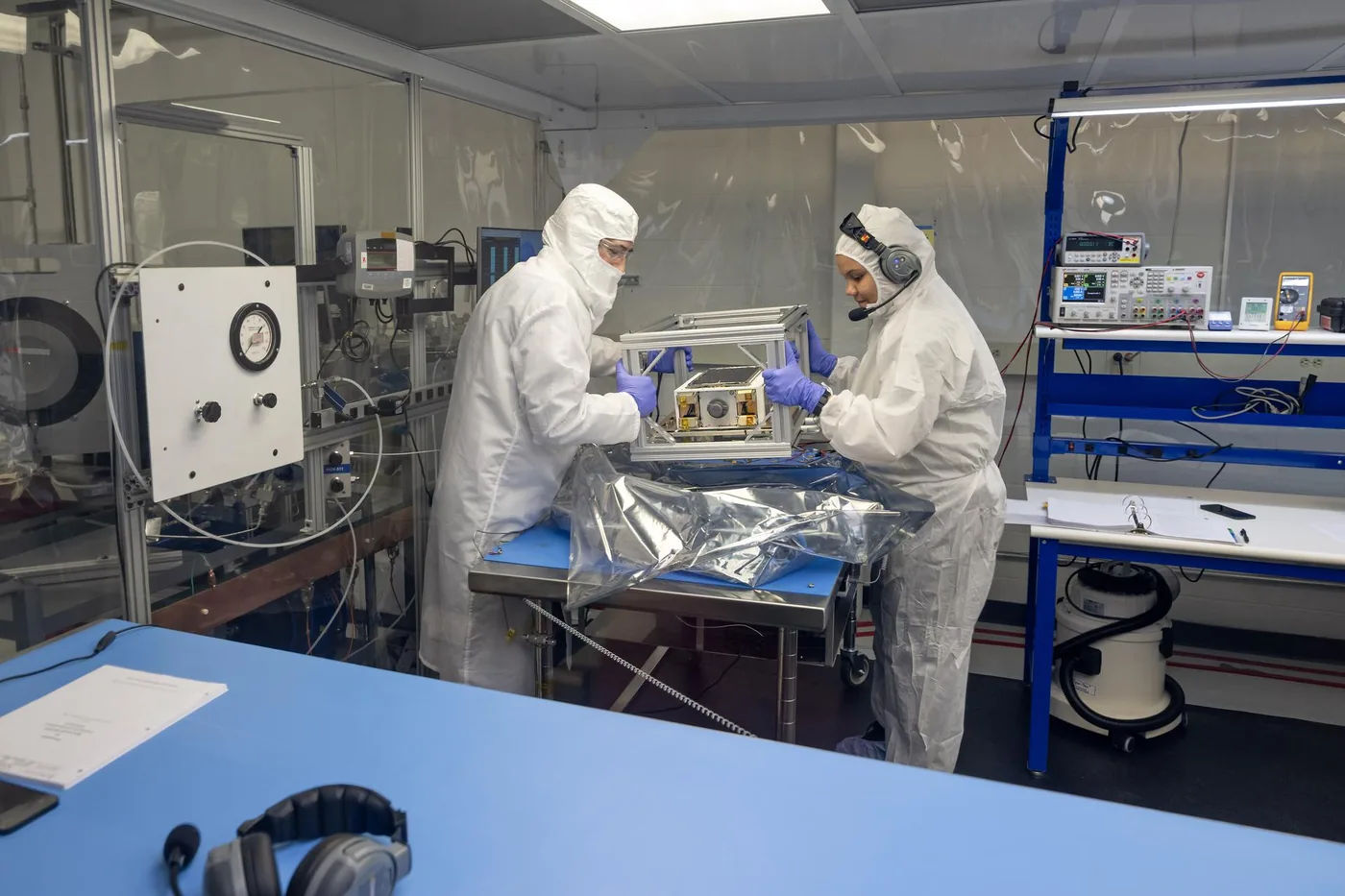
NASA is actively conducting ground verification and environmental testing today at Marshall Space Flight Center rather than staging a major rocket launch. Engineers inside the Small Spacecraft Servicing and Integration Lab in Huntsville, Alabama, recently finished a rigorous sequence of evaluations to certify the ASCENT spacecraft for flight operations. These ground activities verify that every valve, weld, and structural joint can endure orbital extremes before the satellite ever leaves the ground. Marshall teams conducted the trials. Technicians systematically verified that the integrated hardware functions seamlessly under flight-equivalent operating constraints [1].
Ground testing eliminates catastrophic orbital failures. By validating miniature propulsion architectures on Earth, NASA protects expensive orbital infrastructure and guarantees mission reliability [1].

Is NASA Testing Weapons in Space?
NASA is not testing weapons in space with the ASCENT flight demonstration; the CubeSat evaluates peaceful propulsion efficiency and non-toxic propellant chemistry for scientific exploration. Civilian agency programs focus strictly on expanding satellite mobility, reducing launch costs, and improving orbital safety for commercial and academic researchers. The ASCENT propellant itself represents an environmentally responsible alternative to hazardous propellants like hydrazine, which require cumbersome handling procedures and dangerous toxic containment. The propellant is non-toxic. Developing benign fuel formulations ensures that launch personnel and integration facilities face significantly fewer physical hazards during pre-flight loading operations [1].
International space policy and NASA civil mandates ensure that technological advancements in propulsion serve open scientific objectives. By demonstrating that a low-toxicity propellant can power dual mode propulsion systems on small satellites, the agency lowers economic and regulatory barriers for future astrophysics and Earth observation missions. Small universities and commercial research consortiums will benefit directly from these operational simplifications once the technology achieves flight heritage in orbit [2].
Rigorous Ground Vacuum and Spin Trials
Before any spacecraft qualifies for orbital deployment, it must survive comprehensive simulations inside terrestrial vacuum chambers that replicate the brutal environment of space. Engineers at Marshall Space Flight Center subjected the ASCENT flight hardware to a specialized pressurized helium leak test within a vacuum chamber. Because the architecture feeds both high-thrust chemical combustion and delicate electrospray thrusters from a common fuel tank, verifying the absolute hermetic seal of all internal lines and manifold valves is critical. Leak testing confirmed that the spacecraft seals maintained complete structural integrity under simulated vacuum conditions [1].
Following leak verification, technicians placed the CubeSat into a thermal vacuum chamber that replicates orbital temperature extremes and atmospheric absence. Orbit exposes satellites to severe swings between blazing solar radiation and icy orbital shadow. The thermal vacuum trials demonstrated that the onboard computers, power routing electronics, and thruster valves operate reliably despite steep thermal transitions. Space allows no second chances. In addition to thermal trials, the hardware completed a precision spin test to quantify dynamic mass properties (center of gravity). Validating dynamic balance ensures the satellite maintains proper orientation in flight, allowing solar panels to track the Sun and directional antennas to maintain stable Earth communications [1].

With environmental, thermal, and dynamic spin testing successfully finished, project teams entered the final launch preparation phase. Engineers are conducting final electrical system checkouts and mounting deployable solar arrays before shipping the completed hardware to California. Launch preparations are on schedule. The mission shares launch vehicle logistics with other science payloads, similar to how NASA selected a SpaceX Falcon 9 for the StarBurst mission to reach orbit efficiently. Once shipped, technicians will conduct final health checks at Vandenberg Space Force Base before loading the payload onto the rocket [1].
Testing Dual Mode Space Propulsion in Orbit
The ASCENT mission is scheduled to launch no earlier than October 1 aboard a SpaceX Falcon 9 from Vandenberg Space Force Base in California. The rocket will deploy the satellite into an operational orbit roughly 325 miles above Earth. Launch occurs from California. Once separated from the launch vehicle dispenser, ground operators will initiate a comprehensive checkout phase to establish solar power generation and verify two-way radio links with ground stations. After confirming vehicle health, operators will begin the active propulsion evaluation phase. Initial in-space testing will involve brief test firings of both the chemical thruster and the electrospray thrusters to confirm that the shared fuel feed mechanism functions properly in microgravity [1].
The primary orbital demonstration will unfold across a nine-month operational mission in low Earth orbit. The flight plan calls for alternating between high-thrust chemical burns and extended electric propulsion maneuvers to perform multiple orbit-raising and lowering cycles. High-thrust combustion provides rapid trajectory alterations, while the low-thrust electrospray system enables gradual, highly efficient orbital adjustments. Proving that both propulsion modes can operate reliably from a unified fuel reservoir will validate the dual mode propulsion paradigm for future small satellite constellations [1].
Project management and funding stem from NASA’s Small Spacecraft & Distributed Systems program within the agency’s Research and Technology Mission Directorate at NASA Headquarters in Washington. The program office operates out of Ames Research Center in California’s Silicon Valley. The mission spans nine months. As small satellites take on increasingly complex deep-space assignments, the success of the ASCENT mission will determine whether unified propellant systems become standard infrastructure for the next generation of interplanetary CubeSat explorers [2].
- PRESS RELEASE Wallace, J., & Mohon, L. (2026, September 25). NASA tests dual mode propulsion CubeSat ahead of launch. NASA. [Article Link]
- PRESS RELEASE NASA. (2026, September 25). ASCENT propulsion dual mode mission testing and flight preparation. NASA Science. [Article Link]
APA 7: TWs Editor. (2026, September 26). NASA Prepares Dual Mode Propulsion CubeSat for Flight. PerEXP Teamworks.


