





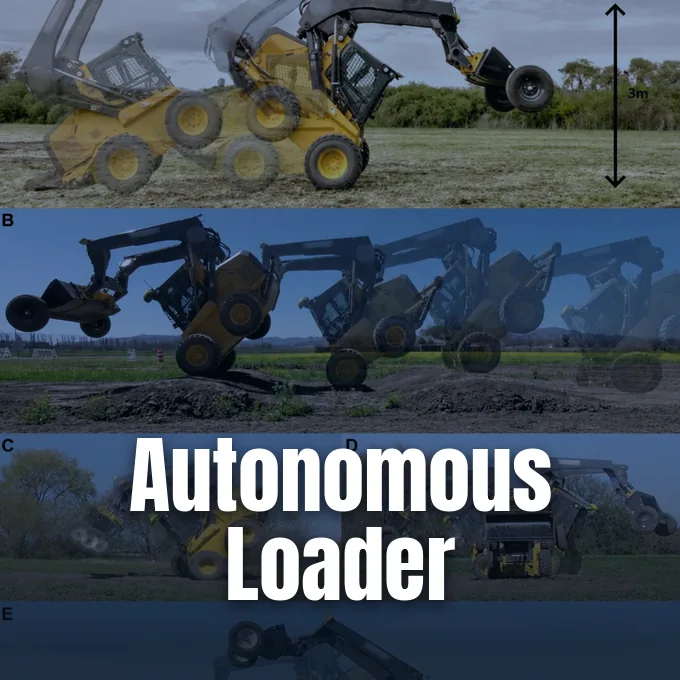
Roboticists from ETH Zurich, Blue River Technology, Gravis Robotics, and Intel’s Intelligent Systems Lab trained an autonomous control system that lets a John Deere 332G construction loader perform acrobatic maneuvers on two wheels. The five-metric-ton machine learned dynamic balance policies inside a computer simulation before researchers transferred the software onto the real loader. The findings, published in Science Robotics, prove that reinforcement learning can push heavy industrial equipment beyond the limits of standard human operation [1].
Selecting the John Deere 332G
Construction sites rely on human drivers to steer heavy loaders, excavators, and earthmovers. These diesel machines carry huge loads across rough dirt surfaces every day, moving gravel, sand, and rubble across active work zones. A single driving mistake can tip a five-ton vehicle over or put workers in physical danger [2].
To test autonomous dynamic control on heavy equipment, the engineering team selected an 11,000-pound John Deere 332G loader. The vehicle serves as a common workhorse on building projects, farms, and industrial supply yards because its compact frame fits into tight alleys. Unlike standard wheeled tractors that steer by pivoting their front axle, a skid-steer loader changes heading by spinning the wheels on one side faster than the wheels on the opposite side. This aggressive steering mechanism lets the loader pirouette within its own footprint, but it also creates harsh friction against the soil that complicates automated balance and makes vehicle motion harder to predict during extreme physical maneuvers [1].
Lead authors Pierre-Jean Lorentz and Pascal Egli organized the collaborative project at ETH Zurich, teaming up with robotics specialists from Blue River Technology, Gravis Robotics, and Intel’s Intelligent Systems Lab. The research group published their complete experimental findings in Science Robotics to show how modern software can master extreme vehicle dynamics [1].
Simulated Training for Two-Wheel Balance
Early software tests on an autonomous loader create serious hazards in open dirt. If an early software routine loses balance, an 11,000-pound loader can crash, roll onto its roof, or crush nearby sensor equipment during field testing. Lorentz and Egli recognized that a heavy crash during live trials would stall research and cost thousands of dollars in mechanical repairs [1].
To bypass the dangers of live vehicle crashes, the research team built a virtual physics simulation where the computer learned control strategies through reinforcement learning. In this digital environment, an algorithm controlled the virtual loader through millions of quick trial runs, receiving mathematical score rewards whenever the simulated John Deere 332G maintained its balance and moved toward target coordinates without flipping. If the machine tipped too far, spun out of control, or bumped into virtual obstacles, the training loop reset the trial and penalized the neural network. Over countless simulation hours, the software discovered subtle counterweights, steering corrections, and bucket movements that kept the vehicle stable during aggressive stunts [2].
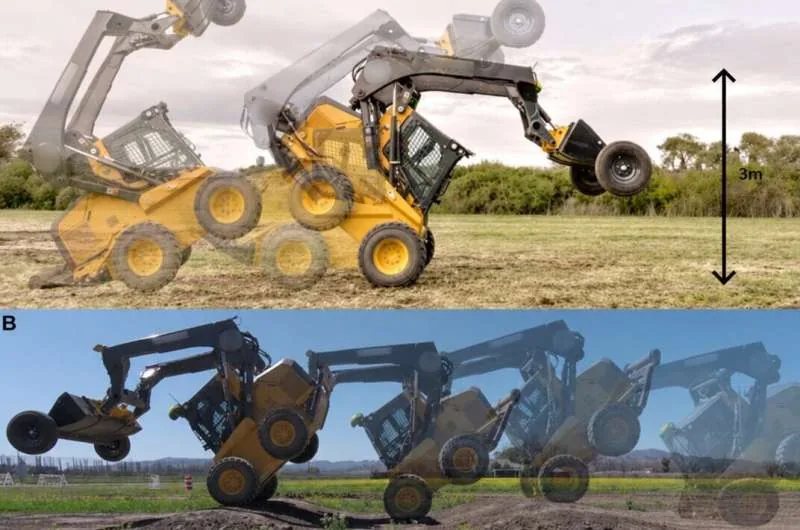
The researchers separated the stunt training into concrete sub-skills that the algorithm had to solve in sequence. First, the loader learned to pull its front wheels off the dirt. Next, it learned to hold a stable wheelie stance. Finally, the policy learned to drive along curved lines and set its wheels down softly [1].


Hydraulic Delays and Vehicle Weight
A five-metric-ton diesel loader poses far tougher control challenges than a small electric rover or a passenger car. Industrial construction machines depend on hydraulic actuation, which pumps pressurized oil through flexible hoses, valves, and heavy cylinders to spin wheels and lift metal buckets. Because oil compresses slightly and takes time to travel through narrow valves, the machine suffers from nonlinear lag between when the computer sends an electric signal and when the steel cylinders actually push. A slight steering delay in a vehicle carrying eleven thousand pounds can quickly cause a rollover, because the massive momentum of the chassis pulls the center of gravity past the point of recovery [1].
“Automation of heavy machinery offers the opportunity to improve productivity in mechanized industries such as construction, mining and material handling,” wrote Pierre-Jean Lorentz, Pascal Egli and their colleagues in their paper. “Yet, automation of such machines is challenged by their complex dynamics, in part because of hydraulic actuation that involves fluids, flexible elements and nonlinear delays. A concomitant challenge is the size and weight of these machines, which can make experiments on the physical systems exceedingly dangerous.” [1]
To overcome these hydraulic delays, the team tuned their digital simulator to match the lag and fluid resistance of the real John Deere 332G. This successful sim-to-real transfer ensured that the learned control commands worked reliably when deployed onto the real machine at the outdoor test track [2].
Live Balance on the John Deere 332G
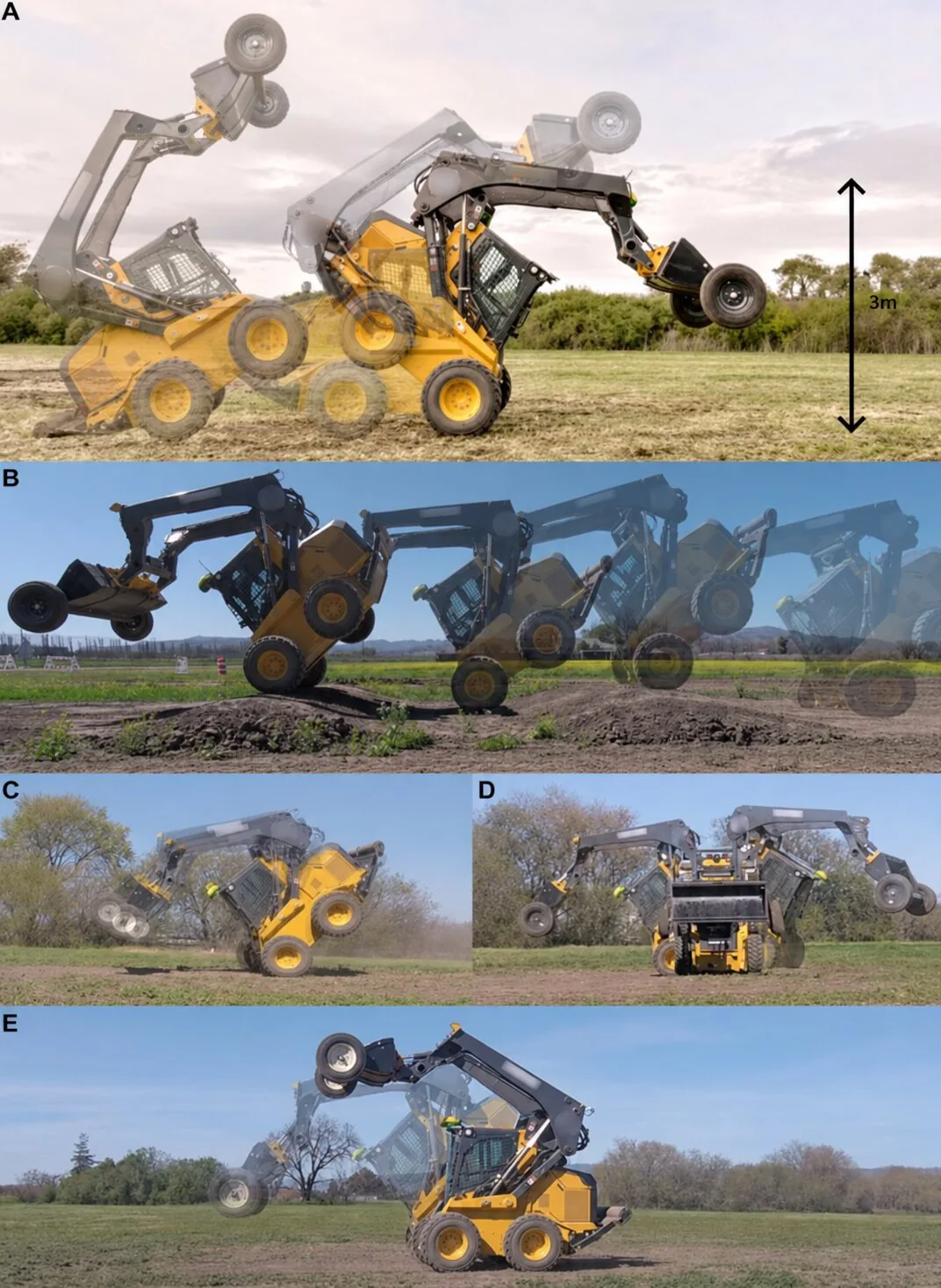
Once simulated training finished, the engineers flashed their neural network software onto the onboard computer of the real John Deere 332G. The robotics team from ETH Zurich and Gravis Robotics tested the physical loader on an open dirt course. During proving ground tests, the five-ton machine accelerated backward, engaged its hydraulics, and lifted its front axle clean into the air to balance steadily on two wheels. With no human operator sitting in the cab, the autonomous loader adjusted its wheel speeds hundreds of times per second to keep its balance intact on bare dirt [1].
The real loader accomplished several complex stunts while balancing on its rear axle. “The policies can autonomously swing the machine up onto two wheels and, while balancing on two wheels, drive over rough terrain, trace out specified trajectories, spin around and swing the bucket back and forth before landing it safely back onto four wheels,” wrote the authors [1].
Such dynamic control pushed the construction vehicle to the edge of its operational limits. Elite human stunt drivers previously performed two-wheeled wheelies in loaders only during sanctioned world-record exhibitions [2].
Future Steps for Construction Automation
Tech Xplore science journalist Ingrid Fadelli detailed how the ETH Zurich experiments expand heavy machinery automation beyond routine tasks. The researchers explained that their project was not built merely to stage entertaining machine acrobatics. Instead, teaching heavy machinery to recover from extreme tilts and slips gives autonomous vehicles the agility they need to work safely on loose gravel pits, steep embankments, and cluttered construction zones [1].
“We show that RL in simulation, followed by transfer of the learned policies from simulation to reality, can successfully automate acrobatic maneuvers that push a heavy construction machine to the limits of its actuation and have only previously been accomplished by a small number of elite human operators in official world-record performances,” wrote the authors [1].
Before contractors can deploy autonomous loaders on active building sites, the control software will require extensive safety testing under rain, mud, and dust. “This work demonstrates that RL and sim-to-real transfer enable dynamic autonomous control of heavy machinery, directly contributing to greater automation in heavy equipment sectors,” the authors wrote in Science Robotics. The collaborative research from ETH Zurich, Blue River Technology, Gravis Robotics, and Intel’s Intelligent Systems Lab shows how heavy equipment can prevent rollover accidents and reduce injuries among human workers in mining and construction [1].
- ACADEMIC JOURNAL Lorentz, P., Egli, P., Jelavic, E., Li, C., Sundar, R., Suresh, H., Montgomery, P., Redden, L., Müller, M., Sener, O., Koltun, V., & Hutter, M. (2026). Heavy metal acrobatics: Learning dynamic control for skid-steer loaders. Science Robotics, 11(120). [Article Link]
- ONLINE NEWS Fadelli, I. (2026, November 28). AI teaches a 5-metric-ton construction loader to perform acrobatics. Tech Xplore. [Article Link]


