




What is QUIC protocol? It is a general-purpose transport layer protocol created by Jim Roskind at Google in 2012 and later standardized by the Internet Engineering Task Force in RFC 9000 [1, 2]. Web traffic long relied on Transmission Control Protocol, but kernel dependencies and middleboxes made network updates difficult on the global Internet. Measurements show that 6.5% of Internet paths encounter harmful ossification from middleboxes that alter metadata [2]. By encapsulating multiplexed streams inside User Datagram Protocol, the QUIC protocol merges crypto handshakes with connection setup to eliminate round trips and prevent packet loss from stalling other streams [1].
What Is QUIC Protocol?
Google began developing the protocol in 2012 to address latency bottlenecks that simple bandwidth upgrades could not fix. The speed of light limits signal travel across fiber cables. Because round-trip time between browsers and remote servers stays fixed on mobile links, Google engineers recognized that adding raw bandwidth would not solve user-perceived delays. Google had previously built SPDY to multiplex requests over TCP. While SPDY formed the foundation of the Hypertext Transfer Protocol update known as HTTP/2, a single dropped packet on that socket still stalled every active stream [3, 4]. Engineer Jim Roskind announced the project in 2013. Writing on the Chromium Blog, Roskind explained that Chrome dev channels would test the transport, hoping “QUIC features will migrate into TCP and TLS if they prove effective” [3].
The name originally stood for Quick UDP Internet Connections in early Google documents [1, 2]. Later, the IETF designated QUIC as a formal name [1]. Because standard TCP logic lives inside operating system kernels, updating network software across billions of consumer phones and laptops would take over a decade to deploy at scale [4, 6]. UDP offered a direct way forward. Internet routers and firewalls already forward UDP packets without inspection, enabling rapid user-space experimentation across diverse network paths [6]. Frederic Lardinois covered the rollout for TechCrunch. Lardinois reported that Google measured a 3% improvement in mean page load times on Google Search, while YouTube viewers experienced 30% fewer video rebuffers on lossy mobile connections. This proved that user-space transport logic handled packet loss better than legacy kernel stacks [4].
Eliminating Head-of-Line Blocking
Standard TCP treats all data within a connection as one unbroken byte stream, using sequential packet numbers and automatic repeat requests to repair drops. If an intermediary router drops a single packet carrying a small file like a website favicon, TCP halts delivery for the entire connection until the missing segment arrives [2]. In contrast, the QUIC protocol architecture separates individual requests into independent, flow-controlled streams [1]. A dropped UDP datagram only delays the specific stream carried inside it. All concurrent streams continue unaffected. Google Cloud Platform engineers Michael Behr and Ian Swett said that this isolation keeps slow or faulty streams from degrading parallel web requests. This keeps pages loading quickly on lossy wireless connections [10].
Within a single connection, streams can be created simply by transmitting data without separate setup overhead. RFC 9000 defines each stream identifier as a 62-bit integer ranging from zero up to 2^62-1. The least significant bit (0x01) indicates whether the client or the server initiated the stream, while the second bit (0x02) determines whether the stream is bidirectional or unidirectional. This design allows endpoints to open thousands of concurrent streams while enforcing independent flow control limits [1].
Zero Round-Trip Handshakes
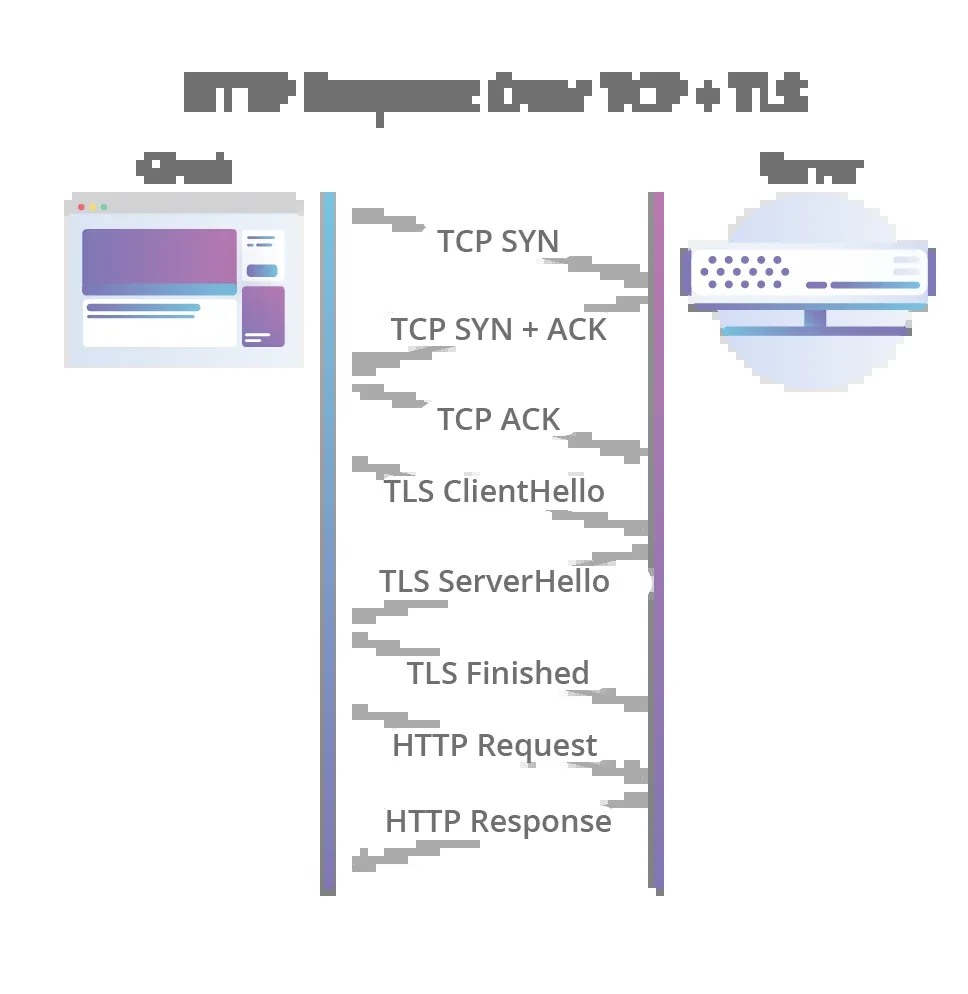
Connecting to a secure web server over TCP takes multiple round trips [4, 5]. The browser must first finish a three-way TCP transport handshake before negotiating crypto session keys through Transport Layer Security, consuming two to three complete round trips across network links before data can travel [10]. Long distances multiply these connection delays [3]. The QUIC protocol merges connection establishment with TLS 1.3 cryptographic key negotiation into a single round trip, cutting initial handshake latency in half when contacting a new server [1, 5].
Subsequent connections achieve even faster speeds through 0-RTT session resumption [1, 5]. If a client has communicated with a server before, it can send encrypted application data in its very first packet using cached security keys [1, 6]. In an analysis of early test traces at cloudflare-quic.com, Cloudflare engineers demonstrated how the first packet includes a CRYPTO frame containing the TLS client hello alongside a PADDING frame. The padding expands the packet to the minimum size mandated by the specification, verifying that network paths handle full-sized UDP frames and lowering the danger of amplification attacks. This mechanism allows returning visitors to download web assets without waiting for round-trip acknowledgments [5].
However, sending data in 0-RTT introduces distinct security trade-offs, particularly the danger of replay attacks. If an attacker intercepts a 0-RTT packet, they could potentially replay it to cause the server to process the request twice. Authors Mirja Kühlewind and Brian Trammell noted in the IETF applicability guidelines that applications must restrict 0-RTT payloads to idempotent operations that do not alter server state. In Section 3.2 of the applicability document, Kühlewind and Trammell weighed the cost of closing connections against keeping them open. Retrieving a static file or sending a basic query is generally safe, but submitting a financial transaction or modifying a database profile needs a completed handshake [12].

Connection Migration for Mobile Devices
Legacy TCP connections are strictly bound to a 4-tuple comprising client IP, client port, server IP, and server port [7, 10]. When a user walks out of an office and their phone switches from a Wi-Fi hotspot to a cellular tower, the operating system assigns a new IP address [2, 10]. Under TCP, this network change breaks open connections. Apps must wait for timeouts and rebuild secure sessions from scratch [2]. By decoupling session state from IP addresses, the QUIC protocol assigns random Connection IDs that stay valid across changing network interfaces [1, 5]. Only clients can initiate migration in RFC 9000. Mobile devices transmit from a new IP without dropping open streams or interrupting active file downloads [1].
Because UDP flows lack formal state on intermediate routers, stateful middleboxes and NAT gateways often enforce short idle timeouts. A 2010 study by Hatonen found that many NAT table bindings expire after just 30 seconds of inactivity, whereas RFC 5382 recommends at least 124 minutes for TCP. If a client remains silent too long, middleboxes drop the path mapping. To preserve connectivity, endpoints can send lightweight PING frames at intervals above 15 seconds as keep-alive signals, or simply reopen the session via 0-RTT when new data arrives [12]. This design helps mobile users move between cell networks without interrupting downloads [10].

From Google Trials to RFC 9000
The evolution of the QUIC protocol involved multi-vendor consensus across the Internet Engineering Task Force (IETF). The original variant, known as gQUIC, used custom crypto framing tightly coupled to Chromium source code. In 2015, Google submitted Internet-Drafts conforming to BCP 78 and BCP 79, leading to the creation of the QUIC Working Group in 2016 [2, 11, 12]. Working group members decided to discard the proprietary crypto stack in favor of standard TLS 1.3, cleanly separating transport mechanics from cryptographic handshakes. Wire formats and packet headers were also rewritten to support multi-vendor implementations and long-term protocol extensibility [11].
In October 2018, Mark Nottingham, chair of the IETF HTTP and QUIC working groups, proposed renaming HTTP-over-QUIC to HTTP/3 to establish it as the third official web generation. Fellow members approved the proposal, moving HTTP/3 development into the dedicated HTTP Working Group. At that time, web tracking portal W3Techs estimated that 31.2% of the top ten million websites supported HTTP/2, while only 1.2% supported QUIC [9]. In May 2021, the IETF officially published RFC 9000, titled QUIC Transport Protocol and authored by Jana Iyengar and Martin Thomson, establishing the protocol as a Proposed Standard along with RFC 8999, RFC 9001, and RFC 9002 [1, 2].

Early real-world measurements captured this transition across global infrastructure. In an unreviewed 2018 study on arXiv, researchers Jan Rüth, Ingmar Poese, Christoph Dietzel, and Oliver Hohlfeld scanned the entire IPv4 address space and 46% of the DNS namespace. They discovered that QUIC-capable IP addresses had tripled to over 617.59 K hosts, with Google serving up to 42.1% of its traffic over the protocol. While 161,000 domains were hosted on QUIC-enabled servers, only 15,000 presented valid certificates at the time. This gap reflected the early experimental state of multi-vendor server software [11].
Deploying QUIC Protocol in Windows and Web Servers
Deploying QUIC protocol stacks across server environments quickly expanded beyond web browsers into enterprise operating systems and infrastructure [7, 8]. Microsoft introduced native support for hosting HTTP/3 services in Windows Server 2022 using its open-source msquic library in the http.sys web server. Technical PM Tojens credited engineers Matthew Cox and Daniel Ring for implementing the transport stack. Administrators can enable HTTP/3 support by creating the EnableHttp3 registry key under HKEY_LOCAL_MACHINE\SYSTEM\CurrentControlSet\services\HTTP\Parameters [8]. Windows 10 Insider builds also gained early components, with WalkingCat uncovering winquic.dll in build 17634 [16].
Beyond website hosting, Microsoft adapted the transport to replace legacy remote file sharing mechanisms through SMB over QUIC. Standard SMB connections rely on TCP port 445, a port widely blocked by Internet service providers due to historical malware risks. SMB over QUIC tunnels file traffic inside a TLS 1.3-encrypted connection over UDP port 443. This setup delivers a virtual private network experience for remote workers. Administrators can configure this feature on Windows Server 2022 Azure Edition and Windows Server 2025, while Windows 11 version 24H2 audits connections under event ID 30832 in the SMBClient log [7].

Consumer applications also rely on modern transport coordination to keep background state synchronized [7, 10]. Just as tools like Google Chrome tab sharing coordinate active states across desktop sessions, browser engines keep QUIC sessions ready to serve parallel background requests without renegotiating cryptographic keys [3, 4]. Platforms like LiteSpeed added native modules, while Cloudflare rolled out edge termination to let websites serve HTTP/3 traffic without rewriting internal backend applications [5, 9].
Security Hardening and Extensibility
Developers adapted the QUIC protocol for name resolution and chat applications beyond web browsing [13, 14]. In May 2022, Christian Huitema, Sara Dickinson, and A. Mankin published RFC 9250, standardizing DNS over Dedicated QUIC Connections (DoQ) on UDP port 853. DoQ provides privacy protections matching DNS over TLS while eliminating head-of-line blocking and reducing name resolution latency [13]. Similarly, Travis Burtrum authored XEP-0467 for the XMPP Standards Foundation to run extensible messaging sessions over QUIC. This setup takes advantage of connection migration when mobile chat clients switch networks [14].
Despite these architectural advantages, deploying complex transport logic into user space introduces fresh security considerations [18, 19]. In a 2022 study in the International Journal of Information Security, researchers E. Chatzoglou, V. Kouliaridis, G. Karopoulos, and G. Kambourakis performed extensive fuzz testing on six production QUIC servers. Their evaluation identified zero-day vulnerabilities capable of exhausting server resources. The results showed that newer software implementations needed further hardening [18]. Because UDP traffic can be spoofed, servers must also enforce token validation during connection setup to prevent bad actors from launching distributed denial-of-service amplification attacks [1, 5].
Privacy analysis reveals further nuances in network traffic patterns. In a 2021 study on website fingerprinting, researchers J. Smith, P. Mittal, and A. Perrig evaluated 117,000 traffic traces across both transports. They discovered that while QUIC is not inherently more difficult to fingerprint than TCP, machine learning classifiers trained exclusively on TCP traces failed to recognize up to 96% of QUIC visits [19]. Because QUIC encrypts transport headers and packet numbers that TCP exposes in cleartext, intermediate observers gain significantly less metadata about active connections [1, 2].
The Future of UDP Traffic
A central question during early protocol design was whether the public Internet could reliably deliver high-volume UDP traffic across diverse access networks [12, 15]. In an unreviewed 2016 preprint, researchers K. Edeline, M. Kühlewind, B. Trammell, E. Aben, and B. Donnet evaluated global paths using RIPE Atlas probes and a tool called copycat. They found that UDP succeeds across the vast majority of networks, with path impairments mostly confined to specific access routers [15]. Nevertheless, field studies indicate that 3% to 5% of restrictive enterprise firewalls still block all UDP packets. Web clients must maintain a silent fallback to standard TCP and TLS [12].
To support emerging workloads, the IETF continues to expand transport capabilities. Standards like RFC 9221 introduce unreliable datagram extensions, allowing audio streaming and gaming services to transmit time-sensitive frames without mandatory retransmissions. Engineers have also developed RFC 10069 to manage multipath transfers, letting devices send data across Wi-Fi and mobile radios at the same time [20]. In public cloud deployments, Google Cloud engineers Michael Behr and Ian Swett reported an 8% worldwide improvement in average page load time, reaching a 13% speedup across regions with higher network delay [10]. As software stacks mature, UDP transports continue to reshape global data delivery [1, 2].
- REPORT Iyengar, J., & Thomson, M. (Eds.). (2021). QUIC: A UDP-Based Multiplexed and Secure Transport (RFC 9000). RFC Editor. [Article Link]
- WEBSITE Wikipedia contributors. (2026). QUIC. Wikipedia, The Free Encyclopedia. [Article Link]
- ONLINE NEWS Roskind, J. (2013, June 27). Experimenting with QUIC. Chromium Blog. [Article Link]
- ONLINE NEWS Lardinois, F. (2015, April 18). Google Wants To Speed Up The Web With Its QUIC Protocol. TechCrunch. [Article Link]
- ONLINE NEWS Cloudflare. (2018, September 25). Get a head start with QUIC. Cloudflare Blog. [Article Link]
- ONLINE NEWS Willis, N. (2013, July 17). Connecting on the QUIC. LWN.net. [Article Link]
- WEBSITE Microsoft. (2025, July 24). SMB over QUIC. Microsoft Learn. [Article Link]
- ONLINE NEWS Tojens. (2021, August 24). Enabling HTTP/3 support on Windows Server 2022. Microsoft Community Hub. [Article Link]
- ONLINE NEWS Cimpanu, C. (2018, November 12). HTTP-over-QUIC to be renamed HTTP/3. ZDNET. [Article Link]
- ONLINE NEWS Behr, M., & Swett, I. (2018, June 13). Introducing QUIC support for HTTPS load balancing. Google Cloud Platform Blog. [Article Link]
- PREPRINT Rüth, J., Poese, I., Dietzel, C., & Hohlfeld, O. (2018). A First Look at QUIC in the Wild. arXiv:1801.05168. [Article Link]
- REPORT Kühlewind, M., & Trammell, B. (2022). Applicability of the QUIC Transport Protocol. quicwg.org. [Article Link]
- REPORT Huitema, C., Dickinson, S., & Mankin, A. (2022). DNS over Dedicated QUIC Connections (RFC 9250). RFC Editor. [Article Link]
- REPORT Burtrum, T. (2022, July 13). XEP-0467: XMPP over QUIC. XMPP Standards Foundation. [Article Link]
- PREPRINT Edeline, K., Kühlewind, M., Trammell, B., Aben, E., & Donnet, B. (2016). Using UDP for Internet Transport Evolution. arXiv:1612.07816. [Article Link]
- ONLINE NEWS Fernandes, C. (2018, April 3). Microsoft to add support for Google’s QUIC fast internet protocol in Windows 10 Redstone 5. Windows Latest. [Article Link]
- ONLINE NEWS De Simone, S. (2015, April 22). Google Will Propose QUIC As IETF Standard. InfoQ. [Article Link]
- ACADEMIC JOURNAL Chatzoglou, E., Kouliaridis, V., Karopoulos, G., & Kambourakis, G. (2022). Revisiting QUIC attacks: a comprehensive review on QUIC security and a hands-on study. International Journal of Information Security, 22(2), 347-365. [Article Link]
- ACADEMIC JOURNAL Smith, J., Mittal, P., & Perrig, A. (2021). Website Fingerprinting in the Age of QUIC. Proceedings on Privacy Enhancing Technologies, 2021(2), 48-69. [Article Link]
- REPORT IETF QUIC Working Group. (2026). QUIC Working Group Documents and Specifications. IETF Datatracker. [Article Link]


