




A mixture of experts divides a hard machine learning problem into smaller parts, letting separate sub-nets learn different regions of the input space instead of forcing one giant network to process every detail [7]. In large language models, this technique routes each token to a small fraction of available weights through a gating function, keeping latency low as overall capacity grows [10]. Because only a few experts compute outputs for any single word, the system expands its parameter count without increasing compute costs per step [6]. Both open-weight systems and proprietary foundation models from Google and Mistral AI rely on this modular concept [5].
What Is a Mixture of Experts?
The concept originated in ensemble learning under the name of committee machines, where multiple learners divide a complex task into manageable, local regions. Each expert network produces an output from the same input, and a separate gating function calculates non-negative weights that determine how much influence each expert receives during the final linear combination [7].
Standard dense models activate every single weight for every incoming token, whereas a sparse model calls only a fraction of its total weights during each forward step [3]. This modular design allows machine learning teams to build systems with billions of parameters that run with the speed and inference cost of much smaller networks [6]. In their survey of the field, S. E. Yüksel, J. N. Wilson, and P. Gader reviewed twenty years of development in IEEE journals, showing that this division of labor improves scores in classification and regression tasks. Separate sub-nets handle distinct slices of data, avoiding compromises between competing objectives during training [8].
The gating mechanism encourages each sub-net to focus on patterns where it performs best. If two experts start with comparable accuracy on a certain topic, the router sends more samples to the slightly stronger one, leaving the other expert free to adapt to alternative patterns in the training data. This self-reinforcing dynamic separates learners into local regions over the data space, creating genuine specialization without requiring manual rules or human supervision [7].
The Mathematics of Gating Networks
Every setup relies on a gating function that maps an input vector to a probability spread over available expert networks [2]. In adaptive mixtures of local experts, the gate uses a linear softmax equation where each expert receives a normalized score based on input features. Each learner predicts a Gaussian curve around a learnable center value, and the system maximizes log-likelihood over the dataset through gradient ascent [7].
Engineers train these models using the expectation-maximization algorithm, which alternates between estimating responsibilities and updating weights to improve explanations across iterations [8]. During the expectation step, the model calculates the posterior probability that each expert produced the observed target value, treating the gate output as an informative Bayesian prior. Experts that explain a data point well receive strong gradient signals to adjust their internal weights, whereas poorly matching experts receive minimal updates and stay focused on their own domains [7]. This statistical framework prevents all learners from collapsing into identical solutions, stabilizing the learning process on complex datasets while preserving modular behavior [8].
Researchers also explore non-Gaussian formulations to handle outliers and heavy-tailed data. In an arXiv paper, Faicel Chamroukhi introduced a robust mixture of experts based on Student’s t distribution, known as TMoE, which optimizes weights through a dedicated expectation-maximization algorithm. When evaluated on tone perception in musical data and temperature anomalies in climate change records, this model prevented extreme observations from distorting the gating decisions [1].
From Meta-Pi to Deep Architectures
Early modular network research dates back to the meta-pi network developed by Hampshire and Waibel for speech recognition tasks. They trained six time-delayed neural network experts on mel spectrograms to recognize phonemes spoken by six Japanese speakers, consisting of two females and four males. Five experts dedicated their weights to five individual speakers, while the sixth male speaker was classified through a linear combination of the three other male experts [7].
As neural systems expanded, researchers moved from single-layer gating to hierarchical trees with multiple decision levels. A top-level gate selects among secondary gating spreads, which then choose individual experts located at leaf nodes. This branching layout mirrors decision trees and decomposes complex tasks across structured layers [7].

In an unrefereed preprint paper that was not peer-reviewed, David Eigen, Marc’Aurelio Ranzato, and Ilya Sutskever extended this idea into a stacked model called the Deep Mixture of Experts on arXiv. Gating networks and expert clusters placed in successive layers exponentially increased the number of effective combinations without blowing up model size. When tested on shifted MNIST digit images, the network learned location-dependent experts at the first layer and class-specific experts at the second layer. They observed similar routing behavior on speech monophone data, confirming that multi-layer gating can factor complex perceptual tasks into modular steps without manual labeling [2].
How Routing Works in Sparse MoE
Modern language models apply sparse gating to transformer feedforward blocks, replacing dense matrix multiplications with a bank of parallel sub-nets. Instead of computing outputs from every sub-net, a router evaluates each input token and activates only the top-k candidates, typically selecting one or two experts [3]. In an IEEE survey on mixture of experts in large language models, W. Cai, J. Jiang, F. Wang, J. Tang, S. Kim, and J. Huang detailed how conditional execution allows systems to scale capacity while keeping latency manageable [10].
Pioneering sparse designs like GShard and Switch Transformers proved that routing tokens conditionally could match or exceed dense model results. GShard used a top-2 gating function where each token went to two experts, whereas Switch Transformers routed each token to a single top-1 expert to simplify communication between hardware devices. Both methods showed that sparse routing achieves faster convergence than dense baselines with equivalent computational budgets [3].
However, top-k token routing often suffers from load balancing problems when popular experts receive too many tokens while others remain underutilized. When a heavily chosen expert hits its buffer capacity, excess tokens are dropped entirely from computation. Developers introduce auxiliary load-balancing losses during training to encourage balanced routing among all learners [3].



Token Choice Versus Expert Choice
Under standard token choice routing, each token independently chooses its preferred top-k experts regardless of how many other tokens want those same resources. This pattern often overloads certain experts and starves others, forcing engineers to tune complex capacity factors and loss penalties to prevent hardware bottlenecks during distributed training runs [3].
In a 2022 paper presented at NeurIPS, Yanqi Zhou, Tao Lei, Hanxiao Liu, Nan Du, Yanping Huang, Vincent Zhao, Andrew Dai, Zhifeng Chen, Quoc V. Le, and James Laudon introduced an alternative formulation called expert choice routing. Instead of letting tokens select experts, their method has experts select their top-k tokens from the batch. This structural inversion guarantees that every expert processes a fixed bucket size, eliminating token dropping while balancing computational workloads between hardware nodes automatically. Because tokens can be picked by multiple experts or none at all, the model allocates more compute capacity to difficult tokens while passing simpler tokens through fewer layers. This flexible allocation creates a heterogeneous routing pattern that adapts to language complexity [3].
The GLUE and SuperGLUE tests confirmed that expert choice routing improved pre-training convergence time by more than 2x compared to the single-expert Switch Transformer setup and the two-expert GShard design. For the same computational cost, the model achieved higher fine-tuning accuracy on eleven selected language evaluation tasks. At a smaller activation budget, the setup outperformed the dense T5 model on seven out of the eleven benchmark tasks evaluated in the study [3].

Open Implementations: Mixtral and OLMoE
Sparse models entered open-source software when Mistral AI released Mixtral 8x7B under an Apache 2.0 license. Mixtral is a decoder-only sparse network where each feedforward layer selects from eight distinct parameter groups. At every layer, a router assigns each token to two experts, combining their outputs additively. The system holds 46.7 billion total parameters in storage, but it computes only 12.9 billion active weights per token, achieving inference speeds six times faster than Llama 2 70B on standard benchmarks [6].
Mixtral handles a context window of 32k tokens in English, French, German, Spanish, and Italian with strong scores on code generation tasks. The instruction-tuned version reached an 8.30 score on MT-Bench, matching GPT-3.5 quality. In evaluations measuring bias on BBQ and BOLD benchmarks, Mixtral displayed less bias and higher positive sentiment than Llama 2. Mistral AI contributed kernel improvements to vLLM using MegaBlocks CUDA kernels to enable deployment through SkyPilot with technical support from CoreWeave and Scaleway [6].
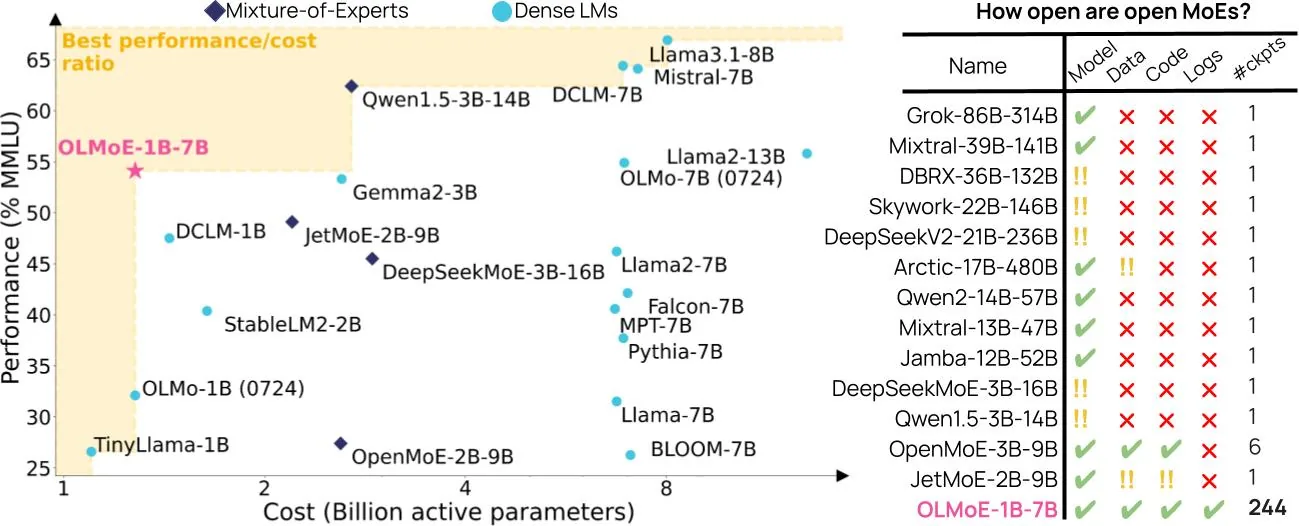
The open-source team at allenai published OLMoE-1B-7B-0924 on GitHub, a model containing 6.9 billion overall weights that activates roughly 1.3 billion for each token. Niklas Muennighoff, Luca Soldaini, Dirk Groeneveld, Kyle Lo, Jacob Morrison, Sewon Min, Weijia Shi, Pete Walsh, Oyvind Tafjord, Nathan Lambert, and colleagues released all pre-training code, data recipes tokenized on Dolma, and checkpoints across SFT, DPO, and KTO. Their repository outlined practical steps for sparse upcycling, converting dense models like OLMo-1B into eight-expert sparse configurations to accelerate training. Supported in vLLM, SGLang, and quantized llama.cpp builds, OLMoE showed that compact sparse networks can run efficiently on commodity developer hardware [4].
Key Challenges in Mixture of Experts Models
Despite their efficiency during inference, mixture of experts models introduce substantial engineering hurdles during training and deployment [5]. Memory capacity remains a major obstacle because all weights must reside in accelerator memory even if only two experts activate for a given token [6]. Large models require specialized distributed training systems like DeepSpeed-MoE, FastMoE, and MegaBlocks to minimize communication latency between cluster nodes, as documented in XueFuzhao’s curated collection of sparse architecture research on GitHub [5].
Unstable routers also threaten training runs when early random assignments cause certain experts to receive more updates than others. If left uncorrected, dominant experts absorb an increasing share of tokens, causing neglected sub-nets to stop learning altogether [3]. Researchers apply auxiliary balancing losses, gating dropout, and dropless token choice to keep workloads distributed. Without these safeguards, sparse networks risk representation collapse, where multiple experts learn redundant functions instead of dividing the problem space [5].

Downstream adaptation brings additional routing challenges for sparse models. Downstream datasets often display narrower vocabulary distributions than general pre-training corpora, pulling tokens toward a small subset of experts. Teams manage this transition with gradual learning rate warmups and preference optimization methods like DPO to preserve routing diversity during task adaptation [4].
Applications Beyond Language Processing
Modular architectures have established applications in computer vision and multimodal perception, extending well beyond modern text generation [8]. In an IEEE publication, Enzweiler and Gavrila developed a multilevel framework for pedestrian classification that combined pose cues, image intensity, depth, and optical flow. Local experts built from multilayer perceptrons and support vector machines reduced false positive detections by up to a factor of 42 compared to baseline intensity detectors [9].
Academic teams have also adapted gated ensembles to solve dynamic multiobjective optimization problems. R. Rambabu, P. Vadakkepat, K. C. Tan, and M. Jiang applied a mixture of experts prediction framework to track varying Pareto-optimal solutions across complex benchmark problems. Predictor switching guided by the gating network significantly improved search performance on non-linear problems as environmental conditions shifted. In satellite communications, R. Zhang and co-authors used similar gating principles to coordinate transmission strategies across orbital networks [8].
The division of complex tasks among separate learners remains a foundational strategy in artificial intelligence [7]. From early speech recognition to systems like BaGuaLu, GLaM, and DeepSeekMoE, modular routing provides a viable path for scaling parameter counts within practical hardware limits [5]. Researchers continue to refine gating algorithms to make sparse computation faster, more stable, and accessible to the wider developer community [4].
- ACADEMIC JOURNAL Chamroukhi, F. (2016). Robust mixture of experts modeling using the t distribution. Neural Networks, 79. [Article Link]
- PREPRINT Eigen, D., Ranzato, M., & Sutskever, I. (2013). Learning factored representations in a deep mixture of experts. arXiv. [Article Link]
- CONFERENCE PAPER Zhou, Y., Lei, T., Liu, H., Du, N., Huang, Y., Zhao, V., Dai, A., Chen, Z., Le, Q. V., & Laudon, J. (2022). Mixture-of-experts with expert choice routing. Advances in Neural Information Processing Systems, 35, 7103–7114. [Article Link]
- REPORT Muennighoff, N., Soldaini, L., Groeneveld, D., Lo, K., Morrison, J., Min, S., Shi, W., Walsh, P., Tafjord, O., Lambert, N., Gu, Y., Arora, S., Bhagia, A., Schwenk, D., Wadden, D., Wettig, A., Hui, B., Dettmers, T., Kiela, D., … Hajishirzi, H. (2024). OLMoE: Open mixture-of-experts language models. GitHub. [Article Link]
- WEBSITE Xue, F. (2022). Awesome mixture-of-experts: A collection of awesome things about mixture-of-experts. GitHub. [Article Link]
- PRESS RELEASE Mistral AI. (2023). Mixtral of experts. Mistral AI. [Article Link]
- WEBSITE Wikipedia contributors. (2026). Mixture of experts. Wikipedia. [Article Link]
- ACADEMIC JOURNAL Yüksel, S. E., Wilson, J. N., & Gader, P. (2012). Twenty years of mixture of experts. IEEE Transactions on Neural Networks and Learning Systems, 23(8), 1177–1193. [Article Link]
- ACADEMIC JOURNAL Enzweiler, M., & Gavrila, D. M. (2011). A multilevel mixture-of-experts framework for pedestrian classification. IEEE Transactions on Image Processing, 20(10), 2967–2979. [Article Link]
- ACADEMIC JOURNAL Cai, W., Jiang, J., Wang, F., Tang, J., Kim, S., & Huang, J. (2025). A survey on mixture of experts in large language models. IEEE Transactions on Knowledge and Data Engineering, 1–20. [Article Link]


