



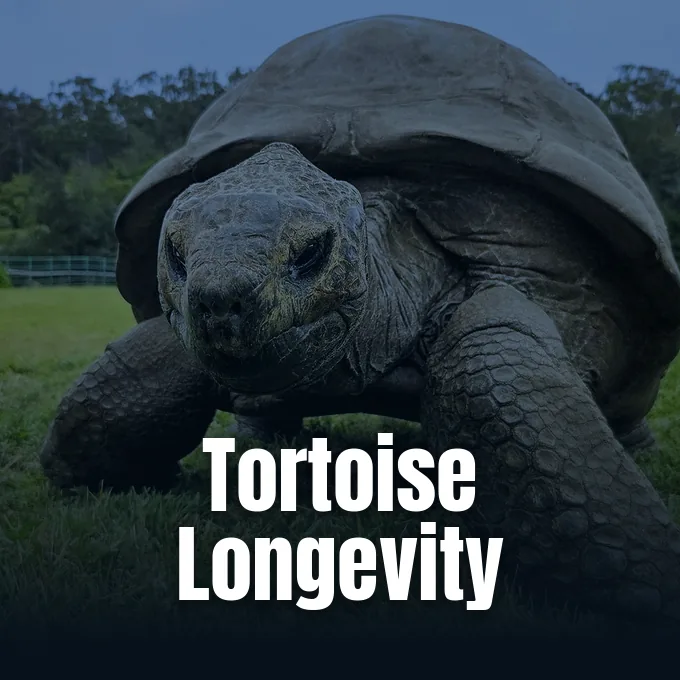
Jonathan the giant tortoise has lived on the remote South Atlantic island of St. Helena since the nineteenth century, outlasting every other known land animal on Earth. At 194 years old, the Aldabra giant tortoise (Aldabrachelys gigantea) has exceeded the typical lifespan of his species by about a century [4]. In a study published on October 7, 2026, in the journal Science Advances, researchers sequenced his genome to see what keeps his cells healthy at an age nearly double that of most tortoises [1].
How Old Is Jonathan the Giant Tortoise?
Jonathan is 194 years old in 2026, making him the oldest known living land animal and the oldest giant tortoise on record [4, 6]. When British officials brought him to St. Helena from the Seychelles in 1882, he was already a fully grown adult, which led naturalists to calculate that he was at least 50 years old on arrival [5, 6]. His long life spans the entire modern era [6].
He was alive when Charles Darwin formulated theories of evolution, when Queen Victoria took the British throne, and when Thomas Edison had not yet patented the incandescent lightbulb. Public interest in his survival has turned him into a global figure, but his fame has also attracted false rumors. False reports circulating in June claimed that the venerable animal had passed away, but island staff quickly dispelled the rumors by confirming he was grazing safely on the lawn. The Jonathan giant tortoise appears on the reverse side of the St. Helena five-pence coin and on official postage stamps. Giant tortoises once shaped island ecosystems across the Galápagos and Seychelles, and their slow metabolism provides a useful contrast with mammals that face severe evolutionary constraints, a dynamic explored in the longevity bottleneck hypothesis [1, 6].

From Seychelles to Plantation House Grounds
The journey that brought Jonathan to his island home began in 1882, when four Aldabra giant tortoises were collected in the Seychelles and loaded onto a transport vessel. The ship sailed nearly 3,000 nautical miles across the South Atlantic Ocean to reach St. Helena, a British Overseas Territory known for its isolation. Sir William Grey-Wilson received the animals as a gift [5, 6].
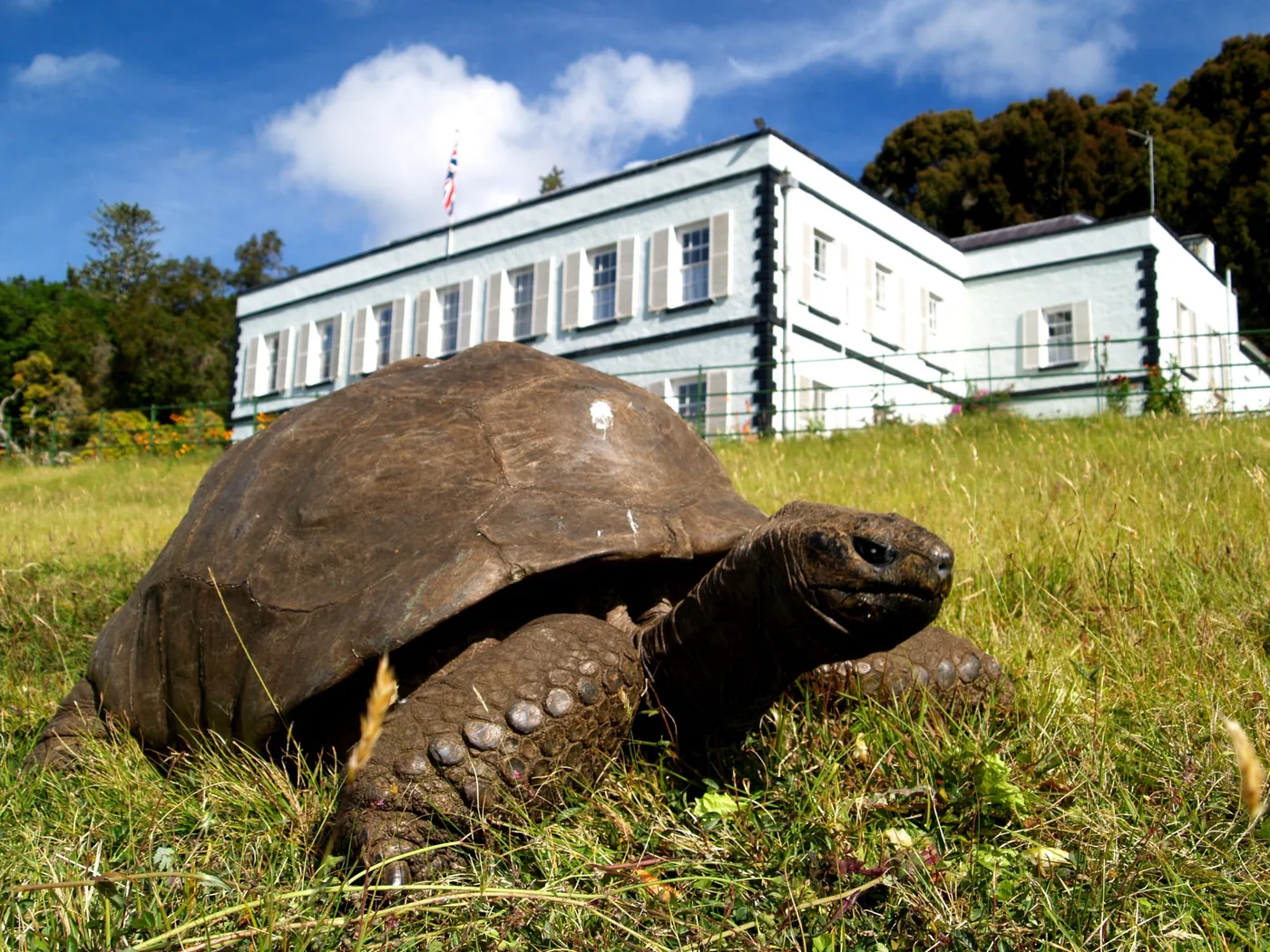
Grey-Wilson later served as governor of the island and died a century ago, but Jonathan has remained on the grounds of Plantation House, the official governor’s residence, for 144 years [5, 6]. The Jonathan giant tortoise shares the estate pasture with other tortoises, including a male companion named David. Resident vet Joe Hollins has looked after his health for decades, monitoring his nutritional needs and seasonal habits [4, 6]. Jonathan has lost his sight to cataracts and can no longer detect food by smell, but he still moves with surprising strength during feeding routines [4, 5]. Study co-author Justin Gerlach from the University of Cambridge described the experience of examining him as unique, remarking, “Working with a really old giant tortoise is such a privilege: you get a sense of the tortoise being your collaborator, not your study subject” [5].
DNA Sequencing Challenges and Cheek Scrape Testing
Gathering genetic data from the Jonathan giant tortoise proved to be a difficult task that took nearly ten years to solve. Island authorities forbade Hollins from drawing blood, fearing that an open wound or infection might harm the animal. Study co-author Stephen Clark, founder and chief scientist of the Kallel Foundation in Nashville, agreed with the caution. “I didn’t want to be the doctor that killed Jonathan,” Clark said [4].
Hollins tried taking a cheek swab, but when the samples reached the laboratory in the United States, computer systems repeatedly crashed because the isolated material came from oral bacteria rather than the tortoise himself. Clark asked island officials for permission to try again, leading Hollins to collect cheek scrape samples with a different tool to gather real epithelial cells. The DNA extracted from those cheek scrapes was far more fragmented than material from a fresh blood draw, so researchers had to piece the sequence together by comparing it with a 36-year-old Aldabra tortoise named Tank whose baseline code had already been mapped. They also compared the sequence with the genome of Lonesome George, a Galápagos tortoise (Chelonoidis abingdoni) who died in 2012 at an age thought to exceed 100 years. These reference baselines allowed Clark and his colleagues to reconstruct Jonathan’s functional genetic code [1, 4].


Unique Variants in the Jonathan Aldabra Giant Tortoise
The comparative genomic analysis revealed that Jonathan carries 287 unique gene variants that set him apart from both Tank and Lonesome George [4, 5]. These variants cluster in biochemical networks that govern cellular protection, including pathways that repair broken DNA strands and suppress tumor formation. Other variants help control insulin signaling and calm chronic tissue inflammation [5, 6].
Several of these modified genes directly influence telomeres, the protective caps at chromosome ends that wear down as an animal ages. By keeping telomere degradation low, Jonathan avoids the quick loss of cellular division that limits the lifespan of shorter-lived reptiles and mammals [1, 4]. Biologist Greer Dolby from The University of Alabama at Birmingham noted that these shared pathways show a broader signature of aging that operates across different species. In many animals, random genetic mutations build up until key organs fail [4]. This dynamic resembles findings on how genetic mutations affect longevity, where species evolve distinct trade-offs between rapid growth and durable cellular maintenance [1, 3]. In the Jonathan giant tortoise, these protective defenses have operated without interruption for nearly two centuries. “Nature has already solved the puzzle of aging in remarkable ways, and Jonathan’s genome provides a blueprint for cellular resilience,” Clark said [5].
How Does Mitochondrial Methylation Entropy Shield Cells?
Mitochondrial methylation entropy measures the loss of order among chemical tags on metabolic genes, and Jonathan shields his cells by keeping this disorder unusually low [1, 4]. Beyond the letters of the DNA sequence, the researchers studied the epigenome, the collection of methyl groups that attach to DNA to switch specific genes on or off [4, 6]. As animals grow old, these chemical tags drift into disorganized patterns, a shift that biologists describe as epigenetic entropy [3, 4].
In most parts of Jonathan’s genome, this methylation drift matched the disordered state expected in an old animal. But in genes responsible for mitochondrial energy production, his methylation patterns were remarkably tidy and looked much like those of young tortoises. Mitochondria supply the chemical energy (adenosine triphosphate, or ATP) that cells need to repair damaged structures and keep metabolic waste from poisoning surrounding tissue [4, 5]. In humans and other mammals, mitochondrial function fades with age as chemical regulators shut down. In the Jonathan giant tortoise, the on-switches for these energy engines remain active [5]. “We found that the gene regulators involved in energy production and DNA repair have remained incredibly stable in Jonathan over almost two centuries,” Gerlach said [6]. Low entropy in these metabolic pathways keeps his cellular machinery running steadily in his nearly 200-year-old body [4, 5].
Can Jonathan Giant Tortoise Traits Aid Human Medicine?
Applying insights from the Jonathan giant tortoise to human longevity medicine remains an active scientific goal that still faces substantial hurdles [4, 6]. Biologist Vincent Lynch from the University at Buffalo warned that scientists have not yet proven a direct cause-and-effect link between low entropy in mitochondrial genes and the tortoise’s long life. Cheek tissue alone cannot show how other organs hold up over time [4].
“Some organs are more susceptible to different diseases of old age than other ones, and that happens because mutations accumulate over time,” Lynch said. “We would ideally like to know what those mutations are in those specific tissues”. Lynch also questioned whether Jonathan represents a general rule for his species or if he is simply an unusual survivor. “Maybe Jonathan is just really good at being old,” Lynch noted. Clark plans to pursue further work using blood samples to assess immune cells and circulating markers in greater detail. The Kallel Foundation hopes that studying these evolutionary adaptations can eventually guide drug treatments for human age-related illnesses. For now, the 194-year-old tortoise continues his quiet routine on St. Helena, grazing on the lawn of Plantation House while researchers analyze the cellular secrets behind his two centuries of life [4, 6].
- ACADEMIC JOURNAL Vaisvil, B., Schmitt, D. P., Jones, A., Kapatral, V., Ford, J. M., Taylor, M. L., Colwell, M., Hollins, J., Pascucci, S., Weissenow, K., Rost, B., Notin, P., Gerlach, J., Terwilliger, T. C., Hung, L., Jensen, L. J., Reed, K., Robeck, T. R., Horvath, S.,. Clark, S. W. (2026). Epigenetic insights into extreme longevity in the world’s oldest terrestrial animal, Jonathan. Science Advances, 12(41). [Article Link]
- ACADEMIC JOURNAL Field, A. E., Robertson, N. A., Wang, T., Havas, A., Ideker, T., & Adams, P. D. (2018). DNA Methylation Clocks in Aging: Categories, Causes, and Consequences. Molecular Cell, 71(6), 882-895. [Article Link]
- ACADEMIC JOURNAL Chan, J., Rubbi, L., & Pellegrini, M. (2025). DNA methylation entropy is a biomarker for aging. Aging. [Article Link]
- ONLINE NEWS Schneider, L. (2026, October 7). Scientists discover the genetic secrets that may have helped Jonathan the tortoise live to 194 years old. Live Science. [Article Link]
- ONLINE NEWS Reese, D. (2026, October 7). How to Live to Be 194 Years Old. Nautilus. [Article Link]
- ONLINE NEWS Baisas, L. (2026, October 7). Jonathan the tortoise is 194 years old and thriving. His genes help explain why. Popular Science. [Article Link]
APA 7: TWs Editor. (2026, October 8). Jonathan the Giant Tortoise Yields Genome Clues to Extreme Age. PerEXP Teamworks. https://perexpteamworks.com/en/jonathan-giant-tortoise-genome-longevity/


