





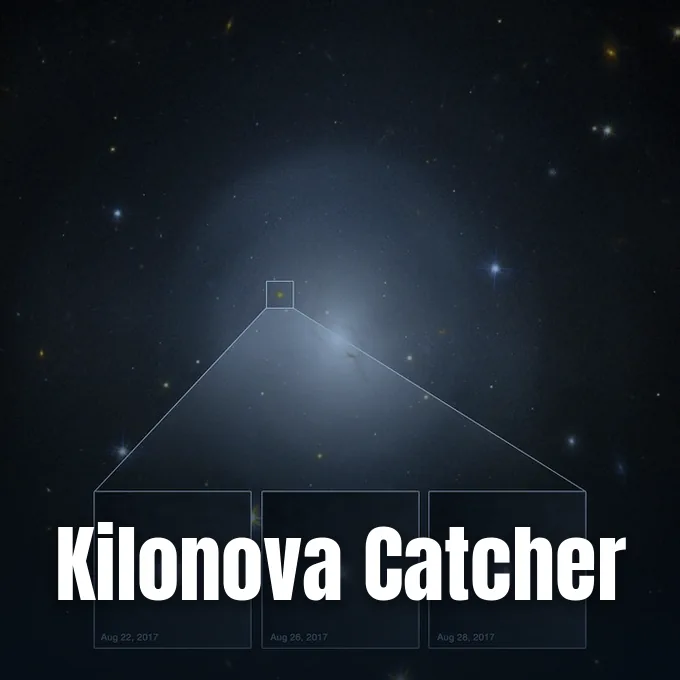
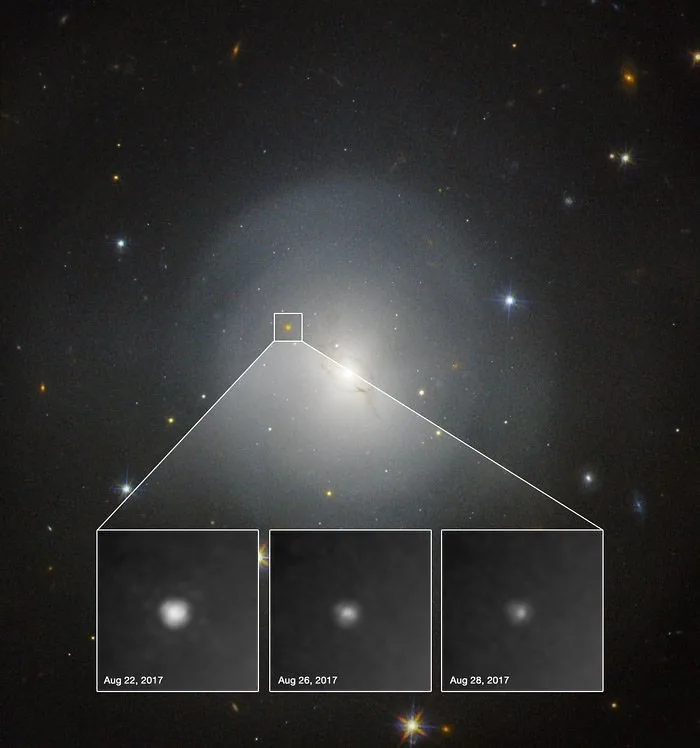
When dead stars collide, they can release a brief flash of light called a kilonova, scattering heavy elements into deep space. To help astronomers detect these fleeting cosmic eruptions before they disappear, NASA has mobilized backyard observers through the global kilonova catcher network [1].
Rapid Response to Cosmic Collisions
Neutron stars are the ultra-dense, city-sized leftovers of dead stars, packing the mass of an entire sun into a compact sphere only miles wide. When two of these extreme bodies spiral together and collide, their explosive merger releases a brief flash of light known to astronomers as a kilonova. The collisions forge much of the universe’s gold, platinum, and other heavy elements, scattering freshly synthesized matter across interstellar space. Because a kilonova fades within days, researchers must spot the optical glow quickly. No single professional observatory can watch the entire sky at once. If clouds, daylight, or positioning obscure a ground station, the brief window for data collection can close permanently [1].
Amateur astronomers with access to camera-equipped telescopes offer a practical solution to this observational bottleneck. By pointing their personal instruments toward alert coordinates on short notice, volunteers provide the distributed coverage needed to track fading light before it slips below detection limits [1].
How the Kilonova Catcher Network Operates
The operational model connects amateur skywatchers into a rapid-response network that activates whenever gravitational wave detectors or space telescopes broadcast an alert. When an alert arrives, volunteers swivel their personal telescopes toward the sky to pinpoint the source and monitor its declining brightness over consecutive nights. In addition to chasing neutron star mergers, the network follows up on gamma-ray bursts, the most powerful explosions in the universe, and catches other short-lived cosmic transients whenever opportunities arise. More than 150 registered members across several continents currently participate in the project. Volunteers work side by side with professional observatories, so global sky surveillance continues as Earth rotates through daylight and dark [1].
“Here at Kilonova Catcher, by chasing the light from gravitational-wave events, we’re seeing how a single collision reaches across the universe,” said Cristina Andrade, Kilonova Catcher head of operations at the Minnesota Institute for Astrophysics [1].
Andrade stressed that upcoming observatories will soon generate massive data streams that automated pipelines cannot fully analyze alone. “The observatories that make this possible will produce an unprecedented amount of data,” Andrade said. “We need more human minds, more people with their eyes on the sky and on the data, both literally and figuratively. And more importantly, we need more people to realize they are capable of great feats of science, regardless of their background.” The collaborative venture is co-led by Andrade and Principal Investigator Dr. Damien Turpin, a researcher at the French Alternative Energies and Atomic Energy Commission (CEA), who coordinate alert dissemination and verify incoming observational logs [1].
Early Milestones and Scientific Impact
Volunteers in the network have already contributed to more than 64 official reports shared through NASA’s General Coordinates Network. Professional researchers rely on this real-time communication system to distribute transient discoveries, coordinate ground telescopes, and track short-lived cosmic emissions before their faint optical signals disappear completely [1].
The quality of volunteer observations has earned amateur participants credit as named co-authors on peer-reviewed scientific papers. Co-authorship reflects the practical utility of amateur hardware when combined with disciplined tracking protocols. During the Artemis II mission, volunteers broadened their observational duties by joining NASA’s lunar Impact Flash! project campaign, turning their cameras toward the Moon to record tiny flashes of light made when meteoroids strike the lunar surface. Damien Turpin praised this expanding versatility, valuing the commitment of citizen astronomers who push their technical limits to capture transient physical phenomena [1]. “I am inspired by the expertise and drive of our amateur astronomers,” Damien said. “They are always digging for more information and pushing the limits of their understanding. This science could not be done without their contributions.”
Prospective observers who own or can access a camera-equipped telescope can register on the project website at kilonovacatcher.in2p3.fr or contact organizers via kilonovacatcher@gmail.com [1]. The initiative welcomes contributors from every background, requiring only functional imaging gear and a willingness to respond when alerts appear.


The Strategic Origins of the Catcher Designation
The project’s name borrows from the defensive role in baseball and softball, where the catcher occupies a unique vantage behind home plate. When a batter steps up to hit, the catcher crouches directly in front of the home umpire to receive each delivery thrown by the pitcher. The posture closely resembles the wicket-keeper in cricket, anchoring the defensive perimeter. Facing outward toward the outfield, the catcher commands a panoramic view of the entire playing field, making the position ideal for directing teammates, calling defensive shifts, and managing live plays as action unfolds across the diamond. The player manages defensive tactics between pitches, reading the game continuously while the ball remains out of play [2].
Catchers call pitch selections using PitchCom electronic devices or traditional hand signals, tailoring choices to pitcher mechanics and batter weaknesses. They must also field foul tips, secure errant balls bouncing in the dirt, and absorb physical collisions with base runners attempting to score at home plate [2].
Handling defensive demands requires protective equipment, including a face mask, throat protector, chest protector, shin guards, and a heavily padded catcher’s mitt. Some chest protectors extend lower to guard sensitive areas, though players typically wear a separate pelvic protector or cup. Just as a baseball catcher remains alert to snag fast pitches, participants in the Kilonova Catcher network work to seize fleeting optical transients that flash across the night sky. Both roles demand specialized gear, split-second reflexes, and unwavering focus to secure fast-moving targets before they slip away unrecorded. In both settings, a single lapse in positioning can mean the difference between capturing a transient signal and losing it forever [1, 2].
Defensive Specialization and Tactical Evolution in Baseball
Baseball began shifting from amateur recreation into an organized professional sport during the middle of the nineteenth century. Before the American Civil War, pitchers delivered balls underhanded simply to initiate contact, much like a basketball referee tossing up a jump ball to begin play. Catchers played twenty to twenty-five feet behind the batter and wore no protective equipment [2].
As pitchers shifted to overhand deliveries to throw faster pitches, the introduction of the called strike in 1858 forced catchers to move closer to home plate because completing a strikeout required catching the ball on the fly. The tactical shift made protective gear necessary and changed tactical demands. Because managing a pitching staff demands understanding game strategy, former catchers yield many field managers in Major League Baseball and Minor League Baseball, including Yogi Berra, Connie Mack, Steve O’Neill, Al López, Mike Scioscia, Joe Girardi, Stephen Vogt, and Joe Torre. The physical strain of catching every play often dampens offensive output over long seasons [2].
As a result of this defensive prioritization, catcher is the only fielding position besides pitcher without a member in the 3,000 hit club, excluding Craig Biggio who played only four seasons behind the plate before switching to second base. Iván Rodríguez holds the career hit record for catchers with 2,844 hits. Major League Baseball teams accept modest batting numbers from defensive specialists such as Jerry Grote, Jeff Mathis, Martín Maldonado, Ray Schalk, Jim Hegan, Jim Sundberg, and Brad Ausmus. Schalk compiled a career batting average of just .253, yet his enshrinement in the Baseball Hall of Fame in 1955 honored his defensive skill and mastery of the position designated as number 2 on scorecards [2].
Preparing Kilonova Catcher for Roman Space Telescope Alerts
Looking ahead to the next generation of space astronomy, the network is preparing to follow up on thousands of transient alerts generated by NASA’s upcoming Nancy Grace Roman Space Telescope. Roman will scan wide regions of the sky with deep infrared instruments, identifying candidate transient signals that ground observatories must verify [1].
Because large space-based survey missions identify far more candidate events than elite research observatories can track on their own, distributed citizen networks provide observational bandwidth. By mobilizing backyard astronomers across different time zones, the project helps ensure that whenever a cosmic alert sounds, someone on Earth has dark skies, favorable weather, and imaging equipment ready to capture the fading light. The program bridges the divide between professional astrophysics and amateur stargazers, proving that dedicated volunteers with off-the-shelf cameras can record genuine scientific discoveries. As future surveys illuminate the transient cosmos, these dedicated observers track the rarest fireworks the universe has to offer [1].
- WEBSITE Dollar, A., & NASA Science Editorial Team. (2026, November 24). Amateur Astronomer? Be a Kilonova Catcher! NASA Science. [Article Link]
- WEBSITE Wikipedia. (n.d.). Catcher. [Article Link]
APA 7: PerEXP Teamworks. (2026, November 25). Kilonova Catcher Recruits Amateur Astronomers for NASA. PerEXP Teamworks. https://perexpteamworks.com/en/kilonova-catcher-amateur-astronomers-nasa/


