




Can technology engineered for another planet rescue a pint of craft beer on Earth? When industrial supply chains dried up, commercial breweries turned toward NASA Mars machines originally designed for In Situ Resource Utilization (ISRU), the practice of harvesting extraterrestrial resources to sustain off-world exploration missions. Long before reaching commercial taprooms, these automated systems captured atmospheric carbon dioxide to synthesize propellant and breathable oxygen. Today, that identical Martian chemistry protects fermentation tanks across global brewing facilities [1].
How Do NASA Mars Machines Work?
The core mechanism relies on chemical separation units that harvest carbon dioxide directly from ambient surroundings. In the late 1990s, aerospace firm Pioneer Astronautics secured multiple Small Business Innovation Research (SBIR) contracts from Johnson Space Center in Houston to develop autonomous propellant manufacturing systems for future robotic expeditions. Robert Zubrin, an aerospace engineer and longtime advocate for human exploration, had previously outlined these foundational technologies within the Mars Direct architecture he coauthored in 1990 to minimize launch payload mass. His chemical subsystems captured ambient atmospheric carbon dioxide and combined it with onboard hydrogen to synthesize water for astronaut life support and methane rocket fuel [2]. Martian air is 96 percent carbon dioxide [3].
At the time these chemical reactors were constructed, planetary scientists did not know that massive deposits of frozen water existed beneath the Martian crust. Mission architectures required the recovery hardware to generate water for crew life support before splitting those molecules into breathable oxygen and recyclable hydrogen. While theoretical principles of chemical synthesis existed for decades, Pioneer Astronautics engineered systems that were remarkably compact, automated, and thermodynamically efficient. Unlike massive terrestrial chemical installations, these prototypes operated autonomously inside confined spacecraft envelopes without human maintenance [2].
Developing autonomous resource harvesting remains a defining challenge for planetary science, inspiring complementary research pathways such as biological systems using engineered yeast for Mars habitats to synthesize essential structural materials off-world. Yet mechanical capture hardware offered distinct advantages in raw gas throughput. Operational tests confirmed that NASA Mars machines sent two years ahead of an expedition could reliably harvest local air without intervention [3].

Why Did Martian Hardware Enter Breweries?
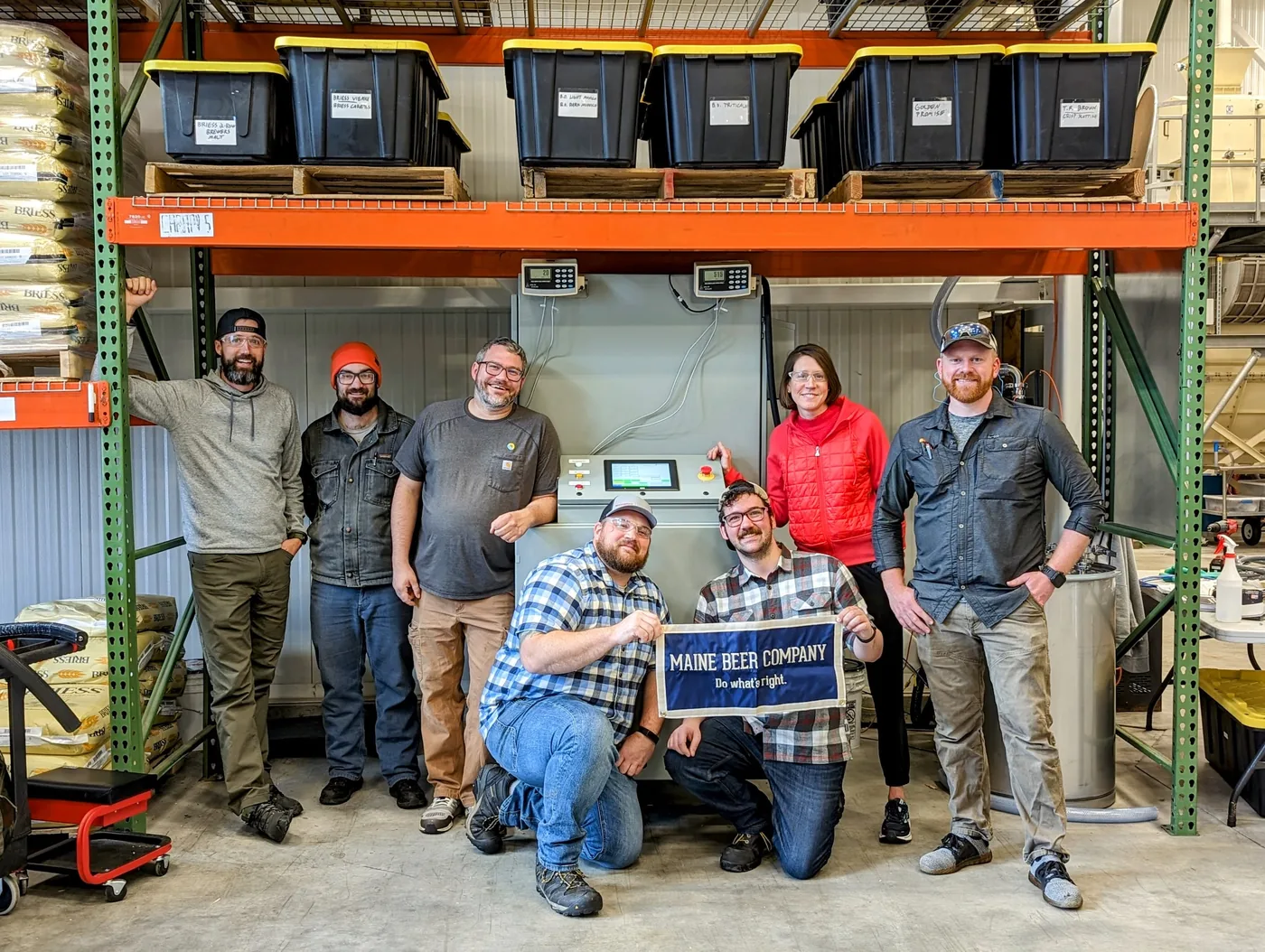
Brewing facilities turned to space hardware because traditional suppliers abruptly failed during widespread industrial supply contractions. In 2021, Maine Beer Company discovered that commercial carbon dioxide deliveries had dwindled to critical levels across the northeastern United States. Consumable carbon dioxide, often produced as an industrial by-product of petroleum refining, became severely scarce when pandemic travel restrictions halted transportation networks. Dave Love, the brewery’s sustainability manager, realized that missing gas deliveries jeopardized every active tank across their packaging operations [1]. ‘There was potential for our beer to go stale in the tanks,’ Love explained, warning that bottling, kegging, and centrifuge operations would shut down completely without sufficient gas [2].
Fossil fuel facilities historically supplied the food sector with byproduct gas generated during hydrocarbon refining, petroleum processing, and ammonia manufacturing. When automotive transport and commercial flights plummeted, refineries curtailed operations, triggering volatile supply shortages for regional beverage makers. Multi-million dollar recovery plants existed only at giant industrial brewing conglomerates, leaving smaller producers without viable internal recapture options. Microbreweries routinely vented tons of natural fermentation carbon dioxide directly into the air, forced to purchase trucked replacement cylinders later [4].
Small craft facilities paid between $200 and $300 per ton to purchase trucked industrial gas while venting pure carbon dioxide produced by their own yeast strains. Zubrin noticed this economic contradiction while visiting local craft taprooms in Colorado. ‘When you ferment beer, the process that produces alcohol also produces carbon dioxide,’ Zubrin noted [3].

Adapting NASA Mars Machine Systems on Earth
Translating aerospace hardware into commercial brewing cellars required radical downsizing and extreme mechanical simplification. In 2008, Zubrin established Pioneer Energy in Lakewood, Colorado, repurposing his Houston space contracts to develop compact mobile equipment for resource processing. Engineers packaged gas scrubbers, condensation pumps, and pressurization valves onto a mobile cart known as the Craft Brewery Recovery System. Automated robotic software developed for distant Martian landers eliminated the need for specialized technicians. The system produces five tons monthly [3].
Each modular unit generates enough carbon dioxide to support breweries producing 60,000 barrels annually, allowing producers to stack multiple recovery units for expanded cellar capacity [3].
Pioneer Energy ultimately decided to focus core engineering resources on oil and gas recovery fields, placing the brewery capture patents up for commercial licensing [2]. Amy George founded Earthly Labs in Austin, Texas, in 2016 after recognizing that small emitters lacked access to affordable capture technology. She acquired an exclusive license for the Martian-derived recovery architecture and commercialized the hardware under the trade name CiCi, short for carbon capture [4]. ‘Most of the effort and policy had been focused on the largest emitters, and this represented a way for others to participate,’ George stated [2].


Purity Gains and Supply Chain Security
Financial calculations for independent brewers shifted rapidly as volatile gas distribution networks threatened catastrophic production losses. When Maine Beer Company commissioned its Earthly Labs unit in 2022, management sought an insurance policy against unexpected supplier cancellations rather than total carbon self-sufficiency [4]. While the machine supplies less than half of their total cellar demand, it guarantees enough baseline carbonation to keep bottling lines moving during emergencies. Love calculated that the equipment paid for itself during the very first supply disruption, avoiding $100,000 in vanished revenue that would occur from dumping a single spoiled batch [2].
Standard beverage gas requires 99.5 percent purity. Commercial deliveries derived from fossil fuel cracking occasionally contain trace hydrocarbons or volatile sulfur compounds that alter delicate hop aromas. In contrast, fermentation gas scrubbed by Earthly Labs hardware registers near 100 percent purity, giving brewmasters superior sensory consistency [2]. Installation requires approximately one single week [4].
Operating reliable life-support hardware in closed planetary habitats requires absolute control over atmospheric contaminants, creating technological standards that now safeguard earthly beverages. Aerospace agencies validate these rigorous filtration principles through extensive environmental flight qualifications, parallel to how engineers conduct testing specialized Mars flight hardware in simulated atmospheric chambers before sending mechanisms into orbit. By eliminating ambient air intrusion during tank purges, specialized NASA Mars machines scrubbers prevent microbial contamination, ensuring that natural fermentation esters remain unspoiled throughout packaging [6].
How NASA Machines in Space Aid Energy
Beyond regional craft brewing, the modular separation technology developed from space programs has expanded into large-scale energy production and agricultural facilities. In 2021, industrial cryogenic equipment manufacturer Chart Industries acquired Earthly Labs to scale its thermal capture technology across heavy municipal utilities and landfill gas projects. Chart Industries completed the acquisition in 2021 [1]. Biological waste plants generate massive streams of raw methane and carbon dioxide that previously escaped into the atmosphere. Establishing closed-loop carbon recycling allows renewable energy facilities to sell purified gas while strengthening their environmental credentials [4].
The volumetric difference between craft breweries and utility plants highlights the adaptable scalability of the underlying aerospace architecture. ‘A brewery application might produce around 150 pounds of CO2 per hour, and then a biogas plant might produce 3,000 pounds an hour or more,’ George pointed out, emphasizing that industrial biogas systems operate at magnitudes far beyond regional beverage houses. Expanding hardware capacity enabled the company to establish over 100 international installations across Europe, Australia, the Middle East, and Brazil, creating approximately 60 high-tech manufacturing jobs in the United States [2].
Similar closed-loop resource recovery models are gaining traction across sustainable manufacturing, where industrial facilities repurpose by-products much like research teams studying microbes engineered to convert waste into food within circular supply chains. Zubrin viewed this cross-sector expansion as validation of public space investment, stating that ‘the intellectual capital being developed in NASA’s research and development programs is playing out across the economy, and this is just a small example’ [3].

Could Martian Separation Tech Secure Helium Reserves?
Advanced cryogenic separation systems derived from planetary research are now positioning themselves to stabilize critical global supplies of helium. In 2024, mineral exploration firm Pulsar Helium signed a formal agreement with Chart Industries to conduct engineering feasibility studies for a dedicated gas purification plant in Minnesota. Thomas Abraham-James, president and chief executive officer of Pulsar Helium, noted that helium is indispensable for manufacturing semiconductor microchips, fiber-optic communication cables, and superconducting magnetic resonance imaging (MRI) equipment [2]. Subterranean helium deposits remain locked with heavy concentrations of carbon dioxide and hydrocarbon gases [1].
Minnesota reserves contain 14.5 percent helium. This concentration represents the richest helium discovery in North America, but the raw reservoir gas is simultaneously saturated with abundant carbon dioxide. Abraham-James initially intended to reinject the unwanted greenhouse gas deep underground, but severe commercial carbon shortages prompted Pulsar Helium to reevaluate the revenue potential of separating both elements simultaneously. ‘Earthly Labs is really at the forefront, the cutting edge with the engineering of this purification technology,’ Abraham-James emphasized, praising the specialized efficiency of their cryogenic extraction units [2].
What began as an aerospace blueprint for keeping astronauts alive on Mars has transformed into a resilient industrial architecture across terrestrial supply chains. From preventing spoiled batches in independent brewing tanks to capturing utility landfill gas and refining semiconductor-grade helium, compact carbon scrubbers demonstrate that planetary technology can resolve acute resource bottlenecks on Earth. ‘Efficiency is the big thing they have, and then you get reduced operating costs,’ Abraham-James concluded [2]. As closed-loop engineering spreads across diverse commercial sectors, the NASA Mars machines originally drafted for in situ resource utilization continue proving their enduring practical value [6].
- PRESS RELEASE DiCicco, M., & Wagner, A. (2026, September 24). NASA’s Machines for Mars Make Beer Bubbly. NASA. [Article Link]
- REPORT NASA Spinoff. (2026, June 1). Machines from Mars Make Beer Bubbly: Carbon-Capture Technology Repurposed for Breweries Spreads and Finds New Applications. Spinoff. [Article Link]
- PRESS RELEASE NASA. (2016, March 16). Technology for Mars Puts Bubbles into Beer. NASA Spinoff. [Article Link]
- ONLINE NEWS SAE Media Group. (2026, January 1). Machines from Mars Make Beer Bubbly. Tech Briefs. [Article Link]
- ONLINE NEWS Mirage News. (2026, September 24). NASA’s Machines For Mars Make Beer Bubbly. Mirage News. [Article Link]
- ONLINE NEWS Custommapposter. (2026, September 25). NASA’s Mars Tech: From Space to Your Beer Glass. Custommapposter. [Article Link]
- ONLINE NEWS Independent Space News. (2026, September 24). NASA’s Machines for Mars Make Beer Bubbly. Independent Space News. [Article Link]
APA 7: PerEXP Teamworks. (2026, September 25). How NASA Mars Machines Put the Bubbles in Craft Beer. PerEXP Teamworks. https://perexpteamworks.com/en/nasa-mars-machines-carbonate-beer/


1 comment