






Astronomers have identified an unusual stellar pairing where a dead star flashes radio waves into space every eight minutes beside a companion matching the Sun. Observations conducted by researchers at the Curtin University node of ICRAR link these periodic signals to GPM J071507−114153, a system situated over 5,000 light-years from Earth [1]. The investigation marks the first time that repeating pulses from a white dwarf pulsar have been detected orbiting a star of similar mass and temperature to our own [2].
White Dwarf Pulsar Signals in Survey Data
Since 2021, astronomers have tracked a rare category of celestial broadcasters known as long-period transients. Such unusual cosmic sources produce bright flashes of radio waves over intervals extending from several minutes to multiple hours [1]. Previous systems identified in this class paired compact stellar corpses with small, cool red dwarf stars [2]. In late 2024, Curtin University astronomers searched the southern sky using the Murchison Widefield Array at Inyarrimanha Ilgari Bundara, the CSIRO Murchison Radio-Astronomy Observatory on Wajarri Yamaji Country in Western Australia [1].
PhD student Csanád Horváth developed an innovative search pipeline that isolated short radio flashes arriving like clockwork every 7.9 minutes [2]. To verify the physical nature of the source, researchers processed more than 100 hours of observational data at the Pawsey Supercomputing Research Centre in Western Australia. The resulting study, published in Nature Astronomy, showed that the radio bursts emanate from a magnetized white dwarf pulsar. Commissioning scientist Dr. Sam McSweeney with the Square Kilometre Array Observatory explained that the pulses were sharp enough to trace orbital displacement. McSweeney said: “This is the first time the pulses are clear enough to see the white dwarf moving in its orbit around its companion, so we know that the pulsations are coming from a region close to the white dwarf, or possibly even from the white dwarf itself” [1].

Signals from the Wrong Kind of Star
The behavior of GPM J071507−114153 initially confounded researchers when the detected radio pulses vanished completely for weeks. When the team graphed detections alongside quiet intervals, a steady cadence came into focus. Pulses switch on only during an observation window lasting roughly six hours, followed by 26 hours of silence. The recurring cycle reveals two stars completing an orbit every 32 hours, oriented so radio beams sweep Earth only during favorable alignment [2].
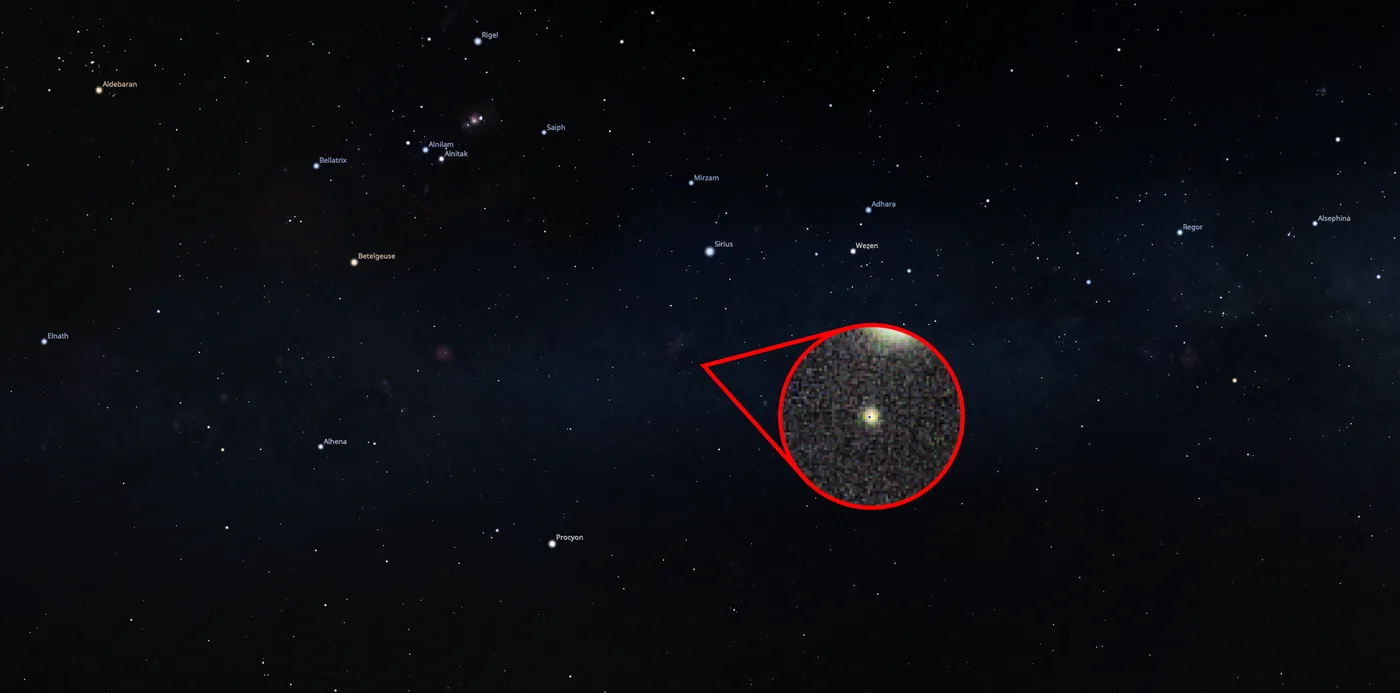
To localize the emitter, astronomers turned to the MeerKAT radio telescope, operated by the South African Radio Astronomy Observatory in the North Cape province [1]. MeerKAT pinpointed the radio pulses to a single faint optical star in the Milky Way. Scientists then utilized the W.M. Keck Observatory on Maunakea in Hawai’i to record the optical spectrum of the companion star. The resulting spectrum revealed a luminous G-type star possessing nearly the same mass and temperature as our Sun [2]. Long-period transients had previously been found only alongside dim red dwarfs [1]. The discovery proved that dead stars can generate periodic radio emissions while locked in close orbits with stars identical to the Sun [2].
Atmospheric Flares on the Companion
The orbital architecture of GPM J071507−114153 turns the system into an astronomical probe of stellar magnetic fields. As the white dwarf travels along its 32-hour path, its focused radio emission shines directly through the outer atmospheric layers of the G-type companion. The periodic illumination allows astronomers to map coronal features without resolving the stellar disc. Radio data revealed clear evidence of magnetic storms erupting across the companion star [1].
Associate Professor Natasha Hurley-Walker at Curtin University reported that radio filtering uncovered turbulent plasma activity on the host star. Hurley-Walker described seeing the compact core pass behind an intense magnetic region, identifying it as a stellar prominence where loops of hot plasma erupt into space. Similar magnetic turbulence occurs in our solar system, as seen when aurora-like radio signals above a sunspot illuminate active plasma loops. Detecting flares across interstellar distances represents a significant observational advance, prompting Hurley-Walker to say: “It’s amazing that by using radio wavelengths we can detect the storms on a star over 5,000 light-years away”. Radio monitoring reveals atmospheric weather on distant stars [1].


White Dwarf Pulsar Mass Measurements
Early interpretations of long-period transients favored ultra-slow neutron stars spinning far more slowly than regular radio pulsars. Neutron stars form during core-collapse supernovae and typically rotate several times every second. Standard astrophysics calculations show that a neutron star with an eight-minute spin rate should generate insufficient electrical potential to drive radio emission. Precise timing measurements of GPM J071507−114153 resolved the puzzle by testing the gravitational mass of the radio emitter [2].
Recorded pulse arrival times fluctuate by as much as four seconds depending on where the emitting object travels along its orbital path relative to Earth. The four-second time delay allowed scientists to calculate the physical diameter of the binary orbit. High-resolution optical spectra from the Keck telescope in Hawai’i showed that the Sun-like star barely wobbles as its partner orbits. The absence of reflex motion indicates that the companion star holds far more mass than the pulsing body. By combining orbital dimensions, orbital velocity, and the 32-hour cycle, researchers determined that the pulsing core is approximately two-thirds as heavy as the Sun. The mass measurement confirms that the object is far too light to be a neutron star, establishing that it operates as a white dwarf pulsar [2].
Common Envelope History and Supernovae
The compact orbit of GPM J071507−114153 sheds light on how close binary stars evolve through late-stage interactions. Millions of years ago, the star that formed the white dwarf expanded into a red giant. As the dying giant swelled, its outer gas envelope engulfed the Sun-like companion in a common envelope phase. Drag from the surrounding gas caused the companion to spiral inward, shrinking the orbit before the envelope blew into interstellar space [2].
Astronomers study close binary pairs to understand the mechanisms that lead to thermonuclear stellar explosions. Compact pairs containing white dwarfs are primary candidates for progenitors of Type Ia supernovae. When a white dwarf strips enough gas from a companion star or merges with an orbital partner, it explodes in a brilliant detonation. Cosmologists rely on Type Ia supernovae as cosmic standard candles to measure intergalactic distances and gauge the expansion rate of the universe. Tracking systems like GPM J071507−114153 provides empirical evidence of how binary separations decrease prior to potential explosive events [2].

Binary interactions do not always result in catastrophic destruction, and massive stars often undergo non-terminal outbursts. Researchers observe these distinct eruptive behaviors when a supernova impostor mimics star death without exploding, releasing energy while leaving the stellar core intact. Contrasting non-destructive mass loss with the stable orbital configuration of GPM J071507−114153 helps astrophysicists map the diverse pathways of stellar evolution in binary systems [2].
Future Surveys with the SKA Observatory
White dwarf companions orbiting bright stars are notoriously difficult to detect with optical instruments because brilliant stellar glare hides the dim remnant. Radio pulses cut directly through the optical glare, granting astronomers an effective method to identify compact objects that optical and X-ray telescopes miss. If long-period transients commonly conceal white dwarfs around Sun-like stars, radio surveys may expose an extensive, previously hidden population of stellar cores across the Milky Way [2].
Both the Murchison Widefield Array in Western Australia and MeerKAT in South Africa serve as key precursor facilities for the Square Kilometre Array Observatory. The upcoming observatory will deploy SKA-Low in Australia and SKA-Mid in South Africa, providing increased sensitivity for detecting transient radio emissions [1]. With the next generation of radio telescopes at the SKA Observatory, astronomers expect to detect many more periodic broadcasters [2]. McSweeney said: “If we are already making such discoveries with precursor telescopes, just imagine how many more star systems we will be able to find, and what a beautifully detailed view of their signals we will have, once the SKAO telescopes are completely built”. Advanced radio astronomy continues to expand our understanding of stellar life cycles [1].
- ONLINE NEWS International Centre for Radio Astronomy Research. (2026, November 12). A rare star system emits radio signals every 8 minutes. Phys.org. [Article Link]
- ONLINE NEWS Hurley-Walker, N. (2026, November 12). A dead star is flashing radio waves every 8 minutes, and its partner looks a lot like the Sun. The Conversation. [Article Link]
APA 7: PerEXP Teamworks. (2026, November 13). Radio Signals Reveal White Dwarf Pulsar Orbiting a Sun-Like Star. PerEXP Teamworks. https://perexpteamworks.com/en/white-dwarf-pulsar-sun-like-star/


