






The Event Horizon Telescope Collaboration published the first direct radio image of the core of galaxy Messier 87 on April 10, 2019, locating the giant system about 55 million light-years from Earth. Astronomers observed a bright asymmetric ring encircling a dark center, matching predictions derived from Albert Einstein’s general theory of relativity [4]. Sceptics soon argued that the circular shape might be an artifact produced by imaging software instead of a genuine cosmic feature [3, 5]. Samuel Lai and Nithyanandan Thyagarajan from Australia’s national science agency, CSIRO, have now reanalysed the original radio data, confirming that the M87 shadow remains intact [1, 2].
Controversy Over the 2019 Results
The 2019 announcement drew global attention because the Event Horizon Telescope revealed a giant central mass equal to 6.5 billion Suns in galaxy M87. Four blind teams inside the collaboration analysed the data using separate pipelines—including the CLEAN algorithm—to prevent shared human bias. Each team recovered a circular ring of glowing gas [4].
Disputes arose when external astrophysicists studied how the collaboration processed the sparse radio data. Starting in 2022, Junichiro Makino at Kobe University in Japan and his colleagues questioned whether the ring was real. Makino adjusted several calibration parameters in the public data to test how sensitive the results were to human choices [3, 5]. His team obtained a different image. Their alternative map showed a diffuse radio blob instead of an unbroken circular ring. Makino argued that a narrow field of view and gaps in array coverage produced a fake ring [3, 5]. The critique raised serious doubts among astronomers because radio interferometers do not take direct photographs, leaving final images vulnerable to subtle algorithmic bias and calibration choices [2, 3].

The debate divided astronomers who published papers in The Astrophysical Journal and wanted proof from teams outside the Event Horizon Telescope Collaboration [2, 3]. Settling whether the ring was real meant testing the public data with fresh mathematics developed at CSIRO. The new study had to handle telescope flaws without repeating the calibration steps that Makino had challenged [1, 2].
Atmospheric Distortion in Sparse Arrays
The core of M87 is difficult to observe from Earth because the source is tiny and sits 55 million light-years away. The observation is like photographing a doughnut on the Moon from Earth. To get enough resolving power, the Event Horizon Telescope linked antennas in Hawaii, Chile, Spain, and North America into a virtual dish as wide as our planet [2, 4].
Because only eight radio observatories around the globe recorded millimetre waves simultaneously in 2017, the Event Horizon Telescope sampled an incomplete portion of the incoming wave front from M87*. Gaps in antenna coverage left empty patches in the raw data. Computational imaging algorithms had to infer missing spatial frequencies, but atmospheric turbulence above high-altitude sites and receiver drifts contaminated every station with local phase corruptions [1, 4]. Standard radio interferometry pairs signals from two stations at a time. Astronomers routinely estimate station errors and subtract them during iterative calibration routines, but residual flaws linger in calibrated datasets whenever telescope baselines remain sparse [1, 2]. These calibration errors can distort reconstructed source shapes [1].

These weak spots gave weight to the doubts that Junichiro Makino and his Kobe University colleagues raised in Japan [3, 5]. If calibration models favoured a circular shape, the output would reflect software bias instead of genuine astrophysics, meaning that settling the dispute required a mathematical method that bypassed station calibration entirely [1, 2]. Station bias had to go [1].
How Closure Invariants Map the M87 Shadow
To remove station errors, Samuel Lai and Nithyanandan Thyagarajan at CSIRO turned to closure invariants to map the M87 shadow. Standard techniques link signals from pairs of dishes, but closure invariants multiply signals from triplets of antennas in closed loops, cancelling out station errors algebraically. Weather delays and instrument errors cancel out along these closed loops. The resulting data stay clean because local station flaws drop out through simple algebra [1, 2].
Radio astronomers have known about closure invariants for decades, but turning them into maps was long viewed as too difficult because the math is non-linear [1, 2]. The step from closed loops back to an image is an ill-posed mathematical problem with multiple possible solutions, because closure loops discard absolute position data and require complex inversion tools to recover true sky brightness distributions. Earlier teams avoided invariants. Older software could not solve the loop equations without rigid geometric guesses, so the CSIRO team created a direct framework linking closure invariants to the M87 shadow [1].
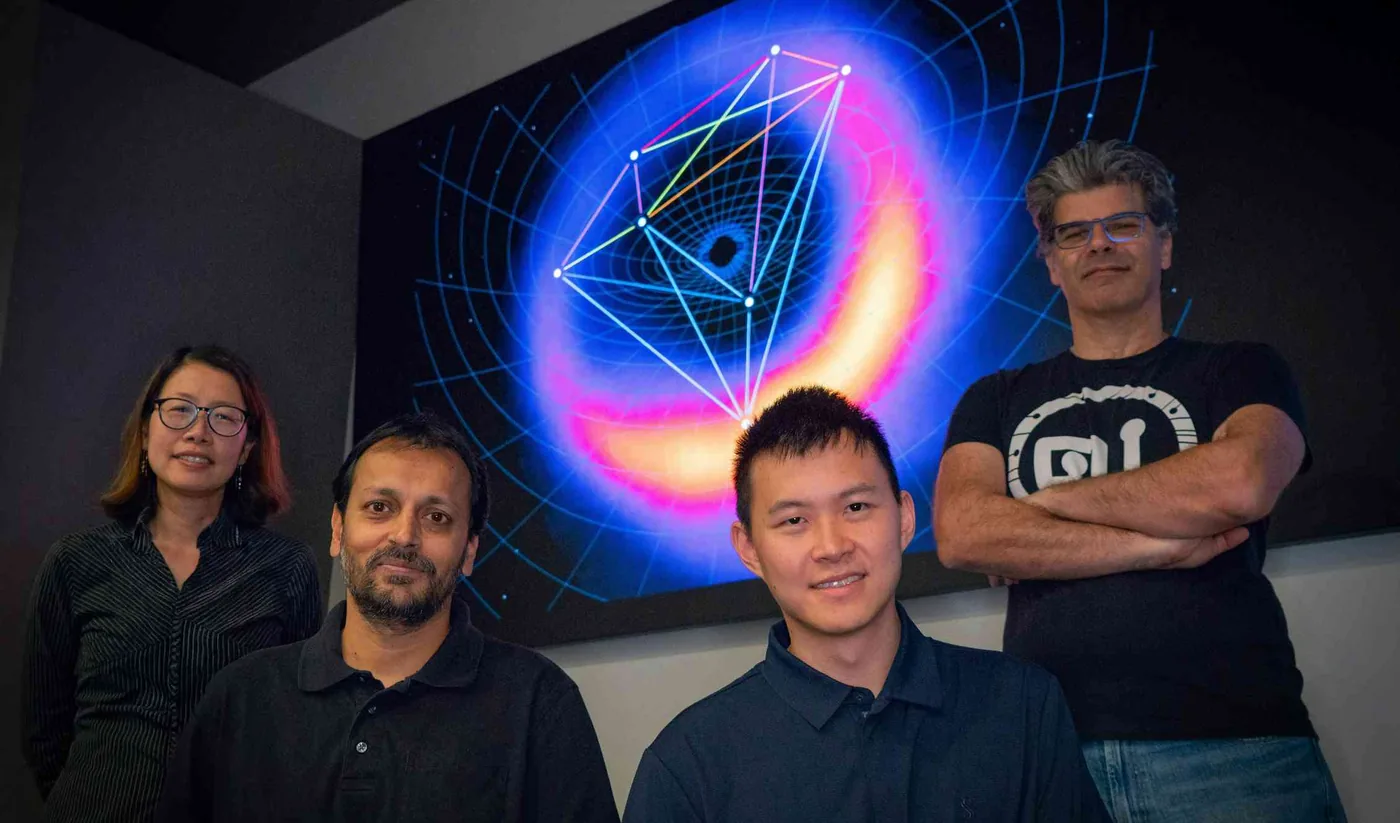
This mathematical method allowed Lai and Thyagarajan at CSIRO to separate true cosmic structures from instrument noise [1, 2]. By relying purely on invariant data, the authors ensured that station errors could not distort the source shape. The next step was building an imaging engine that could turn these clean loops into reliable sky maps [1].


GenDIReCT Training on Everyday Images
The CSIRO researchers built a software package called GenDIReCT, which stands for Generative Deep learning Image Reconstruction with Closure Terms [1, 2]. GenDIReCT uses conditional diffusion models to generate pictures that match measured closure invariants. The authors wanted to ensure that the neural network did not learn to produce rings from astronomical training sets [1, 2].
Samuel Lai, Nithyanandan Thyagarajan, and Ivy Wong from CSIRO trained GenDIReCT on pictures of cats, dogs, and cars from the CIFAR-10 computer vision dataset [1, 2]. The software had no prior idea what a black hole looked like [2]. Rigorous validation tests required the diffusion model to reconstruct synthetic non-ring geometries and complex jet structures without forcing them into circles. The CSIRO team also tested GenDIReCT on real radio interferometry data from Centaurus A and quasar 3C 279, recovering true astrophysical features without bias. Once performance was confirmed, the scientists froze all model weights so human operators could not tweak parameters [1, 2]. The blind protocol was complete [1].
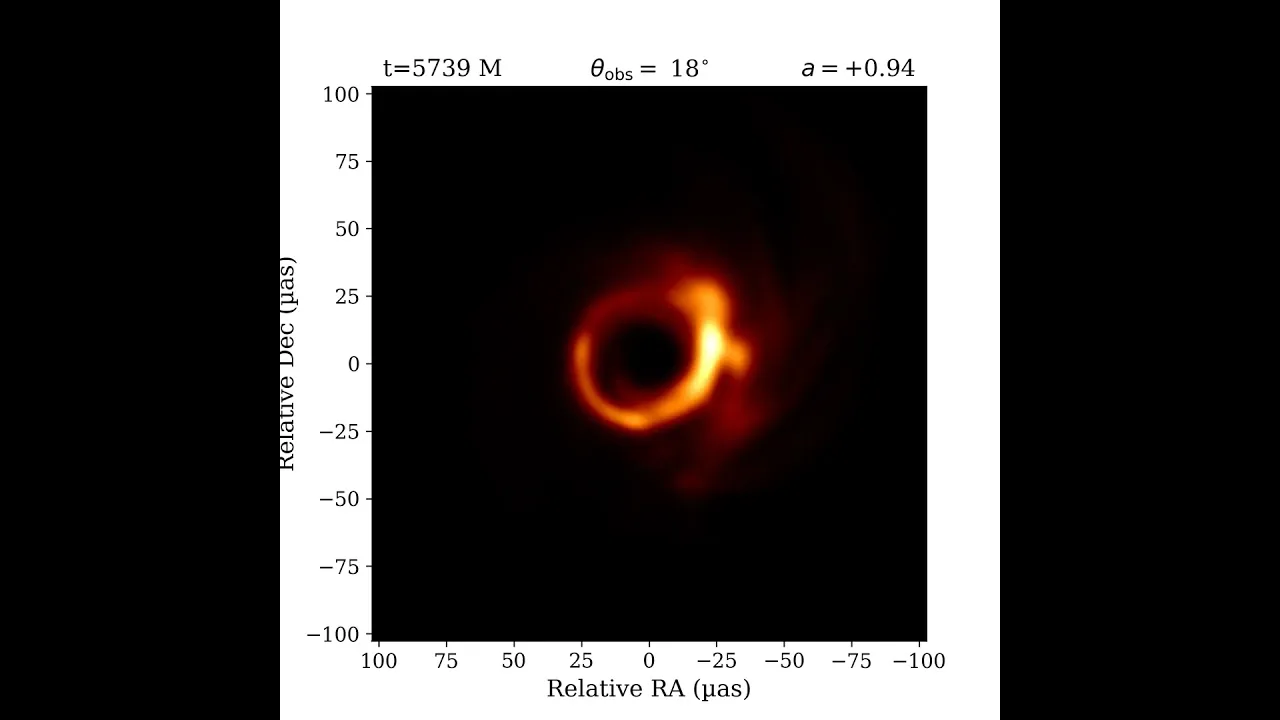
The frozen software ensured that human bias could not influence the result [1, 2]. The code could not alter its internal rules when fed real astronomical data. On December 4, 2025, the researchers finally allowed GenDIReCT to process the April 2017 Event Horizon Telescope observations of M87 [1, 2].
Confirmation of the M87 Shadow Ring
During every observation night from the 2017 campaign, the ring structure emerged clearly in the GenDIReCT images. The recovered ring diameter matched the 2019 Event Horizon Telescope findings for the M87 shadow, outlining a central object of 6.5 billion Suns viewed from an angle that Lai described as “looking straight down into the eye of a hurricane” [1, 2]. The dark central dip remained sharp [1].
Minor variations in ring thickness and brightness appeared between pipelines, but the central brightness depression remained visible across all reconstructions. The persistent dark void was not an artifact [1, 2]. The finding directly answered the critique that Junichiro Makino and his Kobe University colleagues published in 2022 [3, 5]. Makino’s alternative model showing a diffuse emission blob failed to appear when closure invariants governed the imaging pipeline [1, 3]. To confirm that machine learning did not create a false result, the CSIRO researchers built a second imaging pipeline based on traditional statistical methods applied to closure invariants. The statistical pipeline operated on the same closure invariant dataset without neural networks and confirmed the identical circular silhouette [1, 2]. Both methods agreed [1].
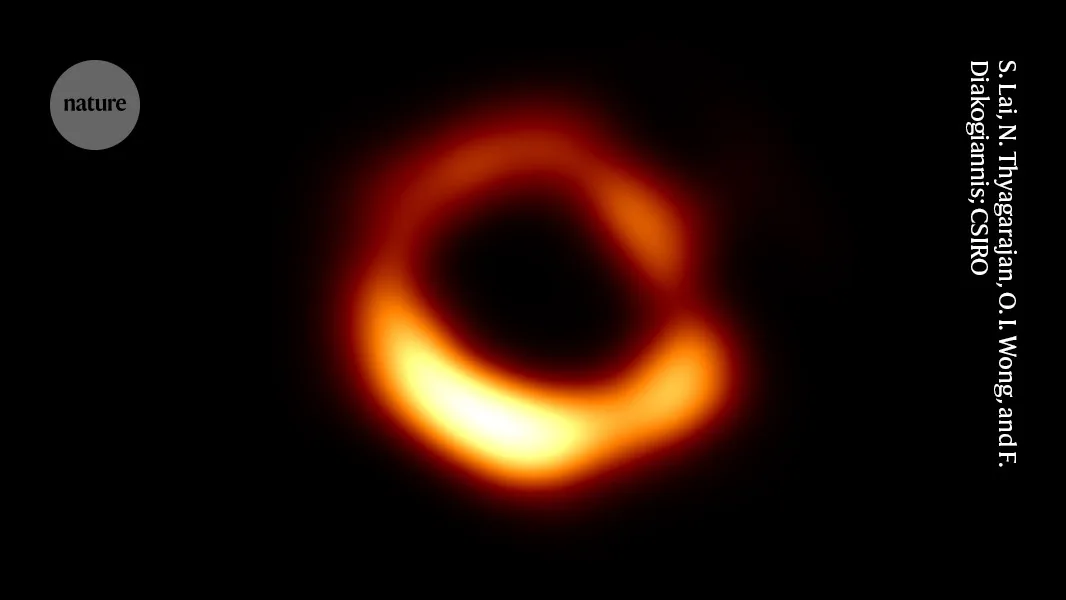
Two separate mathematical pipelines converged on the same geometry, providing firm validation for the M87 data and showing that the ring does not depend on a single code base [1, 2]. The dark center represents the true physical shadow of the event horizon, outlined by relativistic gas [1]. Understanding compact galactic cores also connects to how simulations link early giant black holes to little red dots throughout cosmic history.
Broader Practical Applications
The independent study published in Nature resolves a major dispute in modern astronomy, confirming that the Event Horizon Telescope accurately captured the M87 shadow [1, 3]. The confirmed 2019 observation strengthens the empirical foundation of Albert Einstein’s general relativity in extreme gravity [1, 4]. Modern astrophysics tracks how compact objects grew over cosmic time, showing that early galaxies displayed elongated shapes instead of settled disks in the young universe. Astronomers can now resolve nearby galactic cores with closure invariants, proving that sparse arrays can yield trustworthy maps when station calibration errors are eliminated mathematically [1].
The imaging tools developed by the CSIRO team extend beyond astrophysics into practical sensor networks. Data from scattered detectors present a common challenge across several scientific fields. The authors noted that closure invariant diffusion algorithms could help clinicians improve medical imaging scanners, while geophysicists could apply the mathematics to seismic networks to map underground earthquake faults with sharper precision [1, 2]. The technique is versatile. The CSIRO method turns corrupted sensor loops into clear structural maps, giving scientists a dependable tool for probing hidden environments across varied scientific disciplines [1, 2].
- ACADEMIC JOURNAL Lai, S., Thyagarajan, N., Wong, O. I., & Diakogiannis, F. (2026). Independent interferometric observable confirms black hole shadow in M87*. Nature, 659(8140), 317-323. [Article Link]
- ONLINE NEWS Thyagarajan, N., & Lai, S. (2026, November 11). Is this iconic black hole image accurate? New study delivers an independent result. The Conversation. [Article Link]
- ONLINE NEWS Castelvecchi, D. (2026, November 11). Iconic first image of black hole holds up to scrutiny. Nature. [Article Link]
- ACADEMIC JOURNAL The Event Horizon Telescope Collaboration, Akiyama, K., Alberdi, A., Alef, W., Asada, K., Azulay, R., Baczko, A., Ball, D., Baloković, M., Barrett, J., Bintley, D., Blackburn, L., Boland, W., Bouman, K. L., Bower, G. C., Bremer, M., Brinkerink, C. D., Brissenden, R., Britzen, S.,. Chael, A. (2019). First M87 Event Horizon Telescope Results. I. The Shadow of the Supermassive Black Hole. The Astrophysical Journal Letters, 875(1), L1. [Article Link]
- ACADEMIC JOURNAL Miyoshi, M., Kato, Y., & Makino, J. (2022). The Jet and Resolved Features of the Central Supermassive Black Hole of M87 Observed with the Event Horizon Telescope (EHT). The Astrophysical Journal, 933(1), 36. [Article Link]
APA 7: PerEXP Teamworks. (2026, November 12). M87 Shadow Image Withstands Scrutiny in New Analysis. PerEXP Teamworks. https://perexpteamworks.com/en/m87-shadow-confirmed/


