






When people ask what is multiple sclerosis, doctors describe an immune illness in which the body’s defenses mistakenly attack its own central nervous system, damaging brain tissue. In this disease, rogue immune cells strip away myelin, the fatty sheath shielding nerve fibers in the brain, spinal cord, and optic nerves. Without that protective coating, signals lose their swift speed, disrupting electrical messages that control muscle movement, vision, and sensation. First described in 1868 by French neurologist Jean-Martin Charcot, the condition alters daily life for millions. In 2024, about 3.1 million people lived with MS worldwide [12].
What Is Multiple Sclerosis?
Multiple sclerosis develops as a chronic illness where misguided immune cells inflict persistent damage on healthy nerve tissue within the brain and spinal cord. Most patients receive a diagnosis between the ages of 20 and 40, though illness can start in childhood or later in life [3, 12]. Women develop MS twice as often as men [3]. Early signs vary widely from person to person. While one patient suffers from numbness, tingling, or blurry vision, another struggles with stiff limbs and profound exhaustion that disrupts ordinary day-to-day work [11, 12]. Because myelin plaques can form anywhere along central nerve tracts, two patients rarely share the exact same symptoms during a flare [12].
Geographic patterns show sharp differences in disease frequency across the globe. In Texas, researchers led by Aaron Saguil recorded 40 cases per 100,000 people in Lubbock, compared with 191 cases per 100,000 in Olmstead County, Minnesota [3]. Regions further from the equator consistently record higher rates, a geographic gradient linked to lower sunlight levels and reduced vitamin D synthesis in the skin [12].
Most patients first develop relapsing-remitting disease, marked by sudden flare-ups followed by quiet periods of recovery. Over time, incomplete healing after repeated attacks can lead to steady accumulation of permanent disability. When relapses give way to steady decline, clinicians classify the illness as secondary progressive disease. About 10 to 15 percent of patients have primary progressive disease, facing continuous functional decline from symptom onset without distinct remissions [3, 12].
Myelin Breakdown and Nerve Signaling
Under healthy conditions, human neurons transmit electrical signals at speeds reaching 100 meters per second along axons insulated by fatty myelin coatings. In multiple sclerosis, autoreactive T cells and B cells cross the blood-brain barrier to trigger swelling that strips away this protective insulation [4, 12]. Tissue studies by Claudia F. Lucchinetti at the Mayo Clinic identified four distinct immunopatterns in early active lesions, ranging from macrophage infiltration to antibody-mediated destruction and primary loss of oligodendrocytes. These variations show that underlying disease mechanisms differ from one person to another, influencing how patients respond to acute clinical therapies [8].
When myelin breaks down, exposed axons fail to transmit signals properly. If swelling calms, repair cells create thinner myelin sheaths, forming so-called shadow plaques during remyelination. Over time, chronic attacks cause permanent axonal transection and irreversible loss of function [8].
Beyond white matter tracts, researchers found that gray matter lesions accumulate early in the disease as leukocortical, intracortical, or subpial plaques. Meningeal inflammation further links to cortical demyelination and microglial activation, explaining why patients suffer memory loss and mental fog even when standard magnetic resonance imaging scans show few white matter lesions. In clinical studies from Neurologia i Neurochirurgia Polska, cortical plaque load strongly predicted long-term physical impairment [8].
Environmental Triggers
Decades of medical tracking suggested that common viral infections could set off the autoimmune cascade in genetically vulnerable people. In 2022, a research team led by Alberto Ascherio at Harvard University analyzed blood samples from more than 10 million US military personnel stored in the Department of Defense Serum Repository. The researchers tracked 955 service members diagnosed with multiple sclerosis and discovered that infection with Epstein-Barr virus multiplied the risk of developing the illness more than 32-fold [4, 12]. Service members who remained uninfected by the virus virtually never developed the disease. The virus infects over 90 percent of adults [4, 12].
The biological link became clear when Stanford University immunologist Bill Robinson uncovered a mechanism of molecular mimicry. His team showed that antibodies targeting the viral protein EBNA1 mistakenly bind to GlialCAM, a structural protein found in human glial cells and myelin sheaths. This cross-reaction causes the confused immune system to attack nervous tissue as if fighting a lasting viral invader. Prof Gavin Giovannoni from Queen Mary University of London noted that targeting Epstein-Barr virus could open new avenues for preventative therapies [4].

Workplace chemical exposures also alter individual risk. In November 2026, Anna Karin Hedström at the Karolinska Institutet in Stockholm, supported by the Swedish Research Council, evaluated 2,872 patients with newly diagnosed illness and 6,122 matched controls. Her group reported that workplace exposure to petroleum-derived lubricants, such as cutting fluids and hydraulic oils, raised disease odds by 38 percent. Among exposed workers who smoked tobacco and carried risk genes, the odds of developing MS rose more than 33-fold [6].
Ancient Genetic Roots
Family genetics strongly influence susceptibility, though the illness is not inherited in a simple single-gene pattern. An identical twin of an affected person faces roughly a 30 percent lifetime risk, compared with 5 percent for a nonidentical twin and 2.5 percent for a sibling. Genome-wide association screens have pinpointed over 200 risk variants across human chromosomes, with the major histocompatibility complex on chromosome 6 playing the largest role, particularly the HLA-DRB1*15:01 allele [12].
The ancestry of these risk genes traces back to prehistoric migrations across Eurasia. In 2024, an international research team led by Dr William Barrie from the University of Cambridge and Prof Lars Fugger from the John Radcliffe Hospital in Oxford analyzed ancient DNA from 5,000 prehistoric human skeletons. They found that key risk variants entered northwestern Europe about 5,000 years ago through a massive westward migration of Yamnaya cattle herders from the Pontic-Caspian steppe. At that time, these heightened immune traits offered critical survival benefits by protecting herders against animal pathogens carried by their cattle and sheep, yet in modern clean environments those same genes predispose descendants to autoimmune attacks [5].
Beyond standard immune genes, non-peer-reviewed preprint research led by V. G. Jokubaitis examined 1,813 individuals from the MSBase registry to explore genetic drivers of disease severity. Because this study remains an unpublished preprint that has not undergone peer review, clinicians await formal confirmation before using its machine learning model in daily practice. The authors found that long-term severity correlates with mitochondrial and central nervous system variants [2].



Early Warning Signs
The clinical onset of multiple sclerosis typically presents as a clinically isolated syndrome, representing an initial neurological episode lasting at least 24 hours. About 85 percent of patients experience acute focal symptoms such as unilateral optic neuritis, which causes sub-acute eye pain and pronounced loss of color vision [3, 12]. Other common early signs include facial numbness, limb weakness, tingling, or balance trouble. Many patients describe Lhermitte sign, an electric shock sensation that shoots down the spine when bending the neck forward [3, 12]. These symptoms often evolve over several days before gradually receding [3].
Symptoms can fluctuate when body heat rises. Between 60 and 80 percent of patients experience Uhthoff phenomenon, where minor temperature increases temporarily worsen nerve deficits. A hot shower, vigorous physical activity, or a mild fever can slow signals along damaged fibers without causing new tissue loss [12].
Mounting evidence reveals that a subtle prodromal stage precedes formal clinical diagnosis by several years. Studies by Ruth Ann Marrie and colleagues show that future patients visit primary care clinics more often for fatigue, headache, pain, and mood disorders [12]. In military blood archives, researchers found that serum neurofilament light chain levels rose significantly years before any clinical attack occurred. This early elevation confirms that microscopic axonal damage begins long before a person ever notices an overt physical symptom [1].

Multiple Sclerosis Diagnostic Criteria
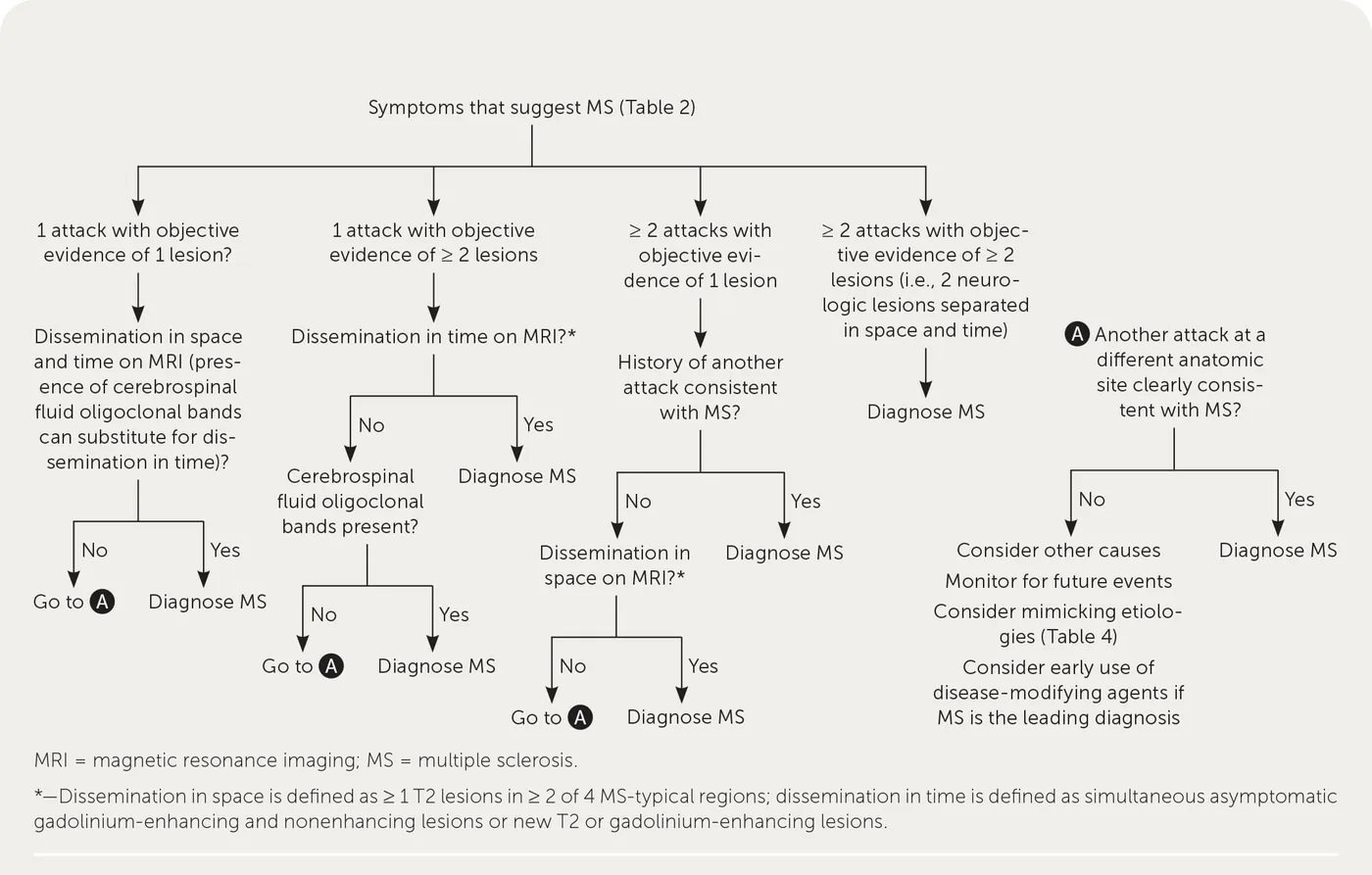
Accurate diagnosis requires demonstrating dissemination of central nervous system lesions in both space and time while ruling out alternative medical conditions. Historically guided by the Schumacher and Poser criteria, current clinical practice relies on the McDonald criteria, which combine neurological exams, magnetic resonance imaging scans, and spinal fluid analysis [3, 13]. Magnetic resonance imaging detects demyelinating plaques in periventricular, juxtacortical, and infratentorial regions, as well as classic Dawson fingers that extend outward from the lateral ventricles [3].
The 2024 revisions to the McDonald criteria, synthesized by Xavier Montalban and an international consensus panel at Amsterdam UMC, introduced major improvements to diagnostic speed. The optic nerve is now formally accepted as a fifth anatomical location for proving dissemination in space. In addition, specialized imaging markers such as the central vein sign and paramagnetic rim lesions provide vital specificity to distinguish multiple sclerosis from vascular disease, migraine, and other demyelinating conditions. These updated criteria allow clinicians to confirm a diagnosis earlier while preventing misdiagnosis [7].
Cerebrospinal fluid obtained via lumbar puncture reveals oligoclonal bands of immunoglobulin G in 75 to 85 percent of patients, providing key laboratory evidence of chronic central nervous system inflammation [13]. The 2024 revised criteria also endorse kappa free light chain levels as a fast and sensitive diagnostic biomarker [7]. Careful clinical testing separates multiple sclerosis from neuromyelitis optica spectrum disorders and acute disseminated encephalomyelitis [8].
Fatigue and Muscle Spasticity
Among the many challenges of central nervous system injury, persistent fatigue ranks as one of the most debilitating symptoms [11, 12]. Around 65 percent of people with multiple sclerosis experience fatigue, with many calling it their greatest daily hurdle [12]. The Multiple Sclerosis Trust distinguishes between primary fatigue, caused directly by damaged nerve fibers struggling to carry signals, and secondary fatigue caused by chronic pain, poor sleep, or muscle spasms. This exhaustion differs from normal tiredness because it comes on suddenly and does not improve with simple bed rest [11]. It often peaks during late afternoons [12].
To manage fatigue, guidelines from the National Institute for Health and Care Excellence recommend supervised aerobic exercise, resistance training, and energy conservation techniques tailored to individual mobility. Cognitive behavioral strategies help people pace daily chores and cope with emotional stress, preventing unnecessary energy depletion [9, 11].

Muscle stiffness and spasticity also demand structured non-drug care to preserve walking ability and prevent dangerous falls. In a systematic review in the Annals of Rehabilitation Medicine, Bhasker Amatya, Fary Khan, and colleagues at the Royal Melbourne Hospital evaluated physical therapy regimens. They reported significant benefits from dynamic neuromuscular stabilization, concentric strength training, and stretching routines, which improved balance and daily mobility. Combining physical training with botulinum toxin injections further eases severe muscle contractions [14].
Therapies for Multiple Sclerosis
Modern therapy relies on disease-modifying treatments to suppress inflammation, reduce relapse rates, and slow long-term disability progression. Since the initial approval of interferon beta-1b in 1993, the treatment landscape has expanded to include convenient daily oral drugs, self-injected therapies, and high-efficacy monoclonal antibody infusions. Clinical practice guidelines from the American Academy of Neurology advise starting disease-modifying therapy early in patients with active disease. During acute relapses, high-dose corticosteroids, such as 1,000 milligrams of intravenous methylprednisolone daily for three to five days, speed recovery from debilitating attacks. Steroids calm acute attacks within days [3].
Patients who do not recover adequately after steroid therapy often benefit from plasma exchange to clear circulating antibodies. Quitting smoking is equally vital: research shows that each smoke-free year slows disability accumulation, whereas ongoing smoking accelerates progression to secondary progressive disease by 4.7 percent annually. In clinical studies, six plasma exchange sessions produced complete functional recovery in steroid-unresponsive patients [3].
Innovative treatments continue to target progressive forms of illness. In June 2026, the European Medicines Agency approved Cenrifki, an oral tablet containing tolebrutinib, for adults with non-relapsing secondary progressive multiple sclerosis. Tolebrutinib inhibits Bruton’s tyrosine kinase, dampening chronic inflammation driven by B cells and microglia in the brain. In clinical trials with 1,131 patients, tolebrutinib cut six-month disability progression to 22.6 percent compared with 30.7 percent on placebo, offering meaningful hope for advanced disease. Patients take the tablet once daily with meals [10].
- ACADEMIC JOURNAL Bjornevik, K., Munger, K. L., Cortese, M., Barro, C., Healy, B. C., Niebuhr, D. W., Scher, A. I., Kuhle, J., & Ascherio, A. (2020). Serum Neurofilament Light Chain Levels in Patients With Presymptomatic Multiple Sclerosis. JAMA Neurology, 77(1), 58. [Article Link]
- PREPRINT Jokubaitis, V. G., Ibrahim, O., Stankovich, J., Kleinova, P., Matesanz, F., Hui, D., Eichau, S., Slee, M., Lechner-Scott, J., Lea, R., Kilpatrick, T. J., Kalincik, T., De Jager, P. L., Beecham, A., McCauley, J. L., Taylor, B. V., Vucic, S., Laverick, L., Vodehnalova, K.,. Patsopoulos, N. (2022). Not all roads lead to the immune system: The Genetic Basis of Multiple Sclerosis Severity Implicates Central Nervous System and Mitochondrial Involvement. [Article Link]
- ACADEMIC JOURNAL Saguil, A., Farnell, E. A., & Jordan, T. S. (2022). Multiple Sclerosis: A Primary Care Perspective. American Family Physician, 106(2), 173-182. [Article Link]
- ONLINE NEWS Gallagher, J. (2022). Is a virus we all have causing multiple sclerosis? BBC News. [Article Link]
- ONLINE NEWS Roxby, P. (2024). Scientists crack mystery of how MS gene spread. BBC News. [Article Link]
- ONLINE NEWS Hedström, A. K. (2026). Workplace exposure to petroleum-based lubricants linked to higher MS risk. News-Medical. [Article Link]
- REPORT Montalban, X., Lebrun-Frénay, C., Oh, J., Arrambide, G., Moccia, M., Amato, M. P., Amezcua, L., Banwell, B., Bar-Or, A., Barkhof, F., & Thompson, A. J. (2025). Diagnosis of multiple sclerosis: 2024 revisions of the McDonald criteria. Amsterdam UMC. [Article Link]
- ACADEMIC JOURNAL Kalinowska-Łyszczarz, A., Guo, Y., & Lucchinetti, C. F. (2022). Update on pathology of central nervous system inflammatory demyelinating diseases. Neurologia i Neurochirurgia Polska, 56(3), 207-219. [Article Link]
- REPORT National Institute for Health and Care Excellence. (2022). Multiple sclerosis in adults: management. NICE guideline NG220. [Article Link]
- REPORT European Medicines Agency. (2026). Cenrifki (tolebrutinib): An overview of Cenrifki and why it is authorised in the EU. EMA. [Article Link]
- WEBSITE Multiple Sclerosis Trust. (2015). MS fatigue. Multiple Sclerosis Trust. [Article Link]
- WEBSITE Wikipedia contributors. (2026). Multiple sclerosis. Wikipedia, The Free Encyclopedia. [Article Link]
- WEBSITE Wikipedia contributors. (2026). Diagnosis of multiple sclerosis. Wikipedia, The Free Encyclopedia. [Article Link]
- ACADEMIC JOURNAL Amatya, B., Khan, F., Song, K., & Galea, M. (2024). Effectiveness of Non-Pharmacological Interventions for Spasticity Management in Multiple Sclerosis: A Systematic Review. Annals of Rehabilitation Medicine. [Article Link]


