



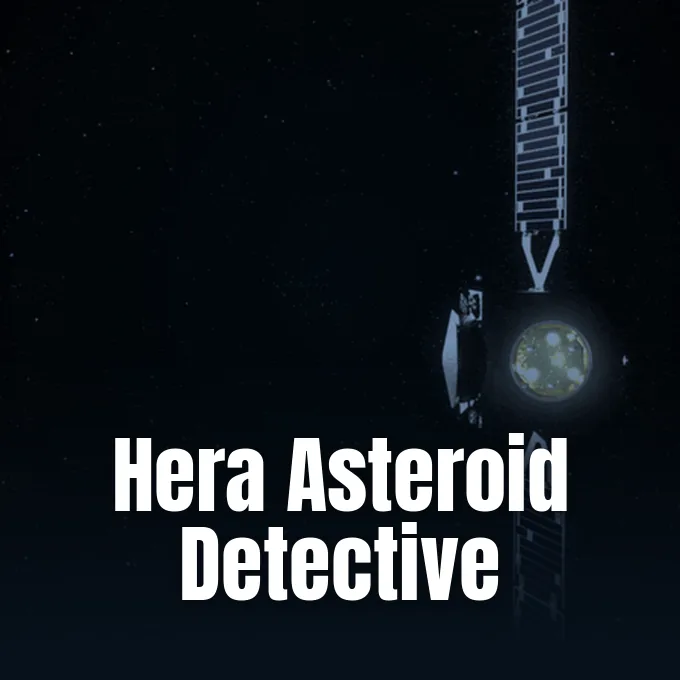
Two years after launching from Earth, the European Space Agency’s Hera mission is firing its thrusters to prepare for arrival at a distant asteroid pair. The robotic probe launched on October 7, 2024, on a long journey toward the Didymos system and its small moon Dimorphos, traveling through interplanetary space to reach the human-made collision site [1]. Rather than speeding past the rocks on a fast flyby course, the spacecraft must reduce its relative speed next month. The rendezvous is scheduled for November 2026.
How the Hera Mission Slows Down
The braking burn is an exacting step in the probe’s flight path, requiring precise alignment before the engines ignite in deep space. To cut its forward speed, the spacecraft rotates so that its ring of Orbit Control Thrusters faces the incoming target rocks, allowing three hydrazine-based thrusters to fire together without pause for 93 minutes to reduce velocity by several hundred meters each second [1]. ESA said the burn works safely.
This engine burn follows two years of travel through interplanetary space. Earlier in 2026, flight controllers carried out a deep-space correction maneuver to align the trajectory with Dimorphos. Engineers also finished an upgrade to the flight software in July 2026, helping all autonomous navigation systems operate as planned so ground teams can track telemetry signals and verify the updated velocity after the October 15 burn finishes [1].
Didymos measures about a half mile wide. Its companion, Dimorphos, spans roughly 560 feet across. Because their gravitational pull is very faint, flight dynamics teams at ESA track each meter of speed change with deep-space tracking dishes to guide the probe toward its arrival in November 2026 [1].
Why Did DART Target Dimorphos?
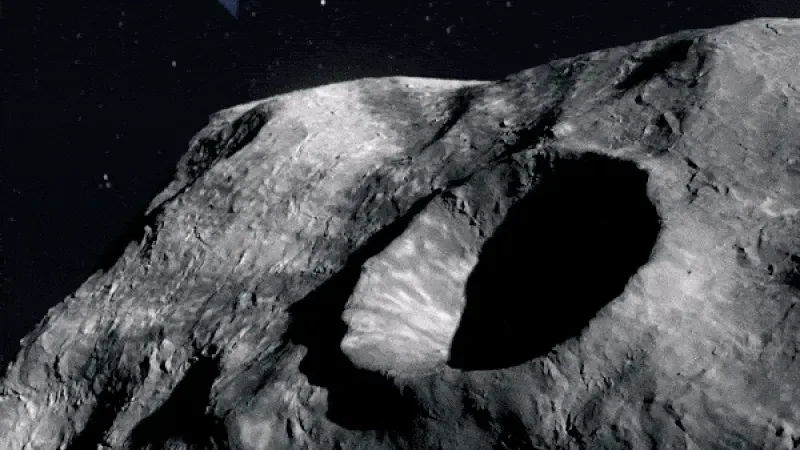
In 2022, NASA slammed the DART spacecraft into Dimorphos to learn whether hitting an asteroid with a fast-moving probe could alter its path before it ever came near Earth. Ground telescopes showed that the collision pushed Dimorphos slightly out of its previous orbit around Didymos while throwing dust and gravel into surrounding space. Scientists suggested this debris could form meteors [1].
Dimorphos offered a safe natural test site because neither asteroid poses any danger of colliding with Earth. The moonlet circles Didymos, an asteroid roughly 800 meters wide that compares in size to the Golden Gate Bridge. By comparison, Dimorphos measures about 170 meters in diameter, making it similar in scale to Rome’s Colosseum or the Great Pyramid, but telescopes on Earth could not resolve the crash site clearly or map the resulting crater across millions of miles of deep space [1].
The Hera spacecraft is now flying to the crash site to carry out what European mission leaders described as a “crime scene investigation” [1]. Earlier research on asteroid dust from Earth examined unexpected findings in mineral particles from space, showing how close examination of cosmic debris reshapes models of asteroid history.
What Instruments Ride on the Hera Spacecraft?
The main probe will not work on its own during its six months of survey work. When Hera reaches the asteroids, it will release two small CubeSats named Milani and Juventas, which ESA described as an asteroid detective’s key assistants that can orbit closer to the terrain than the mothership dare venture [2]. They carry small sensors built to study surface minerals and probe the inner structure of the moonlet [1].
The first companion craft, Milani, carries the title of “the rock decoder” because of its optical camera and spectrometer [2]. Its main job is spectral surface observation, which breaks up reflected sunlight across separate color bands to examine mineral signatures and map dust clouds that fell back after the impact [1]. These spectral readings will help scientists compare the composition of Dimorphos with Didymos to see if both bodies share identical rock types.

The second CubeSat, Juventas, earned the title of “the radar visionary” by carrying a low-frequency radar antenna [2]. This instrument will take the first radar soundings inside the heart of an asteroid, sending radio pulses through the rock to map inner voids and density layers [1]. After completing their orbital surveys, both CubeSats will attempt delicate landings on the asteroid surface [2]. The European Space Agency previously coordinated public engagement for the BepiColombo Mercury arrival.


Three Mysteries of the Didymos System
ESA outlined three main scientific mysteries that the arriving mission will study during its six-month stay. The first mystery centers on whether Dimorphos is a loose “rubble pile” held together only by weak gravity, or a solid boulder wrapped in gravel [1]. Knowing that structure matters for planetary defense, because a solid rock responds to an incoming projectile differently than a loose pile of rubble.
Hera will map the impact scar down to 10-cm resolution, which equals about 4 inches, to reveal how the terrain deformed during the collision. Planetary scientists suspect that the strike might not have left a neat circular crater on the surface. Instead, the kinetic impact could have reshaped the entire moonlet by moving loose gravel over the surface and turning the asteroid into an elongated shape, remodeling the whole body rather than punching a local hole [1].

Roughly 15% of known asteroids are binary pairs. If measurements reveal that Didymos and Dimorphos share identical materials, that fact would back the theory that Didymos spun fast in the past and shed outer debris into orbit [1]. That ejected material would then have coalesced under faint gravity to build Dimorphos over time.
Can the ESA Hera Mission Confirm Asteroid Origins?
Confirming the origin of Dimorphos needs detailed composition data from both space rocks. Hera project scientist Michael Küppers explained that resolving surface minerals will show whether Dimorphos broke away from Didymos during a fast spin event or formed independently as a captured body [1]. In conversations with EarthSky science writer Deborah Byrd, mission researchers said that learning how Didymos sheds mass helps model thousands of double asteroids throughout our solar system.
The investigation will also examine the cloud of boulders and fine dust ejected during the collision in 2022, which formed a long tail streaming behind Dimorphos for weeks [1]. Hera will measure the size of displaced boulders and track how dust scattered in the double asteroid system. Ground teams want to calculate momentum transfer, which tells physicists how much extra push was created by escaping rock fragments during the impact.

Knowing the exact mass and shape of Dimorphos lets researchers calculate the kinetic energy absorbed during the strike [1]. Double asteroid systems provide good conditions for these tests because the orbital period changes can be measured with high precision from ground observatories, turning numerical simulations into verified tools for future planetary defense planning.
Planetary Defense Lessons for Future Earth Safety
Planetary defense work depends on turning single experiments into repeatable deflection methods. Before DART and Hera, researchers possessed no experimental field data on how an actual asteroid reacts to a high-speed collision in space [1]. While computer models predicted several possible deflection outcomes, real space rocks often surprise scientists with unusual porosity and loose surface gravel that can absorb or alter impact forces.
NASA provided the kinetic impact in 2022, while ESA delivers the detailed forensic follow-up four years later [1]. This shared work shows how international space agencies can split tasks to study hazardous near-Earth objects [2]. Coordinated missions reduce costs and technical risks for each partner agency while building shared scientific data for the global planetary defense community.
When the Hera mission finishes its six months of survey work, scientists will possess an accurate assessment of asteroid deflection physics [1]. Didymos and Dimorphos will serve as standard reference points for planetary protection studies for years to come. The findings gathered by the European probe will help ensure that if a dangerous asteroid ever heads to Earth, human spacefarers know how to push it off course without guessing its inner composition or surface strength.
- ONLINE NEWS Whitt, K. K. (2026, October 8). Hera mission hits the brakes to arrive at asteroid. EarthSky. [Article Link]
- PRESS RELEASE European Space Agency. (2026, October 7). The Incredible Adventures of the Hera mission – The space detectives arrive. ESA. [Article Link]
APA 7: TWs Editor. (2026, October 9). The Hera Mission Slows Down for November Asteroid Arrival. PerEXP Teamworks.


