




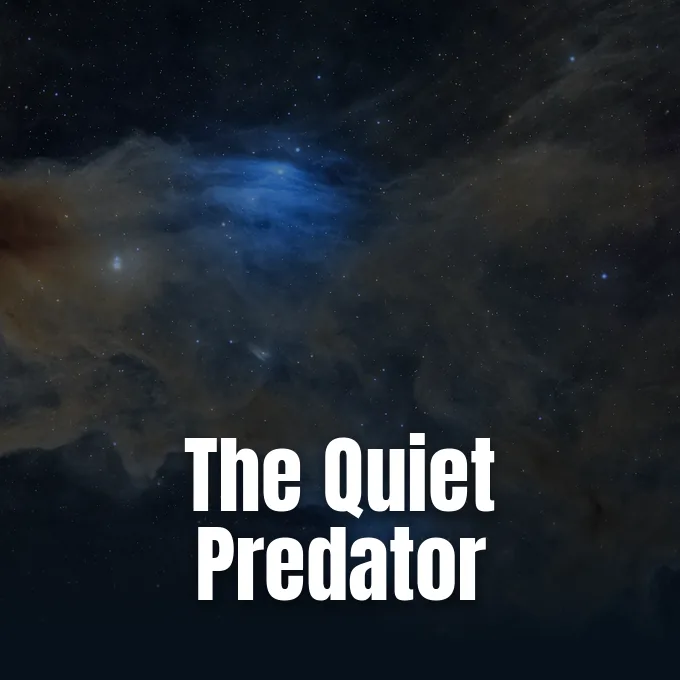
Can patient observers on Earth truly capture the elusive silhouettes of deep interstellar dust drifting hundreds of light-years away? The Royal Observatory Greenwich answered that question by naming amateur astronomy photographer Ali Alobaidly the overall winner of the 18th ZWO Astronomy Photographer of the Year competition [1]. His striking portrait of the Shark Nebula (LDN 1235) led an international field of winners announced on September 17, securing a top prize of 10,000 British pounds before public gallery displays opened at the National Maritime Museum in London [2].
Astronomy Photographer Honors for the Shark Nebula
Capturing distant cosmic dust requires exceptional precision and hundreds of combined readings under clean night skies. Kuwaiti astronomy photographer Ali Alobaidly traveled to the Jahra governorate across two days in August 2025 to track an obscure molecular cloud in the northern constellation Cepheus [2]. Working with an Askar 140 APO telescope mounted on a Sky-Watcher EQ8-R platform and paired with a ZWO ASI2600MM Pro camera, he gathered faint photons across more than 28 hours of total exposure [1]. The resulting portrait, titled The Quiet Predator, reveals an oceanic silhouette prowling through interstellar space roughly 650 light-years from Earth [2]. The nebula glows faint blue.
Distant stellar radiation sculpts this cold interstellar cloud into sharp relief against the dark void. A few embedded bright stars illuminate the surrounding gas, producing subtle blue reflection halos that penetrate surrounding foreground obscurity [1]. Alobaidly explained that the juxtaposition between desert sands and the predatory silhouette in the heavens carried deep personal meaning rooted in ancestral landscapes. In a formal announcement from the competition, judges emphasized that the award of 10,000 British pounds, equivalent to about $13,300, recognized both technical execution and aesthetic patience. Similar celestial dust structures often demand comparable dedication from modern space observatories, much like Webb observations tracking dust structures in distant debris disks where fine particles trace hidden dynamics [2].
The equipment required immense patience. Alobaidly assembled each channel carefully over two nights [2]. His composition triumphed over global contenders [1].
Deep-Sky Visions Beyond the Wormhole
Stellar demise often leaves behind expanding envelopes of incandescent gas that simulate cosmic passageways. In the overall runner-up position, Israeli astronomy photographer Kfir Simon captured Beyond the Wormhole, focusing directly on the core of the Helix nebula. Located approximately 650 light-years away in the constellation Aquarius, this planetary nebula formed when an aging central star shed its outer gaseous layers thousands of years ago. Simon recorded delicate structural tendrils radiating outward from the moribund star while revealing far older background galaxies shining through the translucent veil [1]. The composition demonstrates how planetary nebulae serve as transparent windows into the extragalactic universe.
Deep space imaging requires resolving intricate filaments without overwhelming the subtle backdrop of ancient stars. In the Galaxies category, Chinese photographers Yan Zhipeng and Xinran Li won top recognition for their view of NGC 4753, titled A Symphony of Dust Lanes in Virgo. Operating their equipment under the pristine skies of Chile, each dedicated astronomy photographer imaged an unusual galaxy situated roughly 60 million light-years away from our planet. Observatory judges noted a striking network of dust lanes swirling tightly around the luminous core, documenting complex gravitational histories across immense distances. Astronomical studies examining ancient cosmic environments, including research on exploring ancient stars as potential havens for life, frequently evaluate such enduring stellar nurseries to understand how chemical elements disperse through galactic disks [2].

Solar Dynamics Across Hidden Wavelengths
Can specialized optical filters unmask the violent, boiling layers hidden just beneath the blinding solar corona? Portuguese astronomy photographer Miguel Claro earned the Our Sun category title by documenting Active Region 4122 through a dedicated dual-band solar telescope. Claro focused on the solar photosphere (the visible surface layer of our home star), resolving intricate convection cells where superheated gas or plasma rises from the interior. The resulting image highlights intense magnetic bright spots clustered between churning convection boundaries, revealing turbulent energy transport across the solar disc [2].
Solar imaging extends far beyond single broadband snapshots of the dynamic disc. In the same category, Australian photographer Peter Ward earned runner-up honors with a multi-spectral composite titled Anatomy of the Chromosphere. Ward combined two narrow wavelengths to map the chromosphere (the atmospheric layer situated directly above the photosphere but below the corona). Emissions from ionized hydrogen along the limb appear in vivid red, while localized calcium emissions register in distinct lilac shades [1]. The alignment was brief.
Hydrogen and calcium channels isolate contrasting thermal zones that standard white-light filtration completely obscures. Ward mapped structural magnetic arches rising above the edge of the sun, providing educational clarity on how energetic plasma circulates across low-density coronal boundaries. Such ground-based observations demonstrate how amateur instruments rival specialized institutional monitors when atmospheric seeing stabilizes [1].


Planetary Alignments and Ancient Desert Horizons
Atmospheric clarity occasionally permits celestial observers to record delicate planetary geometries during daytime hours. Czech astronomy photographer Petr Horalek secured first place in the Our Moon category with Venusian Pearl on the Moon, captured on September 19, 2025 [2]. The photograph recorded a relatively rare daytime occultation (an event where one celestial body passes directly in front of another from an observer’s perspective) as the moon traversed Venus [1]. Judges observed that Venus appeared like a shining pearl perched on the lunar limb just before disappearing behind the crescent [2].
Farther out in the solar system, orbital mechanics create fleeting geometric perspectives that occur only twice during a multi-decade journey. British astrophotographer Tom Williams earned the Planets, Comets and Asteroids category award with Saturnian Equinox, photographed during 2025. Williams recorded Saturn with its vast ring system tilted precisely edge-on relative to Earth, marking the start of local spring in the planet’s southern hemisphere during its near-30-year circuit of the sun [2]. The rings appear as a razor-thin needle piercing the gas giant’s equator.
Terrestrial history intersected with night sky observation in the People and Space category. New Zealand photographer Max Inwood documented California desert petroglyphs under starlight in A Message from the Ancients. The carved symbols are believed to record the 13 full moons Earth witnesses during a typical calendar year, connecting ancestral calendar tracking with modern celestial observation [2].

Cometary Plumes and Botswana Star Trails
Cometary apparitions provide dynamic spectacles as frozen bodies plunge toward the inner solar system. In a highly commended entry, Texas observers Julien DeWinter and Landon Boehm captured Comet C/2025 A6 (Lemmon) during October 2025. The comet was approaching perihelion, its closest orbital point to the sun, situated roughly 101 million kilometres from Earth. Intense solar radiation triggered energetic sublimation, propelling two distinct plumes across interplanetary space: one composed of reflective dust and the other consisting of electrically charged plasma [1].
Both plumes spanned deep space. DeWinter and Boehm tracked the active comet from rural Texas [1]. The contrast is striking.
Time-lapse photography transforms the steady rotation of our planet into vibrant geometric tapestries. Italian astronomy photographer Stefano Pellegrini won the Skyscapes category with Botswana Star Trail, recorded within Nxai Pan [2]. Pellegrini aligned his camera beneath ancient baobab trees, accumulating 340 separate exposures of 30 seconds each to trace arcs of stellar light [1]. The photographer adjusted exposure and saturation settings during processing, creating a vivid composite that judges characterized as nearly psychedelic in appearance [2].
Galactic Dust Lanes at the Maritime Exhibition
Atmospheric luminescence at polar latitudes offered another dramatic canvas for competitive astrophotographers. Bulgarian photographer Radoslav Sviretsov claimed the Aurorae category with The Crown, recording an intense northern lights display over Iceland. Working beside an isolated church located between Keflavík and Reykjavík, Sviretsov took advantage of a remote landscape completely free from urban artificial light [2]. Light pollution was absent.
The diverse subjects recognized by the Royal Observatory highlight how modern digital sensors and refined amateur techniques democratize cosmic exploration. From solar chromosphere emissions in Australia to petroglyphs beneath California skies, each category demonstrated that ground-based astrophotography continues to yield remarkable scientific and artistic discoveries [2]. The annual astronomy photographer competition underscores how patient observers document transient phenomena that institutional survey telescopes might overlook during routine operations [1].
Winning entries from the annual astronomy photographer contest will be publicly displayed at the National Maritime Museum in London beginning on Friday, September 18 [2]. Visitors can inspect high-resolution prints of Alobaidly’s Shark Nebula portrait, Simon’s deep view into the Helix core, and Claro’s detailed solar convection cells through specialized gallery installations [1]. The exhibition provides the public with an immersive perspective on how private observers across multiple continents turn simple optical instruments toward the furthest reaches of the cosmos [2].
- ONLINE NEWS Crane, L. (2026, September 17). See the dazzling images that won Astronomy Photographer of the Year. New Scientist. [Article Link]
- ONLINE NEWS Howell, E. (2026, September 17). A space shark, ‘royal’ auroras and a ‘Venusian pearl’: See the winners of the 2026 ZWO Astronomy Photographer of the Year contest. Live Science. [Article Link]
APA 7: TWs Editor. (2026, September 18). Royal Observatory Names 2026 Astronomy Photographer Winners. PerEXP Teamworks. https://perexpteamworks.com/en/astronomy-photographer-2026-winners-showcase/


