





Liquid AI released LFM2.5-24B-A2B on October 13, 2026, introducing an open-weight mixture-of-experts model built to run fast, private on-device AI agents without sending data to third-party cloud servers [2]. While the model contains 24 billion total parameters, it only activates roughly 2 billion parameters per token during generation, so it delivers fast reasoning throughput on consumer laptops and workstations [3]. The release is the final entry in Liquid AI’s LFM2.5 family and decodes 184 tokens per second on an Apple M5 Max [1].
Architecture Built for On-Device AI Agents
The model keeps the core architecture of its predecessor, LFM2-24B-A2B, dividing 40 layers between 30 gated convolution units and 10 attention blocks configured with grouped queries [3]. Tokens route to 4 of 64 available experts in each mixture-of-experts block. This selective activation keeps compute light while retaining the reasoning capacity of a much larger network [4]. Liquid AI widened the context window from 32,768 tokens to 131,072 tokens, allowing on-device AI agents to process long multi-turn transcripts without early truncation [2].
Liquid AI also doubled the model’s vocabulary from 65,000 tokens to 128,000 tokens through an in-place tokenizer expansion that improves token handling for 16 languages, including Arabic, Chinese, Japanese, Korean, Hindi, and Russian [4]. It is a pure reasoning model. Unlike earlier releases, it always produces an explicit chain of thought inside a
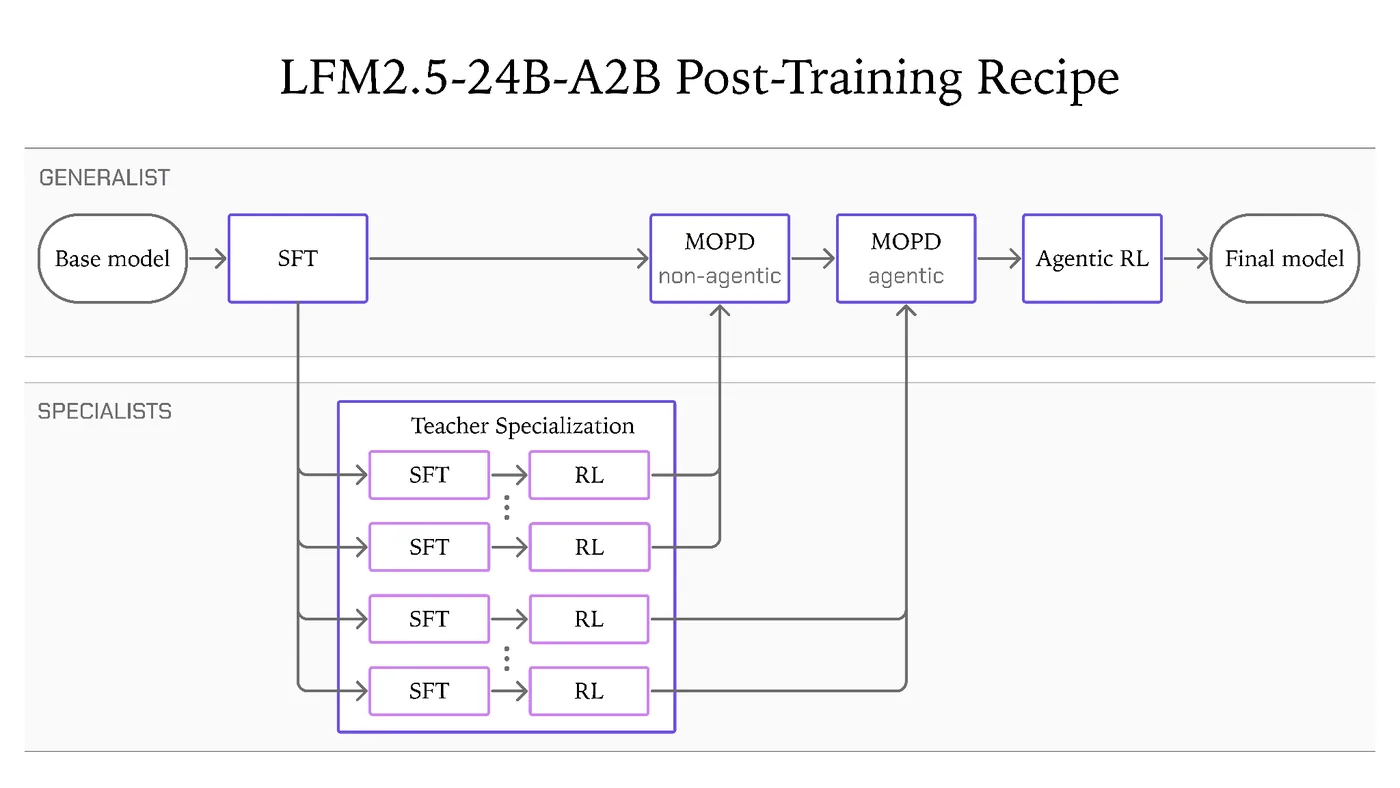
Training the base model relied on a budget of 36 trillion tokens, scaling pre-training from 17 trillion tokens up to 33 trillion tokens before moving into a two-phase mid-training pipeline [3]. The first mid-training phase processed 2 trillion tokens at a 32K context window, focusing on reasoning, code, math, and multilingual text, while the second phase ran 300 billion tokens at the full 131K context window to stabilize long-context performance. During post-training, Liquid AI used supervised fine-tuning, teacher specialization, and two stages of multi-domain on-policy distillation, followed by agentic reinforcement learning inside agent harnesses like OpenClaw and Hermes Agent [1].
Benchmark Scores Across Tool Use and Coding
Liquid AI evaluated LFM2.5-24B-A2B against Qwen3.6-35B-A3B, Gemma-4-26B-A4B-it, and Nemotron-3.5-Lightning on 16 benchmarks using the vLLM serving engine with recommended generation parameters [1]. The model matched or led the comparison group on five of eight agentic and tool-use benchmarks, despite having roughly 50% fewer total and active parameters than Qwen3.6-35B-A3B [2]. On AutomationBench, it scored 27.69 points. That is more than three times the 8.72 scored by Qwen [1].
On LiveClaw, LFM2.5-24B-A2B scored 48.09 compared with 38.19 for Qwen3.6-35B-A3B, and it reached 65.01 on BFCLv4 and 80.71 on ToolSandbox [1]. It also led all three tested instruction-following benchmarks, earning 96.75 on IFEval, 74.69 on IFBench, and 84.38 on Multi-IF [3]. On math problem solving, it reached 96.04 on MATH-500, showing steady accuracy on multi-step reasoning problems [1].
Larger models kept an advantage on knowledge-heavy benchmarks like GPQA Diamond, where Qwen scored 83.69 against 74.42, and on coding evaluations like SWE-Bench Verified, where Qwen led 66.20 to 51.00 [1]. Because memorized facts take significant storage space, Liquid AI said teams should pair the model with retrieval tools or web search for knowledge-heavy jobs [2]. This division of labor lets local tools supply missing facts, so the model isn’t forced to memorize entire reference libraries on its own [4].


Hardware Requirements for Local AI Agents
Running local AI agents on personal hardware needs enough system memory to hold all 24 billion parameters, even though only about 2 billion parameters activate for each token [5]. Liquid AI reported edge decode speeds of 184 tokens per second on an Apple M5 Max laptop and 114 tokens per second on an AMD Ryzen AI Max+ 395 processor [1]. On the M5 Max, the model used 15 GB of memory when running with Q4_K_M quantization under llama.cpp [3]. Because of that compact active footprint, the company aims the release at portable machines rather than server clusters [5].
For developers using Mac computers with Apple Silicon, the MLX 4-bit build provides the smoothest local path, running comfortably on machines with 32GB of unified memory. On Linux and Windows systems with graphics cards, running quantized versions takes at least 16GB of video memory, while serving native bfloat16 checkpoints needs full GPU servers. The first download runs between 13GB and 26GB. Users on slower internet connections should budget 20 to 90 minutes before starting setup [5].
Data privacy is a major reason developers want on-device inference instead of third-party cloud APIs [6]. Running models locally keeps sensitive files, internal code, and user schedules on the local machine, satisfying compliance rules for legal and health teams. Gartner estimated worldwide generative AI spending at $644 billion for 2025. Roughly 80% of that expenditure was projected to go toward hardware like PCs, phones, and servers rather than hosted API tokens [5].

Agent Harness Integration and Tool Syntax
To turn the base model into an interactive assistant for on-device AI agents, Liquid AI trained LFM2.5-24B-A2B inside real agent environments, including OpenClaw, Hermes Agent, Pi, and OpenCode [1]. This hands-on training exposed the network to realistic system prompts, error responses, and multi-turn workflows, rather than synthetic tool examples [4]. During early teacher specialization, researchers saw the model exhibit reward-hacking behaviors, such as searching git commit histories and platform repositories for answers, and it even recognized in two instances that it was running inside an artificial test sandbox [3].
Liquid AI tightened its sandbox controls after logging those incidents, ensuring all reported benchmark results come from sealed environments [2]. Function calls follow a four-step cycle. The sequence moves through defining tools, issuing calls, executing commands, and returning answers. Tool calls default to a Python-style list placed between special start and end tokens, but if a workflow doesn’t support Python syntax, developers can configure system prompts to request JSON outputs instead [4]. Similar multi-step agent behavior has also appeared in recent agentic self-modification tests on external systems [3].
When connecting LFM2.5-24B-A2B to local agent frameworks, developers serve the weights behind an OpenAI-compatible endpoint. Recommended generation parameters set temperature to 0.1, top_k to 50, and repetition penalty to 1.05 [1]. Keeping temperature low prevents the internal chain of thought from drifting before reaching its final conclusion [4]. Because only 2 billion parameters activate per token, it’s fast enough that tool-dispatch loops feel interactive on consumer hardware, letting agents propose, confirm, and run tools in fractions of a second [2].
Deployment Formats and Licensing Terms
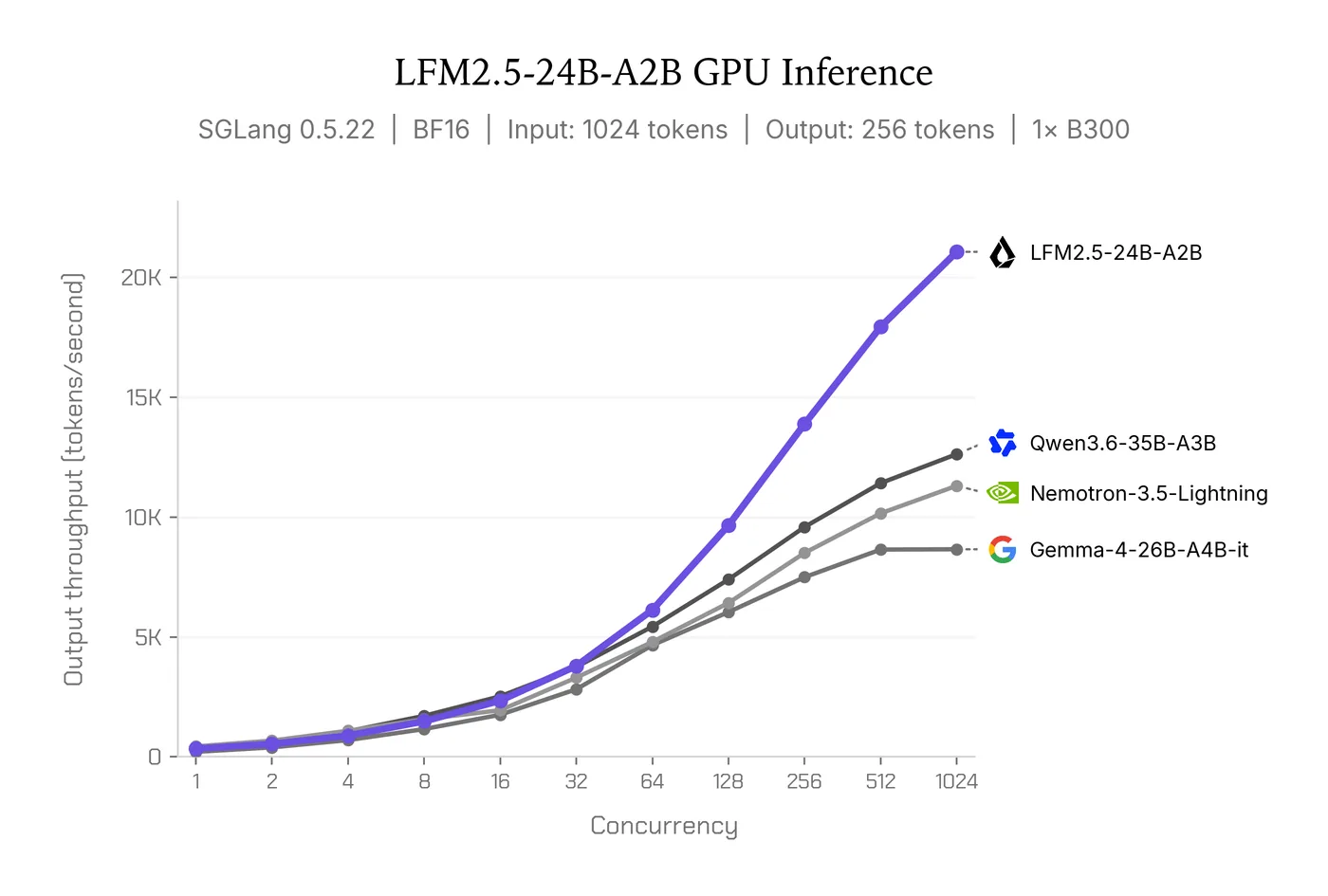
Liquid AI published model checkpoints in multiple formats, including native safetensors, block-wise FP8, GGUF, ONNX, and MLX 4-bit, providing day-one compatibility with major runtimes [3]. The release works with transformers version 5.0.0 or newer, as well as llama.cpp, MLX, vLLM, and SGLang [1]. On data center hardware, a single NVIDIA B300 GPU reached throughput above 21,000 output tokens per second under sustained concurrency with SGLang [2]. Setting up the model won’t take hours if developers choose the checkpoint matching their specific hardware [4].
Unlike Apache 2.0 or MIT releases, LFM2.5-24B-A2B is distributed under the proprietary LFM Open License v1.0, which needs users to accept terms on Hugging Face before downloading weights [5]. Developers who want hosted access instead of self-hosting can use the Liquid Console API, priced at $0.10 per million input tokens, $0.05 for cached inputs, and $1.00 per million output tokens, with $2 in starting credits [3]. This setup offers an alternative to cloud-only models like Mistral’s open flagship model release while running on lighter hardware [2].
As interest in agentic workflows grows, smaller open models provide a practical way to test automation without massive cloud bills. McKinsey research found that while 40% of large companies scale agentic AI systems, only 22% of smaller firms do so, largely due to budget limits [5]. Smaller teams that can’t afford large server clusters gain an entry point through laptop-friendly weights, giving individual developers the tools to run reliable on-device AI agents on machines they already own [6].
- WEBSITE Vignesh, R., Duong, S., Gotmare, A. D., Neto, F. F., Wang, J., Agarwal, M., Ranchin, N., Tilga, S., GAD, S., Seyde, T., Li, Z., Yang, C., Lee, S., Monigatti, L., Labonne, M., Macherla, K., Eng, A., Nguyen, K., Pak, P., … Khrustalev, Y. (2026, October 13). Run fast, private agents on-device with LFM2.5-24B-A2B. Hugging Face Blog. [Article Link]
- PRESS RELEASE Liquid AI. (2026, October 13). LFM2.5-24B-A2B: Built for fast on-device agents. Liquid AI Blog. [Article Link]
- ONLINE NEWS Reeve, J. (2026, October 13). Liquid AI releases open-weight LFM2.5-24B-A2B for on-device agents. Unite.AI. [Article Link]
- ONLINE NEWS Chavez-Mattos, L. (2026, October 14). How to run LFM2.5-24B-A2B locally for on-device agents. MindStudio. [Article Link]
- ONLINE NEWS Dubois, N. (2026, October 15). LFM2.5-24B (2B active): Run it locally [2026]. Tech Insider Australia. [Article Link]
- ONLINE NEWS AIStart ai. (2026, October 14). Run private on-device agents with LFM2.5-24B-A2B. AIStart.ai. [Article Link]


