



Japanese scientists at JAXA are preparing to launch the Martian Moons Exploration spacecraft to collect rock and soil samples from Phobos, the larger of two moons circling Mars. The robotic flight aims to complete the first round trip to the Martian system while uncovering clues about the origin of the solar system and water transport to rocky worlds [1]. Ground teams plan to send MMX into space from the Tanegashima Space Center on Tuesday aboard an H3 rocket [2]. This multi-year effort will test robotic landing gear in low gravity, gather material from multiple surface locations, and return the sealed samples to Earth to help prepare future crewed missions to the Red Planet [3].
Japan’s Martian Moons Exploration Flight Profile
JAXA scheduled the Martian Moons Exploration liftoff for Tuesday at 4:41 a.m. local time (1941 GMT Monday) from the Tanegashima Space Center in Minamitane, Kagoshima prefecture [1]. The MMX spacecraft will ride Japan’s new mainstay H3 rocket into orbit [2]. Makoto Arita, project manager of JAXA’s H3 rocket team, spoke to reporters two days before launch at Tanegashima and said: “Being able to be involved in such a grand mission is incredibly exciting” [1].
The MMX mission is led by JAXA in partnership with NASA, France’s National Centre for Space Studies (CNES), the German Aerospace Center (DLR), and the European Space Agency (ESA). Around 20 universities and tech companies provide hardware and research support [1]. MMX carries 13 instruments, including a NASA pneumatic collection device, a NASA gamma-ray spectrometer, an ESA deep-space communication device, and a JAXA radiation monitor designed to measure exposure for future astronauts traveling to Mars [2].
NASA’s Perseverance rover has already gathered rock cores on Mars, but that return mission was halted after the U.S. Congress voted in January to defund the retrieval program under President Donald Trump. Meanwhile, China’s national space program announced that its Tianwen-3 spacecraft is scheduled for launch around 2028, aiming to bring Martian samples home by 2031. JAXA researchers believe that sand and pebbles gathered from Phobos may offer a broader geological variety than soil taken from Mars alone, particularly if Phobos formed after a giant impact struck the Red Planet [1].
The Martian Gravity Well
Reaching Mars involves crossing a gulf that lies 55 million kilometers (34 million miles) between Earth and Mars at closest approach. Because spacecraft travel along solar orbital transfer arcs, the flight distance from Tanegashima will span between 500 million and 600 million kilometers (310 million to 370 million miles). MMX will cruise through interplanetary space before entering orbit around Mars around August 2027 [1, 2].
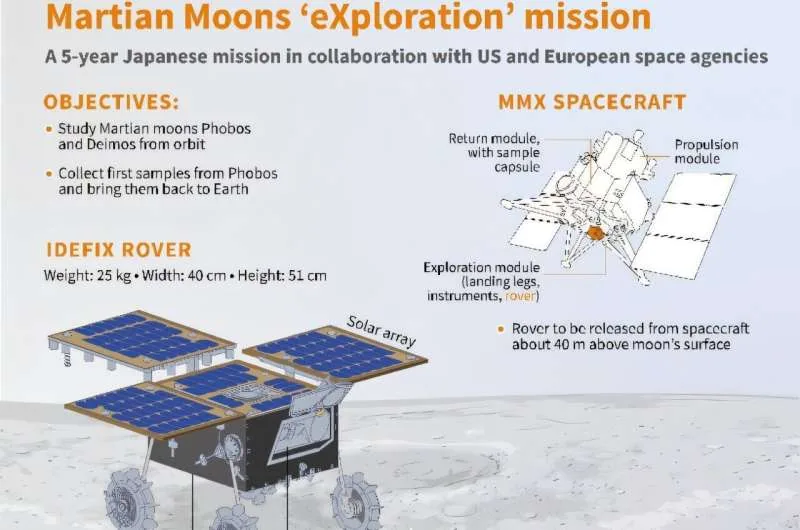
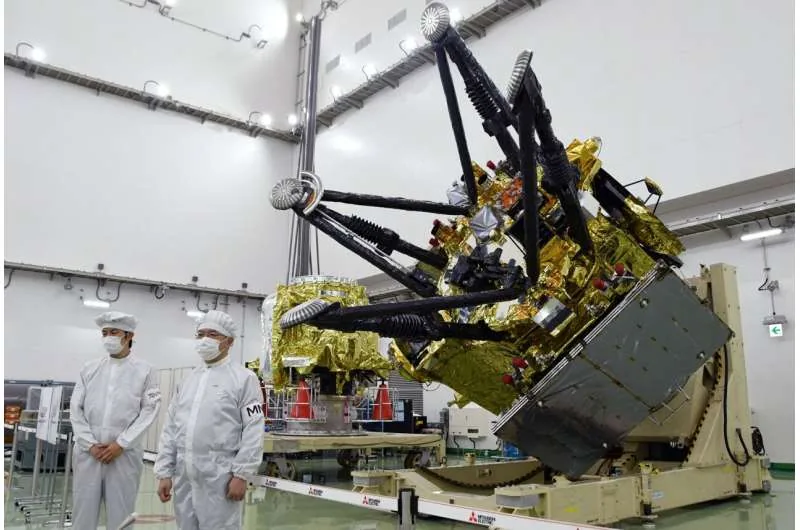
MMX weighs about 5 tons (4.5 metric tons) and consists of three connected modules for propulsion, exploration, and return. Only the return module will travel back to Earth with the collected soil [2]. Phobos orbits roughly 6,000 kilometers, or 3,700 miles, above Mars. MMX project manager Yasuhiro Kawakatsu said that operating near Mars means dealing with intense gravity, saying that entering the “gravity well” is difficult because the vehicle must descend near Mars and still retain sufficient fuel to escape on its journey back home [1].
Landing on Phobos presents unique mechanical hurdles because the small moon has just one two-thousandth of Earth’s gravity [2]. JAXA applied lessons learned from its Smart Lander for Investigating Moon (SLIM), nicknamed the Moon Sniper, which tipped over after touching down on Earth’s moon in 2024 but transmitted data and survived several two-week lunar nights [1]. PerEXP Teamworks previously reported on how engineers developed Mars moon lander for Phobos systems to stabilize uncrewed probes during low-gravity landings. To prevent bouncing upon contact with Phobos regolith, engineers fitted the exploration module with four crushable landing legs with shock absorption features, allowing MMX to rest securely on the cratered terrain and gather samples within a two-hour window [2].
Deploying the Idefix Rover
Before the MMX exploration module attempts its first descent, a small robotic rover named Idefix will touch down on Phobos to survey the surface. Developed jointly by France’s CNES and Germany’s DLR, the rover takes its name from the comic hero Asterix‘s faithful dog [1]. Idefix will explore the moon during a 100-day scouting mission beginning around 2029 [2].
Microgravity makes wheel traction difficult, so Idefix uses specialized treads designed to navigate powdery Martian regolith. JAXA said the rover moves “at a snail’s pace” to keep from losing contact with the ground, and it can right itself automatically if it tips over on steep slopes. Surface data and images sent by Idefix will help JAXA flight controllers in Japan select a relatively smooth and level landing site for subsequent soil sampling by MMX [2].


Surface and Subsurface Sampling Tools
Once MMX lands, mission teams intend to gather no less than 10 grams (0.35 ounces) of surface dust across two touchdowns [1, 2]. The MMX mission combines NASA and JAXA sampling hardware to maximize sample diversity. The NASA pneumatic sampler will release pressurized gas to blow surface dust into a holding canister, while JAXA coring tools will drill roughly 2 centimeters into the subsurface to extract intact regolith cores [2].
During its initial landing, MMX will activate both the pneumatic device and the coring drill to gather both surface and underground samples. MMX will later lift off and make a second landing to take additional subsurface samples from a different location. Taking material from multiple sites on Phobos increases the probability of obtaining diverse materials from different geological eras [2].

Japan has demonstrated sample-return success on past asteroid missions. JAXA’s Hayabusa probe returned asteroid grains to Earth in 2010, and Hayabusa-2 retrieved 5.4 grams (0.19 ounces) of rock and dust from asteroid Ryugu in 2020 [1, 2]. PerEXP Teamworks previously covered how laboratory analysis of asteroid dust from Earth missions uncovered unexpected mineral structures and volatile compounds. All samples from Phobos will be sealed in a heat-protected capsule that will enter Earth’s atmosphere and land in Australia in 2031 before traveling to JAXA curation facilities in Japan [2].
What Martian Moons Exploration Could Reveal
Scientists expect the Martian Moons Exploration mission to clarify how water and organic compounds spread through the inner solar system. Patrick Michel, a French astrophysicist working on the Idefix team at CNES, told AFP: “MMX will shed light on the transport mechanisms that delivered water, volatiles and organic compounds from the outer solar system to the inner rocky planet region—processes that may have played a key role in making these worlds habitable”. Michel said that if the Martian moons are remnants of those early delivery systems, they may hold clues to the origin of life on rocky worlds. Those findings will help scientists understand how habitable environments developed on Mercury, Venus, Earth, and Mars [1].
Crustal material blasted from Mars is projected to constitute roughly 0.1% of the regolith on Phobos. Repeated asteroid collisions with Mars over billions of years blasted planetary rock into space, with some fragments settling on Phobos. JAXA scientists say collecting samples from Phobos increases the chances of finding ancient traces of Martian microbial life or prebiotic chemistry without requiring a complex ascent from Mars’ surface [1, 2].
The voyage also provides critical engineering data for future crewed spaceflight to Mars by the United States, China, and international partners in Europe and Japan [1, 2]. MMX project manager Yasuhiro Kawakatsu said that “despite their potential importance, Martian moons have never been fully investigated,” describing them as “the most important unclimbed mountains in the solar system” [2]. JAXA hopes to evaluate whether Phobos can serve as a natural orbital base, establishing the operational requirements for human round trips to Mars [1].

What Are Martian Moons?
Martian moons are two small, irregular, potato-shaped bodies named Phobos and Deimos that orbit the planet Mars [1, 2]. The pair take their names from the sons of the Greek war god Ares, symbolizing fear and terror. Phobos is the larger moon, measuring about 20 to 30 kilometers (10 to 20 miles) across at its widest point, while Deimos is significantly smaller [2, 3].
Phobos orbits Mars at an altitude of approximately 6,000 kilometers, or 3,700 miles, circling the planet three times every single day [2, 3]. Planetary scientists debate whether the moons formed from debris created when a celestial body collided with Mars, or if they are asteroids captured by Martian gravity [1, 2]. Multiple Russian missions to Phobos failed, including a mission launched in 2011, leaving the origin of both Martian moons unconfirmed [2, 3].
Direct laboratory analysis of pristine samples brought to Earth will finally allow scientists to determine which formation hypothesis is correct [1, 2]. Kiyoshi Kuramoto, the principal investigator for MMX at JAXA, said: “We can almost certainly come to a conclusion by analyzing soil samples”. Because Phobos and Deimos likely share common evolutionary roots, Kuramoto said that analyzing Phobos will also unlock the origin of Deimos and reveal how moons formed around Mars. MMX will also conduct flyby observations of Deimos before returning to Earth, comparing Phobos and Deimos [1, 2].
- ONLINE NEWS Hasegawa, K. (2026, October 18). Japan to launch historic round-trip mission to Mars moon. Phys.org. [Article Link]
- ONLINE NEWS Yamaguchi, M. (2026, October 18). Japan to launch spacecraft on a mission to get samples from a Martian moon. Phys.org. [Article Link]
- ONLINE NEWS Associated Press & Guardian staff. (2026, October 18). Japan to launch world-first mission to collect samples from Martian moon. The Guardian. [Article Link]
APA 7: PerEXP Teamworks. (2026, October 19). JAXA Targets Phobos in Martian Moons Exploration Launch. PerEXP Teamworks.


