






Surrey researcher Rachel Bernasconi adapted mathematical sleep models to track how the human body moves between wakefulness and deep restorative sleep stages during nightly rest cycles [2]. Sleep medicine has often relied on broad group averages, but personal biology regularly breaks standard rules. Bernasconi studied the shapes of known sleep equations to show that custom formulas can forecast bedtime shifts for irregular sleepers across different schedules [1]. Her University of Surrey team showed that these math tools help turn raw clinical data into daily habits, showing that simple changes in light exposure reset the body clock [2].
The Global Toll of Insufficient Sleep
Millions of adults struggle with chronic sleep trouble that ruins daytime mood, memory, and general health across entire communities. A systematic review in Sleep Medicine Reviews by Benjafield and co-authors examined 18 general population studies covering 262,582 participants across global cohorts to gauge the true toll of sleep loss. The Benjafield team calculated that 852,325,091 adults live with clinical insomnia. Based on United Nations demographic records, that total represents 16.2 percent of the global adult population, with another 414,967,941 people suffering from severe insomnia across international cohorts [3]. Chronic sleeplessness affects hundreds of millions of households across the globe.
Poor rest harms more than morning mood; it threatens long-term physical health. In Healthcare, Chattu and co-authors showed that chronic sleep loss raises the risk of heart disease, diabetes mellitus, and obesity while dulling mental reaction times during daytime tasks. These cognitive deficits lead to higher rates of vehicular crashes and workplace injuries, while late-night smartphone habits worsen sleep deprivation by suppressing the natural nocturnal signals that prompt evening rest. Doctors rarely screen for sleep loss during routine checkups [4].
Foundational Mathematical Sleep Models in Clinical Research
Surrey scientists have used mathematical sleep models for decades to untangle the hidden biology of human rest [1]. Instead of treating sleep as an erratic state, mathematicians build formulas that track physiological variables over 24-hour cycles. In Medical Xpress, Bernasconi said that these formulas provide a virtual playground where researchers can “simulate different sleep patterns and predict what sort of things might make sleep better or worse”. By testing sleep within computer models, research teams test clinical ideas without locking volunteers in dark basement labs [2].
The foundation of modern sleep timing rests on the two-process model published in 1984 by Daan, Beersma, and Borbely. Their framework explains that human sleep depends on two interacting drivers: a homeostatic sleep pressure, called Process S, and a 24-hour body clock rhythm, called Process C. Process S accumulates steadily during waking hours and clears during sleep, but Process C rises and falls according to rhythmic signals from a single brain pacemaker located in the hypothalamus, causing the crossing points of these two curves to decide when a person feels sleepy and how long rest will last. This dual model remains fundamental [5].
In 1975, McCarley and Hobson published an influential paper in Science using Lotka-Volterra equations to track how reciprocal interactions between pontine gigantocellular field cells and locus coeruleus neurons trigger switches between rapid eye movement (REM) dreaming and non-REM deep sleep. Their model reproduced cellular predator-prey rhythms [6]. In 2016, Klerman and Landrigan applied these math formulas in BMC Medical Education to test hospital work shifts, showing that long shifts harm doctor alertness [7].
Why Generic Advice Fails for Irregular Sleepers
Store-bought sleep rings, digital phone apps, and popular health blogs often give uniform rules, telling everyone to sleep eight hours on an identical schedule regardless of personal chronotype. But why does generic sleep advice fail when applied to irregular sleepers? Real human bodies run on different internal clocks that standard tips ignore. Early birds wake up fresh at dawn, but night owls struggle with morning work alarms because their body clocks run late. When generic guides treat these hardwired traits as lazy habits, they overlook the genuine biology that sets human sleep times [1].
Standard formulas fail to capture overnight sleep stages. In a healthy adult, non-REM deep sleep fills the early hours and REM dream stages grow longer toward morning, but this balanced progression breaks down in older adults and vanishes completely in patients with chronic insomnia. To see how quiet rest protects brain function, readers can discover how wakeful rest stabilizes fragile memories during daytime pauses. Without personal mathematical tuning, basic equations cannot explain why one sleeper awakens naturally at dawn while another lies awake until 3 a.m. [8].

Mathematical Sleep Models for Personal Sleep Patterns
Surrey researcher Rachel Bernasconi tackled these shortcomings in her doctoral thesis at the University of Surrey [8]. She worked with Skeldon and Surrey co-authors who published the Homeostatic-Circadian-Light (HCL) model in PLOS Computational Biology, examining the basic geometry of sleep equations [9]. Standard equations worked well for an average person, but they could not track people with extreme sleep schedules. Bernasconi wanted to find whether the building blocks of classic models could be rebuilt to fit real human diversity [8].
To test existing tools, Bernasconi applied coupled oscillator theory and geometric singular perturbation theory to inspect their dynamic foundations. When she inspected the two-process formulation, she found that its mathematical core was already flexible enough to handle different sleep habits. By analyzing Arnold tongues within the equations, her Surrey study proved that the model can simulate extreme night owls and early larks simply by shifting light response and clock period settings [8]. That finding confirmed that personal bedtimes come from tuning known parameters rather than inventing new biology. Applied mathematics showed that existing model equations could describe diverse human schedules.
The McCarley-Hobson framework proved harder to adapt for individual sleepers. In its early form, the Lotka-Volterra equations could not recreate how non-REM stages rule the early night as REM episodes lengthen before wake-up. Bernasconi rearranged the model’s geometric components to let sleep stages shift smoothly over time [8]. That modification gave the math enough flexibility to mimic real sleep architecture across the night.

The Shift Between REM and Non-REM Sleep
Doctors need to understand how the brain cycles through sleep stages to treat chronic insomnia. During REM dreaming, brain waves speed up and body muscles become limp and still. Readers curious about nighttime paralysis and REM motor inhibition can explore what is REM sleep and why the body paralyzes itself during normal nocturnal transitions. When sleep disorders break this natural cycle, people wake up feeling exhausted even after a full night in bed.
In her Surrey thesis, Bernasconi showed that mathematical sleep models must account for how REM episodes lengthen as morning nears. In healthy adults, the opening REM period lasts only a few minutes, but later episodes stretch out during the final third of the night. By adjusting parameters that control brainstem cell interactions, Bernasconi built simulations where REM episodes grow longer across the sleep window [8]. These updated equations give doctors a clear mathematical tool to analyze sleep disorders that fragment nighttime rest.
Her sleep modeling project won the Editor’s Choice award in the 2026 Three Minute Thesis contest run by Vitae and sponsored by The Conversation UK. The event honors researchers who explain complex mathematics in clear, engaging language. Bernasconi proved that mathematical sleep models can capture delicate personal variations that doctors usually miss. Her Surrey research offers clinics a solid math foundation to test sleep therapies on computers before trying them on patients [1].
Digital Simulation Tools for Daily Rest
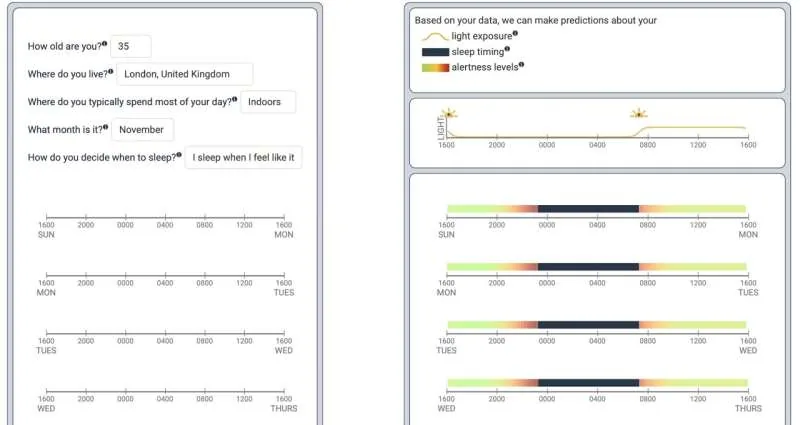
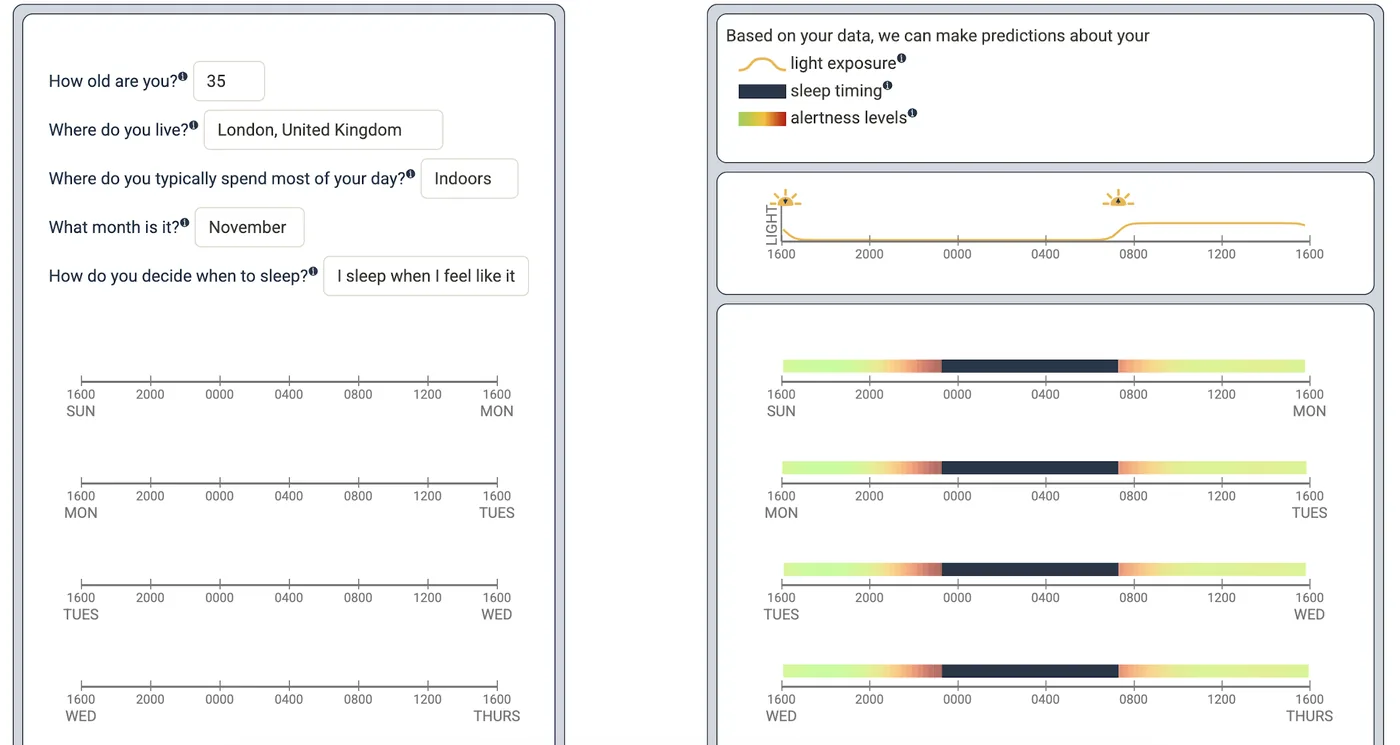
The University of Surrey team built on these mathematical advances to create interactive digital tools that simulate human sleep patterns on personal computers using weekly wearable data. These apps let people enter weekly light levels and sleep logs gathered from consumer smartwatches. By matching personal data with math formulas, the Surrey software graphs an individual’s circadian rhythm and sleep debt [2]. Users can test schedule tweaks in the simulator before making changes in real life, finding routines that protect rest [1].
The computer simulations show that small daily habits often produce major gains in sleep quality. In many model tests, getting a short blast of morning sunlight gives the body clock the exact push it needs to shift earlier [1]. Sunlight serves as the main time cue that aligns the brain’s internal clock with the 24-hour day. For tired workers and night owls, planned morning light helps reset bedtime without sleeping pills or prescription drugs [2].
Personal math modeling turns sleep science from looking back at poor sleep into planning for restful nights. Ordinary trackers merely count tossing and turning, but predictive formulas forecast how tonight’s sleep will react to work shifts and daylight. In The Conversation, Bernasconi said that “my research showed that it is possible to make models that predict some of the key, finer details of sleep—the kind of details that vary from person to person” [1]. As the Surrey team rolls out its online Visualisation Tools, custom equations will help millions of sleepers turn restful nights into daily reality [2]. Digital modeling makes restful nights attainable.
- ONLINE NEWS Bernasconi, R. (2026). Dreaming of better sleep? Personalised mathematical modelling may help turn that dream into reality. The Conversation. [Article Link]
- ONLINE NEWS Bernasconi, R. (2026). Dreaming of better sleep? Personalized mathematical modeling may help turn that dream into reality. Medical Xpress. [Article Link]
- ACADEMIC JOURNAL Benjafield, A. V., Sert Kuniyoshi, F. H., Malhotra, A., Martin, J. L., Morin, C. M., Maurer, L. F., Cistulli, P. A., Pépin, J., & Wickwire, E. M. (2025). Estimation of the global prevalence and burden of insomnia: a systematic literature review-based analysis. Sleep Medicine Reviews, 82, 102121. [Article Link]
- ACADEMIC JOURNAL Chattu, V. K., Manzar, M. D., Kumary, S., Burman, D., Spence, D. W., & Pandi-Perumal, S. R. (2018). The Global Problem of Insufficient Sleep and Its Serious Public Health Implications. Healthcare, 7(1), 1. [Article Link]
- ACADEMIC JOURNAL Daan, S., Beersma, D. G., & Borbely, A. A. (1984). Timing of human sleep: recovery process gated by a circadian pacemaker. American Journal of Physiology-Regulatory, Integrative and Comparative Physiology, 246(2), R161-R183. [Article Link]
- ACADEMIC JOURNAL McCarley, R., & Hobson, J. (1975). Neuronal excitability modulation over the sleep cycle: a structural and mathematical model. Science, 189(4196), 58-60. [Article Link]
- ACADEMIC JOURNAL Klerman, E. B., Beckett, S. A., & Landrigan, C. P. (2016). Applying mathematical models to predict resident physician performance and alertness on traditional and novel work schedules. BMC Medical Education, 16(1). [Article Link]
- THESIS Bernasconi, R. (2026). A functional anatomy of sleep/wake modelling. University of Surrey Open Research repository. [Article Link]
- ACADEMIC JOURNAL Skeldon, A. C., Rodriguez Garcia, T., Cleator, S. F., della Monica, C., Ravindran, K. K. G., Revell, V. L., & Dijk, D. (2023). Method to determine whether sleep phenotypes are driven by endogenous circadian rhythms or environmental light by combining longitudinal data and personalised mathematical models. PLOS Computational Biology, 19(12), e1011743. [Article Link]
APA 7: PerEXP Teamworks. (2026, November 28). Rachel Bernasconi Uses Mathematical Sleep Models to Tailor Rest. PerEXP Teamworks. https://perexpteamworks.com/en/mathematical-sleep-models-tailor-rest/


