





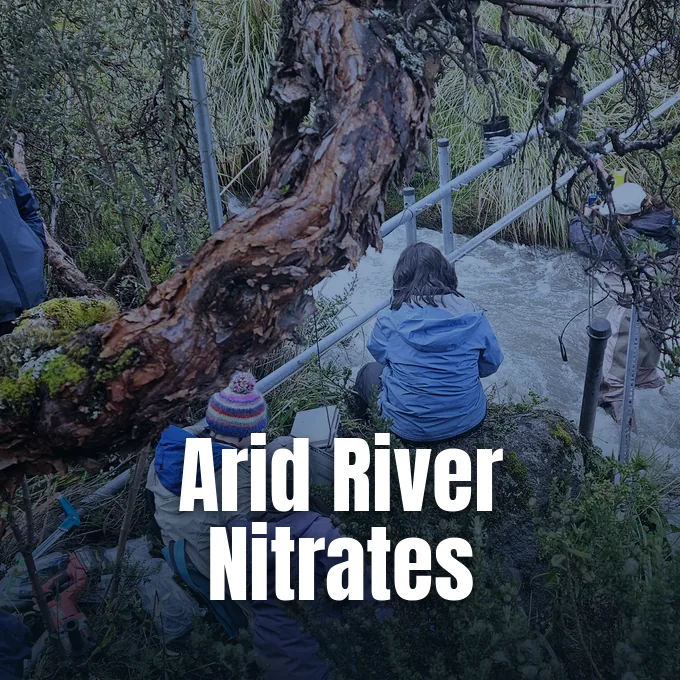
Water pollution from nitrogen compounds is widely treated as a direct signature of human farming and urban sewage, but hot weather patterns can drive chemical buildup without municipal runoff. In a global study published in Science, researchers led by postdoctoral scholar Kayalvizhi Sadayappan and professor Li Li at Pennsylvania State University showed that climate aridity systematically elevates river nitrate pollution in remote landscapes. The team combined water records from more than 7,000 river sites with machine learning models to map nitrate concentrations across nearly 2.9 million river segments worldwide. In arid basins, sparse rainfall is too low to flush naturally occurring soil minerals into larger drainage networks [1]. As a result, unmanaged dry waterways allow dissolved nitrogen to accumulate over decades.
Aridity as a Driver of River Nitrate Pollution
Environmental managers usually associate elevated nitrogen with agricultural fertilizers and urban wastewater discharge. Soil microbes naturally break down organic matter and release nitrate into shallow groundwater across all terrestrial ecosystems. In humid regions, frequent rainfall dilutes these compounds and washes them quickly through river networks before toxic concentrations develop [2]. Severe aridity disrupts that natural flushing mechanism.
Without sufficient precipitation to flush the soil, nitrate builds up over years and concentrates in nearby stream channels. This dynamic creates unexpected pollution hotspots in regions with almost no farming or urban development, including the Rocky Mountains of the western United States and northern Africa’s Sahara Desert. Despite having sparse human populations, the Sahara showed river nitrate pollution levels comparable to or higher than humid river basins in Southeast Asia that support intensive agriculture. Naturally occurring nitrate simply accumulates because water movement is too limited to export dissolved chemicals to the ocean. “Human inputs still have the biggest impact, but nitrate levels are elevated even in some of the world’s most remote regions, particularly in small headwater streams that flow only seasonally,” Sadayappan said [3].

Machine Learning Reconstructs Global Watersheds
Routine chemical monitoring remains rare because physical river sensors are expensive to install and maintain. To overcome widespread data gaps, the Penn State team trained artificial intelligence models to predict water quality across unmonitored river networks. The researchers compiled millions of historical measurements taken from more than 7,000 river monitoring stations worldwide [3]. Field sampling provided the training foundation.
For each river segment, the scientists extracted 26 landscape features, including average annual precipitation, mean temperature, soil characteristics, and nearby land-use patterns. They built roughly 1,000 machine learning models, training each version on a different subset of data while withholding remaining records to evaluate predictive accuracy against real observations. This approach enabled the team to reconstruct long-term average nitrate concentrations across nearly 2.9 million river segments around the world [1]. The resulting global map revealed severe geographic imbalances in environmental monitoring resources. While temperate basins in North America and Europe possess dense water sensor networks, arid regions such as North Africa feature almost no ground stations, which makes predictive modeling indispensable for identifying hidden water quality hazards in remote landscapes [3].
Health Thresholds and Drinking Water Exposure
The global reconstruction shows that nitrate concentrations exceed ecological thresholds across approximately 33 percent of global land area. That ecological exceedance affects roughly 5.6 billion people, or 73 percent of the global population, mainly by feeding toxic algae blooms that deplete dissolved oxygen and disrupt freshwater ecosystems. In addition, river nitrate levels exceed human health thresholds across roughly 2 percent of global land area, placing about 480 million people near waterways with elevated nitrogen concentrations [1]. Roughly half of that health threshold exceedance occurs in middle-income countries and sparsely settled landscapes where routine water monitoring is rare. Populations in these dry regions face chemical hazards without municipal testing.
In the United States, federal drinking water rules enforce a regulatory ceiling of 10 milligrams of nitrate-nitrogen per liter (mg/L). Enacted during the 1970s, this standard guards against methemoglobinemia, or blue baby syndrome, a fatal disorder that stops blood from transporting oxygen. About 37,000 people live near rivers exceeding that limit, concentrated in the Midwestern Corn Belt from Nebraska to Ohio [3].

Between 2021 and 2023, approximately 18 percent of the U.S. population was exposed to drinking water influenced by elevated river nitrate pollution. Medical evidence indicates that slower, chronic illnesses develop at exposure levels well below the 10 mg/L legal standard. In Public Health, Mendy and Thorne linked long-term consumption of drinking water with lower nitrate concentrations to elevated cancer mortality in American communities [5]. Writing in the Journal of Environmental Economics and Management, Sorensen Montoya found that lower nitrate concentrations also correlate with adverse birth outcomes, including preterm births and low birth weight [6]. These maternal and infant health hazards mirror broader climate change nutrition risks that threaten vulnerable families.

Why Small Headwater Streams Accumulate Nitrogen
Most waterways identified with high nitrogen concentrations are small upland headwater streams rather than large navigable rivers. Headwater streams make up the vast majority of total channel length in global river networks. Despite their abundance, these minor upland channels are rarely sampled by national environmental protection agencies [2]. Their small size conceals substantial chemical risk.
A global investigation in Nature Water led by Botter, Barone, and Durighetto demonstrated that non-perennial channels account for more than 70 percent of the global river network when small headwaters are fully included. Even across relatively humid territories like Italy and the eastern United States, non-perennial streams represent over 50 percent of total drainage channels. During dry summer months, flow in these upland channels ceases completely, leaving shallow stagnant pools where natural nitrates concentrate without dilution. When autumn rains arrive, that accumulated chemical load flushes downstream into major rivers that provide drinking water for urban utilities. Upland headwaters dictate chemical conditions throughout the entire river basin, making headwater protection indispensable for downstream populations [4].
Tracking River Nitrate Pollution in Arid Regions
Predicted concentrations in river channels do not always match what flows from domestic faucets because municipal water utilities often blend raw river water with other sources before delivery. In sparsely settled arid basins, however, many rural residents rely entirely on private domestic wells rather than municipal piped water systems. These rural wells draw groundwater directly from shallow aquifers that exchange water with nearby streams, allowing contaminants to seep into household drinking supplies without detection [2]. Standard water treatment facilities remove suspended dirt and microbial pathogens, but conventional filtration does not eliminate dissolved nitrate. Removing nitrate requires advanced ion exchange or reverse osmosis systems that are expensive to build and operate in sparsely populated desert settlements [1].
Arid regions experience compounding environmental stresses as shifting weather patterns alter regional freshwater supplies. These dry landscapes face ecological disruptions similar to atmospheric shifts observed when wildfire smoke changes as it drifts over arid western river basins. Understanding true human exposure requires testing drinking water directly at household taps in remote communities [1].

Monitoring Remote Basins in a Warming World
Projected global warming is expected to expand drylands and intensify aridification across temperate and tropical continents. Under hotter and drier climates, river nitrate levels could rise even if human societies do not apply additional synthetic fertilizers to surrounding soils. “Right now, roughly a half-billion people are living in proximity to rivers where nitrate concentrations exceed levels that can potentially lead to negative health effects,” said Li, the Barry and Shirley Isett professor of environmental engineering at Penn State. Li explained that climate aridity transforms nitrate pollution from a local agricultural problem into an international environmental challenge. “This finding implies that nitrate pollution is beyond a local management issue: It’s a broader problem directly related to climate, which is becoming increasingly hotter and drier,” Li said [3].
Recognizing water quality degradation remains difficult because chemical contamination does not produce visible landscape destruction like floods or severe droughts. Dissolved nitrate leaves stream water looking clear and harmless. “There’s a lot of discussion about floods and droughts because their impacts are easier to see, but it can be difficult to notice water quality issues because you can’t visually observe the issues until they get really, really bad,” Li said [3].
- ACADEMIC JOURNAL Sadayappan, K., & Li, L. (2026). Climate aridity amplifies global riverine nitrate beyond human inputs. Science, 394(6825), 773-778. [Article Link]
- ONLINE NEWS Li, L. (2026, November 12). Far from farms and cities, dry climates are boosting river nitrate pollution. The Conversation. [Article Link]
- ONLINE NEWS Pennsylvania State University. (2026, November 12). Nitrate pollution in rivers linked to dry climates, not just human activity. Phys.org. [Article Link]
- ACADEMIC JOURNAL Botter, G., Barone, F., & Durighetto, N. (2026). Headwater streams control the non-perennial fraction of the global river network. Nature Water, 4(1), 25-35. [Article Link]
- ACADEMIC JOURNAL Mendy, A., & Thorne, P. S. (2024). Long-term cancer and overall mortality associated with drinking water nitrate in the United States. Public Health, 228, 82-84. [Article Link]
- ACADEMIC JOURNAL Sorensen Montoya, E. (2025). Birth outcome effects of nitrate contamination in drinking water. Journal of Environmental Economics and Management, 133, 103197. [Article Link]
APA 7: PerEXP Teamworks. (2026, November 13). Dry Climates Elevate River Nitrate Pollution in Remote Basins. PerEXP Teamworks. https://perexpteamworks.com/en/river-nitrate-pollution-dry-climates/


