





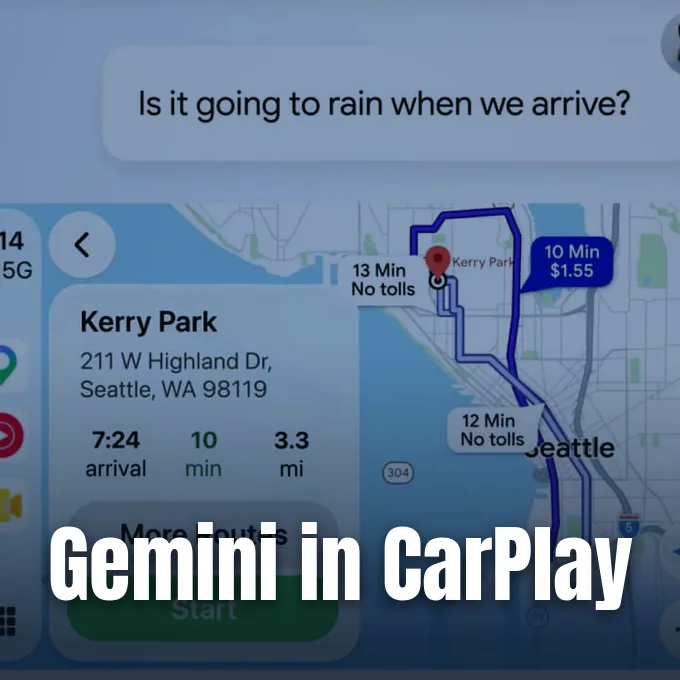
Google rolled out conversational Gemini navigation to Google Maps on Apple CarPlay, giving drivers in the United States hands-free voice assistance during active trips [1]. The update introduces Gemini CarPlay navigation to Apple infotainment dashboards nearly twelve months after similar tools arrived on Android Auto [2]. Drivers can tap a new icon to ask multi-step questions about routes, check destination weather, and report traffic incidents without handling their phones [1].
Using Gemini CarPlay Navigation on the Road
During navigation, users interact with the assistant by tapping a Gemini icon placed on the right edge of the infotainment screen, opening a direct conversational voice session with Google Maps. Drivers can ask: “What park is famous for gorgeous views overlooking the city?”. Once the assistant suggests a destination, motorists can inquire whether now is a good time to go so that traffic stays light and weather remains clear. A driver can then say: “Start navigating me there but make sure to avoid toll roads” [1]. The system processes these compound requests without requiring touchscreen taps as cars move on busy roadways [3].
This is the first time that Google Maps provides integrated voice assistant functionality through the CarPlay interface. In earlier software builds, voice commands in Google Maps worked only directly through the iPhone handset itself, but CarPlay relied on Siri for basic hands-free interactions [1, 7]. Google stated that conversational navigation features are currently active for drivers across the United States, allowing users to report sudden traffic disruptions and unexpected road hazards along their journey through spoken voice commands. The global rollout is underway. Google introduced these conversational tools on Android and iOS last year [1].
Can drivers bypass manual searches when handling complex route changes on highway journeys? The software interprets compound voice requests, letting motorists find alternate paths, locate places to refuel, or gather suggestions regarding extra stops along their scheduled itinerary [3]. Google also added visual guidance tweaks in recent map updates, displaying stop signs and traffic lights before upcoming turns on automotive screens [1].

How Drivers Activate Gemini on Screen
Accessing the tool requires an active route within Google Maps on a compatible vehicle infotainment display. When navigation begins, the Gemini icon appears along the right display border, waiting for a driver to touch it before the system begins listening for spoken driving instructions [1]. The assistant processes voice commands to find alternate paths or suggest stops along the active trip [3]. Motorists can also ask what the weather will be like at their destination when they arrive [5].
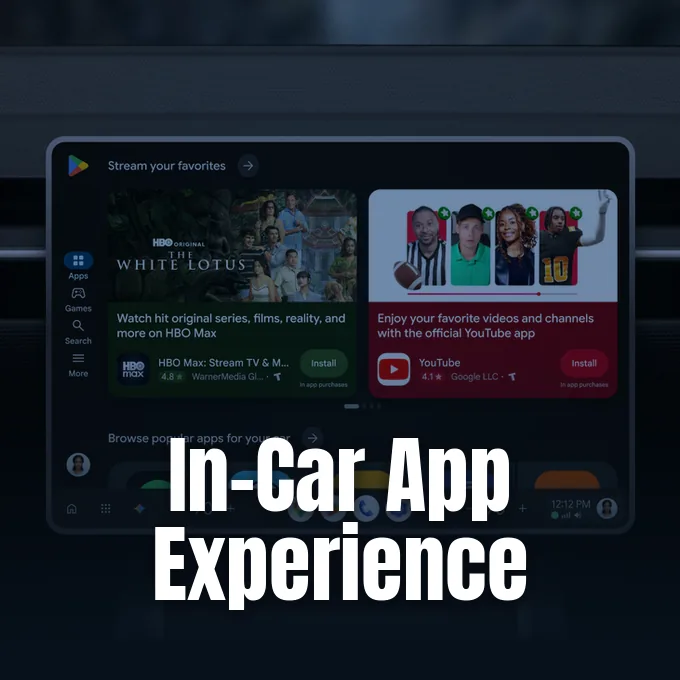
Reaching the right screen edge poses physical usability challenges on wider car displays. Some drivers reported having to lean uncomfortably away from the steering wheel just to tap the assistant icon during highway trips. Google previously revamped its automotive software ecosystem when Google overhauled in-car app experiences for auto partners, tailoring dashboard applications for connected vehicles. Bringing Gemini to CarPlay establishes parity with Apple Maps [1].
The voice interface focuses on driving tasks rather than open web searches [2]. By limiting interactions to route advice, fuel stops, and incident reports, the system keeps motorists focused on road conditions [3]. Google confirmed that global users will receive access as the global rollout expands in coming months [2].


Personal Intelligence Gap on Apple Displays
CarPlay gained conversational navigation, but it didn’t receive the Personal Intelligence features that Google announced for Android Auto. On Android Auto and vehicles with Google built-in, Personal Intelligence connects the assistant to private user data stored in Gmail, Google Calendar, Google Maps, Google Photos, YouTube, and Search [2]. The feature allows Android drivers to ask for restaurant recommendations based on saved location lists and scheduled meeting locations found directly within their personal digital calendars. For example, a driver can ask: “I have a list of restaurants I’ve been meaning to try. What’s the best spot for after my meetings today?” [4]. CarPlay lacks this personal data integration [2].
Google hasn’t confirmed whether Personal Intelligence will reach Apple CarPlay [2]. The company offers Personal Intelligence settings on the web, letting users link services such as Google Flights, Hotels, and Shopping to the assistant. Meanwhile, Google notified AI Ultra subscribers that the new Gemini 4 Argon model will soon replace Deep Think in the Gemini 3.1 Pro tier. That brief in-app notice didn’t clarify whether Deep Think is ending because Gemini 3.1 Pro is retiring or because the specialized reasoning mode is being phased out [4].
The absence of personal data links leaves Gemini CarPlay navigation focused on immediate geographic data. Drivers can interact with map information, live road hazards, and place listings without connecting their private inbox or photo libraries to the vehicle console [2]. For privacy-minded motorists, this functional separation keeps vehicle navigation straightforward [3].

Connecting Gemini CarPlay Navigation to Mapping Roots
Google Maps began in Australia (Sydney) as a C++ program developed by Danish brothers Lars and Jens Rasmussen, Noel Gordon, and Stephen Ma at Where 2 Technologies. Google acquired Where 2 Technologies in October 2004, converting the desktop code into a web application. In that same month, Google acquired Keyhole, whose Earth Viewer software became Google Earth, after buying traffic analyzer ZipDash in September 2004 to strengthen route analysis. Google launched the web application on February 8, 2005 [6].
Mobile versions arrived in 2006 after engineer Sanjay Mavinkurve created a method that lowered palette colors for map graphics, cutting download times by 20 percent on early handsets. By 2013, Google Maps was the world’s most popular smartphone app, used by more than 54 percent of global phone owners. Android user counts topped two billion users in 2017. By 2020, monthly active users surpassed one billion worldwide [6].
The arrival of Gemini CarPlay navigation connects mapping history with modern artificial intelligence. Google announced the Gemini model family on December 6, 2023, with Sundar Pichai and Demis Hassabis presenting Gemini 1.0 as the successor to LaMDA and PaLM 2. Developed by merged teams from DeepMind and Google Brain, the models draw their name from NASA’s Project Gemini and the Latin word for twins [8].
Demis Hassabis pointed to how DeepMind’s AlphaGo defeated Go champion Lee Sedol in 2016, noting that Gemini would build on that legacy. Alphabet co-founder Sergey Brin returned to assist hundreds of engineers during development. Gemini was designed to process text, audio, images, and computer code simultaneously, creating the multimodal foundation that now powers conversational navigation on vehicle infotainment screens [2, 8].
Evolution of Phone Mirroring Standards
Apple introduced CarPlay for iPhone 5 and later models running iOS 7.1, establishing an automotive mirroring standard supported today by more than 800 vehicle models. Integration roots date back to 2008, when Mercedes vehicles first sold audio systems incorporating iPod and iPhone connectivity through Harman Kardon NTG 2.5 hardware. Modern CarPlay systems run software on the connected iPhone and project visual interfaces to automotive head units through wired USB links or wireless Wi-Fi connections. Phone hardware handles the computing [7].
Apple requires third-party developers to obtain explicit permission before publishing CarPlay apps, organizing approved software into distinct categories such as audio streaming, messaging, and turn-by-turn navigation guidance. Automakers continue balancing tech partnerships with proprietary dashboard interfaces, as seen when the GM CarPlay update reshaped Silverado and Sierra pickup trucks. Apple also announced CarPlay Ultra on the Aston Martin DBX707 in May 2025, showing ongoing efforts to deepen software ties with vehicle instrument clusters on premium luxury models. Developers must follow strict guidelines [7].
Navigation apps on CarPlay must adhere to driver safety rules that restrict visual complexity when vehicles are in gear. By bringing Gemini conversational tools into CarPlay, Google gives motorists an alternative voice assistant that handles multi-step route requests without requiring any physical interaction with their mobile phones [1, 7]. The update expands modern artificial intelligence tools to millions of drivers who rely on Google Maps in Apple vehicle environments [1, 2]. Hands-free voice replaces screen taps [1].
- ONLINE NEWS Li, A. (2026, October 21). Google Maps on CarPlay rolling out Gemini when navigating. 9to5Google. [Article Link]
- ONLINE NEWS Weatherbed, J. (2026, October 21). Conversational Gemini navigation comes to Apple CarPlay. The Verge. [Article Link]
- ONLINE NEWS Android Authority. (2026, October 21). Now even CarPlay users can talk to Gemini during Google Maps navigation. Android Authority. [Article Link]
- ONLINE NEWS Li, A. (2026, October 22). Gemini app expands Google Maps Personal Intelligence, replacing Deep Think. 9to5Google. [Article Link]
- ONLINE NEWS AppleInsider. (2026, October 21). Google Maps now lets you ask Gemini for help on the road with CarPlay. AppleInsider. [Article Link]
- WEBSITE Wikipedia contributors. (2026). Google Maps. Wikipedia, The Free Encyclopedia. [Article Link]
- WEBSITE Wikipedia contributors. (2026). CarPlay. Wikipedia, The Free Encyclopedia. [Article Link]
- WEBSITE Wikipedia contributors. (2026). Gemini (language model). Wikipedia, The Free Encyclopedia. [Article Link]


