



When planetary scientists prepare to track fast-moving asteroids across the night sky, which ground-based observatories provide the necessary infrared acuity? The answer centers on the NASA Infrared Telescope Facility (an optical and infrared observatory dedicated to planetary and astronomical research). Solicitations for NASA IRTF proposals covering observing semester 2027A officially opened on September 1, 2026, under solicitation number NN2027AOBSERV_IRTF announced by the Cosmic Origins Team at NASA Science. The proposal deadline is Thursday, October 1, 2026, at 5:00 PM Hawaii Standard Time. [1, 2]
NASA IRTF Proposals and Semester 2027A Deadlines
Observing semester 2027A spans six months from February 1, 2027, through July 31, 2027. Astronomers submitting NASA IRTF proposals access an online application form hosted by the Hawaii Institute for Astronomy at the University of Hawaiʻi. The web portal for the Proposal Form opened at midnight on September 1, 2026, and accepts applications until 5:00 PM Hawaii Standard Time on October 1, 2026, with an automatic grace period of 15 minutes before the submission system shuts down entirely. Investigators must click the final submission button for every session. Unsubmitted sessions remain incomplete. [4, 7]
Official confirmation emails arrive approximately one week after the deadline. What happens if this verification message fails to reach the principal investigator? The facility advises teams to contact support staff immediately to prevent accidental exclusion from scientific review. Applicants submitting multiple projects can generate a unique Session Code to edit distinct files. Technical questions regarding submission guidelines can be addressed directly to Warren Skidmore. Proposals require an extended abstract of up to 300 words that concisely articulates the big science picture and technical justifications for preservation in the public archive. [1, 4, 7]
Strict page limits govern all proposal documentation. Each submission permits one page for scientific justification, another page outlining technical execution, and a single page dedicated to charts or tables. Grant Meridian highlights that the opportunity actively supports cross-disciplinary research and innovation, confirming that global eligible researchers across international institutions may apply through standard submission pathways. Deadlines remain firm. [4, 5]

Mauna Kea Facility Capabilities and Elevation
The High-Performance Infrared Observatory operates from an exceptional geographic vantage point. Stationed near the summit of Mauna Kea at an elevation of approximately 13,600 feet, the specialized 3.2-meter telescope takes full advantage of dry Pacific skies, sharp astronomical seeing, minimal water vapor, and suppressed thermal background noise to deliver premier observational data. These environmental conditions make the Mauna Kea summit ideal for ground-based infrared astronomy. The facility delivers spectroscopic observing capabilities covering wavelengths from 0.4 microns in the optical regime to 25 microns in the thermal infrared for NASA Science investigators. [2, 3, 4]
Spectral resolving power spans from reconnaissance at resolving power 50 up to cross-dispersion modes reaching 85,000. For moving bodies, the mount control system utilizes automated non-sidereal tracking to follow rapid near-Earth asteroids and Solar System comets across wide sky trajectories. The telescope tracks targets reliably. An auxiliary wide-field optical camera simultaneously tracks brightness variations while confirming target positions during transient science campaigns for NASA Science observers. [2, 3]
Observatory scheduling distributes nighttime allocations evenly between planetary science and celestial targets outside the solar system, setting aside 18 nights each semester for engineering calibration. This balanced allocation ensures that galactic and extragalactic astronomers share observing time with planetary researchers across global astronomical networks. Ground infrastructure complements NASA Cosmic Origins planning for future space observatories by conducting preparatory target characterization from the ground. Teams submitting NASA IRTF proposals can request target-of-opportunity status for urgent investigations. [1, 2, 4]
Core Spectrometers: SpeX, MORIS, and iSHELL
SpeX serves as the workhorse medium-resolution spectrograph and imager across 0.7 to 5.3 microns with resolving powers between 50 and 2,500. The instrument employs selectable 0.7 and 0.9 micron dichroics that direct optical light toward the guiding camera. Instrument scientist Mike Connelley recommends that observers acquire at least three nodded pairs of integrations even when measuring bright targets to subtract random radioactive decays and determine true spectral slopes. A background software routine performs immediate spectral extraction, rendering quick-look results directly on observatory screens. [4]
Optical guiding relies on MORIS (an optical Andor CCD camera featuring a 512×512 pixel array attached to the side-facing port of the SpeX cryostat with a 60-arcsecond field of view). Guiding in the optical regime significantly improves spectral sensitivity by more than one full astronomical magnitude compared to infrared guiding by minimizing slit losses. High-precision spectroscopic inquiries utilize iSHELL, a 1.06 to 5.3 micron cross-dispersed echelle spectrograph capable of resolving powers up to 80,000, where slight optical fringing with five percent contrast requires frequent flat fielding. [4]

For telluric absorption correction, the Xtellcor_model tool uses atmospheric models rather than standard stars. Radial velocity measurements demonstrate precisions around 10 meters per second for stars brighter than K-magnitude 10, and 3 to 5 meters per second for bright K-magnitude 4 targets as published by Cale and Plavchan in The Astronomical Journal. Scheduling limits radial velocity runs to approximately 25 epochs per semester. Adwin Boogert coordinates instrument support, while reduction software developed with Peter Plavchan remains accessible on GitHub. Automated reduction pipelines mirror training initiatives discussed in NASA AI/ML STIG training on astronomical data tools. [4]


Specialized Detectors: ‘Opihi, MIRSI, and TEXES
Asteroid recovery receives dedicated optical support through ‘Opihi, a wide-angle finder telescope aligned directly with the primary mount. The system consists of a 17-inch Planewave CDK telescope paired with a CCD camera offering a 32-arcminute field of view and a filter wheel housing g’r’i’z’ and open filters. Can ‘Opihi recover fast faint targets quickly? The system acquires near-Earth asteroids down to magnitude V~20 in approximately one minute. It computes rapid ephemeris updates and sends orbital trajectories straight to the Telescope Control System. Observers deploy ‘Opihi in parallel with SpeX to gather simultaneous multicolor photometry and monitor local cloud extinction across Mauna Kea skies. [4]
Thermal infrared instruments present notable operational constraints for applicants preparing NASA IRTF proposals. The mid-infrared facility instrument MIRSI, equipped with an optical channel called MOC, underwent mechanical upgrades including a closed-cycle cooler and a science-grade detector array installed in semester 2023B. Diagnostic testing by instrument lead John Rayner revealed a suspected internal light leak that severely limits detector sensitivity. Because of this light leak, the observatory withdrew MIRSI from the semester 2026B schedule while engineers investigate internal optical reflections. [4]
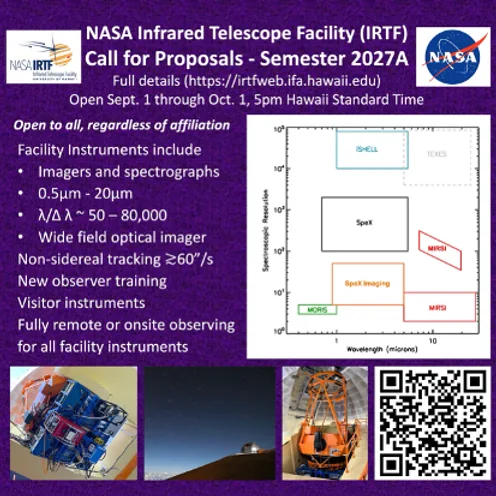
To cover mid-infrared spectroscopic science, the Texas Echelon Cross Echelle Spectrograph (TEXES) is offered as a collaborative visitor instrument for semester 2027A. Operating from 5 to 20 microns at high spectral resolution, TEXES proposals require prior consultation with principal investigator Tommy Greathouse at the Southwest Research Institute. Off-axis guiding with Felix remains available across all facility and visitor instruments. Advanced detector development for future low-noise infrared astronomy instruments is also examined in a recent laboratory study, although that work remains a preprint that has not yet undergone peer review. [4, 9]
Dual-Anonymous Review and Strategic Credit
All submitted applications undergo Dual-Anonymous Peer Review (a formal evaluation system designed to remove cognitive bias during selection). Reviewers score proposals on scientific merit and technical feasibility without knowing the identities or institutional affiliations of the applicants. Warren Skidmore oversees compliance with NASA Science guidelines, warning that violations of anonymity instructions result in point penalties or outright rejection. Two independent Time Allocation Committee (TAC) panels review submissions, dividing proposals into Solar System and non-Solar System groups of four or more members each. Technical feasibility input submitted by observatory staff assists both panels during deliberations. [4]
Beginning in semester 2026A, an Additional Credit system rewards observing programs that directly advance NASA strategic goals. Prioritized areas include NASA Science research, active flight mission support, and Planetary Defense initiatives. Feedback provided to investigators includes the proposal quartile ranking of successful applications. Successful teams must seek formal pre-approval from the IRTF Director before making any significant modifications to an approved observing program. [4]
Target of Opportunity (ToO) interrupt programs allow rapid observations when transient astronomical phenomena occur unexpectedly across celestial fields. The facility allocates up to 24 hours per semester for Solar System interrupts and 24 hours for non-Solar System events, with each interrupt limited to three hours in length. Observing time is taken from scheduled, non-time critical programs, with affected observers offered makeup time from Director Discretionary Time. Under the official IRTF Data Archive Policy, raw data files become publicly accessible online following a 12-month proprietary period for data acquired in semester 2025A and later. This structured archiving procedure reflects open science standards similar to open data sharing policies under the Artemis Accords. [4, 7]
Observing Procedures and Weather Recovery
Observing is usually conducted fully remotely from any domestic or international location equipped with broadband Internet access. On-site observing for complex investigations or researcher training remains supported, with facility lodging provided at HP. Due to vehicle shortages caused by maintenance issues, the observatory cannot allocate a dedicated staff truck solely to visiting astronomer teams. Guest observers must travel from sea level to HP independently, and arrange transport from HP to the telescope with IRTF Telescope Operators or through private four-wheel-drive rentals. [1, 2, 4]
To minimize the incidence of missed remote observing runs, the facility enforces strict administrative rules. Observing teams must enter the contact telephone numbers and email addresses of two different observers into their Observing Requirements Form. Unattended observing slots incur administrative penalties that jeopardize future time allocations on the telescope. Observatory astronomers provide instructional orientations for visiting researchers unfamiliar with instrument commands to ensure operational efficiency. [2, 4]
Observatory operations have fully resumed. Power failed during Hurricane Lala. [2, 5, 6]
Canadian Astronomical Society officers remind observers that the call remains open until Oct. 1 for semester 2027A, while the NASA Infrared Science Archive confirmed on social platforms that web services and operations have recovered. With digital submission portals and summit infrastructure restored, global astronomers can finalize their NASA IRTF proposals before the October 1 deadline arrives. [6, 8]
- PRESS RELEASE Tyler, P., & Cosmic Origins Team. (2026, September 16). REMINDER: 2027A NASA IRTF Call for Proposals. NASA Science. [Article Link]
- PRESS RELEASE Tyler, P. (2026, August 19). NASA IRTF Semester 2027A Call for Proposals. NASA Science. [Article Link]
- PRESS RELEASE Tyler, P., & Cosmic Origins Team. (2026, March 23). Call for Proposals for NASA IRTF. NASA Science. [Article Link]
- WEBSITE NASA Infrared Telescope Facility, & Institute for Astronomy. (2026). Call for Proposals 2027A. University of Hawaiʻi. [Article Link]
- WEBSITE Grant Meridian. (2026, August 22). NASA Infrared Telescope Facility – Semester 2027A Call for Proposals. [Article Link]
- ONLINE NEWS Secretary. (2026, September 11). Reminder: NASA IRTF’s Call for Proposals is Open Until Oct. 1 for Semester 2027A (Feb. 1 – July 31). Canadian Astronomical Society (CASCA). [Article Link]
- WEBSITE NASA Infrared Telescope Facility, & Institute for Astronomy. (2026, September 1). IRTF Time Proposal Form. University of Hawaiʻi. [Article Link]
- WEBSITE IR Science Archive [@NASA_IRSA]. (2026, August 20). NASA IRTF Call for Proposals – Open Sept. 1 until Oct. 1 for Semester 2027A [Post]. X. [Article Link]
- PREPRINT IBEX Collaboration. (2026). Characterization of IBEX LmAPD detectors at CEA for future low-noise NIR astronomy instruments. arXiv:2609.17371. [Article Link]
APA 7: TWs Editor. (2026, September 17). How NASA IRTF proposals secure Mauna Kea observing time. PerEXP Teamworks.


