





What will NASA AI ML STIG cover when its September lecture turns to LLM agents (large language model agents)? NASA Science names Josh Speagle of the University of Toronto as the speaker for a virtual presentation on the foundations and current state of the field. The NASA AI/ML STIG listing gives the event a specific place in the calendar: September 14, 2026, at 4:00 p.m. ET. A separate announcement schedules a hands-on session for the following week. [1, 2]
NASA AI ML STIG Lecture Details
NASA Science gives the September 14 lecture the title Foundations of LLM Agents and State of the Art. The presentation combines an introduction with an assessment of the field. Josh Speagle is the scheduled speaker. His affiliation is the University of Toronto. NASA labels the event a lecture and specifies a virtual location, so the announcement supplies an online setting without naming a physical venue or a host campus. [1]
The lecture is still ahead. As of September 10, NASA’s announcement establishes a scheduled educational event, without providing a transcript, slides, or findings from the presentation in the supplied excerpt. The title signals what Speagle plans to address; it cannot establish which examples he will choose or what conclusions he will reach when he speaks. NASA does not identify individual models, demonstrations, evaluation results, or a detailed sequence of topics in that excerpt. [1]
NASA places the event in its Cosmic Origins community pages, within the astrophysics programs section of NASA Science. The institutional setting connects the announcement to a scientific community, while the advertised subject remains LLM agents. Neither the page title nor the supplied event details identify a telescope, space mission, or observing campaign as the lecture’s focus. [1] PerEXP Teamworks previously covered robot team actions in ambiguous environments. Here, the subject is astronomy education about language-model agents; NASA announces no new robot coordination method.
What Does the Group Name Mean?
NASA expands AI/ML STIG as Artificial Intelligence & Machine Learning Science and Technology Interest Group. AI refers to artificial intelligence. ML means machine learning. STIG identifies the science and technology interest group. NASA uses that community name on both September event listings. The full name describes the group’s subject area; the separate lecture titles identify what each speaker is scheduled to discuss. [1, 2]
PerEXP Teamworks introduces the broader field in its explanation of machine learning and intelligent algorithms. The NASA AI ML STIG announcement narrows the immediate subject to LLM agents, but it does not provide a technical definition of an agent or describe a particular system’s architecture. A detailed account of how the software works would require supporting material beyond the event notice. [1]
NASA established the group under the Cosmic Origins Program Analysis Group (COPAG), calling for astronomy-specific AI training. The founding notice cites The Future of Artificial Intelligence and the Mathematical and Physical Sciences (AI+MPS). NASA describes the community paper as identifying a need for better AI literacy. The linked arXiv version has not undergone peer review. The notice also names PyTorch and JAX in its proposed training program. [3, 8]

What Will Speagle Discuss?
Speagle’s advertised title brings together the foundations of LLM agents and the current state of the field. NASA supplies no abstract in the research excerpt. How much technical background will the session assume? The notice leaves that open. NASA does not specify whether Speagle will concentrate on software design, scientific use cases, or comparisons between existing systems. It names no intended experience level. No named product appears in the supplied listing. The University of Toronto affiliation identifies the speaker’s institution, while the words in the lecture title remain the available guide to the presentation’s scope rather than a detailed syllabus or an account of completed research. [1]
NASA names no required software. The excerpt also supplies no reading list. [1]
The phrase state of the art appears in the announced title. NASA does not attach a performance ranking to it. In particular, the notice offers no basis for selecting a leading agent, comparing providers, or concluding that a system meets the requirements of scientific research. The lecture may address such questions, but the available announcement does not say whether it will. [1] The earlier seminar by Francisco Villaescusa-Navarro of Flatiron provides concrete context: NASA listed ReAct (Reason + Act), LangGraph workflows, multi-agent collaboration, hypothesis generation, and code generation among its topics. Those subjects describe the earlier program, not a confirmed syllabus for Speagle. [4]


What Follows on September 21?
NASA Science lists a second virtual lecture for September 21, 2026, also at 4:00 p.m. ET. Christopher Stubbs of Harvard University will speak about practical tools. Its title is Hands-On Session I: Agentic Coding and Research Tools. The two dates fall one week apart. Their titles suggest a progression from foundations toward practical work, although NASA does not explicitly make attendance at Speagle’s lecture a prerequisite for Stubbs’s session in the supplied notices. [1, 2]
Stubbs’s session names agentic coding and research tools as its subject, but the excerpt does not identify a coding environment, an installation process, or a particular research workflow. NASA includes “Session I” in the title. Yuan-Sen Ting’s announcement also names Serat Saad of The Ohio State University for Hands-On Session II the following week. Ting lists retrieval and memory (RAG), tool use and MCP, and mechanistic interpretability among later topics. [2, 5]
The NASA AI ML STIG calendar separates the two topics into distinct events. A calendar entry for the September 14 foundations lecture should retain Speagle’s name; the September 21 hands-on entry should retain Stubbs’s. Combining their titles would obscure which speaker and date belong to the practical session, particularly because NASA assigns both events the same starting time. [1, 2]
Does This Announce Research Findings?
NASA’s supplied notices contain event details rather than experimental methods or results. Neither excerpt reports a benchmark, a new model release, or a scientific discovery made with an agent. The announcements do not establish how well any system performs. The speakers’ scheduled participation provides information about the program. It supplies no independent evaluation of a tool’s accuracy, reliability, or suitability for a specific scientific task. [1, 2]
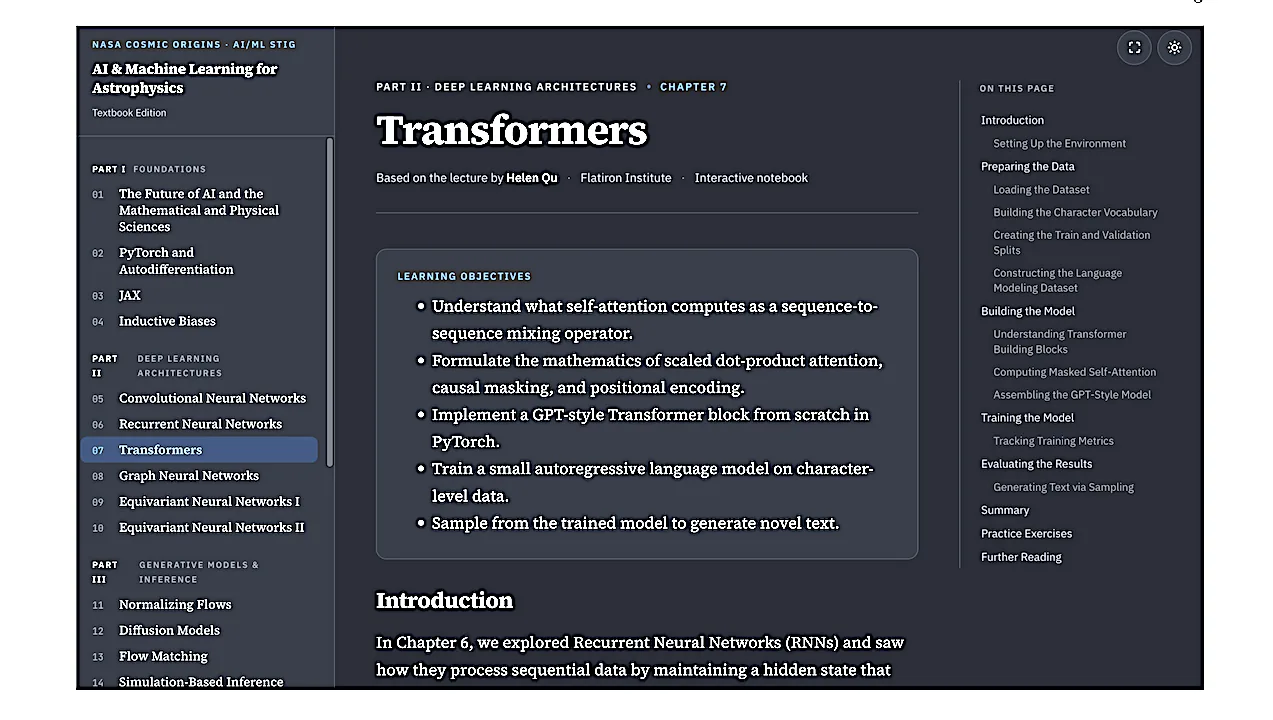
PerEXP Teamworks also covers scaling deep learning models in chemistry research, a separate research topic within the broader machine learning context. NASA does not identify that work as part of either lecture. The group does have a directly related publication: Yuan-Sen Ting, Digvijay Wadekar, Phill Cargile and colleagues describe Deep Learning for Astrophysics, an open textbook curated from the STIG lectures. Their original textbook paper is a preprint that has not undergone peer review. It describes educational materials, including executable notebooks, rather than demonstrating the performance of Speagle’s forthcoming presentation. [7]
What evidence would support an account of the lecture’s scientific content? Speagle’s actual presentation, an abstract, or accompanying research would allow more specific reporting than the short calendar notice permits. The supplied excerpt contains none of those materials. Until then, attributing a technical recommendation or a research conclusion to the University of Toronto speaker would go beyond NASA’s announcement. [1]
Where Are the Attendance Details?
NASA Science’s September 14 event page is the primary reference for Speagle’s scheduled lecture. NASA states 4:00 p.m. ET, specifies a virtual location, and supplies a Microsoft Teams meeting link. ET is the notice’s time-zone label. Yuan-Sen Ting describes the series as free, fully remote and open worldwide, with recordings publicly available. The NASA AI ML STIG GitHub repository directs participants to ai4astro.org for its continuing lecture library. [1, 5, 6]
The separate September 21 event page identifies Stubbs’s hands-on session. NASA provides the same starting time and virtual setting for that event. Ting directs participants to ai4astro.org for the schedule, viewing information and mailing-list sign-up. The repository lists Jupyter notebooks, code examples, exercises and slide decks among its teaching resources. It does not identify a required installation for Stubbs’s session. [2, 5, 6] Prospective participants can use the NASA AI ML STIG listings to identify the relevant date, speaker, and subject before checking the official event pages for joining details. Preparation instructions for the hands-on session remain unspecified in the supplied material. [1, 2, 5, 6]
- WEBSITE Tyler, P., & Cosmic Origins Team. (2026, September 10). AI/ML STIG lecture series, 14 Sept 2026. NASA Science. [Article Link]
- WEBSITE Tyler, P., & Cosmic Origins Team. (2026, September 10). AI/ML STIG lecture series, 21 Sept 2026. NASA Science. [Article Link]
- WEBSITE Tyler, P. (2025, October 6). New artificial intelligence & machine learning STIG. NASA Science. [Article Link]
- WEBSITE Tyler, P., & Cosmic Origins Team. (2025, November 24). AI/ML STIG lecture series, 24 Nov 2025. NASA Science. [Article Link]
- WEBSITE Ting, Y.-S. (2026, September 8). NASA Cosmic Origins AI/ML STIG [Post]. LinkedIn. [Article Link]
- WEBSITE NASA AI/ML STIG. (n.d.). AI/ML Science and Technology Interest Group [Repository README]. GitHub. [Article Link]
- PREPRINT Ting, Y., Wadekar, D., Cargile, P., Cuesta-Lazaro, C., Curtis-Trudel, A., Green, G., McClelland, R., Muthukrishna, D., Nguyen, T., Qu, H., Rozanski, T., Scaife, A., Thaler, J., Verde, L., Villaescusa-Navarro, F., Wu, J. F., Xu, D., Yao, S., Gagliano, A.,. Ravindranath, S. (2026). Deep Learning for Astrophysics: An Open Textbook from the NASA Cosmic Origins AI/ML Science and Technology Interest Group. arXiv (Cornell University). [Article Link]
- PREPRINT Ferguson, A., LaFleur, M., Ruthotto, L., Thaler, J., Ting, Y., Tiwary, P., Villar, S., Alves, E. P., Avigad, J., Billinge, S., Bilodeau, C., Brown, K., Candes, E., Chattopadhyay, A., Cheng, B., Clausen, J., Coley, C., Connolly, A., Daum, F.,. Frutos, L. M. (2025). The Future of Artificial Intelligence and the Mathematical and Physical Sciences (AI+MPS). arXiv:2509.02661. [Article Link]
APA 7: TWs Editor. (2026, September 10). LLM agents take the stage at NASA AI ML STIG. PerEXP Teamworks.


