





High blood pressure affects roughly one-third of adults worldwide, yet nearly half of all patients cannot control their numbers with standard pills [4]. Why do conventional medications so often fail to keep vascular tension in check? A 2026 study in Circulation Research reveals that neurogenic hypertension can stem from breathing control neurons in the brainstem that actively constrict blood vessels [1]. In animal tests, quieting this brain area brought blood pressure back to normal [4].
- What Drives Neurogenic Hypertension in the Brain?
- How Brainstem Breathing Circuits Constrict Blood Vessels
- Why Does Neurogenic High Blood Pressure Resist Standard Drugs?
- England Population Study Reveals Undiagnosed Hypertension Rates
- Can Neck Sensors Treat Brainstem Hypertension Without Brain Surgery?
- Future Clinical Steps for Targeted Blood Pressure Treatments
What Drives Neurogenic Hypertension in the Brain?
Neurogenic hypertension is driven by overactive brainstem circuits that fire distress signals to the sympathetic nervous system and force peripheral blood vessels to narrow against the flow of blood [1]. In a healthy body, autonomic reflexes adjust arterial tone to preserve steady circulation during standing, walking, or resting [4]. But when sympathetic signaling stays chronically active, arteries remain constricted and push blood pressure into dangerous zones [1]. Clinical researchers estimate that roughly 50 percent of all patients with high blood pressure have a nervous system driver behind their illness [4]. In their published paper, the authors stated: “Given that around 50 percent of patients with hypertension have a neurogenic component, the challenge is to understand mechanisms generating sympatho-excitation in hypertension” [1].
To locate this neural driver, scientists from the University of São Paulo in Brazil and the University of Auckland in New Zealand mapped autonomic connections deep inside the brainstem [4]. Co-authors including Julian Paton and D. J. Moraes tracked how involuntary respiratory centers communicate with cardiovascular hubs. Their experiments focused on active exhalation circuits [1].
Finding this mechanism matters because about 40 percent of people taking blood pressure drugs still have uncontrolled readings that put them at serious cardiovascular risk. Most existing pills relax vessel walls or purge sodium, but they leave brainstem signaling untouched. Unchecked pressure spikes raise the long-term likelihood of heart failure, stroke, and vascular cognitive disorders such as dementia [4].
How Brainstem Breathing Circuits Constrict Blood Vessels
Researchers centered their search on the lateral parafacial (pFL) region, a specialized cluster of brainstem cells linked to respiratory control [1]. Normal resting exhalation is passive, requiring no active muscle effort as lungs naturally recoil. The pFL neurons stay quiet during quiet rest, but they fire when breathing turns deliberate and forceful during exercise, coughing, or laughing [4]. In laboratory tests on rats, scientists discovered that pFL cells also signal blood vessels to clamp down [1].
Using targeted genetic tools in rats, the team turned pFL neurons on and off while recording changes in sympathetic nerves and blood pressure. Switching these neurons on caused immediate spikes in arterial blood pressure [1]. Silencing them in hypertensive rats reversed the narrowing, prompting Julian Paton to say: “We discovered that, in conditions of high blood pressure, the lateral parafacial region is activated and, when our team inactivated this region, blood pressure fell to normal levels” [4].
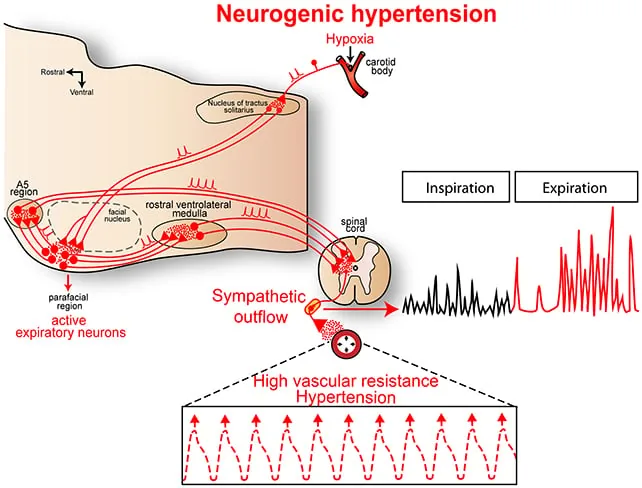
This dual role linking respiration and circulation helps explain why people with obstructive sleep apnea face a much higher risk of persistent high blood pressure. During nighttime apnea episodes, paused breathing causes sharp drops in oxygen and climbs in carbon dioxide [4]. These blood gas shifts excite pFL neurons, triggering sympathetic vessel narrowing that continues long after normal breathing resumes in the morning [1]. Investigating such interrelated autonomic reflex pathways mirrors how scientists find a possible explanation for severe morning sickness by tracing specific cellular receptor interactions that disrupt ordinary metabolic and cardiovascular stability throughout the body [4].
Why Does Neurogenic High Blood Pressure Resist Standard Drugs?
Neurogenic high blood pressure resists standard drugs because common prescription therapies target blood vessels or kidneys rather than the brainstem circuits that order vessels to constrict. Common pills such as ACE inhibitors or calcium channel blockers work locally in peripheral tissues to dilate smooth vascular muscle [4]. But if autonomic brainstem nuclei keep broadcasting strong constriction impulses, the continuous neural signal overpowers the relaxing influence of the daily medication [1].
Designing drugs to calm brainstem neurons directly is difficult because the blood-brain barrier shields central neural tissue from most circulating chemical compounds. Molecules engineered to cross that barrier often cause heavy drowsiness or blunt automatic breathing. Researchers need a way to quiet pFL cells from outside the brain [4].
Chronic autonomic overactivation subjects the entire circulatory system to relentless stress that gradually damages fragile endothelial linings and stiffens large elastic arteries [1]. These long-term wear patterns resemble the broad evolutionary trade-offs explored by researchers studying the longevity bottleneck hypothesis connecting human aging and mammalian physiology under sustained environmental challenges [4]. Left untreated, ongoing sympathetic firing inflicts lasting injury on microvascular beds in the kidneys and brain [1].


England Population Study Reveals Undiagnosed Hypertension Rates
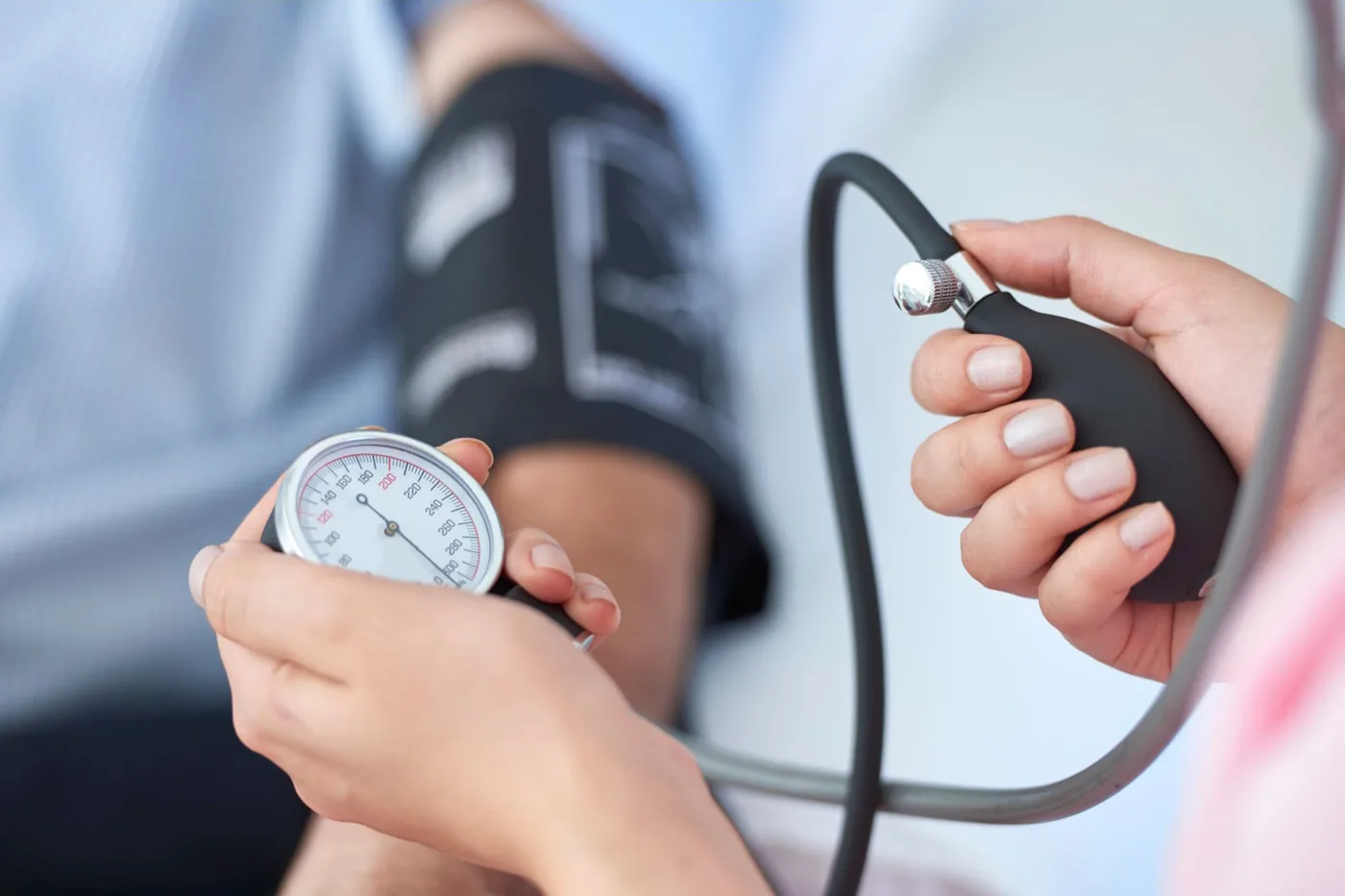
A large study of 1.4 million adults in England shows how commonly high blood pressure occurs and how often it goes undetected. Conducted by researchers at Oxford Population Health using the Our Future Health research program, the investigation analyzed clinic measurements collected from English volunteers who joined between 2022 and 2025. The authors used World Health Organization benchmarks, classifying an adult as hypertensive if clinic monitors measured a systolic reading of at least 140 mmHg, a diastolic level of at least 90 mmHg, or confirmed regular use of blood pressure prescriptions. Among all 1.4 million participants in the cohort, 37 percent met the diagnostic criteria for hypertension [2].
The study uncovered surprising shortfalls in clinical diagnosis and long-term condition management [5]. Among individuals with hypertension, 59 percent had never been diagnosed and were taking no blood pressure-lowering drugs at all. Even among participants taking prescribed drugs, 50 percent still had clinic readings of 140/90 mmHg or higher [2].
Lead author Wenyu Liu, Medical Statistician at Oxford Population Health, said: “While hypertension is largely a ‘silent killer,’ the current approach to detecting and treating high blood pressure is not fit for purpose”. Liu said over 15 percent of younger adults aged 18 to 39 already had high blood pressure [5]. Rates reached 71 percent among people aged 80 and older [2].
Can Neck Sensors Treat Brainstem Hypertension Without Brain Surgery?
Tiny sensory clusters in the neck called carotid bodies provide an accessible target to calm brainstem hypertension without requiring medications to cross the blood-brain barrier. Nestled beside the carotid arteries, these cellular sensors monitor blood levels of oxygen and carbon dioxide [4]. Sensory nerves travel from the carotid bodies directly into the brainstem, helping coordinate breathing with heart rate and vascular tone [1]. Because they sit in the neck, peripheral drugs can reach them easily [4].
Scientists hope that dampening carotid body activity will stop the sensory inputs that awaken pFL neurons and raise blood pressure in patients with neurogenic hypertension. In New Zealand, Julian Paton is working to repurpose existing medications for this purpose. Paton said: “Our goal is to target the carotid bodies, and we are importing a new drug that is being repurposed by us to quench carotid body activity and inactivate remotely the lateral parafacial region safely, i.e., without needing to use a drug that penetrates the brain” [4].
A related study from the Auckland team published in Cardiovascular Research highlighted an accessible compound that acts on these precise neck chemoreceptors. The team found that pyridoxal 5′ phosphate, the active form of vitamin B6, blocks P2X3 receptors that become overactive in the carotid bodies during hypertension [3]. In hypertensive rats, infusing pyridoxal 5′ phosphate dropped mean arterial blood pressure by an average of almost 16 mmHg. A small trial in 14 patients confirmed that the treatment eased exaggerated chemoreflex responses to low oxygen in humans [4].
Future Clinical Steps for Targeted Blood Pressure Treatments
Turning these laboratory discoveries into practical medical care requires rigorous clinical trials in human patients who suffer from drug-resistant high blood pressure [4]. While rodent experiments in Circulation Research proved the connection between pFL exhalation neurons and vessel constriction, human cardiovascular regulation involves diverse genetic and lifestyle variables [1]. Clinical researchers must confirm that suppressing carotid body sensitivity lowers blood pressure safely without impairing normal breathing responses during exercise or travel to thin air at high altitudes [4].
Current diagnostic guidelines in England may also need updates to catch cases before unmanaged blood pressure causes irreversible arterial damage in younger populations. NICE guidelines now require multiple clinic visits and lifestyle counseling before doctors begin prescribing medications. Clinicians argue this delay leaves high numbers of patients untreated, allowing vascular strain to accumulate silently over months or years [5].
Bryan Williams, Chief Scientific and Medical Officer at the British Heart Foundation, said: “High blood pressure remains the leading modifiable risk factor for cardiovascular disease, linked to around half of heart attacks and strokes in the UK”. Williams said better detection and treatment could help tens of thousands avoid preventable cardiovascular events [5]. By pairing standard vascular pills with drugs that calm carotid chemoreceptors, doctors may finally resolve neurogenic hypertension at its true physiological source [4].
- ACADEMIC JOURNAL Magalhães, K. S., Martins Sá, R. W., Salim, N., Silva, T. M. d., Machado, B. H., Paton, J. F., & Moraes, D. J. (2026). Lateral Parafacial Neurons Evoked Expiratory Oscillations Driving Neurogenic Hypertension. Circulation Research, 138(2). [Article Link]
- ACADEMIC JOURNAL Liu, W., Collister, J., Littlejohns, T., Turnbull, I. J., Clarke, R., & Hunter, D. J. (2026). Hypertension prevalence, detection, treatment and control among 1.4 million adults in England: a cross-sectional analysis from the Our Future Health study in 2022–2025. BMJ Public Health, 4(3), e004815. [Article Link]
- ACADEMIC JOURNAL Felippe, I. S. A., Babbage, T. L., Shaheen, R., Bassetto, M., Fan, J., Pauza, A., Gold, O., Thakkar, P., Dawes, M., Bates, M. L., McBryde, F., Fountain, S. J., Fisher, J. P., & Paton, J. F. R. (2026). Vitamin B6 (Pyridoxal 5′ Phosphate) antagonises carotid body P2X3 receptors in hypertension. Cardiovascular Research, 122(2), 285-296. [Article Link]
- ONLINE NEWS Nield, D. (2026, October 4). Scientists Might Have Found a New Cause of High Blood Pressure, And a Way to Treat It. ScienceAlert. [Article Link]
- ONLINE NEWS SciTechDaily. (2026, October 4). More Than 1 in 3 Adults Had High Blood Pressure – Most Didn’t Know It. SciTechDaily. [Article Link]
APA 7: PerEXP Teamworks. (2026, October 5). How Brainstem Breathing Neurons Trigger High Blood Pressure. PerEXP Teamworks.


