





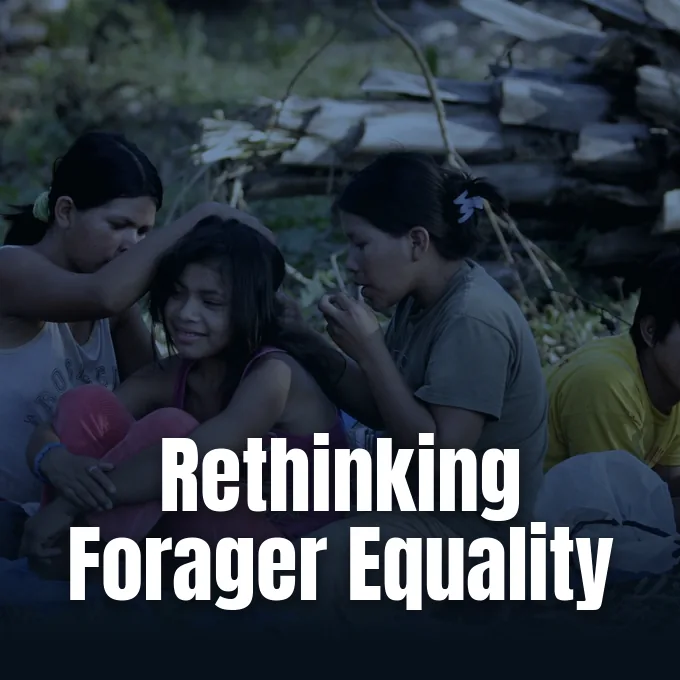
Can modern people find an ideal blueprint for equality in the deep human past? For generations, popular accounts have treated hunter gatherer societies as peaceful communities that lived without wealth gaps, political dominance, or social rank [1]. Anthropologists often pointed to these small foraging groups to suggest that human nature is innately cooperative and generous. But a major cross-cultural review by evolutionary anthropologists Dr. Duncan Stibbard-Hawkes of Baylor University and Dr. Chris von Rueden of the University of Richmond shows that patterned inequalities exist in every recorded human group [8].
Why Were Hunter Gatherer Societies Egalitarian?
Small subsistence communities appeared egalitarian because high residential mobility and limited material storage prevented ambitious individuals from consolidating permanent control over camp decisions or personal resources [1]. Philosophers long looked to foraging bands to explain human origins. In 1987, biologist and geographer Jared Diamond famously argued that the adoption of agriculture “was the worst mistake in the history of the human race,” reinforcing an old narrative commonly attributed to Jean-Jacques Rousseau [3]. During the 19th-century, German thinker Friedrich Engels drew on early reports of subsistence cultures to claim that humanity’s original condition was one of primitive communism without private property, social classes, or entrenched hierarchies. Popular books like The Dawn of Everything push back against these claims, calling total egalitarianism a “Garden of Eden narrative” that overlooks daily social friction [1].
Subsistence bands keep bullying in check through constant mobility [6]. Families store very little material wealth, making large personal accumulation practically impossible. Coordinators wield no power over others. Decisions rely on group consensus, and whenever families disagree, they simply move to another camp [1].
Yet equal wealth does not guarantee equal power. Observers often mistake shared poverty for a moral commitment to equal outcomes. People in small camps value their personal freedom and resist bullies, but they do not abandon personal ambition, social competition, or status seeking [8]. In truth, egalitarianism in hunter gatherer societies reflects an ongoing political struggle where autonomous individuals continuously push back against would-be dominators to safeguard their independence [4].

How Seven Domains Divide Forager Societies
To test whether genuine equality exists in subsistence cultures, Duncan Stibbard-Hawkes and Chris von Rueden synthesized field data covering seven key domains of social life in every reviewed group [7]. Their comprehensive study examined embodied traits like physical strength and hunting skill, social capital, leadership influence, age-based authority, gender relations, material capital or land tenure, and reproductive success in traditional subsistence communities around the world [4]. The authors evaluated diverse societies from several continents, including the Tanzanian Hadza, Central African BaYaka, Malay Batek, Philippine Agta, and Bolivian Tsimane. Rather than finding universal equality, disparities appeared in all seven areas in every society investigated [7]. Individual advantages accumulate over time into real social leverage that shapes daily camp politics.
Differences in embodied capital create clear social divides. Skilled hunters who reliably bring meat into camp earn lasting prestige, speak with greater weight in camp discussions, and attract more marriage partners over their lifetimes. Social capital works in a similar way. People with large kin networks receive far more assistance during illness or hunger [4]. In contrast, individuals with few living relatives face much higher insecurity and carry noticeably less political influence when camp conflicts erupt [8].
Resource rights also challenge romantic portrayals of past harmony [4]. Certain forager societies recognized exclusive family claims to specific berry patches, fishing spots, fruit trees, or sections of coastline that passed between generations [8]. Traveling bands sometimes left severely disabled individuals behind during migrations. Persuasive elders mediated disputes and guided plans without holding formal titles [4].
Why Solo Hunters Share Food in Hadza Camps
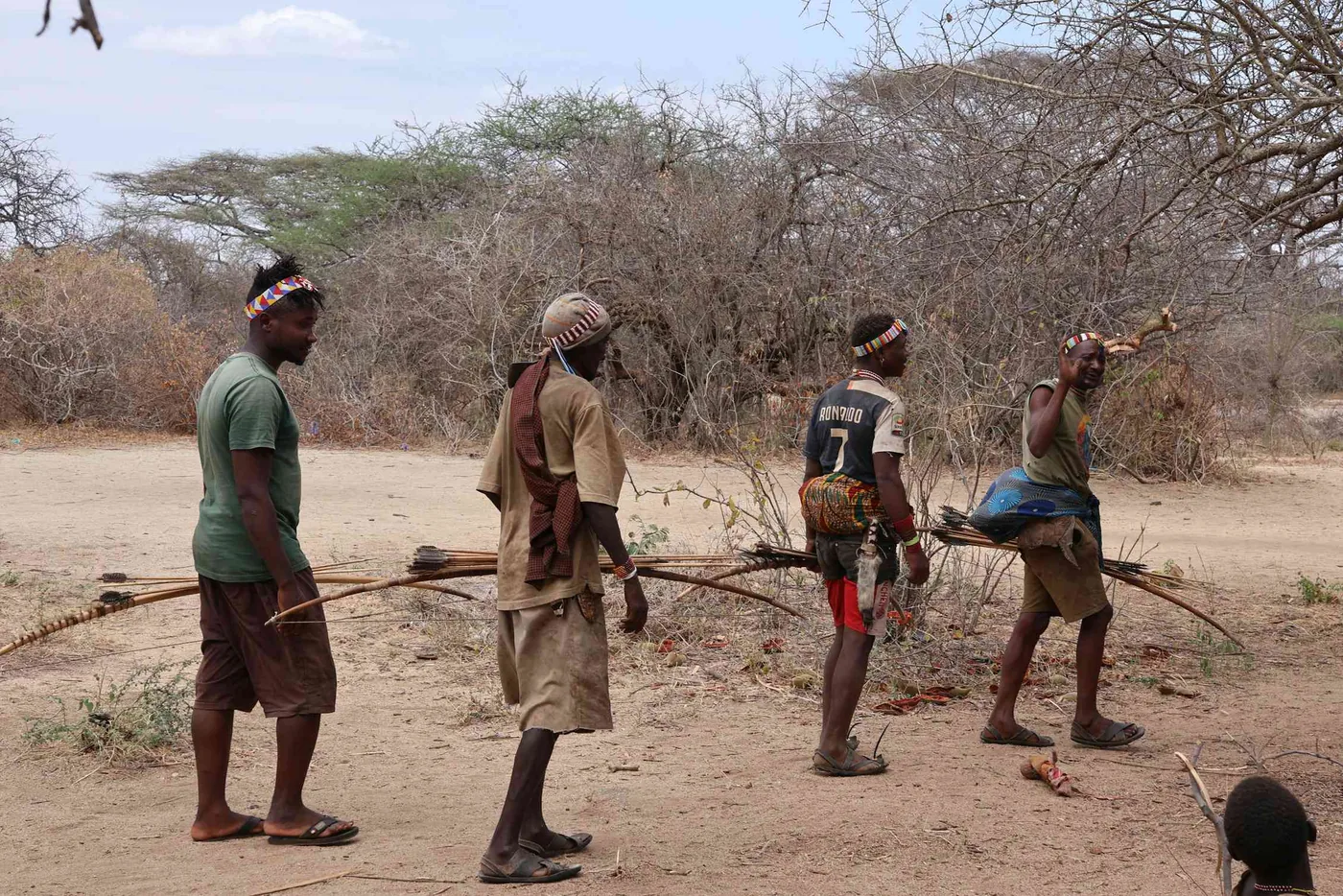
Meat distribution in forager camps provides a vivid window into how sharing actually works. On the dry shores of Lake Eyasi in northern Tanzania, a small population of Hadza people still hunts wild animals and gathers plants using simple bows and digging sticks. When a Hadza archer brings down a kudu (a large antelope with long, spiral horns) using a poisoned arrow, the kill presents an immediate practical challenge. The heavy carcass cannot be carried home alone. He cuts his arrow from its flank, covers the animal with dry grass to hide it from hyenas, and walks back to camp to recruit help [1].
News of the kill spreads like wildfire through the camp. Camp members quickly rush out to butcher the animal, slice through the heavy carcass, carry parcels back to their hearths, and divide cooked portions among extended relatives. On a good hunting day, the archer and his household keep half of the meat, but they often end up with much less. Families from neighboring camps walk in from miles around to claim their expected share, and almost everyone in the vicinity feels entitled to food. Under such intense community pressure, hunters find it nearly impossible to turn visitors away or hoard private reserves for themselves [1].

This scene looks like spontaneous generosity, but experimental work reveals self-interested strategies beneath the surface [5]. In a study published in PNAS Nexus, Duncan Stibbard-Hawkes and colleagues tested sharing choices using behavioral economic games that allowed both donating and taking resources [9]. Only about 40.9% of Hadza participants chose to share surplus resources when they held an advantage, whereas 30% actively seized resources from others when starting at a disadvantage. Rather than relying on unprompted altruism, equality emerges in hunter gatherer societies because disadvantaged individuals assertively demand and take what they need to balance local resource distributions [5].


How Demand Sharing Shapes Hunter-Gatherer Groups
Food sharing functions through social pressure, a mechanism anthropologists call demand sharing. When a hunter brings home a large animal and tries to hoard meat, camp members confront him directly [5]. These face-to-face negotiations prevent private food accumulation. A hunter yields meat because he hates constant badgering and friction [2].
Vocal complaints about selfishness are a constant feature of camp life. Among some !Kung bands living in Angola, Botswana, and Namibia, researchers observed that about 34 per cent of daytime conversation was devoted to complaining about stinginess [2]. When someone hoards tools, honey, or meat, campmates respond with stinging gossip and mockery [1]. Similarly, the Mbendjele of the Republic of the Congo practice a grievance ritual called mosambo (a camp-wide shouting session where an aggrieved person airs complaints publicly) to defend their rights against pushy neighbors [2].
Ridicule serves as a practical weapon against arrogance [1]. When an accomplished hunter returns with big game, campmates downplay the kill, claiming the beast was scrawny. Anthropologist Manvir Singh of the University of California, Davis, explains that such pushback protects autonomy: “People don’t like bullying, they don’t like coercion, and they don’t like ‘big men’” [2]. By poking fun at successful hunters, band members make sure that food provisioning does not turn into political dominance [1].
Gerontocracy and Gender in Egalitarian Societies
Age constitutes a clear source of hierarchy in forager life. In northern Tanzania, Hadza custom reserves specific prime cuts of large game solely for elder men while strictly denying those nourishing portions to younger hunters and women. Senior men in many indigenous Australian communities historically controlled sacred ritual secrets and exercised firm authority over the arranged marriage choices of their younger male and female relatives [1]. Similar complexity has been documented in pre-colonial Aboriginal food systems and cultivation practices, where lineage traditions and territorial claims strictly shaped resource access rather than unconstrained communal sharing [8]. In these settings, gerontocratic dominance ensured that senior elders retained decisive social leverage regardless of individual physical strength [1].
Control over non-material wealth creates further imbalances. While the BaYaka people of the Central African rainforest own few physical belongings, older individuals buy, sell, and hoard ritual knowledge to build personal leverage over younger members. Among the Philippine Agta, parents arrange marriages in ways that heavily penalize orphans, who lack family champions to negotiate on their behalf [1]. Such customs reveal that social status depends on family alliances and private knowledge, even when material possessions remain scarce [4].
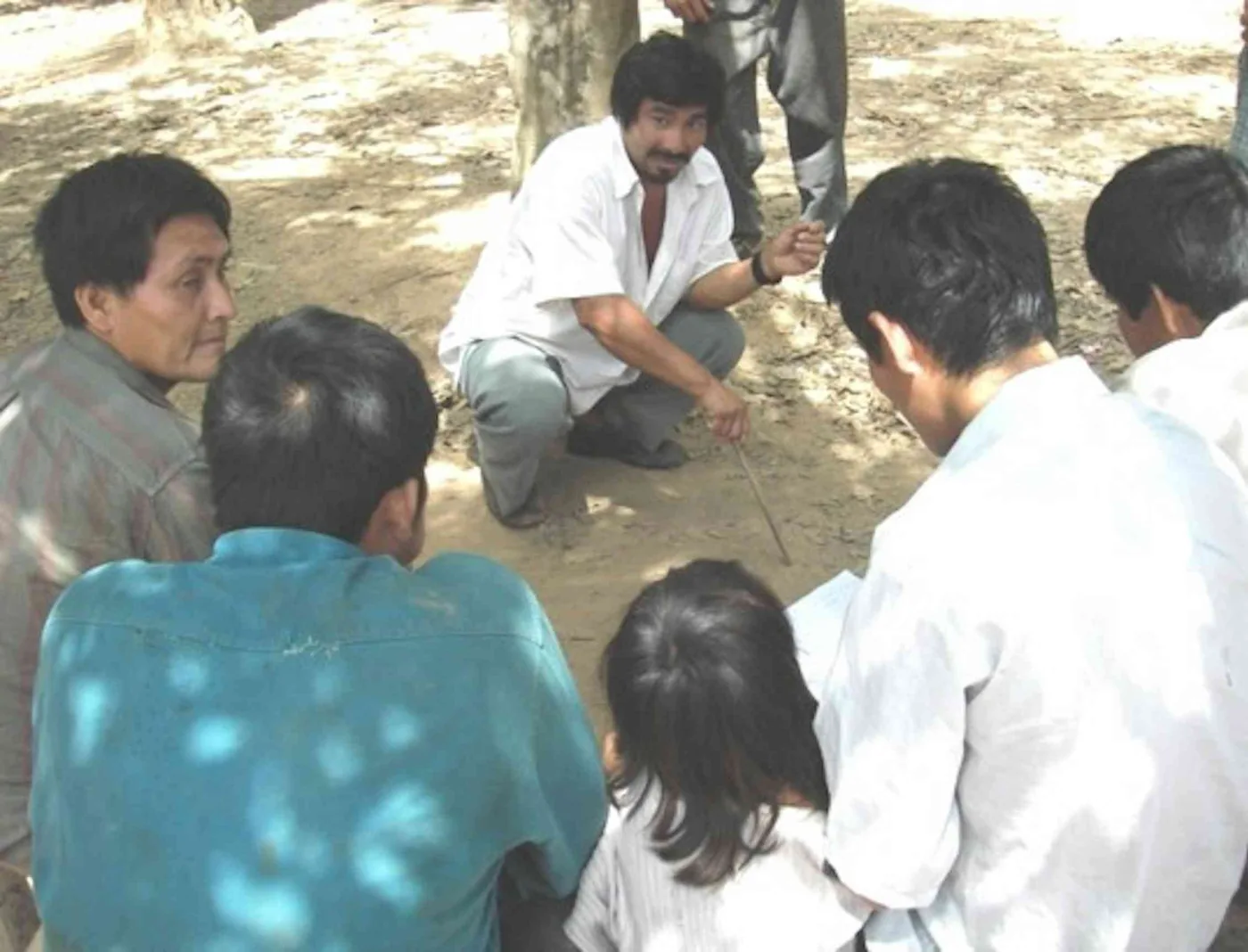
Gender divides also persist in traditional subsistence groups. While women in many foraging communities keep personal independence in daily movement and marriage choices, men participate far more often in collective decision-making meetings that set camp policy [1]. Among the Tsimane of the Bolivian Amazon, community deliberations are open to everyone, but influential men speak with much greater weight during arguments [6]. Reproductive inequality is equally pronounced, as high-ranking men in certain cultures marry multiple wives and achieve far higher reproductive success than other men [4].
Egalitarianism as a Tool for Personal Autonomy
Reframing egalitarianism as an active political process rather than an outcome of complete equality sheds fresh light on human history [4]. Jerome Lewis, an anthropologist at University College London, said that this research is “an important contribution that brings together a range of different ethnographic examples to show the range and diversity of egalitarianism” found in human societies. These decentralized cultures have endured for more than 50,000 years [2].
Understanding ancient social structures also provides context for early human physiological and behavioural traits [3]. Research into hominin evolution, including studies of Neanderthal circadian rhythms and morning activity habits, reveals how early populations adapted to environmental challenges through cooperative foraging [9]. Ancient ancestors did not reach the extreme heights of inequality seen over the last 6,000 years, but they were not paragons of selfless harmony [1]. Their communities succeeded because individuals actively organized against tyranny.
Economic changes continue to alter sharing norms in surviving subsistence groups today [5]. A preprint paper on Hadza settlement by Stibbard-Hawkes and colleagues, which has not yet undergone formal peer review, notes that families settling near agricultural villages show higher tolerance for unequal possessions [10]. As foragers trade in cash markets, communal sharing rules weaken [5]. Ultimately, hunter gatherer societies show that fairness is never an automatic state of nature. It is a set of hard-won tools that ordinary people use to protect their autonomy and keep arrogance in check [1].
- ONLINE NEWS von Rueden, C., & Stibbard-Hawkes, D. (2026). Hunter-gatherer societies are often put on a pedestal as paragons of equality – but the reality is more complicated. The Conversation. [Article Link]
- ONLINE NEWS Phillips, S. (2025). Hunter-gatherer groups are much less egalitarian than they seem. New Scientist. [Article Link]
- ONLINE NEWS Grosjean, P. (2026). The egalitarianism of hunter-gatherer societies has often been exaggerated. Le Monde. [Article Link]
- ONLINE NEWS McMillan, T. (2025). New Study Debunks the Myth of Truly “Egalitarian” Societies in Human History. The Debrief. [Article Link]
- ONLINE NEWS Benton, C. (2026). Rethinking Hunter-Gatherer ‘Egalitarianism’: A More Complex Social Picture Emerges. Scienmag. [Article Link]
- WEBSITE Stibbard-Hawkes, D., & von Rueden, C. (2026). Hunter-Gatherer Equality: Anthropology Or Creation Myth? ScienceBlogs. [Article Link]
- WEBSITE Gallo, C. (2025). Anthropologists Debunk the Myth of Perfect Equality in Human Societies. Profolus. [Article Link]
- ACADEMIC JOURNAL Stibbard-Hawkes, D. N., & von Rueden, C. R. (2026). Egalitarianism is not equality: Moving from outcome to process in the study of human political organisation. Behavioral and Brain Sciences, 49. [Article Link]
- ACADEMIC JOURNAL Smith, K. M., Stibbard−Hawkes, D. N. E., Dimant, E., Mabulla, I. A., Bicchieri, C., & Apicella, C. L. (2026). The “I” in egalitarianism: Hadza hunter-gatherers averse to inequality primarily when personally unfavorable. PNAS Nexus, 5(2). [Article Link]
- PREPRINT Stibbard-Hawkes, D. N., Mabulla, I. A., Endeko, E. S., & Whittaker, L. (2026). Moving On From Movement: Sedentism Provides a Key Pathway to Food Security for Hadza Hunter-Gatherers. [Article Link]
APA 7: TWs Editor. (2026, October 4). Hunter-Gatherer Societies Reveal Hidden Social Disparities. PerEXP Teamworks.


