





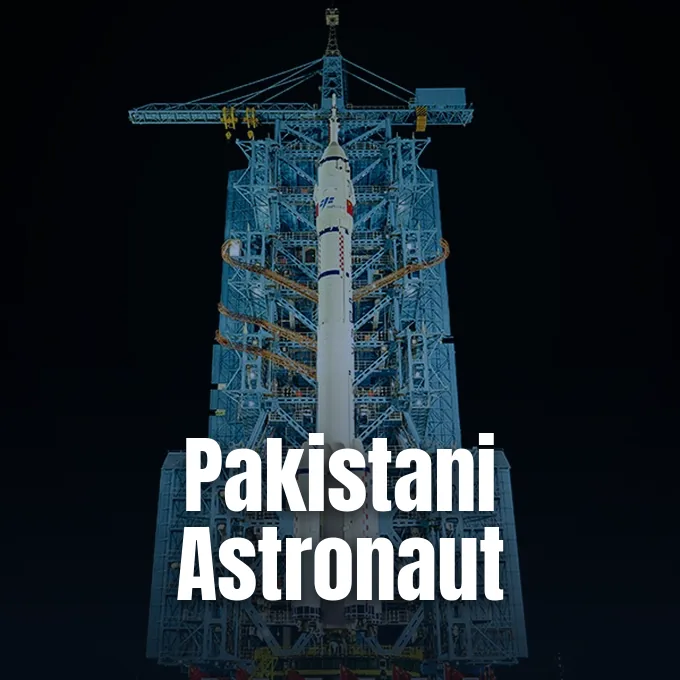
China has scheduled the launch of Shenzhou-24 to send three crew members to its orbital outpost, where a foreign national will enter the station for the first time. Muhammad Zeeshan Ali, a former military pilot selected as a Pakistani astronaut, boards the spacecraft with two Chinese crewmates for a week of scientific work in low Earth orbit. The joint flight follows a bilateral spaceflight agreement signed in Islamabad, carrying university research and testing orbital life support routines [1].
Training a Pakistani Astronaut in Beijing
The path to this flight opened in February 2025, when representatives from China and Pakistan met in Islamabad to sign an agreement on human spaceflight cooperation [1]. Following that signing, Pakistan’s national space agency, the Space and Upper Atmosphere Research Commission, reviewed candidates from military aviation before shortlisting two pilots, Muhammad Zeeshan Ali and Khurram Daud, to undergo primary and backup training. Both men traveled to Beijing. Instructors guided them through rigorous spacecraft simulations [3].
Ali spent seven months in the capital preparing for orbital conditions, studying spacecraft hardware and survival tasks. He learned Mandarin. Chinese officials kept the roster quiet until Monday night on Nov. 23, following standard practice by naming astronauts just one day before launch [1]. At a press conference on Nov. 24, Ali spoke to reporters in Mandarin about his role, saying, “My first [flight] not only represents myself, but also my country” [2]. He added that he carried “the dream of 250 million Pakistani people” into the training center. Adventurer Namira Salim had earlier reached suborbital space during a Virgin Galactic flight in October 2023, but Ali becomes the first Pakistani astronaut to reach Earth orbit [1].
Launch Preparations at Jiuquan
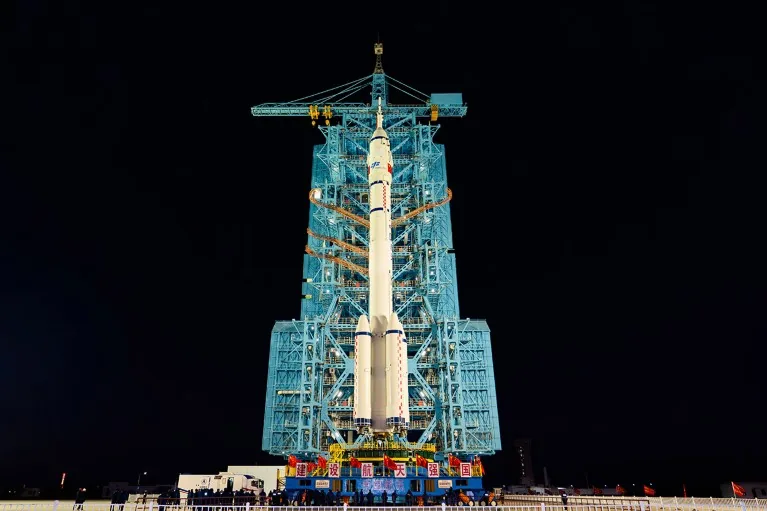
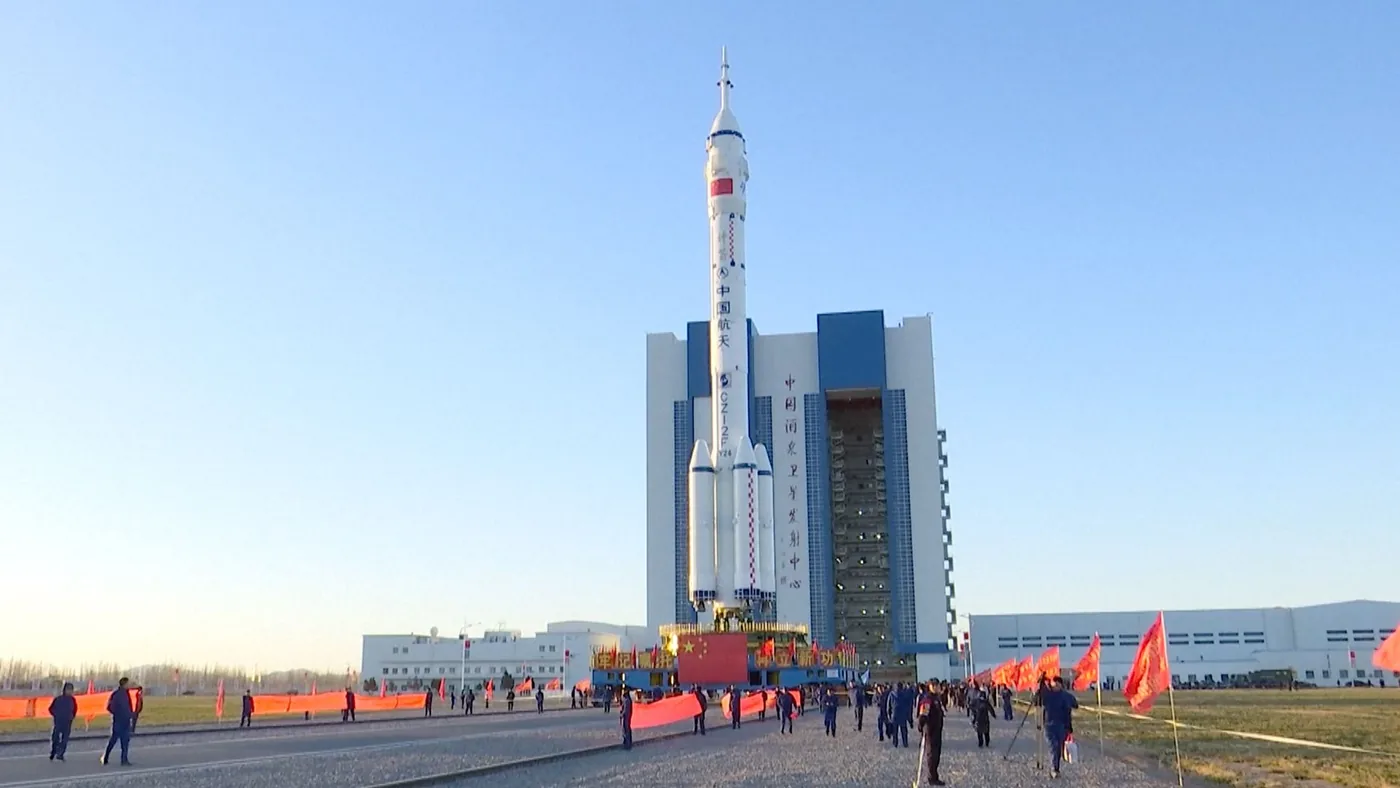
The flight plan centers on the Long March 2F rocket, a two-stage launch vehicle that China has relied on for all its crewed missions to date. Ground crews rolled the rocket out at Jiuquan [1]. The facility sits in the desert region of northwestern China. Zhang Jingbo, a spokesperson for the China Manned Space Programme, announced launch parameters on Nov. 24, confirming that liftoff was set for 08:18 local time on Nov. 25 (7:18 p.m. EST on Nov. 24) [2].
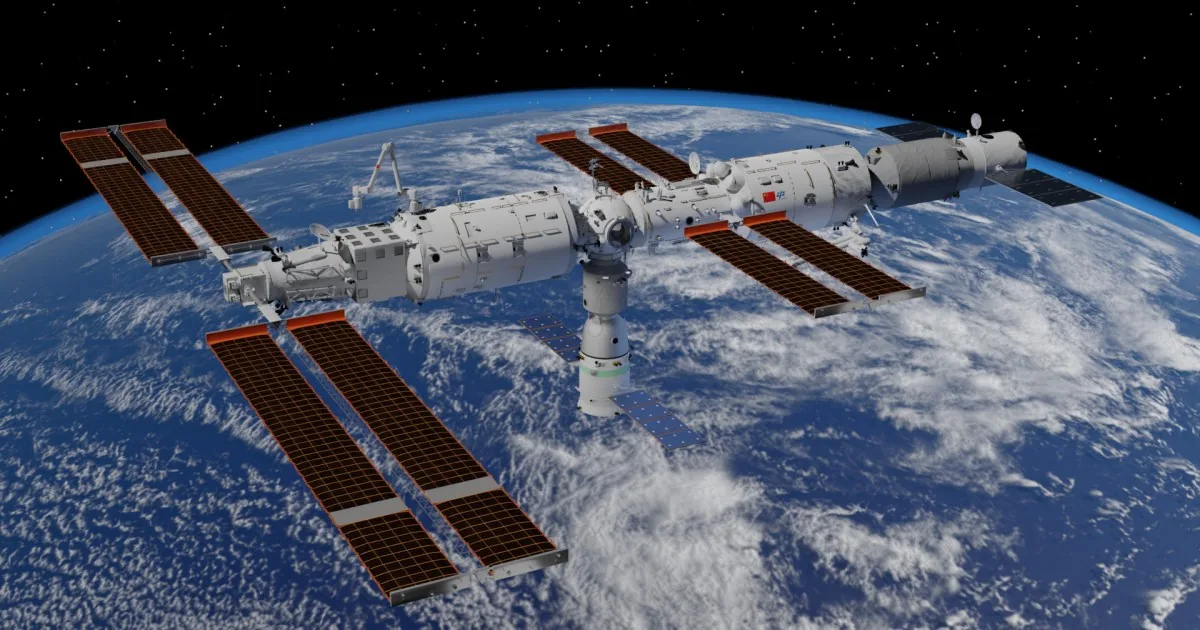
Shenzhou-24 is China’s 18th crewed spaceflight and its 12th astronaut mission to Tiangong. The Chinese station, whose name translates as heavenly palace, completed its assembly in late 2022 as a three-module complex operating in low Earth orbit [1]. The transit is fast. Spacecraft computers will execute automated orbital maneuvers to guide Shenzhou-24 toward the station, docking at Tiangong about 3.5 hours after reaching orbit [2].
Viewers around the world could follow the event live through broadcasts provided by China Central Television (CCTV) [1]. The flight gives outside researchers a clear look at how China handles routine crew rotations at its permanent station. Wajiha Iqbal, a lunar scientist at the University of Münster in Germany, said the launch is “a huge step” for Pakistan’s space goals. Iqbal added that working with China allows Pakistani researchers to “do great science in space” [2].
Crew Roles on Shenzhou-24
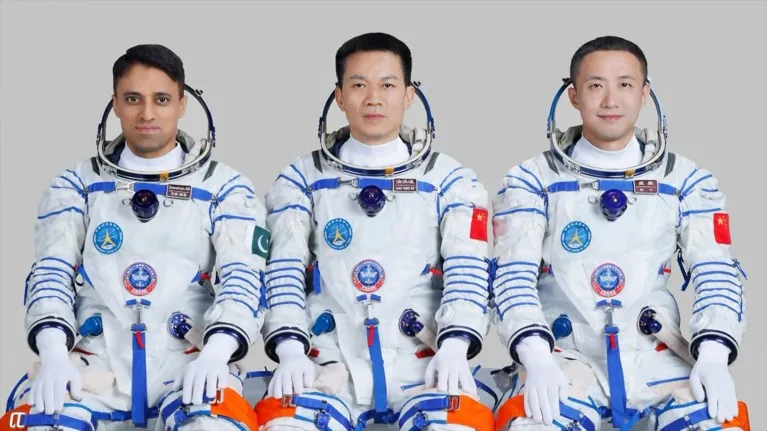
The Shenzhou-24 crew brings together three astronauts with distinct backgrounds to handle daily duties on board. Mission commander Tang Hongbo leads the flight, returning to orbit for his third tour on Tiangong. Tang previously flew on Shenzhou-12 in June 2021 and Shenzhou-17 in October 2023. Tang flew twice before. State-run Xinhua news agency reported that Tang is the first astronaut to visit the Chinese space station three separate times [1].
Serving with Tang is flight engineer Wu Yi, who is making his first journey into space. Wu had never flown. Tang and Wu will live aboard Tiangong for six months, which is the standard rotation period for Chinese crews [1]. Wu handles flight engineering duties, while Tang oversees crew coordination and station operations throughout the mission. Chinese astronauts, often called taikonauts, maintain constant staffing on the station to keep research modules operational day and night [2].
Ali takes a different role on the flight manifest, flying as a payload specialist rather than a pilot or flight engineer [1]. Because his assignment focuses on research, he is not responsible for flying the spacecraft or maintaining station hardware. Yuxuan Jia, who researches Chinese foreign policy at the Center for China and Globalization in Beijing, said the flight signals China’s “aspirations to become a top space power”. Jia said that expanding capabilities now let the nation provide orbital opportunities that few countries can match on their own [2].


Biotechnology Experiments on Tiangong
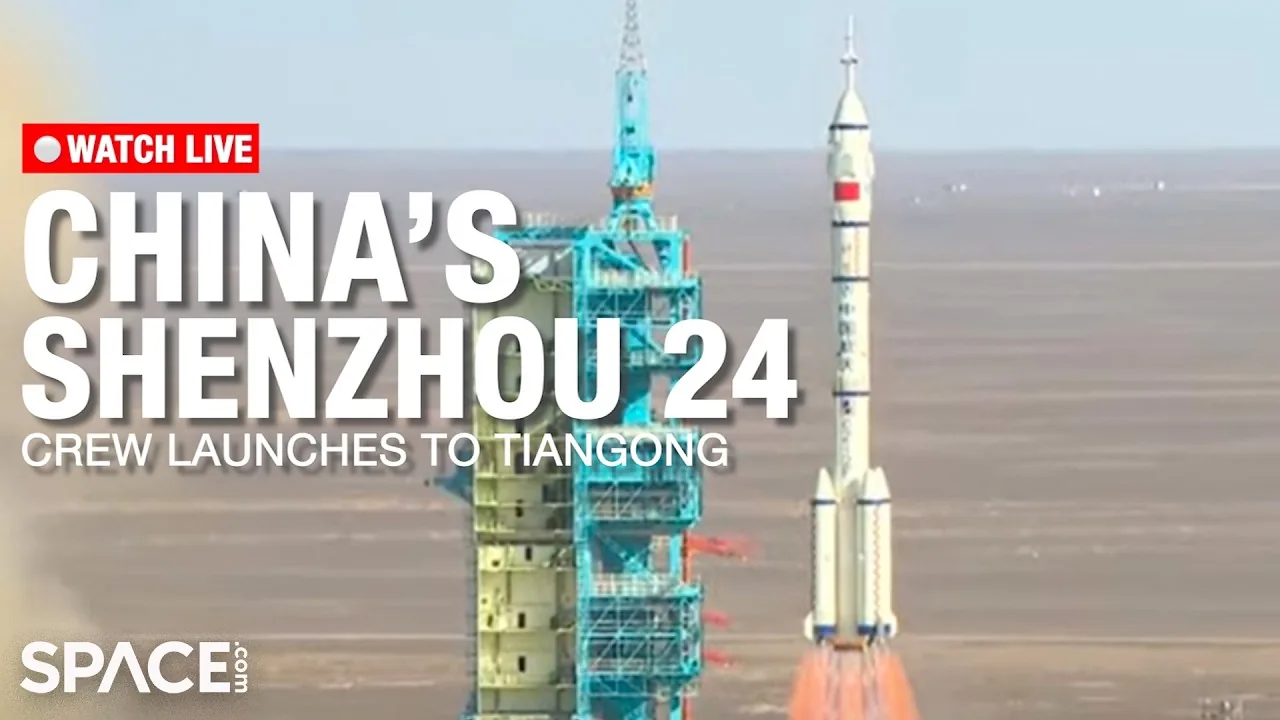
Ali’s main duties in orbit center on running biological tests designed by Pakistani academic institutions. Amer Gilani, an official at Pakistan’s space agency, told Reuters in September that the mission aims to host four biotechnology experiments developed by universities in Pakistan. Although specific details about the research have not yet been made public, the projects focus on biological sciences in microgravity. Carrying out these tests helps Pakistani researchers gather orbital data that ground laboratories cannot produce on Earth [2].
Beyond the university biological experiments, the mission supports Chinese medical studies on prolonged human spaceflight. Zhang Jingbo explained that researchers want to track human physical responses during orbital stays, observing bodily adjustments under prolonged microgravity conditions. Tiangong already supports multiple research racks, including facilities used for ultracold quantum gas experiments inside the orbital complex. Adding international studies to existing station hardware tests how visiting payload specialists interact with station systems during short stays [2].
To support the human adaptation study, Chinese mission planners adjusted crew schedules on the station [2]. Zhu Yangzhu arrived at Tiangong in May on Shenzhou-23. Rather than returning with his original launch partners, Zhu will remain aboard for an extra six months, making him the first Chinese astronaut to spend a full continuous year in orbit. According to the South China Morning Post, that year-long stay helps China gather data for future lunar missions and deep-space flights [1].
Bringing the Pakistani Astronaut Home
While Tang and Wu settle in for a six-month expedition, Ali will remain on Tiangong for only about a week [1]. His short mission is designed around quick execution of the biotechnology experiments, after which he must prepare his samples for return [2]. He will join Shenzhou-23 astronauts Zhang Zhiyuan and Lai Ka-ying, who have lived on the station since their arrival on May 24. The three crew members will board the Shenzhou-23 spacecraft and undock from Tiangong to head back to Earth [1].
This crew swap shows the flexibility of China’s rotation system at Tiangong. By sending a short-term visitor up with an incoming crew and returning him with outgoing astronauts, China can fly foreign specialists without losing a six-month working slot. Staggered crew handovers are a common sight in human spaceflight, where groups like the Expedition 74 crew on the International Space Station balance orbital handover duties. The Shenzhou-23 capsule will land in northern China, returning Ali as the first Pakistani astronaut to work aboard the Chinese orbital outpost [1].
For Pakistan, Ali’s return will conclude an initial orbital flight that officials hope will lead to deeper scientific ties [2]. SUPARCO leaders have expressed interest in expanding cooperation with China’s space programme, which could eventually include additional joint research projects or instrument payloads [3]. The data generated by the four biotechnology experiments will be transferred to Pakistani universities for analysis once the capsule is recovered. Scientists in Pakistan plan to examine how microgravity altered their biological samples during the week spent aboard the orbital station [2].
Broader Orbital Traffic This Week
The Shenzhou-24 launch takes place during one of the busiest launch windows of late 2026, with spaceports on several continents conducting orbital flights. On Nov. 24, Roscosmos prepared a Soyuz-2.1b rocket in Kazakhstan to deliver supplies on the Progress MS-36 freighter toward the orbital laboratory. At the Guiana Space Centre in French Guiana, Arianespace scheduled an Ariane 64 rocket to carry 36 Amazon Leo internet satellites after ground system issues halted an earlier attempt. In California, SpaceX planned a Falcon 9 launch from Vandenberg Space Force Base for the classified USSF-266 mission, aiming to land its booster on the droneship Of Course I Still Love You [3].
China itself maintains a crowded launch manifest in late November, with several state and commercial vehicles slated to lift off from different complexes. On Nov. 26, the China Aerospace Science and Technology Corporation plans a Long March 2D flight from the Xichang Satellite Launch Center. Rocket Lab also scheduled an Electron rocket from New Zealand’s Māhia Peninsula on Thursday to launch the StriX radar satellite for Japan’s Synspective. Additional Chinese launches later in the week include a Long March 6A from Taiyuan, a Kinetica 1 sea launch by CAS Space in the South China Sea, and a Long March 6C. Meanwhile, NASA and Northrop Grumman prepared an NG-25 Cygnus XL cargo spacecraft, named the S.S. James A. Lovell, to fly to the space station on a Falcon 9 from Cape Canaveral [3].
- ONLINE NEWS Wall, M. (2026). China launching 1st international astronaut to Tiangong space station today: Watch it live. Space.com. [Article Link]
- ONLINE NEWS You, X. (2026). Pakistani astronaut to become first foreign visitor to China’s space station. Nature. [Article Link]
- ONLINE NEWS Mendenhall, B. (2026). Pakistan’s first astronaut heads for China’s space station. Astronomy Magazine. [Article Link]
APA 7: PerEXP Teamworks. (2026, November 25). Shenzhou-24 Launches Pakistani Astronaut to China’s Space Station. PerEXP Teamworks. https://perexpteamworks.com/en/pakistani-astronaut-shenzhou-24-launch/


