



Can a stream of photons push backward against its own current without an external engine driving the propulsion? Physicists at Nankai University have demonstrated that a narrow laser beam can actively swim upstream within a broader quantum fluid of light by breaking action-reaction symmetry. Published in the journal Physical Review A, the experiment proves that nonreciprocal optical interactions generate an inverted recoil force inside a nonlinear crystal [1]. The discovery reveals that active autonomous motion does not require an internally motorized particle, offering a new physical mechanism to guide photons across optical circuits.
- How Photons Form a Quantum Fluid of Light
- Why Do Nonreciprocal Interactions Break Newton’s Symmetry?
- Laser Beams Create an Upstream Quantum Light Swimmer
- Can Light Move Upstream Without Shedding Vortices?
- Intermediate Densities Maximize the Upstream Thrust
- Future Quantum Devices Harnessing Synthetic Active Matter
How Photons Form a Quantum Fluid of Light
Light typically travels across empty space in straight lines without interacting with intersecting rays. However, when researchers shoot intense laser light into a specialized nonlinear crystal subjected to an electric voltage, the photons begin to scatter off one another, mimicking the collective hydrodynamic motion of liquid molecules. Lead author Siyu Li and his colleagues at Nankai University configured two timed laser beams to pass through such a medium, transforming an ordinary optical beam into a flowing stream that functions as a fluid of quantum light [1]. By tilting the broader laser beam, the physicists established precise control over its transverse flow velocity and spatial direction across the photorefractive medium.
In this experimental river, the broader laser field acted as the ambient fluid while a second, tightly focused beam served as the swimmer. Unlike speculative theoretical scenarios exploring black holes from light at quantum limits, which investigate extreme gravitational collapse under intense optical energy, this laboratory configuration operates through controlled collective scattering inside a solid-state crystal. Photons form the stream. The narrower wave packet was shaped as a single solitary wave (a localized, non-dispersing optical pulse), allowing the investigators to track its exact position as it encountered the opposing current [2].
Why Do Nonreciprocal Interactions Break Newton’s Symmetry?
Nonreciprocal interactions break action-reaction symmetry because one physical body alters its partner without experiencing an identical counterforce in return. Under classical mechanics formulated by Isaac Newton, every action generates an equal and opposite reaction, guaranteeing that mutual forces between two isolated entities remain symmetrical [3]. A boat traveling up a river must consume chemical fuel or electrical energy to overcome water drag, actively driving propellers to force fluid backward. When matter is driven out of equilibrium, internal interactions can convert into net momentum if the interacting bodies do not exert reciprocal forces on each other [1].
In standard physical interactions, two bodies experience the same category of force, such as the mutual gravitational attraction shared between Earth and our bodies. In the Nankai experiment, however, the solitary swimmer experienced an attractive interaction toward the optical river, but the river simultaneously experienced a repulsive force from the swimmer. While isolated macroscopic systems conform strictly to conservation principles alongside the second law of thermodynamics, open optical systems with non-equilibrium coupling can unlock directional motion without violating global conservation laws. Action-reaction symmetry broke entirely [2]. This mismatched coupling directed net momentum into the solitary beam.
Laser Beams Create an Upstream Quantum Light Swimmer
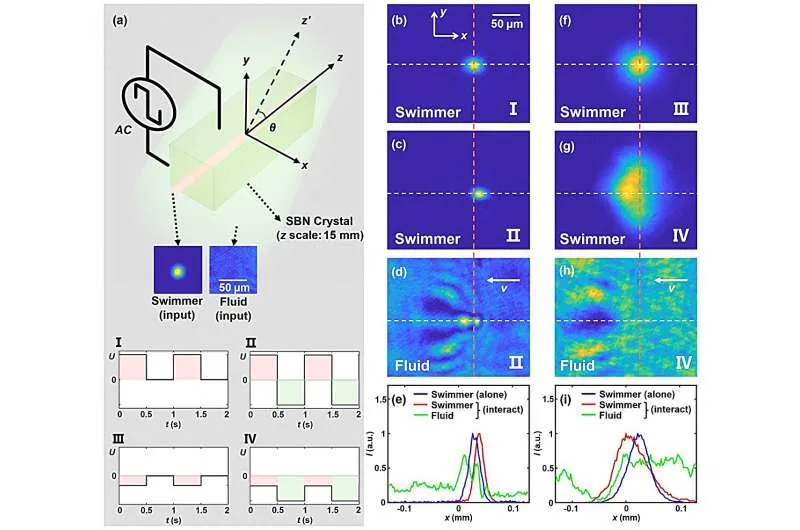
To confirm this phenomenon in the laboratory, the research team united theoretical scattering analysis, computer simulations, and optical bench measurements. Writing in Physical Review A, Siyu Li and co-authors explain that the swimmer beam alters the spatial distribution of the surrounding fluid as it propagates through the nonlinear crystal. As the swimmer cuts through the medium, the optical intensity on one side of the pulse becomes markedly higher than on the opposite flank. This asymmetric pressure gradient produces an inverted recoil force, pushing the narrow light pulse directly upstream against the incoming optical flow [1].
The team compared these experimental runs directly against conventional setups where nonreciprocal interactions were deliberately absent. In those reciprocal control tests, the narrow light beam simply drifted downstream along with the wider fluid current, exactly as traditional hydrodynamic intuition predicts. Senior editor Robert Egan and author Krystal Kasal at Science X Network noted that this direct comparison provided unambiguous visual verification of nonreciprocal propulsion. The beam drifted downstream [1]. By adjusting the phase and interaction parameters, the physicists observed the swimmer reverse its direction, confirming that upstream motion arose strictly from nonreciprocal coupling.


Can Light Move Upstream Without Shedding Vortices?
Optical beams can move upstream without shedding vortices by reorganizing the fluid density profile rather than generating turbulent swirls. Physicist Mathias Albert at Côte d’Azur University in France pointed out that previous laboratory demonstrations of upstream motion in quantum fluids of light relied on vortex shedding, where tiny optical whirlpools cast off behind an obstacle imparted momentum to the swimmer. That older mechanism obeyed Newton’s third law because the shedding of vortices carried away equal and opposite recoil momentum into the fluid wake [3]. The present experiment operates through a fundamentally distinct hydrodynamic principle.
In contrast, this new physical mechanism relies on intrinsic nonreciprocal forces, eliminating any dependence on wake turbulence. The swimmer consumes zero internal energy yet advances continuously through the flowing light field. Senior researcher Yi Hu emphasized that the experiment proves active autonomous motion does not require an internally driven swimmer, reframing how physicists perceive self-propulsion across quantum optical architectures. Yi Hu confirmed the finding [3]. As a consequence, nonreciprocal interactions offer an elegant route to engineer synthetic propulsion without the mechanical complexity of biological flagella or microscopic chemical motors.
Intermediate Densities Maximize the Upstream Thrust
Experimental measurements revealed that upstream propulsion does not increase linearly with fluid flow velocity or beam power. Instead, the researchers discovered that upstream motion peaked at intermediate fluid speeds and densities rather than at either extreme. When fluid velocity is excessively low, the nonreciprocal interaction fails to generate sufficient momentum transfer; conversely, when the fluid flow becomes too fast, the drag of the moving photons overwhelms the inverted recoil force. Scientific editor Gaby Clark highlighted that mapping these operating parameters provides crucial empirical boundaries for optical hydrodynamic engineering [2].
The authors clarify that their experimental setup represents an optical analog of a quantum fluid rather than material fluids like liquid helium or ultracold atomic clouds. In material quantum systems, atoms interact through matter-wave collisions, demanding complex cryogenic refrigeration. In contrast, this photorefractive crystal generates effective photon-photon interactions at room temperature by coupling electric voltage with nonlinear refractive index shifts. This table-top configuration provides an accessible test bed for studying non-equilibrium hydrodynamic phenomena without the cryogenic overhead required by conventional Bose-Einstein condensates [1].

Liquid helium was not required [1]. Benchtop lasers bypassed cryogenic equipment while isolating nonreciprocal momentum transfers.
Future Quantum Devices Harnessing Synthetic Active Matter
The ability to direct optical wave packets upstream against fluid currents opens unexpected possibilities for photonic technology and active matter research. Active matter has historically encompassed living systems like bacterial swarms, flocks of migrating birds, or engineered microscopic robots that consume chemical fuel to navigate their surroundings. Mathias Albert observed that physicists worldwide are actively investigating how concepts from active matter can merge with photonic platforms and quantum fluids of light. Controlling light packets so they travel along selected directions could directly enhance signal routing in integrated optical circuits [3].
Looking ahead, Yi Hu and his collaborators plan to construct more intricate experimental architectures. These future setups will attempt to control multiple swimmers simultaneously or steer light beams through complex, three-dimensional flow patterns inside nonlinear crystals. Demonstrating nonreciprocal transport in optical analogs creates a scalable blueprint for exploring related phenomena across atomic gases and solid-state photonic chips. As quantum information processing and optical communications demand increasingly sophisticated control over individual photons, nonreciprocal light fluids offer an innovative toolkit for governing light transport beyond traditional Newtonian constraints [1].
- ACADEMIC JOURNAL Li, S., Xia, J., Zhang, R., Hu, Y., & Xu, J. (2026). Active upstream motion in a quantum fluid of light arising from nonreciprocal interactions. Physical Review A, 114(3). [Article Link]
- ONLINE NEWS Kasal, K. (2026). Light beam ‘swims’ upstream through a quantum fluid by violating Newton’s third law. Phys.org. [Article Link]
- ONLINE NEWS Padavic-Callaghan, K. (2026). Swimmer made of quantum light breaks Newton’s third law. New Scientist. [Article Link]
APA 7: TWs Editor. (2026, September 23). How a Quantum Fluid of Light Bypasses Newton’s Third Law. PerEXP Teamworks.


