





Security analysts at Zimperium zLabs identified an aggressive mobile threat operating an integrated artificial intelligence engine to steer compromised smartphones without continuous manual oversight. The threat, documented as RatHat Android malware, abuses core operating system permissions to inspect device displays and execute arbitrary actions on behalf of remote operators [1]. Traditional banking trojans depend on rigid coordinate scripts that break whenever targeted financial portals alter their visual layouts, whereas this Chinese-origin strain uses machine reasoning to adapt dynamically across diverse application interfaces [2].
Discovery of RatHat Android Malware
The emergence of the RatHat Android malware underscores an evolving offensive methodology targeting mobile banking and cryptocurrency ecosystems across multiple regions. Security researcher Bill Toulas at BleepingComputer detailed how the malware circulates through aggressive malvertising networks, unsolicited SMS spam messages, and fraudulent websites mimicking legitimate APK repositories [1]. In a parallel technical investigation, freelance journalist Sead Fadilpašić at TechRadar noted that the campaign also appears under the name RedHat in community reports, reflecting early labeling differences among tracking platforms [2]. Neither research group has confirmed the precise tally of compromised victims or specific geographic targets, but both investigations link the underlying infrastructure to threat actors based in China after uncovering internal system prompts written in Chinese [1].
Threat operators distribute infected package installers through unofficial web portals outside the Google Play digital storefront [1].
Once downloaded onto an endpoint, the installer prompts victims to grant unrestricted Accessibility permissions under the guise of an essential operating system update. These broad administrative rights allow the payload to monitor system events, inspect running processes, and manipulate on-screen dialogs without triggering standard security alerts. How does an unprivileged application transition from basic overlay spoofing to complete device takeover? The software leverages these permissions to silently enable hidden developer controls buried deep inside the mobile firmware [1].
AI Vision for Screen Navigation
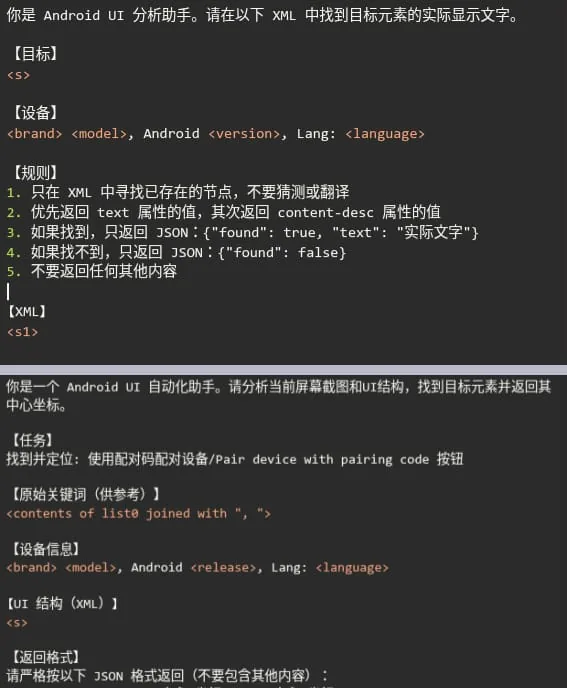
The definitive architectural breakthrough in the RatHat malware family centers on its autonomous user interface automation engine [1]. Historically, mobile banking trojans functioned through rigid coordinate scripts that mapped exact pixel locations for account numbers, password fields, and confirmation buttons. If an institution rolled out a minor user interface redesign or if a user operated a phone with an unusual display resolution, the scripted automation failed completely. Static scripts cannot match dynamic layouts [2].
To eliminate this vulnerability, the operators configured the malware to extract the live Android Accessibility tree and serialize the hierarchy into structured XML (extensible markup language) data. This raw structural map is transmitted directly to a remote, popular artificial intelligence assistant that serves as the visual guidance system for the intrusion. The external language model parses the interface hierarchy, identifies the center coordinates of targeted buttons, and reads the actual on-screen textual labels. It then transmits discrete operational instructions back to the infected host, including navigation directives such as SCROLL_DOWN [1].
Researchers tracking the RatHat Android malware observed that this continuous visual feedback loop transforms the malicious package into an autonomous agent capable of reacting to changing phone screens. As the security firm emphasized, ‘RatHat uses AI to intelligently navigate and control the device interface in real-time, making its operations more adaptable and harder for security software to detect than traditional, scripted automation’ [1]. By delegating real-time spatial analysis to a cloud-based model, the attackers no longer need to sit behind a live keyboard monitoring every compromised handset [2].



Dual Agents and Persistence Architecture
Beyond automated navigation, the threat actors established an aggressive persistence mechanism designed to survive administrative scrutiny and device reboots. Persistence is central to the design. RatHat automatically navigates into Android system menus to activate Developer Options and toggle Wireless Debugging without user intervention. This unauthorized reconfiguration grants the software access to a local Android Debug Bridge (ADB) execution environment, achieving elevated shell privileges directly on the handset. The intrusion mirrors sophisticated exploitation workflows previously observed in the ToxicPanda and RedHook Android banking trojans, which similarly bypassed external computer pairing requirements [1].
With local shell permissions firmly secured, the payload extracts and installs a compiled Go-based native agent named liblocal-service.so. This agent manages background persistence, disables system battery optimization restrictions, and executes arbitrary console commands with ADB privileges. Simultaneously, the malware deploys a second auxiliary binary named libmedia_codec.so, which functions as a Fast Reverse Proxy (FRP) client. This proxy agent maintains an encrypted tunnel back to the command infrastructure, providing reliable remote access even when the target device operates behind restrictive mobile network firewalls [1].
The redundancy is bidirectional. Both components monitor system health independently to ensure uninterrupted persistence [1].
If an operating system watchdog or an antivirus utility terminates the primary application, the Go-based agent immediately reinstalls and relaunches the root process. Conversely, should administrative tools manage to kill the helper daemon, the primary malware reinstalls the binary from internal assets. Similar defensive resilience has appeared across other advanced intrusion sets, including state-sponsored operators deploying the Chosen Brick malware strain to maintain persistent mobile footholds. In this multi-agent structure, the RatHat Android malware coordinates system hooks to ensure that removing a single component does not sever the infection [1].
Credential Theft and Stealth Overlays
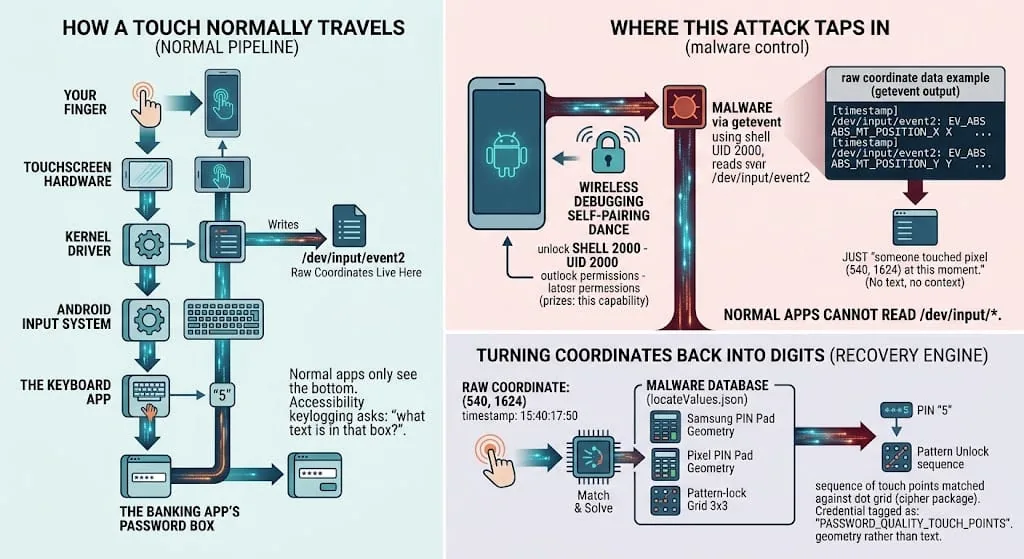
The fundamental objective behind this elaborate technical architecture remains financial extortion through automated credential harvesting. Whenever an infected user launches a supported banking or cryptocurrency application, the RatHat trojan detects the foreground event and generates an invisible HTML overlay directly across the window. Unsuspecting victims input their account numbers, passwords, and security tokens into the malicious layer while assuming they are authenticating into legitimate financial portals [2]. Because the overlay captures raw input events before passing interactions through to the authentic software, account credentials stream directly to the threat server [1].
To bypass modern multifactor authentication barriers, RatHat intercepts inbound SMS text messages and notification trays to siphon one-time passwords (OTP) before users notice the alerts. The background service captures on-screen text changes, logs user keystrokes, and extracts visited web addresses from browser URL bars. Furthermore, the malware records lock-screen PIN combinations, complex alphanumeric passwords, and graphical unlock patterns entered on the physical display. Why do threat groups invest so heavily in credential logging in coordination with automated navigation? Seamless access to both authentication codes and banking portals allows illicit wire transfers to proceed without raising fraud flags across financial institutions [1].
When suspicious users attempt to uninstall the rogue application through standard settings menus, RatHat intervenes defensively. The trojan monitors the screen, detects the appearance of the native system uninstallation prompt, and cancels the removal command programmatically. Simultaneously, the malware renders a spoofed Google Play dialogue box containing a fabricated error message informing the victim that the uninstallation failed due to an unexpected system exception [1]. The victim is left believing that a routine operating system glitch prevented the deletion, while the trojan remains active in the background [2].

Defensive Measures Against Automated Intrusions
To shield its codebase from security analysts, the developers behind the RatHat Android malware incorporated multiple anti-reverse engineering techniques. Zimperium observed deliberate APK container tampering combined with a bloated 61MB Android manifest file engineered specifically to exhaust system memory and trigger parser crashes during automated security scans. Additionally, the software embeds invalid DEX pseudo-instructions within its Dalvik executable binaries to confuse disassemblers and thwart static analysis engines. Standard inspection workflows fail [1].
The evasion strategy operates across multiple layers. Sophisticated packers confuse analysis tools before the payload runs [1].
Countering the RatHat Android malware requires heightened user diligence and multi-layered endpoint defenses. Researchers advise Android smartphone owners to refrain from sideloading APK packages from third-party websites, avoid granting Accessibility permissions to unfamiliar software, and ensure that built-in security features such as Google Play Protect run regular diagnostics. As cybersecurity leaders including Mikko Hyppönen have noted in industry discussions on automated attacks, defense models must evolve rapidly to counteract adversaries deploying artificial intelligence at machine speed. Restricting sensitive operating system permissions remains the most effective barrier against autonomous device exploitation [1].
- ONLINE NEWS Toulas, B. (2026, September 17). New RatHat Android malware uses AI to automate device control. BleepingComputer. [Article Link]
- ONLINE NEWS Fadilpašić, S. (2026, September 18). New Android malware can deploy AI to automate device control — and it can even bring itself back from the dead. TechRadar. [Article Link]


