





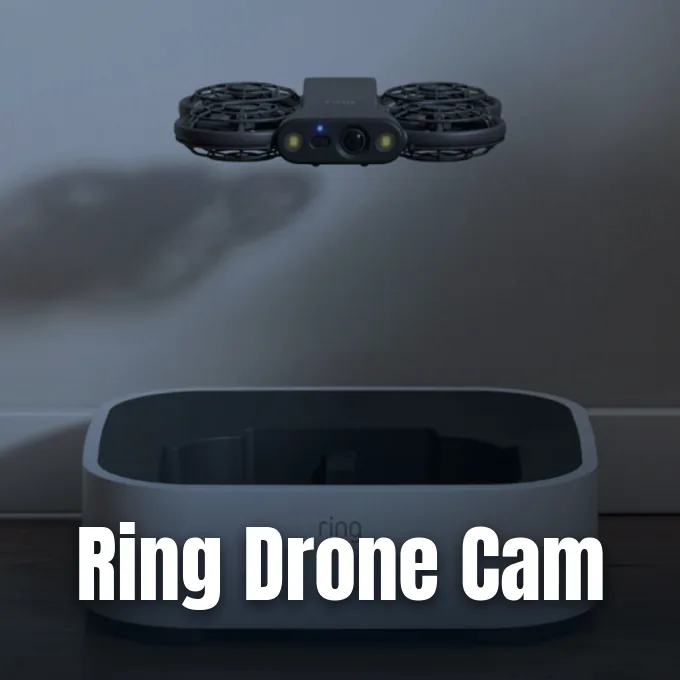
Amazon announced a new robotics division within Ring on November 10, introducing two autonomous mobile devices designed to patrol indoor spaces. The lineup includes the Ring Drone Cam, a $249.99 flying indoor camera, alongside the $999.99 Ring Rover Cam built to monitor commercial offices, retail sales floors, and industrial warehouses without fixed wiring [1]. Both machines navigate spaces using AI Pilot [7]. Instead of waiting for activity near a stationary lens, the devices travel directly to investigate tripped sensors or follow preset schedules using cloud-linked vision models to avoid furniture and walls [2].
Ring Drone Flight Hardware
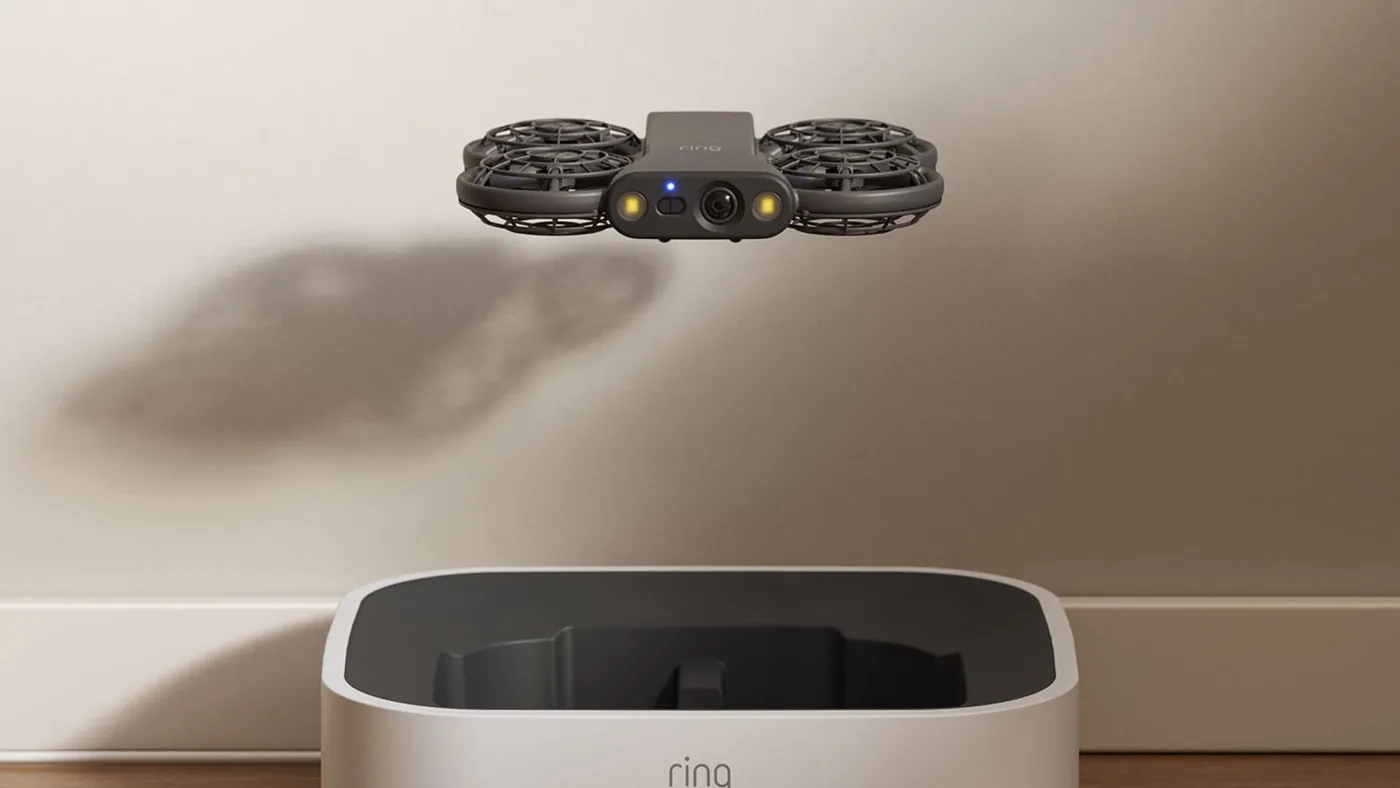
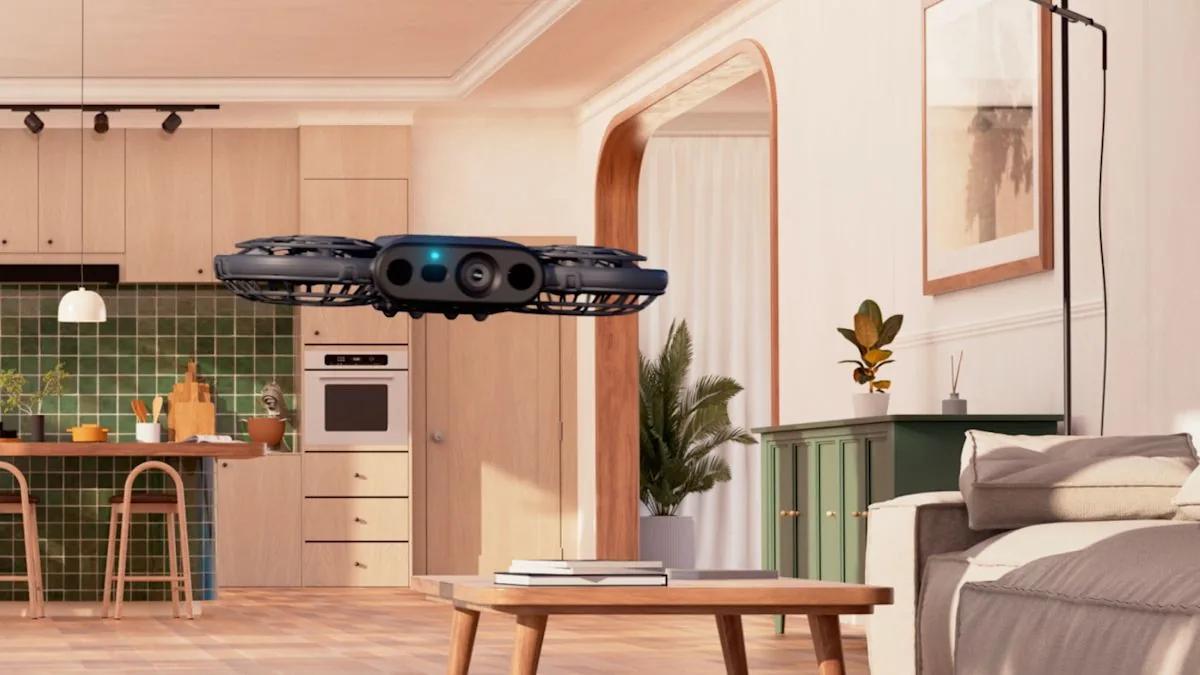
The Ring Drone Cam stays docked until an alarm activates [3]. When a door contact or window sensor trips anywhere in the house, the textbook-sized quadcopter lifts off autonomously, flies along a preset indoor path to investigate the disturbance, and returns home to recharge [2]. Homeowners can also summon the craft manually through Amazon’s Alexa Home Map mobile app [3]. It records video in 2K resolution, carries a camera lens with a 148-degree field of view, and rotates 360 degrees to scan wide living rooms or entry halls [1].
Flight time lasts up to eight minutes. Two plastic-encased propellers keep the flying unit airborne and emit a distinct buzzing sound that alerts anyone in the house that a camera is operating in the room [2]. Dual built-in LED lights activate automatically in dim rooms so the camera can record in low-light environments [1]. At a demo in New York, Ring founder Jamie Siminoff told reporters that an airborne spotlight warns intruders that they have been spotted before they can move deeper into the property. “If someone is going around your house at night, and your motion detector goes off on your Ring doorbell, imagine if you see spotlights and something flying across the window,” Siminoff said. “You’re probably not going to go into that house.” [2]
In 2020, Ring previewed an indoor drone called the Always Home Cam at the same $249.99 price, but the hardware never shipped to customers. Adding onboard sensors made earlier prototypes too heavy to fly. Siminoff told Wired that moving computer processing into cloud infrastructure finally solved the weight problem, allowing engineers to trim onboard hardware so the craft could achieve stable indoor flight [5].
Rover Hardware for Business
The flying camera focuses on residences, but the new Ring Rover Cam targets commercial enterprises that need mobile patrols without paying to install stationary security cameras across every hallway and room. The wheeled robot costs $999.99 for business buyers [1]. Amazon previously expanded beyond Echo speakers and Eero routers with the Astro robot, which debuted in 2021 as a domestic companion before a brief deployment in commercial security roles prior to its retirement [2]. Ring redesigned the chassis from the ground up. The finished machine rolls on a two-wheeled base, carries a front information display, and features an extendable periscope camera mast designed to inspect elevated surfaces [1].
The periscope mast raises and lowers to peer over sales counters, display tables, and warehouse storage racks that would otherwise block the view of a floor-level security camera [1]. The rover streams video in up to 4K resolution [3]. If an alarm trips after business hours, the rover rolls straight to the reported coordinates, extends its periscope, and performs a 360-degree scan and streams live footage to a manager’s phone. It also detects moving people even when parked in its charging dock [1].
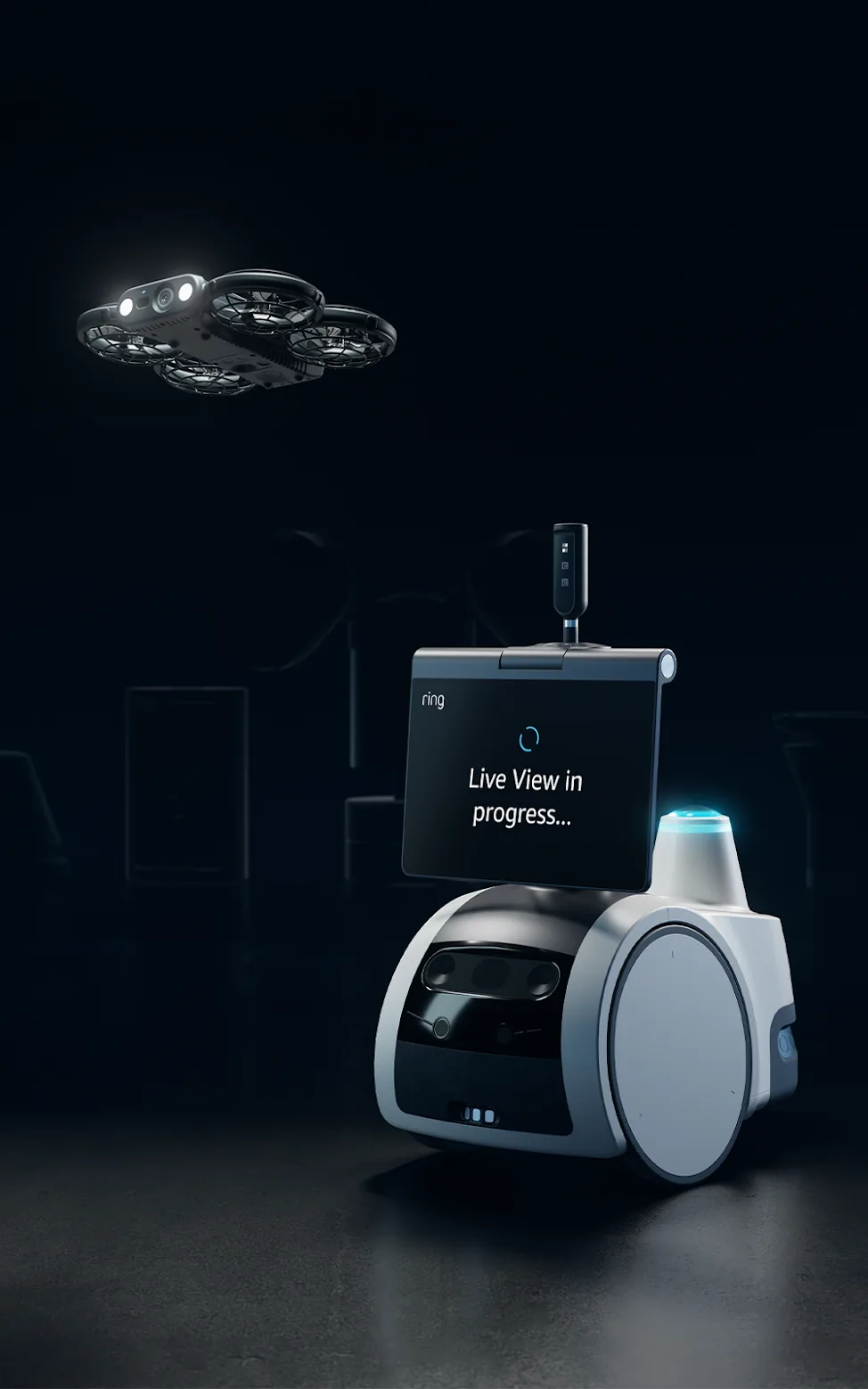
The rover carries active warning gear. Ring equipped the rover with an audible siren, two-way audio communications, and an overhead light tower that shines a bright beam onto the ceiling so staff can track its position [2]. “Together, it’s like having a guard on patrol who never clocks out,” Ring stated in its product announcement [1].


AI Pilot Navigation
Both mobile devices rely on a shared navigation platform called AI Pilot, which combines camera video, on-device sensors, and cloud computing to help each machine navigate complex indoor environments autonomously [1]. Setting up the system is straightforward. To map a house, an owner carries the drone from room to room while its cameras record the layout. For commercial properties, the rover rolls along hallways on its own, translating what its sensors see into a digital floor plan without requiring manual guidance from staff [7].
Once the software finishes the indoor map, AI Pilot automatically suggests key patrol points where extra monitoring helps, including retail cash registers, rear exit doors, and ground-floor display windows. Business operators can accept those suggested points or add custom stops through the app. When a patrol begins, the system plots an efficient route between checkpoints and updates its heading in real time to steer around unexpected obstructions such as moved chairs, ladders, or delivery boxes [1].
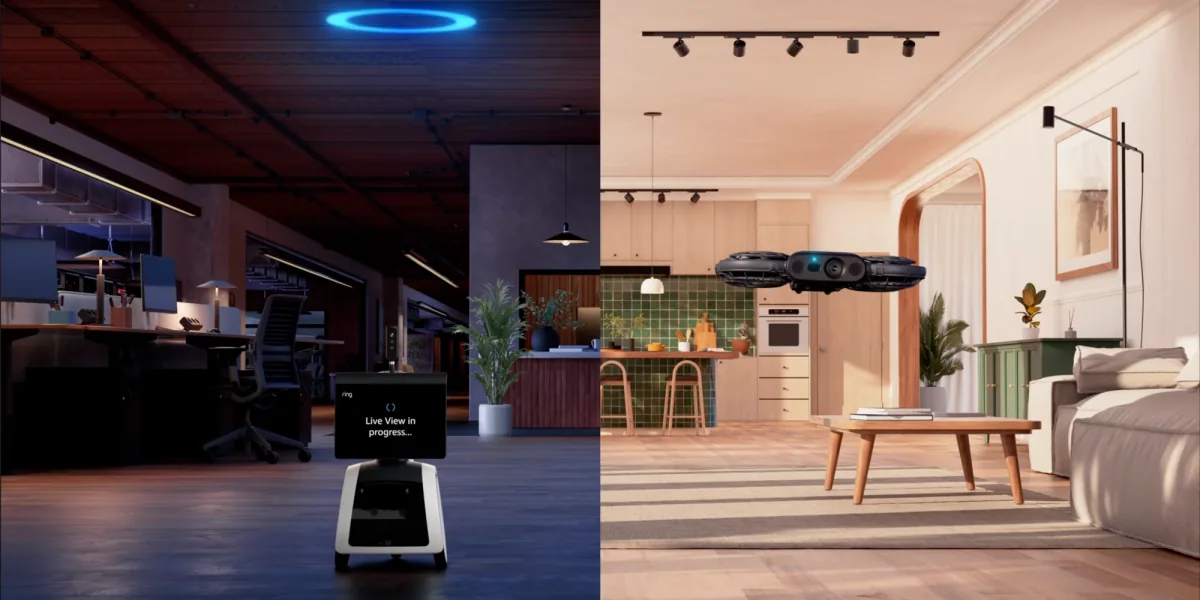
Amazon is introducing these mobile tools into a smart home market where research firm Grand View Research estimates annual sales will top $200 billion this year. Industry rivals Apple and Google also sell connected home devices, but neither company markets autonomous flying or rolling guards. Siminoff explained the customer feedback behind the mobile camera designs during an interview. “People like indoor cameras, but they don’t necessarily want them everywhere around their home,” Siminoff said [2].
Privacy Safeguards
Mobile surveillance cameras inside private properties inevitably raise civil liberties questions. Ring has faced sustained public scrutiny since Amazon acquired the company in 2018, primarily over police access to neighborhood doorbell footage and automated facial or license plate scanning. Earlier this year, Ring drew controversy over an artificial intelligence pet-finding tool called Search Party that aired during the Super Bowl broadcast. Ring later canceled a planned partnership with license plate reader firm Flock Safety after privacy advocates voiced objections [2].
To address consumer skepticism, Ring built privacy safeguards into the physical design of both robotic devices. When resting in its base station, the drone powers down its camera completely, ensuring that the sensor can’t capture video or audio until an authorized flight begins. The rover includes a manual Sleep Mode that turns off its microphone and retracts its periscope mast. Flashing LED indicators show when recording starts. Customer videos are secured by Throw Away the Key encryption, a default protection system that Ring described as its strongest encryption standard yet for safeguarding sensitive indoor recordings. Ring said both devices are built to be seen and heard rather than travel silently through living quarters [1].

Privacy advocates caution that mobile cameras bring new digital risks. Michelle Dahl, who leads the Surveillance Technology Oversight Project as a civil rights attorney, warned that indoor surveillance devices create attractive targets for unauthorized network intrusion. “When you are allowing cameras within your own home, there is a really big risk of a data breach,” Dahl told NBC News. “It’s a bizarre thing to introduce to the market when you consider all the issues it poses.” [4]
Pricing and Rules for Ring Drone Cam
Amazon plans U.S. customer deliveries for the Ring Drone Cam on January 27, 2027, at $249.99, and the Ring Rover Cam begins shipping to commercial buyers on December 16, 2026, for $999.99 [1]. Both devices need an active Ring Protect subscription plan costing $5 each month or $60 per year to unlock automated patrols and preserve recorded cloud video [4]. Commercial buyers can preorder the rover immediately, but drone purchases must wait until federal regulators finish reviewing the flying device’s communications hardware [1].
The Federal Communications Commission has not yet issued regulatory authorization for commercial sale of the drone [1]. Federal regulators have tightened restrictions on imported drone electronics, and Ring told The Verge that its drone is assembled in the United States to meet all agency rules [5]. Federal aviation rules also restrict outdoor drone flight. Because Federal Aviation Administration regulations prohibit operating drones beyond the pilot’s visual line of sight, Siminoff said Ring installed software boundaries that prevent the device from flying outdoors under any circumstances [2].
By taking surveillance cameras off fixed walls and putting them into motion, Amazon is testing whether consumers and small businesses want active robotic patrols inside their private spaces. Siminoff defended the multi-year development effort during the product debut. “For years, customers told us they wanted eyes in the places a fixed camera couldn’t reach, and peace of mind in the spots they’d never want one,” Siminoff said. “The honest answer wasn’t more cameras; it meant reimagining what a security device could be. That kind of invention is hard, and it takes time. But we kept at it until we got it right—and that’s Ring Robotics.” [1]
- PRESS RELEASE Amazon Staff. (2026, November 10). Ring announces Ring Robotics, ushering in a new era of security. About Amazon. [Article Link]
- ONLINE NEWS Palmer, A. (2026, November 10). Amazon’s Ring unveils flying drone and robot to patrol homes and businesses. CNBC. [Article Link]
- ONLINE NEWS Ropek, L. (2026, November 10). Ring, known for its doorbell cameras, launches a home security drone and an enterprise security robot. TechCrunch. [Article Link]
- ONLINE NEWS Li, D. K. (2026, November 10). Amazon’s Ring debuts security robots, including a drone. NBC News. [Article Link]
- ONLINE NEWS Eckert, N. (2026, November 10). Amazon’s Ring introduces security drone and robot. Yahoo Tech. [Article Link]
- ONLINE NEWS Casiano, L. (2026, November 10). Amazon’s Ring launches flying security drones, patrol robots to guard homes, businesses. Fox Business. [Article Link]
- ONLINE NEWS Ars Technica. (2026, November 10). Ring cameras go mobile as Amazon debuts AI-powered security drone and robot. [Article Link]


