






Geologists have long debated how planetary air currents sculpt massive dunes over centuries without constant weather monitoring. A research team at Stanford University examined this dynamic using wind observations and grain measurements from global deserts. Their analysis, published in the Proceedings of the National Academy of Sciences, shows that sand dunes on Earth and Mars form through winds blowing only moderately above the threshold required to move grains. The answer surprised the Stanford team [1].
Minimum Speeds for Moving Grains
How strong does the wind need to be to shape desert sand into towering hills? Common intuition suggests that hurricane-force tempests would dominate landscape evolution by pushing immense volumes of loose sediment across dry terrain. The Stanford University team discovered that ordinary breezes blowing regularly above the movement threshold do most of the actual work of building dunes over time. Rare catastrophic storms blow grains far away without adding to dune height [1].
Wind moves loose sand in predictable stages across open terrain. Air currents can lift fine particles into the sky or push heavier pieces along rocky gravel plains. Smaller grains generally begin moving under different conditions than larger ones, meaning particle size directly reveals the strength of moving air required to initiate motion [1].
Grains within a desert field sort themselves into predictable size brackets based on local atmospheric cycles. Because grain sizes reflect the air speed needed to set them in motion, a dune preserves a natural record of past winds. Geologists calculate past wind speeds by measuring the diameter of quartz or basalt particles. Once wind speeds pass that movement threshold, sand grains bounce along the surface in an ongoing chain reaction that shapes massive ridges across desert terrain over centuries. Ordinary grains of sand function like a natural wind gauge frozen in place, preserving environmental information long after the winds have vanished [1].
Wind Observations in 24 Deserts
To test this relationship, the Stanford University team gathered meteorological records and sediment samples from 24 dune fields spread around Earth. Fieldwork examined thirty years of wind observations and grain measurements from weather stations to track seasonal shifts in wind strength. Mathematical models determined which specific air velocities transported the highest volume of sediment across each desert site [1].
Desert winds vary widely between dry continental interiors and windy ocean coasts, where coastal dunes encounter moist air and shifting gusts while inland deserts face intense daytime heat and dry seasonal drafts. In all 24 studied locations, dominant grain sizes matched the wind speeds that blow most frequently above the transport limit. The strongest storm gusts, while capable of stripping fine topsoil, blow too rarely throughout any given year to construct the main body of a desert dune, meaning winds only moderately above the threshold move vastly more sediment over decades than rare violent tempests [1].
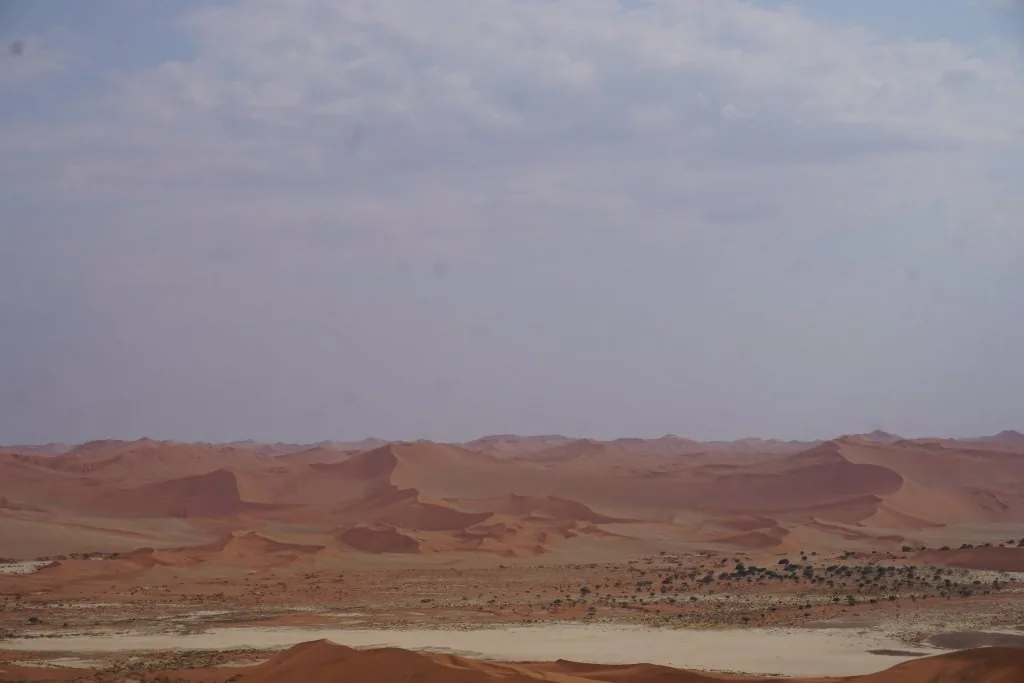
Field observations revealed that dune morphology stays consistent under normal atmospheric variations because sand grains creep steadily forward during common afternoon breezes to feed the crest over months. Dune growth relies on steady persistence rather than raw meteorological violence [1].
Atmospheric Pressure on Mars
Mars presents a starkly different environment for atmospheric science compared to Earth. With a mean diameter of 6,779 kilometers (4,212 miles), the fourth planet from the Sun has about half the diameter of Earth, double that of the Moon, and roughly one-third of terrestrial gravity. Its thin atmosphere consists mostly of carbon dioxide (CO2) at a surface pressure that measures merely a few thousandths of Earth’s atmosphere, while cosmic radiation and extreme aridity define the desert world cataloged on Mars: The Red Planet. The planet hosts towering volcanic formations such as Olympus Mons, which rises 21.9 kilometers high, as well as large rift systems like Valles Marineris spanning 4,000 kilometers. Loose sand blankets vast plains across both Martian hemispheres [2].
Surface temperatures on Mars swing between −153 and 20 °C (−243 to 68 °F), producing sharp thermal contrasts between seasons. Because the Martian axial tilt of 25 degrees mirrors Earth’s tilt of 23.5 degrees, the planet experiences distinct seasonal cycles during its 687-day solar year [2]. Low atmospheric density means winds must travel much faster than terrestrial breezes before they exert enough drag to budge heavy mineral grains [1].


Comparing Martian Sand Dunes
Planetary scientists long questioned whether the physics of dune building would hold true under Martian gravity and low atmospheric pressure. Mars entered its current dry era, known as the Amazonian period, roughly three billion years ago after wetter conditions in the Noachian and Hesperian epochs ceased. Geological evidence shows that an intermittent flow of water possibly lasted hundreds of millions of years in Martian valleys before winds became the sole sculpting force on the surface. During each 24.6-hour Martian solar day (sol), atmospheric circulation drives localized wind gusts across dry impact basins, gradually shifting surface dust [2].
To investigate Martian dunes, the Stanford University researchers applied their grain-size model to high-resolution measurements from a Martian dune field. Although Mars has much thinner air and different gravity than Earth, the relationship between sediment size and dune-building winds proved very similar to terrestrial dunes. Winds only moderately above the threshold do the main work of moving sand on Mars [1].
Planetary geologists struggled for decades to explain dune formation in thin atmospheres. Early orbital exploration with Mariner 9 in 1971 and robotic orbiters operating since 1997 photographed vast dune ripples across the planet [2]. Yet orbital anemometers recorded few violent storms capable of shifting heavy basalt grains on Martian plains. The Stanford University model explains that Mars does not require violent gales to accumulate dunes, because gentle winds blowing just above the movement threshold gradually shift massive amounts of sand over centuries [1].
Ancient Sand Dunes as Climate Records
Preserved wind thresholds provide a valuable window into deep geological history on Earth. Preserved in lithified rock formations around the world, ancient sandstone strata contain fossilized sand dunes formed billions of years ago. These stone layers retain the exact grain packing and dimensions of deserts that existed long before modern weather instruments or written observations existed. Ancient sandstone acts as a climate record [1].
Similar methods could also unlock climate histories on other planetary bodies throughout the Solar System. Radar data from space missions has confirmed broad dune fields in the dense carbon dioxide atmosphere of Venus and the frozen hydrocarbon plains of Saturn’s moon Titan. While orbital photographs readily indicate wind direction from dune crest orientations, estimating ancient wind speeds remained far more difficult until grain size relationships were established. By analyzing grain sizes preserved in ancient sediments, researchers can now infer the atmospheric density and wind energy of alien worlds with far greater confidence. Dunes also cover Venus and Titan [1].
Geologists evaluate past planetary climates by comparing fossilized dune structures with computer simulations. Sand grains serve as durable barometers that outlast the breezes that originally carried them over ancient plains. This geological evidence helps researchers test computer models of planetary climates to discover whether ancient atmospheres changed gradually or experienced epochs of stronger winds [1].
Limits of Grain Size Analysis
Despite the mathematical clarity of the grain-size model, Stanford University researchers stressed that the technique is not universally applicable to every desert setting on Earth or other planetary bodies. When local environments introduce surface moisture and sediment cohesion, water binds sand particles together and drastically increases the force required to initiate movement, breaking the expected link between wind speed and grain dimensions. Complex terrain introduces turbulence. Scientists must carefully evaluate regional humidity and ground conditions before applying grain formulas to ancient sandstone deposits on Earth or Mars [1].
Further testing across different geological landscapes will be necessary to refine the methodology before applying it broadly to extraterrestrial environments on Mars, Venus, or Titan. Researchers must pair grain analysis with detailed environmental models of each planetary basin to avoid misinterpreting unusual wind cycles. Orbital imagery and grain measurements together yield the clearest view of how winds shaped planetary surfaces in the distant past [1].
- ONLINE NEWS Knowridge. (2026, November 17). Sand dunes could reveal ancient wind speeds on Earth and Mars. [Article Link]
- WEBSITE Wikipedia. (n.d.). Mars. [Article Link]
Cover image: Original: João D'Andretta Derivative work: Aristeas / Wikimedia Commons, CC BY-SA 4.0
APA 7: PerEXP Teamworks. (2026, November 18). Sand Dunes on Earth and Mars Built by Moderate Winds. PerEXP Teamworks. https://perexpteamworks.com/en/sand-dunes-wind-speeds-earth-mars/


