





Extortion group ShinyHunters announced that it compromised internal federal networks in a major ShinyHunters FBI breach, allegedly stealing terabytes of personnel records by weaponizing an unpatched zero-day vulnerability in Oracle PeopleSoft. The cybercriminal operation claimed unauthorized access to sensitive recruitment portals before federal administrators severed external connectivity to halt lateral movement. While the Federal Bureau of Investigation confirmed an inquiry into unauthorized activity on its recruitment website, neither the bureau nor ShinyHunters responded to inquiries from TechCrunch regarding confirmed system compromises [1, 2].
ShinyHunters FBI Breach Claims Target Recruitment Systems
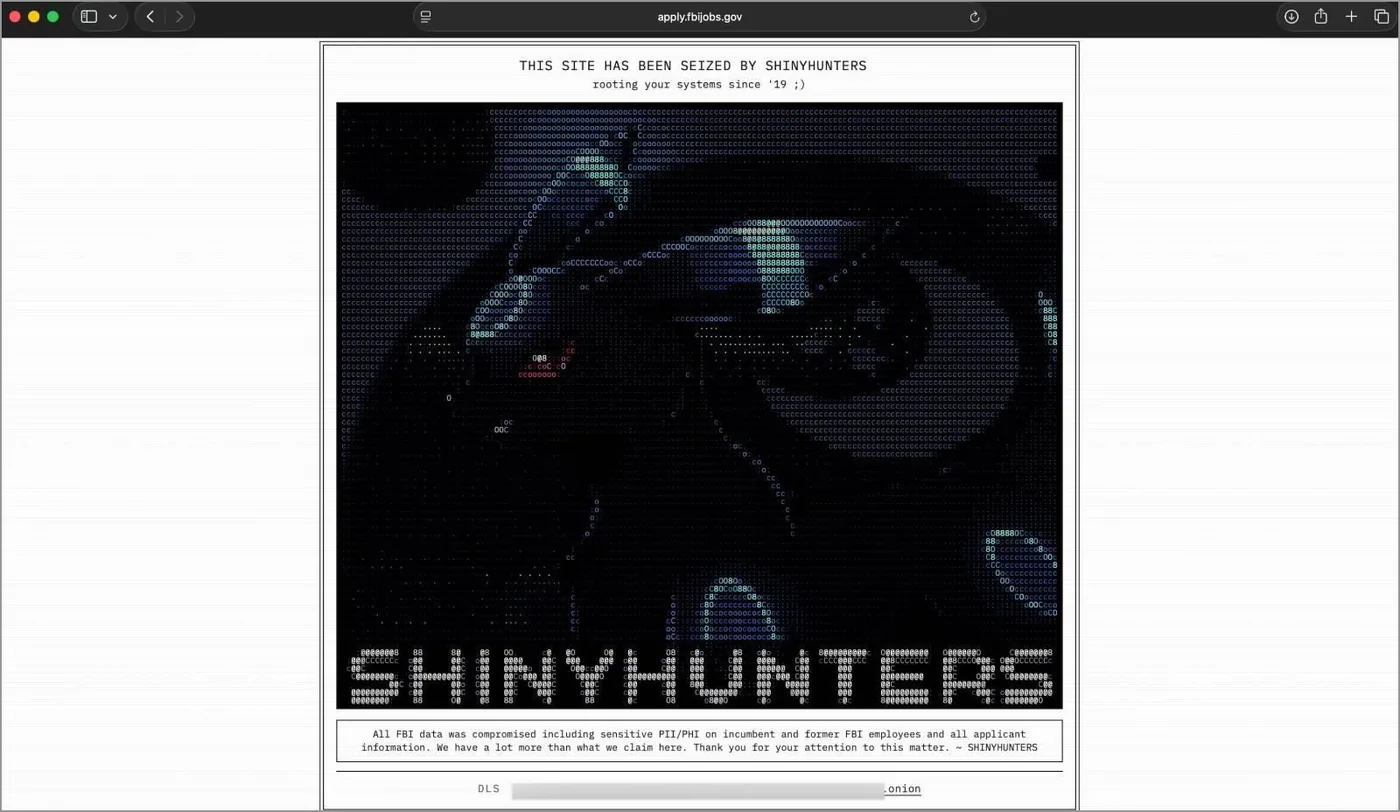
The intrusion surfaced publicly when the Federal Bureau of Investigation applicant portal at apply.fbijobs.gov displayed a defacement banner bearing the threat group’s trademark Umbreon Pokémon logo. The attackers replaced standard recruitment notices with a message reading, ‘THIS SITE HAS BEEN SEIZED BY SHINYHUNTERS. rooting your systems since \’19 ;)’ while warning that personal dossiers had been extracted. ShinyHunters stated that the exfiltrated records encompassed sensitive personally identifiable information (PII) and protected health information (PHI) belonging to incumbent staff, former employees, and civilian applicants [1].
The agency pulled the plug. Network access terminated simultaneously across federal infrastructure once administrators detected the intrusion, leaving the public jobs site displaying a maintenance advisory [1].
To substantiate the claim, the threat actors shared sample records allegedly extracted from compromised servers with security journalists. One dossier reportedly referenced an FBI special agent connected to a previous BreachForums investigation, while another file purportedly listed personal details for FBI Director Kash Patel. The sample held 5,000 records. Independent investigative outlet 404 Media examined the cache, verifying that listed names, home addresses, and phone numbers matched active personnel within the US Department of Justice and their spouses against public records [1, 2]. While federal agencies previously responded to perimeter threats through an emergency Cisco ISE zero-day emergency patch order, the ShinyHunters incident left defenders without a vendor advisory, forcing administrators to isolate recruitment servers while assessing exposed applicant dossiers [1].
Oracle PeopleSoft Zero-Day Exploit Enables Lateral Movement
ShinyHunters claimed the initial breach originated from a previously undisclosed remote code execution flaw in Oracle PeopleSoft enterprise software. The group told BleepingComputer editor Lawrence Abrams that they identified the zero-day vulnerability immediately prior to the intrusion and deployed it directly against public-facing recruitment servers. After securing local access, the hackers allegedly maneuvered deeper into federal networks, shifting laterally from human resources infrastructure into the agency’s AWS GovCloud repository. They reportedly accessed multiple internal operational portals, including FBI Criminal Justice records, Medlink systems, and internal employee databases. The attackers claimed they attempted to purge server logs to conceal the exploit. Oracle issued no emergency patch. Neither Oracle nor Google Cloud’s Mandiant intelligence team released advisories confirming active exploitation, leaving the technical validity of the PeopleSoft zero-day unverified by external researchers [1].
The sheer scale of the alleged exfiltration represents a massive digital footprint, with the threat actors claiming they removed between 2TB and 3TB of proprietary data from the Amazon-hosted government cloud. According to claims published on their dark web leak site, the stolen database spans virtually all personnel who submitted applications through the recruitment portal as well as active special agents [2]. Unlike software flaws resolved through coordinated vendor updates, such as the remediation of zero-click modem flaws, zero-day vulnerabilities in enterprise software often leave administrators with few immediate mitigations [1]. Storing high-volume background profiles in commercial cloud enclaves allows agencies to manage distributed hiring pipelines efficiently, yet single-point perimeter failures expose comprehensive organizational charts to unauthorized interception [2].


FBI PeopleSoft Breach Prompts Inquiries and Verification
Federal authorities responded cautiously to public inquiries following the defacement of the recruitment environment. In a formal response to BleepingComputer, an agency spokesperson stated that the bureau is “currently investigating” unauthorized activity surrounding the FBIjobs.gov domain, though officials pointedly declined to verify whether threat actors breached internal servers or exfiltrated classified archives [1]. When TechCrunch submitted inquiries regarding the compromised infrastructure on Tuesday, neither the FBI nor ShinyHunters provided comment. Both federal recruitment domains went dark. The primary recruitment site and the specialized applicant portal for special agents remained offline, directing visitors to placeholder maintenance screens [2].
Evaluating extortion claims requires distinguishing between perimeter defacements and verified core infrastructure compromises. While public defacements demonstrate that threat actors seized administrative control over web-facing assets, exfiltrating terabytes of backend cloud databases requires substantial lateral movement that external researchers have not independently confirmed [1]. Law enforcement systems have faced repeated intrusions throughout the year, including an earlier breach where unidentified hackers infiltrated an agency system responsible for managing real-time wiretaps and foreign intelligence-gathering warrants. That earlier wiretap intrusion could have compromised active surveillance targets, intensifying federal scrutiny surrounding the recruitment breach [2].
The recruitment claims follow another high-profile security incident involving the agency’s executive leadership. Earlier this year, FBI Director Kash Patel had his personal email account breached and leaked by Handala, an Iran-backed cyber group operating in retaliation for American-led strikes against Iran. Foreign intelligence groups increasingly target the communications of federal officials to execute geopolitical pressure campaigns. When combined with the alleged ShinyHunters FBI breach, these incidents highlight an intensifying wave of cyber operations directed against American law enforcement personnel [2].
ShinyHunters FBI Hack Follows Disputed Intelligence Bulletin
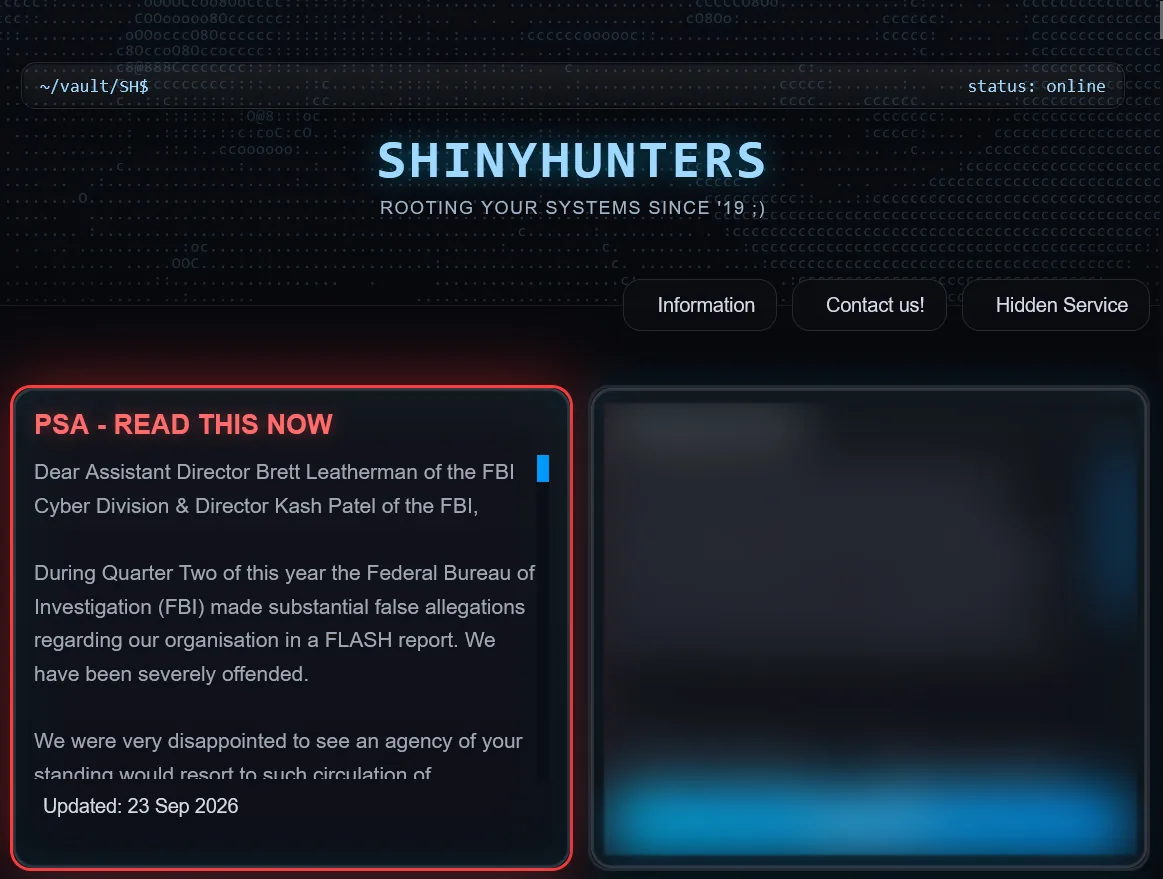
On its dark web data leak site, ShinyHunters published an extensive manifesto stating that the attack was not financially motivated extortion [1, 2]. Instead, the syndicate characterized the operation as direct retaliation for an FBI FLASH report published in May 2026, which documented the group’s tactics, techniques, and historical compromises. The threat actors disputed assertions in the federal bulletin alleging that ShinyHunters routinely fabricates compromised material, conducts swatting calls against victims, and harasses executives’ relatives. The demand deadline is one week. The syndicate gave federal authorities a strict seven-day window to remove the disputed intelligence advisory [1, 2]. When BleepingComputer asked whether they would publish the full database if the bureau maintained the advisory, the threat actors offered a curt ‘No comment’ [1].
ShinyHunters also rejected law enforcement assessments linking the gang to The Com, a loose-knit cybercrime network known for violent swatting incidents and cryptocurrency theft. The syndicate claimed it operates independently of decentralized extortion channels and dismissed the prospect of increased federal law enforcement pursuit. When BleepingComputer editor Lawrence Abrams asked whether the brazen intrusion would accelerate American government efforts to apprehend the operators, the group’s representative replied, ‘I don’t care’ [1].
The alleged exploitation of an unpatched Oracle vulnerability aligns with the syndicate’s established technical history. During the 2025 Oracle E-Business Suite campaign attributed to the Clop ransomware group, ShinyHunters operated within a collaborative faction dubbed Scattered Lapsus$ Hunters that leaked an exploit matching Oracle’s confirmed flaws. ShinyHunters maintained that the exploit originally belonged to their team before Clop appropriated it without authorization. The underworld dispute reignited recently when ShinyHunters compromised and defaced Clop’s dark web leak site, seizing server databases and private encryption keys for Clop’s Tor onion service in declared retaliation [1].
Counterintelligence Risks and Emerging Enterprise Threats
If validated, the theft of applicant dossiers and active personnel records poses severe counterintelligence liabilities for American national security. Files containing residential addresses, unlisted phone numbers, spousal identities, and background clearance records provide foreign intelligence services with actionable targets for coercion and espionage. As highlighted in TechCrunch’s analysis of the breach, hostile state intelligence agencies could weaponize exposed personal background data to coerce or extort FBI special agents and their families into cooperating with foreign governments. Compromising undercover personnel or active field investigations represents an enduring security liability that extends far beyond routine identity theft [2].
Beyond federal law enforcement targets, the alleged zero-day presents immediate risks across commercial and educational sectors. ShinyHunters stated that after deploying the exploit against the education sector, it expanded operations to target private corporations and Fortune 500 enterprises utilizing Oracle PeopleSoft software. The threat actor claimed to have erased telemetry on compromised machines, complicating efforts by enterprise security operations centers to detect malicious persistence. Can organizations detect silent PeopleSoft exploitation before data exfiltration occurs? Defending distributed enterprise environments requires auditing administrative access logs and verifying perimeter software builds against unauthorized remote code execution [1].
With the bureau’s jobs portal remaining offline and the syndicate’s seven-day ultimatum ticking down, federal investigators face an urgent mandate to assess forensic traces across internal servers. TechCrunch and BleepingComputer both noted that the ultimate impact of the ShinyHunters FBI breach will depend on whether independent digital forensics substantiate the theft of deep GovCloud archives or confirm that the breach remained confined to web-facing application servers [1, 2].
- ONLINE NEWS Abrams, L. (2026, September 22). ShinyHunters claims FBI hack, data theft in PeopleSoft zero-day breach. BleepingComputer. [Article Link]
- ONLINE NEWS Whittaker, Z. (2026, September 22). Hacking group ShinyHunters claims it breached the FBI, stole agents’ and applicants’ data. TechCrunch. [Article Link]


