






How does a reusable megarocket evolve from explosive atmospheric prototypes into an operational orbital transport? SpaceX achieved an unprecedented milestone during its thirteenth Starship test flight from Texas, demonstrating orbital engine relight and executing an intact ocean splashdown. While earlier iterations suffered destructive structural breakups during atmospheric descent, the 408-foot-tall vehicle proved its Version 3 architecture across several critical flight phases. Data gathered across these successive test flights paved the way toward full orbital velocity and booster recovery attempts. The mission launched at 6:51 p.m. ET on July 24 from Starbase before completing its planned oceanic return [6].
- What Did the Latest Starship Test Flight Accomplish?
- Super Heavy Booster Anomalies in the SpaceX Starship Test
- How Did Ship Survive Intact During Starship Test Flights?
- Deploying Next-Generation Starlink Payloads in Orbit
- Tower Catches and Reusability Goals for Flight 14
- Artemis Lunar Milestones and Florida Launch Infrastructure
What Did the Latest Starship Test Flight Accomplish?
The thirteenth Starship test flight validated upper stage survivability during reentry while achieving every major orbital demonstration goal scheduled for the mission. Engineers verified that the Starship upper stage could reignite a Raptor engine in the vacuum of space, deploy commercial payload prototypes, and steer autonomously toward a targeted oceanic touchdown. SpaceX spokesperson Dan Huot highlighted the operational breakthrough during the official broadcast. “Lucky number 13. Hell of a flight for Starship,” Huot declared as the ship reached water [6].
Flight 13 reached space. Six Raptor engines fired, propelling the 124-meter vehicle away from the booster [4].
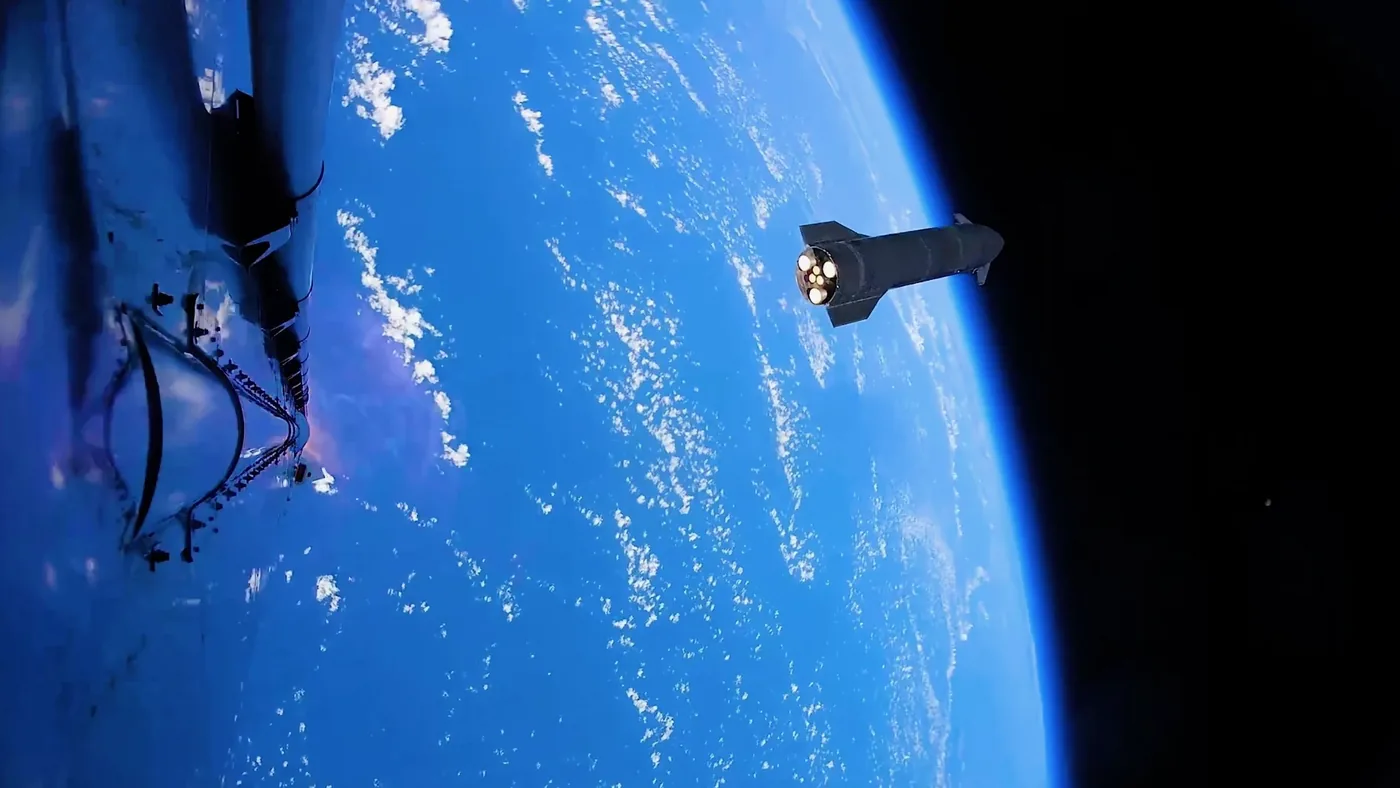
Cameras mounted aboard the Super Heavy booster captured the upper stage pulling away against the curved horizon of Earth, creating visual confirmation of nominal stage separation at hypersonic velocity. Rather than tumbling out of control as seen in early 2023 flight trials, the vehicle maintained steady attitude control while coasting along its suborbital trajectory. SpaceX confirmed that the ship achieved stable telemetry transmission throughout its coast phase, allowing controllers to track internal temperatures and aerodynamic loads as the vehicle prepared for atmospheric entry. The vehicle completed its orbital engine reignition test before plunging back into the upper atmosphere, proving that the propulsion hardware can restart reliably in zero gravity without propellant feed disruptions [4].
Super Heavy Booster Anomalies in the SpaceX Starship Test
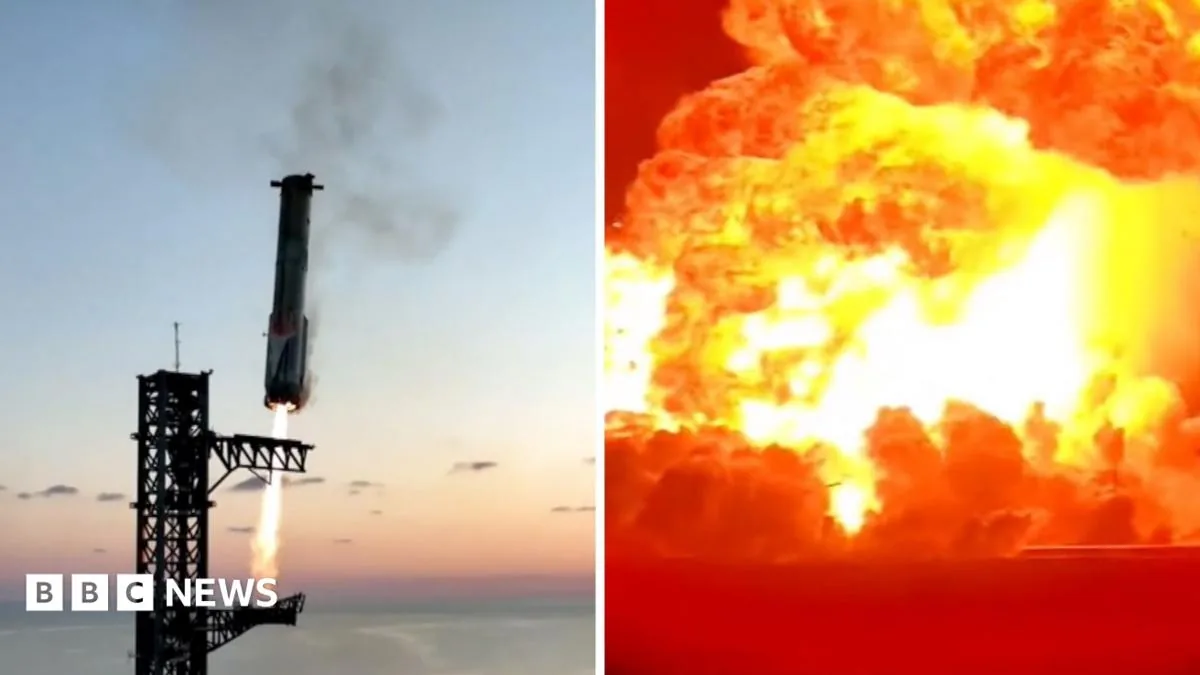
The SpaceX Starship test encountered significant propulsion difficulties during the recovery phase of the Super Heavy booster. While the massive booster lifted the full stack off the pad with nominal thrust, only eight out of the thirteen Raptor engines commanded to ignite for the landing burn fired successfully. As a direct consequence of this engine deficit, the booster hit the waters of the Gulf of Mexico (also designated as the Gulf of America) far harder than mission plans had anticipated [6].
Pre-flight preparations had already exposed hardware vulnerabilities within the booster propulsion bay prior to the July 24 liftoff. One week before flight, four of the thirty-three Raptor engines failed to start during an integrated static test sequence, triggering a rare post-ignition abort. Turbopump failures caused the abort. Technicians responded by replacing six separate Raptor engines at the launch site to ensure flight safety margins before clearing the rocket for flight [6].
Engine anomalies on the Super Heavy booster have persisted across multiple iterations of the Version 3 vehicle. Telemetry records show that propulsion issues affected both the May 22 and July 24 flights, underscoring ongoing challenges in mastering the simultaneous operation of 33 methane-fueled Raptor engines during each Starship test flight. Engineers are analyzing fuel manifold pressures and turbopump dynamics to prevent similar ignition dropouts on future test runs. Four engines had failed earlier [6].
How Did Ship Survive Intact During Starship Test Flights?
Ship survived intact during the flight by maintaining aerodynamic stability throughout atmospheric entry and touching down gently in the Indian Ocean under controlled engine thrust. For the first time in the program’s history, the upper stage did not undergo catastrophic structural failure or rupture violently upon water contact. “Really great day for Version 3,” Dan Huot stated as tracking stations monitored the vehicle bobbing upright in the ocean off the coast of Western Australia [6].
Thermal protection represented the primary technical hurdle that previous missions struggled to conquer. Overhead cameras and onboard tracking sensors revealed that the vast majority of hexagonal ceramic heatshield tiles remained securely attached despite the searing plasma friction generated during atmospheric deceleration. A localized fire broke out near the forward flaps and nosecone during terminal descent. Tiles protected the nosecone [4].
Drone video captured the final seconds of descent as the ship ignited its center engines, rotated into a vertical landing orientation, and settled into the swell. The vehicle tipped over slowly while burning residual propellant, remaining buoyant instead of sinking immediately beneath the surface. Navigating these aerothermal regimes during the Starship test flight provides empirical calibration for earlier projections for Starship orbital flight liftoff and long-duration reentries. The vehicle floated intact [4].


Deploying Next-Generation Starlink Payloads in Orbit
The Starship test flight demonstrated the rocket’s payload deployment mechanism by releasing twenty next-generation Starlink V3 demonstration satellites into space. This orbital payload test served as an operational proof of concept for the vehicle’s internal dispenser bay, which ejects satellites through a specialized narrow deployment slot. Ground stations successfully established two-way radio contact with all twenty satellites before atmospheric drag caused them to reenter shortly into the flight profile [6].
Future operational launches will scale this deployment capacity significantly beyond current spaceflight standards. SpaceX confirmed that operational Starship vehicles will possess the physical volume and throw weight necessary to deliver 60 Starlink V3 satellites per launch. Falcon 9 carries 29 satellites. Expanding constellation deployment speed remains central to the business architecture of the company [6].
Demonstrating payload delivery in tandem with an in-space engine relight marks a shift from purely experimental test launches toward commercial utility. Successful engine restart in microgravity confirms that Starship can perform deorbit burns safely, preventing abandoned stages from lingering as hazardous space debris in low Earth orbit. Advanced spacecraft operations also draw technical parallels with dual-mode propulsion spacecraft currently being developed to optimize trajectory maneuvering. Engine relight was verified [4].
Tower Catches and Reusability Goals for Flight 14
Rapid reusability forms the core design philosophy of both the Super Heavy booster and the Starship upper stage. SpaceX intends to fly both stages back to the launch site shortly after liftoff, catching them out of the air using the launch tower’s mechanical chopstick arms. Tower chopsticks catch the booster. SpaceX has successfully caught the Super Heavy booster on three previous test flights and plans to attempt a ship catch on Flight 14 provided that review of Flight 13 data uncovers no critical warning signs [4].
Chief executive Elon Musk stated that technical teams will analyze engine relight telemetry and structural aerothermal data before committing to the first-ever ship catch attempt. A successful tower catch would dramatically shorten turnaround intervals, allowing SpaceX to inspect, refurbish, and restack vehicles in a matter of days. Turnaround speed determines launch cadence [4].
As the BBC’s Ricky Boleto reported, SpaceX is preparing to execute its 14th Starship test flight on Monday to push operational endurance even further. If successful, the upcoming flight will mark the first time a Starship achieves a complete orbital path around Earth, representing the furthest distance the vehicle has ever traveled. Six orbits will take 10 hours [1].
Artemis Lunar Milestones and Florida Launch Infrastructure
Beyond commercial satellite delivery, Starship serves as a cornerstone for NASA’s deep-space lunar architecture under the Artemis program. The agency selected a specialized Starship Human Landing System (designated as HLS) to transport American astronauts down to the lunar surface. Operational milestones align with broader mission assignments such as the commercial station flights awarded to SpaceX by NASA. NASA confirmed that a dedicated docking mechanism will be installed on the nose of Starship V3 to test orbital docking with the Orion spacecraft during the 2027 Artemis III mission, although astronauts will not transfer between the vehicles during that uncrewed checkout [6].
The deep-space timeline culminates in late 2028 when Starship is scheduled to land astronauts near the south pole of the Moon on the Artemis IV expedition. Achieving this ambitious lunar landing target requires proving that Starship can dock, transfer cryogenic propellants in orbit, and execute precise planetary touchdowns without landing pad infrastructure. Every Starship test flight provides critical real-world hydrodynamic and aerothermal benchmarks for these lunar flight modes [4].
To support this expanding manifest, SpaceX is expanding launch operations beyond its development proving grounds in Boca Chica, Texas. Construction teams are finalizing Launch Pad 39A at the Kennedy Space Center, with Florida launches anticipated to begin as early as the end of the year. Launch Complex 37 at Cape Canaveral Space Force Station is also designated for future Starship operations. Pad 39A approaches completion [6].
- ONLINE NEWS BBC News. (2026, September 27). The ups and downs of SpaceX’s Starship test flights. [Article Link]
- ONLINE NEWS BBC News. (2026, September 27). The ups and downs of Space X’s Starship test flights. [Article Link]
- ONLINE NEWS BBC News. (2026, September 27). The ups and downs of SpaceX’s Starship test flights [Video]. [Article Link]
- ONLINE NEWS Wall, M. (2026, July 27). Starship in space! See highlights of SpaceX megarocket’s epic Flight 13 test launch. [Article Link]
- ONLINE NEWS Roadblock Radio. (2026, September 27). Watch: The ups and downs of SpaceX’s 13 Starship test flights. [Article Link]
- ONLINE NEWS Edwards, B. (2026, July 24). ‘Lucky number 13’ SpaceX’s Starship ends test flight with intact splashdown. [Article Link]
APA 7: PerEXP Teamworks. (2026, September 28). How Starship Test Flight Milestones Paved SpaceX’s Orbital Path.


