



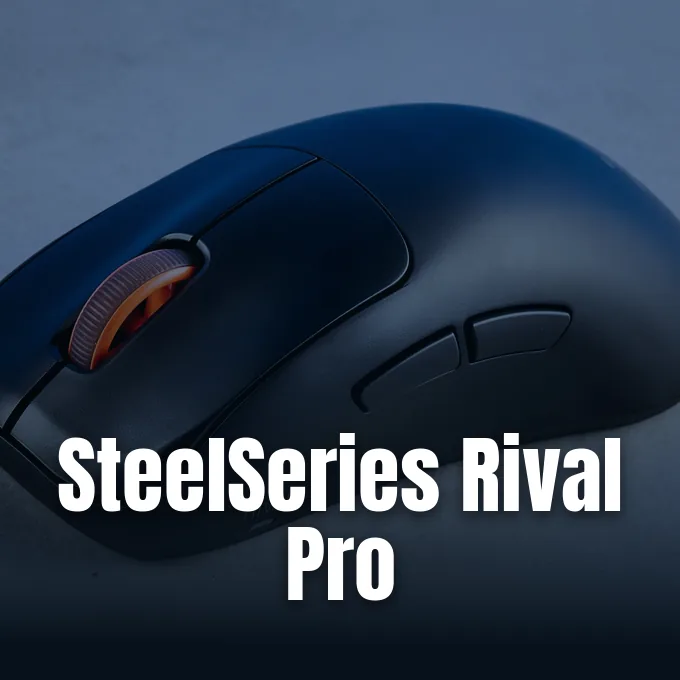
SteelSeries unveiled the SteelSeries Rival Pro gaming mouse on September 29, 2026. Celebrating the brand’s 25th anniversary, the flagship peripheral targets competitive esports players with a right-handed palm grip silhouette, eliminating conventional wireless congestion through an ultra-wideband radio architecture that transmits outside crowded household Wi-Fi frequencies across the upper 6GHz spectrum. The $179.99 package combines dual hot-swappable batteries, an optical sensor scaling to 42,000 DPI, and true 8,000Hz polling [6].
SteelSeries Rival Pro Adopts Ultra-Wideband Wireless
Standard wireless gaming mice route digital tracking packets across the congested 2.4GHz radio band shared with household Wi-Fi routers. When multiple devices broadcast simultaneously across identical frequencies, wireless peripheral transmitters pause momentarily to hunt for vacant transmission channels, creating micro-delays that disrupt cursor motion during high-stakes competitive esports matches. Tom’s Guide reviewer Peter Wolinski noted that channel hunting causes disruptive tracking dead zones in cursor response [2].
To eliminate packet collisions in crowded arenas, SteelSeries deployed ultra-wideband (UWB) wireless technology operating across an expansive radio spectrum from 6.4GHz to 9.056GHz rather than legacy consumer wireless bands. This high-frequency pipeline delivers approximately twenty times the bandwidth of standard 2.4GHz connections [6]. Because transmission range remains confined to an immediate desktop radius, adjacent wireless peripherals cannot generate signal crosstalk even when operating within close physical proximity [2].
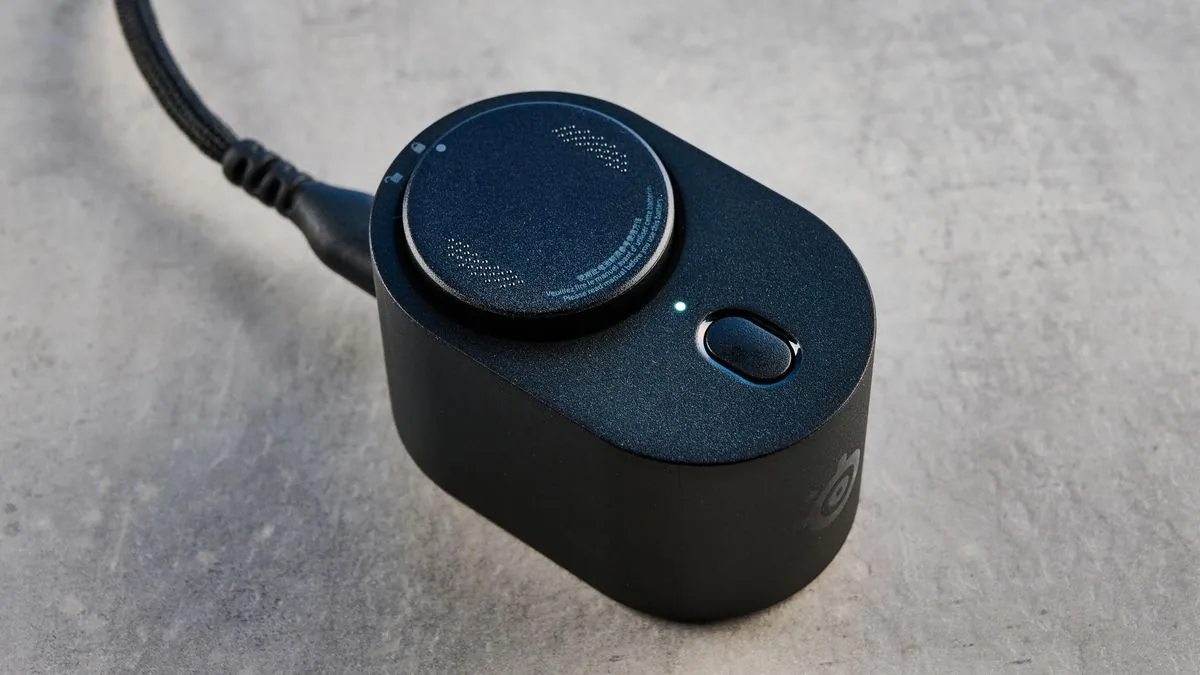
A weighted USB desktop base station anchors the connection, positioning the receiver in direct line of sight beside the mousepad. Reviewer Joshua Boyles tested the connection across fast rounds of Overwatch and Counter-Strike, reporting that keeping the transceiver on the desk maintained flawless tracking [3]. A travel dongle costs $24 [2].

Hot-Swappable Batteries Eliminate Operational Downtime
High polling rates drain wireless batteries rapidly, exhausting conventional recharge cells in single-digit gaming hours. SteelSeries resolved this endurance barrier by adapting its Infinite Power System, previously featured on Arctis Nova Pro headsets and the Aeon Pro controller, to supply non-stop battery rotation without plugging into a tethered cord. Players receive two swappable lithium battery modules that interchange directly through the underside of the mouse. Recharging takes place without connecting cables directly to the mouse body [5].
Each battery pack delivers up to 16 hours of continuous runtime when operating under full 8,000Hz polling. Lowering polling to standard 1,000Hz expands runtime to 60 hours per pack, providing 120 combined hours across the pair [6]. A full recharge takes three hours. Because the spare battery charges continuously inside the top cradle of the desktop transceiver, players always have a refreshed power unit available before the primary cell runs out of charge [5].
Jacob Fox tested the swap mechanism, replacing the battery puck within seconds before the mouse touched the desk surface again [1].



TrueMove 42K Sensor Powers True 8K Polling
Tracking relies on the TrueMove 42K Pro optical sensor, developed through a direct hardware collaboration with PixArt around a customized PixArt 3955 core. The sensor captures 20,000 frames per second. PixArt fabricated the optical core according to SteelSeries performance parameters [4]. The sensor tracks speeds up to 800 inches per second and withstands 70G acceleration forces, maintaining accurate surface registration during the most violent flick shots in competitive matches [6]. Reece Bithrey tested the sensor in Counter-Strike 2 at 1,600 DPI [4].
The mouse implements true 8K polling by transmitting single packets with dedicated acknowledgments, eliminating the batch-reporting anomalies that trigger micro-stutter on competing high-polling esports mice. Optical switches register primary clicks in 0.35 milliseconds across 100 million actuations. An internal processor oversamples readouts from a 9,000Hz stream before transmitting at the 8,000Hz USB limit [6].
Because full 8,000Hz sensor reporting places intense processing strain on computer central processors and triggers frame drops in titles like Valorant, Apex Legends, and Fortnite, SteelSeries engineered a software decoupling architecture named SuperSync [5]. This system allows players to retain instantaneous 8,000Hz click reporting over ultra-wideband wireless for immediate trigger response, while independently adjusting sensor tracking to 1,000Hz or 2,000Hz to preserve frame rates across demanding esports game engines [2]. David Burdette confirmed smooth recoil control. Review testing across Counter-Strike 2 and Halo Infinite demonstrated that decoupling sensor reporting eliminates micro-stutters during heavy gunfights while preserving ultra-low click latency for rapid weapon fire [5].
Rival Pro Balances Ergonomics and Lightweight Build
Chassis geometry dictates tournament endurance, prompting PC Gamer hardware reviewer Jacob Fox to state that “shape is king” when assessing the Rival Pro. Comparing the shell against the Zowie EC2-DW, Fox observed that the Rival Pro features a gentle left-side slope that supports the hand comfortably during gameplay [1]. Joshua Boyles confirmed that the central hump presses naturally into the palm during hybrid grip play [3]. The physical chassis measures 4.9 inches long, 2.6 inches wide, and 1.6 inches tall [2].
Despite housing an internal battery cradle and an ultra-wideband antenna, the standard black edition weighs 53 grams, with the white shell adding one gram [1]. The Mini variant scales to 49 grams [6]. SteelSeries attained that low weight without cutting honeycomb perforations through the shell, employing solid composite plastics that prevent structural flex or creaking when squeezed firmly during fast competitive matches [1]. A mechanical latch secures the swappable battery pack on the baseplate, eliminating heavy magnetic fixtures to trim overall mouse mass without sacrificing structural stability during rapid swipes [4].
To reach the 53-gram specification, engineers removed the traditional USB-C charging port entirely, committing the mouse to pure wireless connectivity [1]. While omitting ports saves internal weight, Joshua Boyles pointed out that the lack of a physical cable means future diagnostics and firmware maintenance depend completely on stable wireless transmissions [3]. Two large PTFE feet provide smooth glide across gaming pads, positioning the mouse against ergonomic competitors like the Razer DeathAdder V4 Pro [4].
Market trends show mobile gaming expanding after coders uncovered two iPhone game controllers in code, but dedicated desktop peripherals continue prioritizing zero-latency tournament speed [1].

SteelSeries GG Suite Expands with Web Tools
Customization options center on the SteelSeries GG software suite, which controls lift-off distances, angle snapping thresholds, sensor angle adjustments, and scroll jump protection across custom player profiles. A sensitivity converter matches DPI settings from previous hardware for seamless peripheral transitions [6]. David Burdette highlighted the utility of QuickSet profiles for switching between individual shooter titles [5]. Reece Bithrey reported that SteelSeries will introduce Performance Coach, a dedicated training tool designed to evaluate precision aiming errors and overshoots between match respawns [4].
In addition to local desktop software, SteelSeries launched GG Web, a browser configuration portal that allows rapid adjustments without requiring software installation on host machines [2]. Esports athletes playing on locked tournament PCs can modify polling presets and sensitivity stages directly through standard web browsers [4]. Peter Wolinski confirmed that previous SteelSeries gear cannot access GG Web [2].
The complete retail package bundles the mouse, the desktop base station, two hot-swappable batteries, grip tape, and replacement PTFE feet for $179.99. The braided cable spans 6.5 feet [5]. Combining ultra-wideband transmission with an uninterrupted swappable battery workflow, the Rival Pro secures a distinct hardware identity for dedicated competitive players across modern esports arenas [6].
- ONLINE NEWS Fox, J. (2026, September 29). This is the comfiest mouse I’ve held and it has hot-swap batteries. PC Gamer. [Article Link]
- ONLINE NEWS Wolinski, P. (2026, September 29). SteelSeries just re-entered the chat: I tested its elite mice for a month. Tom’s Guide. [Article Link]
- ONLINE NEWS Boyles, J. (2026, September 29). SteelSeries Rival Pro and Sensei Pro review. Express.co.uk. [Article Link]
- ONLINE NEWS Bithrey, R. (2026, September 29). SteelSeries Rival Pro Review. Trusted Reviews. [Article Link]
- ONLINE NEWS Burdette, D. (2026, September 29). SteelSeries Rival Pro and Sensei Pro gaming mice review. GAMINGTREND. [Article Link]
- PRESS RELEASE TheLostSwede. (2026, September 29). SteelSeries Unleashes the Ultra-Wideband Sensei Pro and Rival Pro Series Gaming Mice. TechPowerUp. [Article Link]


