





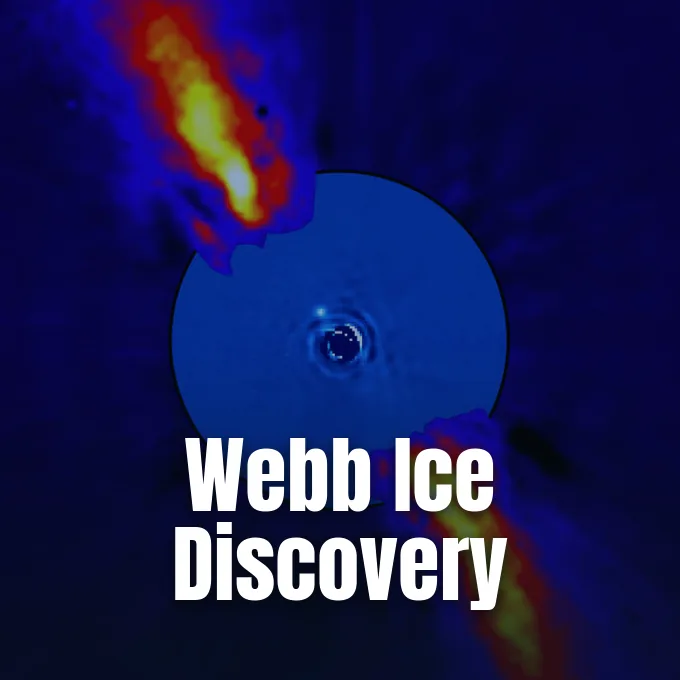
Astronomers using the James Webb Space Telescope have identified ancient water ice preserved inside debris disks orbiting nearby young stars. In spectral data gathered from systems such as Beta Pictoris and HD 181327, researchers found both glassy and crystalline frozen water grains that survived the turbulent birth of their parent stars. Known widely as JWST, the international observatory led by NASA with partners ESA and CSA detected these volatile reservoirs across deep space. These observations of Webb telescope ice show that volatile compounds formed in cold interstellar space can persist across tens of millions of years rather than boiling away during stellar ignition. The detections give planetary researchers at institutions like the Space Telescope Science Institute direct evidence that the chemical ingredients needed to form oceans endure intact to seed emerging rocky worlds [1].
Ancient Grains Around Beta Pictoris
Beta Pictoris is a young star roughly 20 million years old that sits about 64 light-years from Earth. As Ars Technica recounted, astronomers first imaged the disk of dust and rubble around Beta Pictoris in 1984, establishing the system as one of the most studied cosmic laboratories in astrophysics. The disk appears almost edge-on from Earth, providing a clear vantage point for researchers tracking planet formation. Three giant planets already orbit within the inner zones of Beta Pictoris [1].
A research team led by Sarah Betti, an astronomer at the Space Telescope Science Institute in Baltimore, used JWST to search for frozen volatiles in this dust disk. Their study in Science reported detections of both water ice and carbon dioxide ice mixed into the circulating rubble. Rather than forming organized crystal lattices, the detected water ice exists in an amorphous, glassy state. This glassy water ice is mixed with carbon dioxide in proportions very similar to the chemical ratios observed in comets within our own Solar System [1].
Because amorphous ice condenses only under deep cold, it formed in interstellar clouds before Beta Pictoris ignited. Pristine ice grains survived the birth of Beta Pictoris, acting like frozen time capsules from the early Milky Way galaxy [6]. Stellar radiation continues to grind down the debris, but ancient volatiles stayed intact.
How Webb Telescope Ice Data Confirms Crystalline Grains
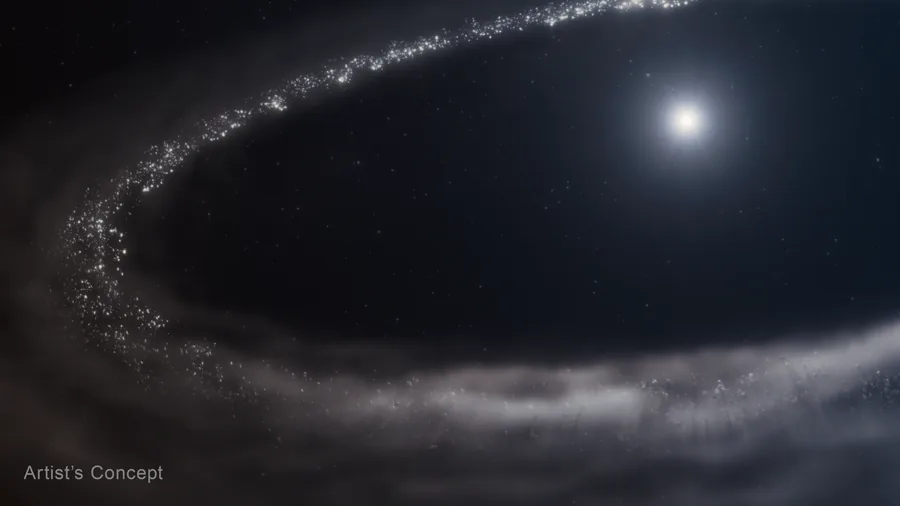
While Beta Pictoris holds glassy volatiles, the young Sun-like star HD 181327 provided the first definitive evidence of crystalline water ice in a distant debris ring. Located 155 light-years from Earth, HD 181327 is a 23-million-year-old star that is slightly hotter and more massive than our Sun, which has burned for 4.6 billion years [3].
In 2008, data from NASA’s retired Spitzer Space Telescope hinted that frozen water might exist around HD 181327, but earlier space instruments lacked the sensitivity needed to verify the faint signal. Researchers resolved the question by analyzing infrared spectra gathered by the Near-Infrared Spectrograph, known as NIRSpec, aboard JWST. As EarthSky reported, the Webb Near-Infrared Spectrograph NIRSpec captured spectral features that previous observatories could never resolve. The findings, published in Nature on May 14, 2025, revealed clear absorption bands that belong strictly to crystalline water ice. “Webb unambiguously detected not just water ice, but crystalline water ice, which is also found in locations like Saturn’s rings and icy bodies in our solar system’s Kuiper Belt,” said lead author Chen Xie, an assistant research scientist at Johns Hopkins University in Baltimore, Maryland [3].
These measurements showed that Webb telescope ice studies can isolate solid water grains paired with dust across interstellar space [3]. Reading about how modern observatories differ clarifies why earlier missions struggled with this task, since older space telescopes lacked the sensitivity and resolving power required to separate microscopic icy particles from intense stellar glare [7]. Advanced infrared detectors on JWST made the difference [4].
Debris Ring Architecture at HD 181327
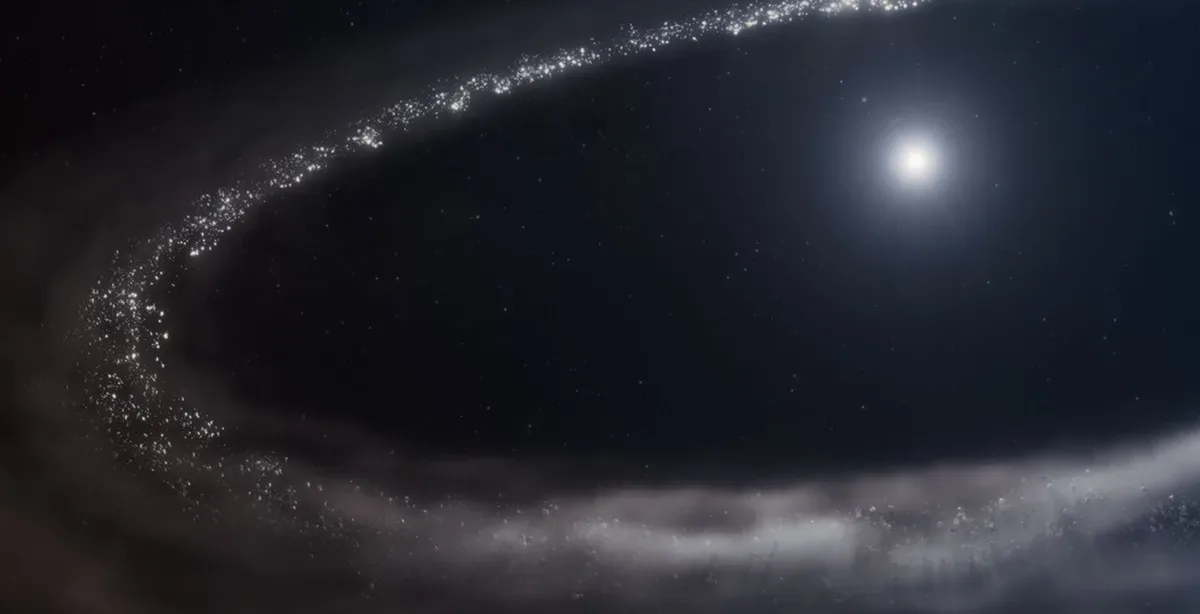
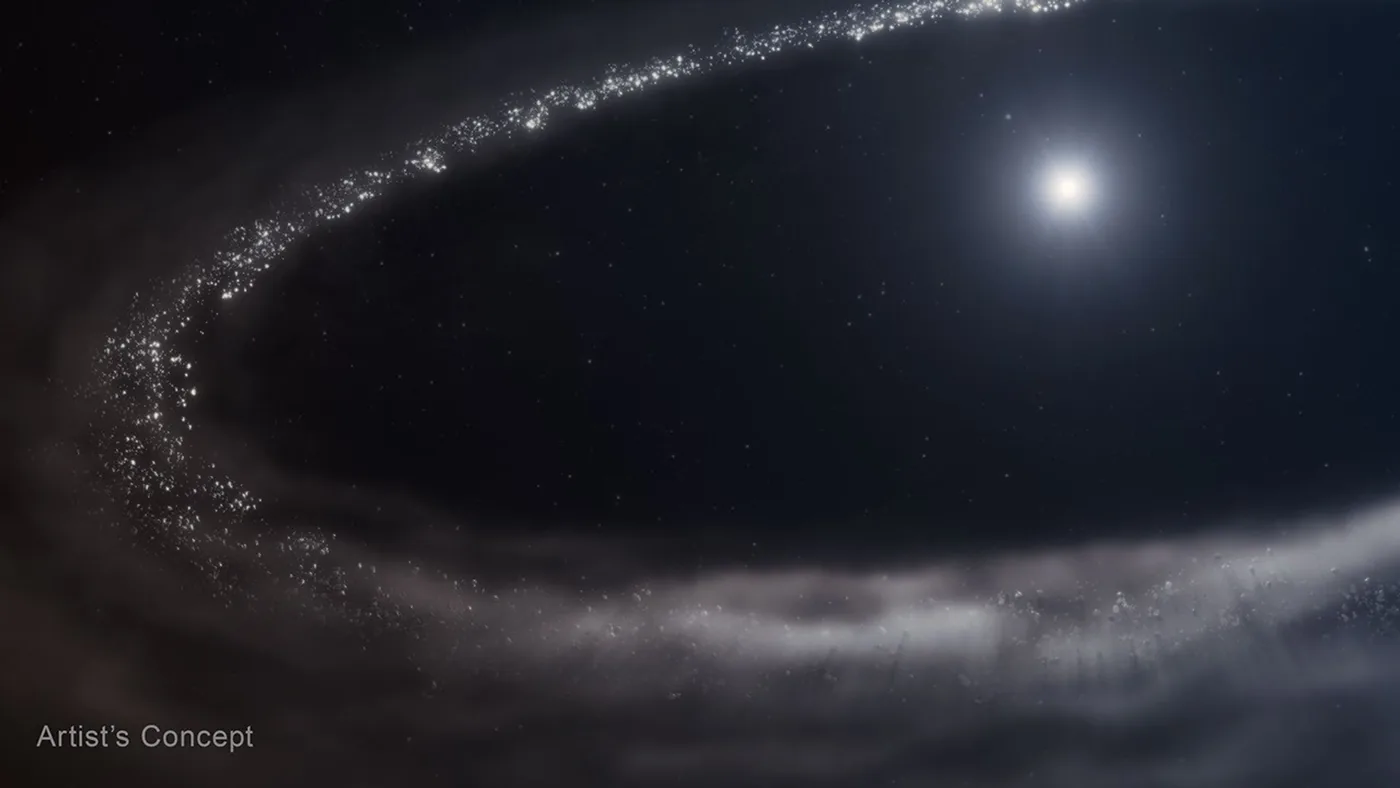
A wide, dust-free gap separates HD 181327 from its outer debris belt, as NASA and STScI observations confirmed [2]. Beyond that clear boundary, icy bodies and rocky fragments circle in a crowded belt where orbital collisions continuously pulverize large parent rocks into fine grains of water ice coated with silicate dust. Impacts happen constantly in HD 181327 [3].
Astronomers describe these microscopic grains as tiny dirty snowballs rushing through circumstellar space [4]. “HD 181327 is a very active system,” said co-author Christine Chen, an astronomer at the Space Telescope Science Institute in Baltimore. “There are regular, ongoing collisions in its debris disk. When those icy bodies collide, they release tiny particles of dusty water ice that are perfectly sized for Webb to detect”. Chen had anticipated such detections for decades before modern space hardware made them practical. “When I was a graduate student 25 years ago, my advisor told me there should be ice in debris disks, but prior to Webb, we didn’t have instruments sensitive enough to make these observations,” Chen said [3].
That 25-year wait ended when JWST turned theoretical expectations into verified observational data [4]. In BBC Sky at Night Magazine, science writer Iain Todd highlighted the Nature paper (025-08920-4), noting that collision cascades continuously replenish the microscopic ice population around HD 181327 [7].


Where Webb Telescope Ice Survives Stellar Heat
The concentration of frozen water varies widely across HD 181327. Instead of spreading evenly, ice abundance shifts dramatically with distance from the central star because local thermal conditions dictate whether volatile compounds can survive or vaporize into space. In the cold outer zone, water ice constitutes over 20% of all circulating material, Chen Xie explained while presenting the Johns Hopkins University survey. Levels drop closer in. Toward the middle belt, frozen water accounts for roughly 8% of disk mass, where ongoing collisions produce fresh icy particles slightly faster than stellar radiation breaks them down [3].
As researchers looked inward, the proportion of Webb telescope ice dropped steadily. In the region closest to HD 181327, Webb detected almost no exposed ice [3]. Intense stellar heat sweeps the inner boundary clear of frozen volatile grains.
Two physical factors explain why ice grains disappear near HD 181327. First, ultraviolet light emitted by the star vaporizes exposed specks of water ice in the inner disk cavity. Second, rocky bodies known as planetesimals may have locked frozen water deep inside their interiors where infrared sensors on JWST cannot spot it. Examining how the infrared observatory works shows how spectroscopic instruments trace these temperature thresholds across circumstellar disks [3].

Comparisons With the Solar System Kuiper Belt
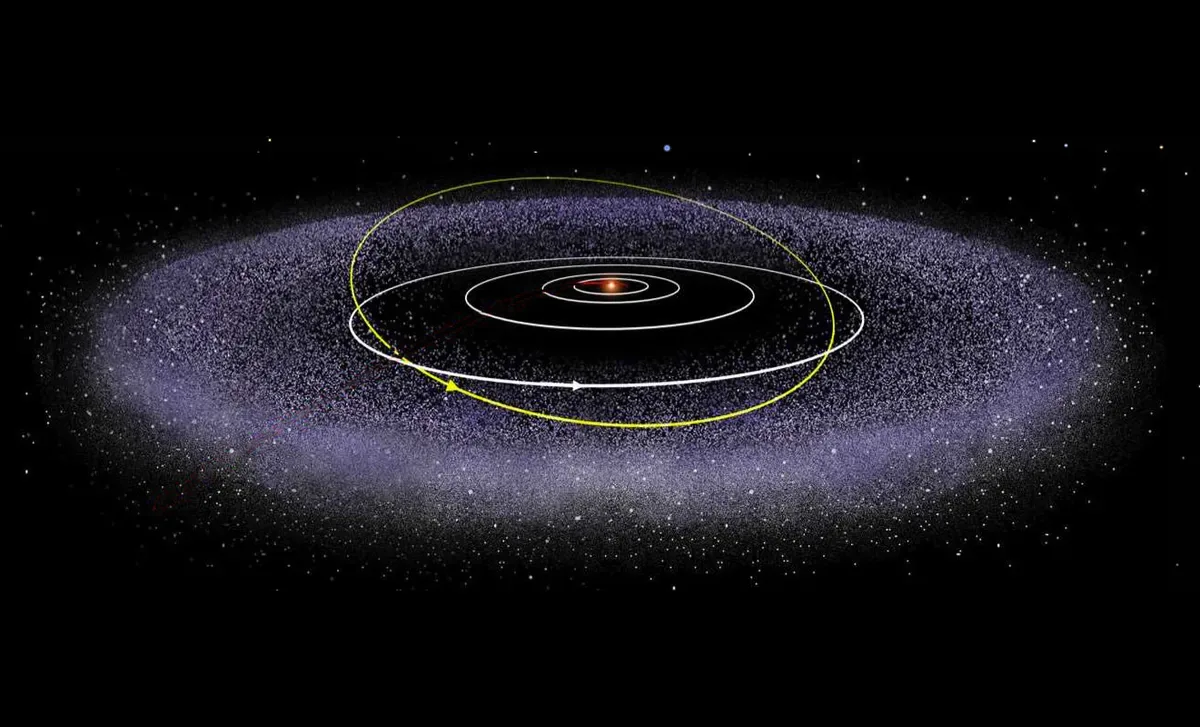
The layout of HD 181327 looks familiar to astronomers who study our own planetary neighborhood. The outer ring of cold debris mirrors the architecture of our Solar System’s Kuiper Belt, a vast ring of comets, dwarf planets, and icy fragments orbiting beyond Neptune [5].
Billions of years ago, when our Sun was only about 20 million years old, our own Kuiper Belt was likely just as chaotic and collision-prone as HD 181327 [3]. As Frank Landymore reported for Futurism, water ice has been documented across our Solar System in locations like Saturn’s rings, Europa, and Mars, but astronomers had never confirmed frozen water around another star. Seeing the same crystalline water ice around HD 181327 demonstrates that our Solar System is not an anomaly in how it stores frozen volatiles. Planetary systems assemble from similar cosmic raw materials across the Milky Way [5].
What makes this comparison compelling is how it clarifies the early history of rocky worlds. The debris disk at HD 181327 provides researchers with an active analog of the ancient solar environment that eventually produced Earth [7]. By observing how icy fragments collide and spread out, astronomers can reconstruct how volatile compounds traveled before planetary orbits became stable [4].
Water Delivery to Forming Terrestrial Worlds
Frozen water plays an important mechanical role during the earliest stages of planet assembly. In cold outer disks, ice grains stick together much more easily than dry silicate dust, speeding up the growth of tiny pebbles into solid planetesimals [2]. These icy cores can grow large enough to pull in surrounding hydrogen and helium gas, driving the formation of giant planets like Jupiter that shape the layout of entire planetary systems [5].
Beyond helping assemble gas giants, icy fragments serve as delivery vehicles for volatile compounds needed by rocky worlds. “The presence of water ice helps facilitate planet formation,” Xie said. “Icy materials may also ultimately be ‘delivered’ to terrestrial planets that may form over a couple hundred million years in systems like this” [3]. Terrestrial planets forming close to a star often begin dry because intense heat drives away moisture, meaning cometary impacts must supply water later [5]. Studying young debris belts around stars like Beta Pictoris and HD 181327 helps researchers at NASA and STScI track when and where these water deliveries take place during the evolution of habitable environments [4].
The detection of amorphous ice at Beta Pictoris and crystalline ice at HD 181327 proves that frozen water exists in diverse states across young star systems. By combining Webb telescope ice observations with numerical simulations, scientists can track how volatiles travel from interstellar clouds to planetary surfaces [6]. These icy disks show that the chemical ingredients for oceans are widely scattered across the galaxy [7].
- ONLINE NEWS Ars Technica. (2026). James Webb telescope finds ice older than the star it orbits. [Article Link]
- PRESS RELEASE NASA Webb Telescope Team. (2025). Webb finds icy disk. NASA. [Article Link]
- PRESS RELEASE McCoy, M., & NASA Webb Mission Team. (2025). Another first: NASA Webb identifies frozen water in young star system. NASA Science. [Article Link]
- ONLINE NEWS EarthSky Voices. (2025). 1st discovery of frozen water in young star system. EarthSky. [Article Link]
- ONLINE NEWS Landymore, F. (2025). NASA’s James Webb telescope just found frozen water around another star. Futurism. [Article Link]
- WEBSITE Coaio Limited. (2026). James Webb telescope discovers ancient ice older than its host star: Revolutionary insights into planet formation. Coaio. [Article Link]
- ONLINE NEWS Todd, I. (2025). Finally! Webb has discovered water ice around a nearby star just like our own Solar System. BBC Sky at Night Magazine. [Article Link]
APA 7: PerEXP Teamworks. (2026, November 16). Webb Telescope Identifies Ancient Ice Older than Host Star. PerEXP Teamworks. https://perexpteamworks.com/en/webb-telescope-ice-older-star/


