





Can a dying stellar remnant capture the boiling outer atmosphere of a massive supergiant star and convert that gas into explosive high-energy radiation? In stellar wind accretion, gravitational attraction pulls material away from a stellar furnace and directs it toward a compact companion. This gravitational capture fuels luminous outbursts. Using the Resolve Spectrometer aboard the Japan-led XRISM (X-ray Imaging and Spectroscopy Mission) observatory, researchers led by Roi Rahin have directly observed this capture process unfolding within the BP Crucis binary system, recording plasma racing toward a neutron star at 335,000 mph [2].
- How XRISM Solved a Decades-Old Cosmic Infall Mystery
- BP Crucis as an Extreme Stellar Laboratory
- Why Highly Ionized Iron Unveiled Plasma Motion
- Turbulence and Direct Infall in Stellar Wind Accretion
- Distinguishing Binary Wind Accretion from Isolated Pulsar Nebulae
- What Resolve Data Means for High-Energy Astrophysics
How XRISM Solved a Decades-Old Cosmic Infall Mystery
Astrophysicists have spent decades theorizing how compact stellar remnants consume turbulent outflows produced by their enormous stellar companions. Models predicted that fierce stellar winds should plunge directly toward orbiting neutron stars. Yet acquiring definitive observational evidence remained an enduring astronomical hurdle. Past X-ray observatories lacked the spectral sensitivity needed to separate complex emission signals from genuine infalling gas. Lead author Roi Rahin, an astrophysicist at UMBC (University of Maryland, Baltimore County) and NASA’s Goddard Space Flight Center in Greenbelt Maryland, highlighted that researchers had never before seen clear indications of wind plasma falling onto a compact object [2].
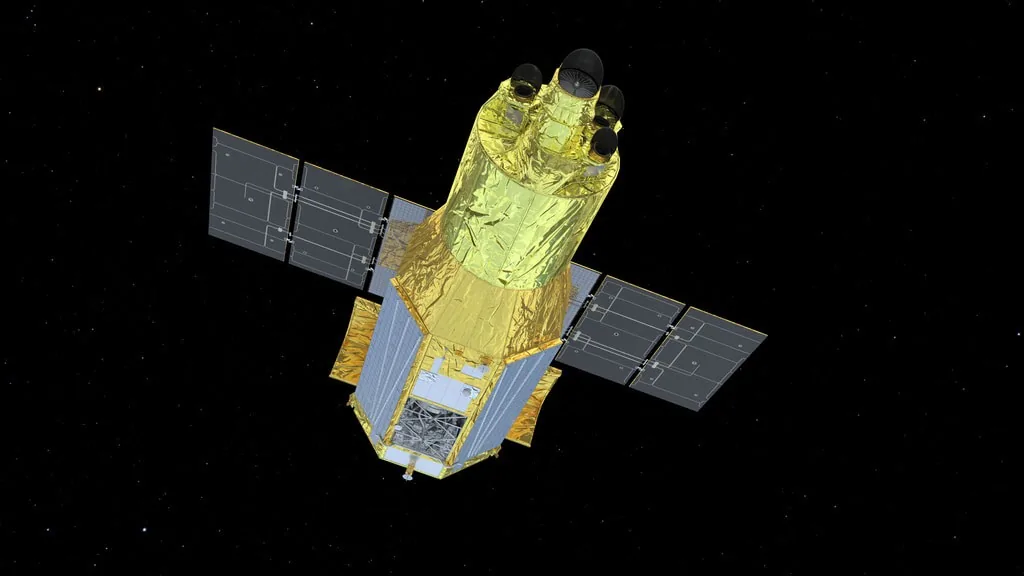
The breakthrough arrived through XRISM, an orbital observatory jointly developed by NASA and the Japan Aerospace Exploration Agency. The spacecraft carries the Resolve Spectrometer, a cryogenic instrument that measures individual X-ray photons with exceptional energy precision. The Resolve Instrument captured rapidly changing emission and absorption features across extreme temperatures. The instrument operated flawlessly. As science writer Francis Reddy documented for NASA Science, when Roi Rahin initially inspected these spectral profiles, he realized the data revealed unprecedented physical behavior. Rahin searched the scientific literature for comparable observations and confirmed that no previous telescope had recorded anything like them [2].
The physical contrast remains staggering. A crushed stellar core barely the size of a terrestrial city commands the tempestuous winds of a giant companion star within the Southern Constellation [2].
BP Crucis as an Extreme Stellar Laboratory
The dramatic cosmic interaction takes place within BP Crucis, a high-mass X-ray binary located approximately 13,000 light-years from Earth in the Southern Constellation Crux. The primary anchor of this system is Wray 977, an astonishing blue hypergiant star possessing roughly 40 times the mass of the Sun and expanding to 60 times its physical diameter. Within the Southern Constellation, Wray 977 stands as an extraordinarily luminous beacon. Intense stellar radiation constantly expels ionized plasma away from its surface in an unceasing stellar wind [2].
Sharing this extreme orbital environment across the Milky Way is GX 301-2, an intensely magnetized neutron star created when a massive progenitor star exploded in a supernova long ago. Despite packing more mass than the Sun into a dense sphere roughly 12 miles (20 kilometers) across, GX 301-2 wields a formidable gravitational pull. The pulsar rotates rapidly. It spins once every 11 minutes, sweeping an X-ray beam toward Earth that astronomers register as regular pulsar pulsations [2].
The orbital architecture of BP Crucis creates predictable outbursts repeating across a 41.5-day cycle. Twice during each 41.5-day orbit, near its closest and farthest points from Wray 977, the pulsar triggers violent eruptions that generate powerful X-ray flares lasting several days. Gravitational tidal forces pull an especially dense stream of plasma across the void. This corridor sustains active stellar wind accretion. As GX 301-2 barrels through this stream, it scoops up abundant matter, sparking the strongest flares closer to Wray 977 where plasma density reaches its peak [2].
Why Highly Ionized Iron Unveiled Plasma Motion
To catch this violent accretion mechanism in action, the research team pointed XRISM toward BP Crucis on Feb. 1, 2025. The observatory tracked the binary system continuously for approximately 16 hours near the concluding stages of one of its most powerful flares. The team monitored spectral shifts. Co-author Nazma Islam, formerly affiliated with Baltimore County and Goddard Space Flight Center and now an assistant professor at Manipal Centre for Natural Sciences in India, pointed out that the groundbreaking dataset demanded rigorous scrutiny to determine how the dense plasma stream behaves in close proximity to the neutron star [2].
The secret to unlocking the gas kinematics lay in narrow absorption lines produced by highly ionized iron atoms embedded within the rushing wind [1]. Working with colleagues at Goddard Space Flight Center, Roi Rahin and Nazma Islam discovered that these spectral absorption fingerprints were displaced to lower energy levels compared to laboratory benchmark measurements. This systematic shift, known as a redshift (an apparent drop in spectral energy caused by movement away from the observer), demonstrated that the gas was traveling away from Earth and hurtling directly toward the pulsar [2].
Precise calibration of the redshift allowed the team to compute the physical speed of the infalling plasma stream. The spectral measurements indicated that ionized iron atoms are racing toward GX 301-2 at astonishing velocities of around 335,000 mph (540,000 kph) [2]. The Resolve Instrument documented the rapid descent of matter in real time. Gas moved with incredible velocity. Reporting in Science Advances, researcher Roi Rahin and colleagues verified that stellar gas was plummeting toward the surface of the compact stellar remnant [1].


Turbulence and Direct Infall in Stellar Wind Accretion
Detailed modeling published in Science Advances reveals a four-stage process that governs stellar wind accretion as the pulsar crosses the plasma corridor [1]. When GX 301-2 first encounters the dense stream, its gravity rapidly sweeps up oncoming gas, collecting material into a thick, messy, and turbulent accretion disk. Gas within this swirling reservoir spirals downward, experiencing tremendous gravitational friction that heats the plasma to millions of degrees and generates luminous X-ray flares recorded by orbiting telescopes [2].
As the pulsar plunges deeper into the dense corridor, this temporary disk structure abruptly disintegrates. Astronomers suspect that as GX 301-2 travels directly into the oncoming stream, the inflow lacks sufficient angular momentum (the rotational momentum required to sustain a circulating disk) to maintain an orbital ring. Without orbital momentum to preserve the disk, gas collapses directly onto the neutron star surface. The Resolve Spectrometer captured its 16-hour observation run precisely near the end of this direct infall phase, recording the raw transfer of matter before disk dynamics resumed [2].

As Roi Rahin and colleagues documented in Science Advances, the final stages of the stream transit deliver another unexpected mechanical twist [1]. As GX 301-2 approaches the opposite margin of the plasma flow, a chaotic accretion disk re-forms for a brief period, this time spinning in the reverse direction. Rotation reversed within hours. This counter-rotating structure quickly dissolves as the neutron star departs the stream entirely, completing a four-day journey across the companion’s stellar wind [2].
Distinguishing Binary Wind Accretion from Isolated Pulsar Nebulae
How does this dramatic binary mechanism differ from other energetic pulsar environments observed throughout the Milky Way? Previous coverage has illuminated a pulsar and its nebula in the sky, where an isolated spinning neutron star ejects relativistic particles outward to inflate an expansive, luminous pulsar wind nebula [2]. Across the Milky Way, isolated pulsars act as energetic emitters, gradually expending rotational kinetic energy to illuminate surrounding interstellar gas [1]. In sharp contrast, BP Crucis in the Southern Constellation showcases the opposite thermodynamic scenario through active stellar wind accretion, in which the neutron star serves as a cosmic consumer that gathers mass and converts gravitational potential energy into scorching X-rays [2].
The presence of a companion star fundamentally alters the high-energy physics of the system. Rather than shedding energy into empty space, GX 301-2 operates within a volatile symbiotic cycle where stellar winds dictate accretion rates, flare timing, and transient disk formation [2]. Observing BP Crucis allows astrophysicists led by Roi Rahin to witness mass transfer in its rawest form. Binary dynamics transform the interaction. The four-day stream crossing documented by XRISM proves that accretion flows can shift from turbulent disks to direct radial infall within hours [1].
What Resolve Data Means for High-Energy Astrophysics
The unprecedented observations of BP Crucis establish a brand-new observational benchmark for studying compact stellar objects and high-mass binaries [1]. Brian Williams, the XRISM project scientist at Goddard Space Flight Center, emphasized that the BP Crucis binary system represents an ideal laboratory for investigating wind-fed pulsar accretion, noting that the Resolve Spectrometer provides the precise high-resolution capabilities necessary to decipher these complex gravitational interactions [2]. Future studies by researchers at Goddard Space Flight Center can now apply these high-resolution spectral techniques to evaluate stellar wind accretion across diverse compact binaries throughout our galaxy [1].
These findings arrive as space agencies prepare an expansive next-generation fleet of astronomical observatories. Just as NASA’s Roman mission investigating the twinkling lights of the Milky Way will survey wide swaths of the galactic plane to map stellar populations and dynamic variability, XRISM delivers the exquisite microcalorimeter resolution required to dissect individual cosmic powerhouses in spectroscopic detail [2]. Observatories will complement each other. By combining wide-field demographic surveys of the Milky Way with targeted high-energy spectroscopy, researchers can systematically investigate how compact objects evolve together with massive companion stars [1].
The results published by Roi Rahin and Nazma Islam in Science Advances mark the beginning of a transformative era in high-energy astrophysics [1]. Astronomers no longer need to infer gas velocities from idealized numerical simulations. With the Resolve Instrument actively probing the cosmos, researchers can measure infalling plasma velocities directly, turning extreme stellar binaries into empirical testing grounds for the laws of physics [2].
- ACADEMIC JOURNAL Rahin, R., Ballhausen, R., Islam, N., Leutenegger, M. A., Behar, E., Zamora, D., Coley, J., Hell, N., Kallman, T., Lorenz, M., Pradhan, P., Wilms, J., & Zainab, A. (2026). Direct spectroscopic observation of matter falling onto a compact stellar object. Science Advances, 12(38). [Article Link]
- PRESS RELEASE Reddy, F. (2026, September 18). NASA-JAXA XRISM mission sees pulsar gathering companion’s ‘wind’. NASA Science. [Article Link]
APA 7: TWs Editor. (2026, September 18). How Stellar Wind Accretion Powers Giant Pulsar Flares. PerEXP Teamworks. https://perexpteamworks.com/en/stellar-wind-accretion-xrism-pulsar/


