






Astronomers searching for distant exoplanets have uncovered an unusual stellar family right in our cosmic backyard. While tracking subtle stellar wobbles with the Canada-France-Hawaii Telescope on Mauna Kea, researchers detected a compact triple star system located just 28 light-years from Earth [1]. The discovery revealed an ancient red dwarf sharing a close orbit with a dense white dwarf, while a second white dwarf circles much farther out [2]. No comparable arrangement exists within 100 light-years of our Sun [1]. Current models can’t explain how the inner pair survived [2].
Why Welopō‘ai Aa Surprised Radial Velocity Surveys
Lead author Étienne Artigau and his team at the Trottier Institute for Research on Exoplanets, based at the Université de Montréal, noticed erratic behavior in a target star while searching for exoplanets in data detailed in the Astronomy & Astrophysics Journal. The researchers had pointed the Canada-France-Hawaii Telescope on Mauna Kea toward a mid-M dwarf known as Welopō‘ai Aa, also designated IRAS 21500+5903 and TYC 3980-1081-1 A [1, 2]. They anticipated subtle planetary signals. Instead, they recorded velocity swings approaching 10 miles per second [1].
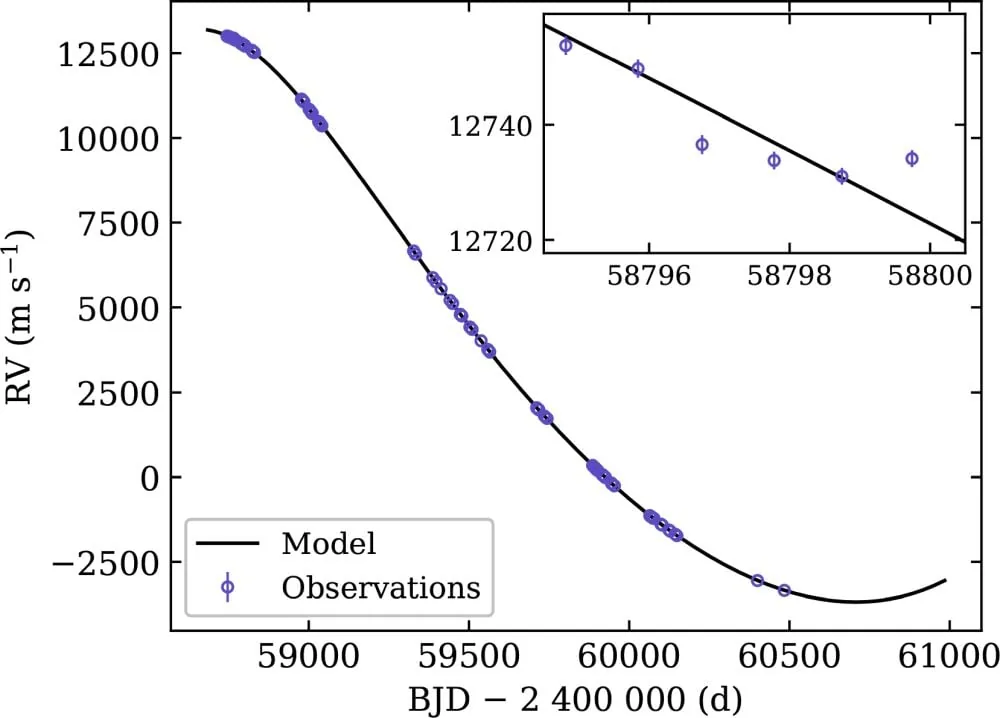
Observations gathered over 4.8 years with the SPIRou spectrograph confirmed that the red dwarf experienced a steady acceleration of roughly 5 m s−1 d−1, equivalent to nearly 1800 m s−1 yr−1. That steady acceleration ruled out an ordinary orbiting exoplanet. Around a star of 0.42 solar masses, even a massive planet the size of Jupiter would only induce accelerations between 40 and 130 m s−1 yr−1. Black holes were considered. Researchers at the Université de Montréal could not initially exclude a neutron star or a hidden black hole, but no high-energy radiation emerged [1, 2]. The unseen companion had a mass exceeding half the Sun. “The object’s unusual combination of high mass and dim light left only one plausible explanation: it was the remains of a dead star,” explained study co-author Charles-Antoine Parent [1].
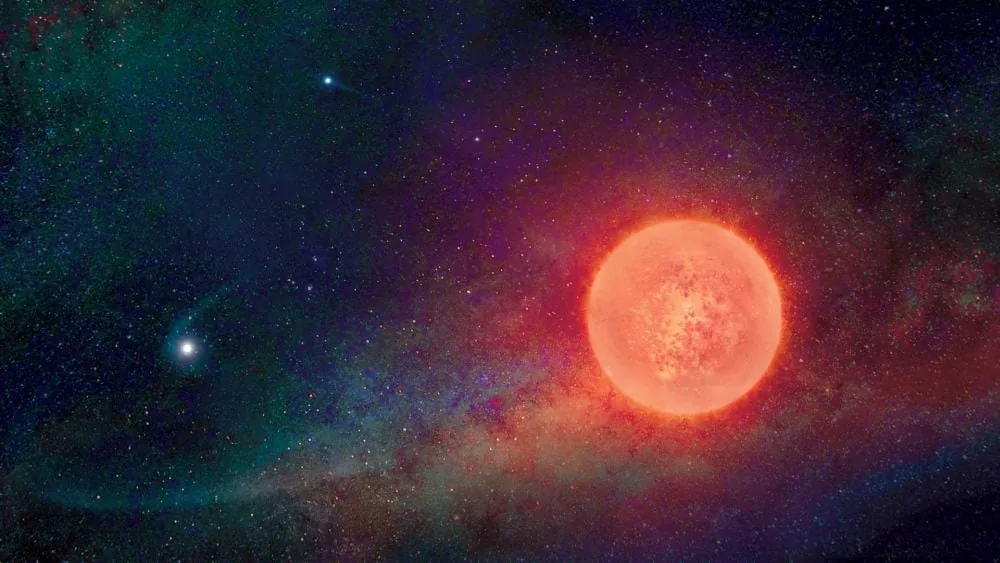
Discovery of an Unexpected Triple Star System
Astronomers already knew that the red dwarf possessed a distant companion star, but detecting the inner object transformed the pair into an unexpected trio. Archival surveys using Pan-STARRS1, STScI, and MAST had documented an outer white dwarf orbiting at a projected separation of 123.9 astronomical units, with an orbital period exceeding 1000 years. That distant companion sat far too far away to influence the rapid inner velocity swings observed in Hawai’i [1, 2].
The realization that an unseen white dwarf was hugging the primary star confirmed that this triple star system possessed a hierarchical architecture with no known analogue within 30 parsecs of Earth. The research team gave the stellar group the Hawaiian name Welopō‘ai, combining the words welo, meaning an inherited or family trait, and pō‘ai, which refers to an orbit or encircling path. The name evokes a “path of family traits” to honor the shared physical connections binding the trio [1, 2]. Under standard naming conventions, the central red dwarf is designated Welopō‘ai Aa, the newly identified close companion is Welopō‘ai Ab, and the distant outer star is Welopō‘ai B. Together, the three stars form a gravitational unit situated 8.46 parsecs away from our solar system. “The system should not exist,” said co-author Patrick Dufour, a white dwarf specialist at the Université de Montréal [1, 2].
Atmospheric Imaging with the Gemini North Telescope
Separating the faint white dwarf from the intense glare of Welopō‘ai Aa required powerful optical tools capable of cutting through the blurring effects of Earth’s atmosphere. Étienne Artigau and his collaborators turned to the Gemini North telescope on Mauna Kea, employing its high-resolution ‘Alopeke instrument [1, 2]. ‘Alopeke uses speckle imaging to freeze atmospheric turbulence through thousands of rapid, short exposures supported by the International Gemini Observatory and NSF [2].
Targeted observations in December 2023 and December 2024 revealed the dim companion. Because Welopō‘ai Ab exerts a measurable gravitational pull on its host star, researchers at the Trottier Institute for Research on Exoplanets were able to calculate its mass dynamically rather than relying on indirect brightness or spectral models. Solitary white dwarfs rarely yield clean masses. Within 20 parsecs of Earth, only a handful of white dwarfs possess direct mass measurements. The orbital mechanics in Welopō‘ai allowed Patrick Dufour and Charles-Antoine Parent to pin down the inner white dwarf at 0.62 solar masses with sub-percent precision at the 0.7 percent level [2].


Surviving Inside the Common Envelope
The physical survival of Welopō‘ai Aa poses a fundamental challenge to prevailing theories of binary star evolution. Before collapsing into a white dwarf, the progenitor star of Welopō‘ai Ab was roughly 40 percent more massive than our Sun, expanding hundreds of times in radius as it exhausted its core nuclear fuel. It engulfed the red dwarf. Standard models predict that gas drag forces such close companions to spiral inward until both stars merge completely [1, 2].
In standard astrophysical theory, friction inside this dense gaseous envelope robs the orbiting companion of orbital energy, dragging it inward until the two stars merge into a single body [1, 2]. Yet Welopō‘ai Aa did not merge with the expanding giant star, nor was it destroyed by the extreme hydrodynamic drag. Instead, the red dwarf emerged completely intact, settling into a stable orbit around the remaining degenerate stellar core. The puzzle of shedding stellar material without destroying the orbital architecture resembles investigations into how a supernova impostor mimics star death without exploding during eruptive stellar phases. “We have no clean explanation for how it got here,” Dufour admitted when discussing the system’s survival. If the envelope had cleared too slowly, the drag would have doomed the red dwarf, but if it had cleared too quickly, the system could not have reached its present orbital scale [1, 2].
Unusual Metallicity Inside an Ancient Red Dwarf
The orbital survival of the red dwarf is not the only mystery confounding astronomers, because the chemical makeup of Welopō‘ai Aa also contradicts established astrophysical models. Stellar dating indicates that the red dwarf is between 9 and 11 billion years old, making it an ancient citizen of our galaxy. Stars formed during that distant epoch typically contain very few elements heavier than hydrogen and helium [2].
Despite its extreme age, Welopō‘ai Aa displays an unusually high concentration of heavy elements. Astrobiologists studying ancient stars as potential havens for life track how stellar longevity influences planetary environments over billions of years. One theoretical explanation is external pollution, where the red dwarf captured metals ejected by the white dwarf progenitor during its final evolutionary stages. Under this scenario, enriched material blasted into space settled onto the surface of the surviving companion. However, mathematical modeling creates a deep barrier. To reproduce the observed metallicity, Welopō‘ai Aa would have needed to capture roughly two-thirds of the heavy metals expelled by its dying companion while absorbing virtually none of the surrounding hydrogen or helium gas. No known physical mechanism allows a star to filter and swallow heavy elements while rejecting light gases [2].
Future Observations of the Hierarchical Architecture
Because Welopō‘ai sits only 8.46 parsecs away, it offers an accessible natural laboratory for exploring tidal physics and stellar evolution. Étienne Artigau and the IREx team, known for developing instruments like SPIRou, NIRPS in Chile, and contributing to FGS/NIRISS on the JWST, plan to continue tracking Welopō‘ai. Spectrographs will provide ongoing radial velocity data, helping scientists test new simulations of common-envelope dynamics [2].
Astrophysicists view Welopō‘ai as a prime testing ground to study how closely orbiting stars exchange heavy elements and navigate complex gravitational interactions over time. By examining how Welopō‘ai Aa survived its companion’s red giant phase, astrophysicists hope to resolve broader questions about multi-star systems across the galaxy [2]. The discovery proves that compact stellar groupings can endure violent transitions that theorists once considered fatal. “Discoveries like this remind us that our own cosmic neighborhood still contains remarkable surprises,” Artigau said [1, 2]. “Even when we’re searching for planets, our Universe often has something completely unexpected waiting for us!”. Continued monitoring will test whether Welopō‘ai represents a solitary anomaly or a broader class of surviving stellar systems [1, 2].
- ONLINE NEWS Paul, A. (2026, November 20). A rare triple-star system near Earth ‘should not exist’. Popular Science. [Article Link]
- ONLINE NEWS Gough, E. (2026, November 20). A triple star system ‘that shouldn’t exist,’ only 28 light-years from Earth. Universe Today. [Article Link]
APA 7: PerEXP Teamworks. (2026, November 21). Welopō‘ai Triple Star System Defies Stellar Evolution Rules. PerEXP Teamworks. https://perexpteamworks.com/en/triple-star-system-welopoai-discovery/


