





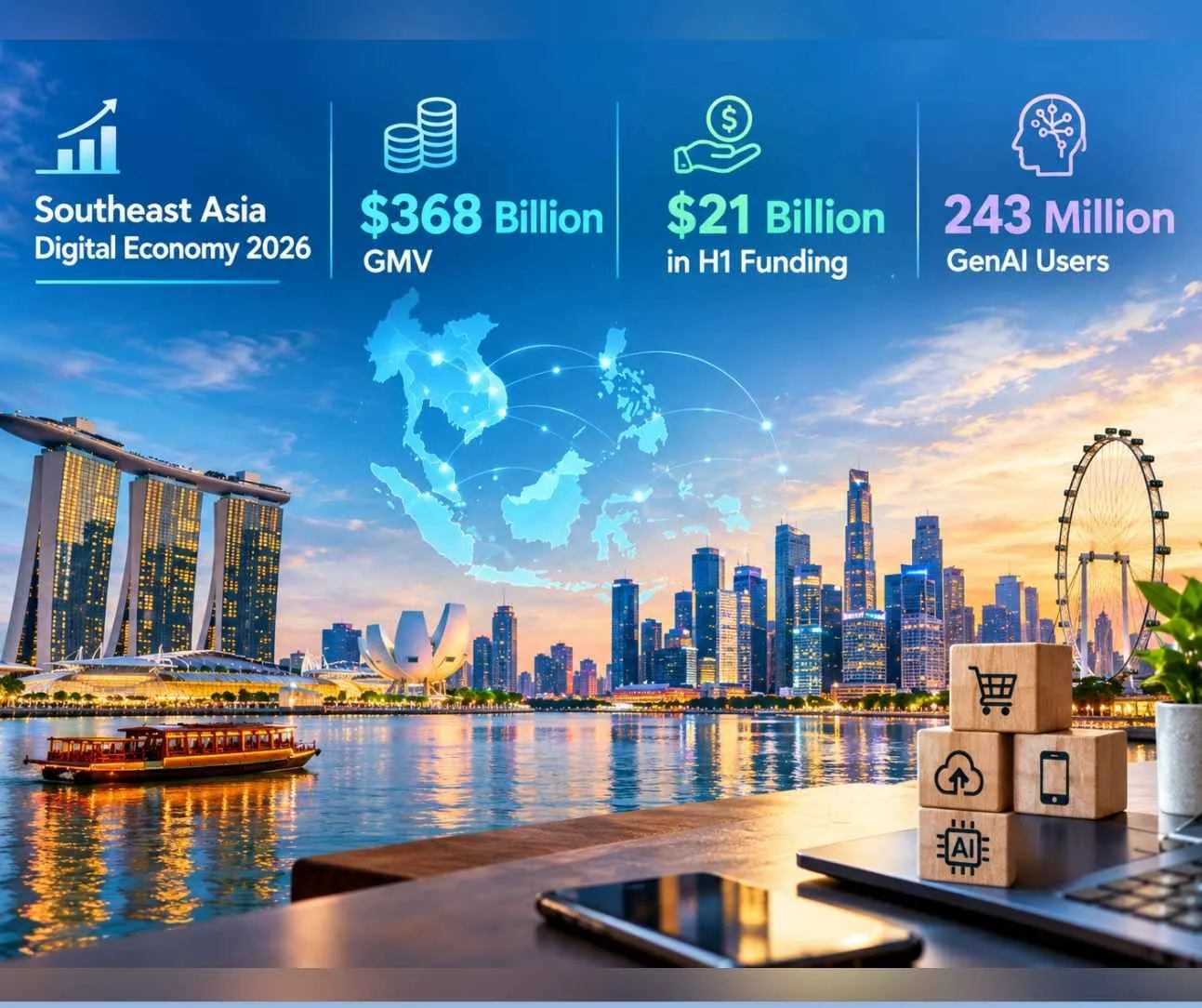
Google, Temasek, and Bain & Company announced on October 21 that the Southeast Asia digital economy will grow 17% in 2026 to reach $368 billion in gross merchandise value. The projection comes from the 11th annual e-Conomy SEA study, titled Building the Intelligent Economy, which tracks digital spending in Indonesia, Malaysia, the Philippines, Singapore, Thailand, and Vietnam [1]. The joint study projects that long-term momentum will push total platform transactions past $1.1 trillion by 2035, even as local businesses navigate shifting global financial conditions [2].
Market Gains Across Retail Platforms
E-commerce serves as the main engine for this growth, climbing 18% to reach $226 billion in 2026 from $191 billion a year earlier [5]. Online merchants are rolling out automated assistants to help shoppers discover products through conversational chat and image searches [1]. Bain partner Florian Hoppe said sellers are seeing a 10% to 15% conversion lift by deploying generative AI to produce short promotional videos and personalized product recommendations for shoppers [5]. These tailored catalog displays also help boost customer order values by as much as 75% on major shopping apps [1].
Consumer habits are shifting in step with these merchant tools. A study in six core markets showed that 69% of online shoppers use automated systems to compare product prices and specifications before checking out [5]. In addition, multimodal discovery accounts for 31% of all product queries on regional shopping apps [3]. Platforms in Singapore, Malaysia, and Thailand have paired these discovery tools with free shipping offers and loyalty rewards to keep buyers engaged [5].
Other digital service categories recorded steady gains in transaction volume. Online travel bookings grew 10% to $59 billion, driven by higher flight prices and rising hotel room rates [5]. Standalone generative software platforms captured 26% of travel planning journeys, surpassing social media networks at 23% [3]. Online media climbed 22% to $44 billion in revenue, helped by retail advertising networks and playable game ads. Food delivery and transport services rose 15% to $40 billion, supported by smarter routing algorithms and voice booking assistants for elderly passengers [5].
Southeast Asia Digital Economy Adoption Trends
Generative tools have reached 243 million people in Southeast Asia in under three years, representing about 58% of the working-age population. That adoption pace scaled four times faster than the historic rollout of mobile internet services [1]. Singapore leads the region in overall penetration, with 70% of its working population—approximately 3.2 million people—using generative tools for daily professional and study tasks [3]. Malaysia ranks second in total adoption, while Vietnam holds third place. However, Vietnam ranks first in daily frequency, with 26% of its online population interacting with generative systems every day [2]. Despite that reach, people in Southeast Asia consume an average of 5 to 7 million tokens per person, compared with 14 million in Europe and 60 million in the United States [3].
User confidence plays a central role in how these tools move from casual chat into commercial tasks. Around 72% of consumers in the region already depend on automated software for tasks like price tracking. Building on that habit, 75% of surveyed users expressed willingness to let autonomous agents compare product deals and complete online purchases on their behalf. Trust in artificial intelligence tools rose over the past year, with 62% of respondents citing greater confidence based on accurate outputs and reliable service history. However, buyers still demand clear safeguards: 44% ask for data privacy protections, 36% want clear explanations of system limits, and 30% expect the option to reverse accidental automated purchases [1].

Temasek Global Investments head Fock Wai Hoong said user enthusiasm drops quickly if automated material looks unauthentic or low quality. As Fock said: “You don’t need the most powerful model to compare two tennis rackets, that just doesn’t make sense.” [2]


Data Center Capacity and Power Demands
Soaring software adoption has placed heavy demands on electrical grids and computing facilities in Southeast Asia [1]. Built data center capacity in the region grew from 4.0 gigawatts at the close of 2025 to 5.8 gigawatts by the middle of 2026, marking a 45% increase in six months [4]. Projections show that meeting compute needs through 2030 will require server capacity to expand roughly threefold in key hubs. Enterprise software workloads now drive between 45% and 60% of total computing demand in Singapore and Malaysia [3].
Governments are introducing environmental standards to manage the heavy power draw of these server facilities. Singapore allocated an additional 200 megawatts of green energy to its 1.4-gigawatt compute base, while enforcing binding Power Usage Effectiveness rules through its Digital Infrastructure Bill. In Malaysia, operators rely on the Corporate Renewable Energy Supply Scheme to secure cost-competitive clean energy for AI workloads [3]. The joint study concludes that without reliable green electricity and clear efficiency rules, hardware shortages could limit software deployment [6].

Token consumption serves as a key measure for this growing computing demand. Consumers generate about 60% of regional AI tokens through everyday study and office tasks, leaving substantial headroom for enterprise adoption [3]. As software tools transition from answering single questions to completing multi-step autonomous transactions, the study projects a 60-fold surge in regional AI usage by 2030 [1]. That projected increase reinforces the need for scalable data centers and reliable connectivity [6].
Funding Shifts in the Southeast Asia Digital Economy
Private funding for digital companies rebounded to $21 billion in the first half of 2026, nearly doubling the $11 billion recorded for all of 2025. Two landmark data center transactions accounted for the vast majority of that capital. Singapore-based operator ST Telemedia Global Data Centres closed an $11 billion deal, while platform DayOne completed a $5 billion transaction [3]. Together, those two investments represented $16 billion of the six-month total, signaling strong investor commitment to digital infrastructure [4].
Early-stage venture capital showed a more measured pace. Startups raised $580 million during the first half of 2026, marking a slight rise from $530 million recorded in the prior year period. However, funding for businesses with dedicated artificial intelligence products surged to $3.2 billion in the first half of 2026, up from $900 million in early 2025. AI startups captured over 50% of early-stage deal volume and 80% of total funding value in Southeast Asia. Temasek investment head Fock Wai Hoong explained that backers now insist on clear unit economics: “It’s clear that you can’t really invest in early-stage startups if you’re not demonstrating returns; no one’s going to give you the money.” [2]
Public capital markets provided additional exit pathways for early tech investors. Initial public offering proceeds reached $8.5 billion in the twelve months ending June 30, 2026, more than double the $3.6 billion raised during the previous annual period. Listings in Singapore and Malaysia generated the bulk of that public capital [4]. Full-year 2025 data showed IPO proceeds climbing to $6.8 billion from $3.7 billion in 2024, demonstrating renewed liquidity [2].
Regional Digital Trade Agreements
Cross-border business operations still face hurdles from fragmented national rules. Ten member states plan to formalize the ASEAN Digital Economy Framework Agreement in November 2026, creating the world’s first region-wide digital trade pact. The agreement aims to harmonize standards for cross-border electronic commerce, secure data flows, and digital payments [3]. A unified regulatory structure will help the Southeast Asia digital economy expand by reducing compliance friction across national borders [1].
Individual countries are also enacting local governance frameworks to guide autonomous software deployment. Singapore published its Model AI Governance Framework for Agentic AI and established runtime guidelines for automated financial systems known as SAFR. The country also launched its National AI Impact Programme, which aims to train 100,000 individuals in modern technical skills by 2029. Digital lending balances in the region grew 22% to $116 billion, supported by Singapore’s leadership in digital wealth platforms [3].

Economic resilience across ASEAN member states provides a stable foundation for this digital expansion. The International Monetary Fund projects ASEAN gross domestic product to expand 4.9% in 2026 and 4.7% in 2027, outpacing global economic forecasts of 3.1% and 3.4%. Florian Hoppe of Bain said at a media conference that investment momentum has shielded regional markets from wider geopolitical headwinds. As Hoppe said: “GDP has held up remarkably well, and that has been linked partially also to the fact that investment has been very strong.” [5]
- WEBSITE Gajria, N. (2026, October 21). Southeast Asia’s digital economy to hit $368 billion. Google Blog. [Article Link]
- ONLINE NEWS Cher, B. (2026, October 21). South-east Asia digital economy to hit US$368 billion GMV in 2026, US$1.1 trillion in 2035: report. The Business Times. [Article Link]
- ONLINE NEWS Anderson, L. (2026, October 21). Southeast Asia Digital Economy 2026: $368 Billion GMV and 243 Million GenAI Users. BestStartup.Asia. [Article Link]
- ONLINE NEWS CEO Insights Asia Team. (2026, October 21). Southeast Asia Digital Economy to Hit US$368bn in 2026. CEO Insights India. [Article Link]
- ONLINE NEWS Chee, K. (2026, October 21). South-east Asia’s digital economy to hit US$368b in 2026, up 17% as AI uplifts growth. The Straits Times. [Article Link]
- ONLINE NEWS Developments Today. (2026, October 21). Southeast Asia Digital Economy Hits $368B in 2026. Developments Today. [Article Link]


