



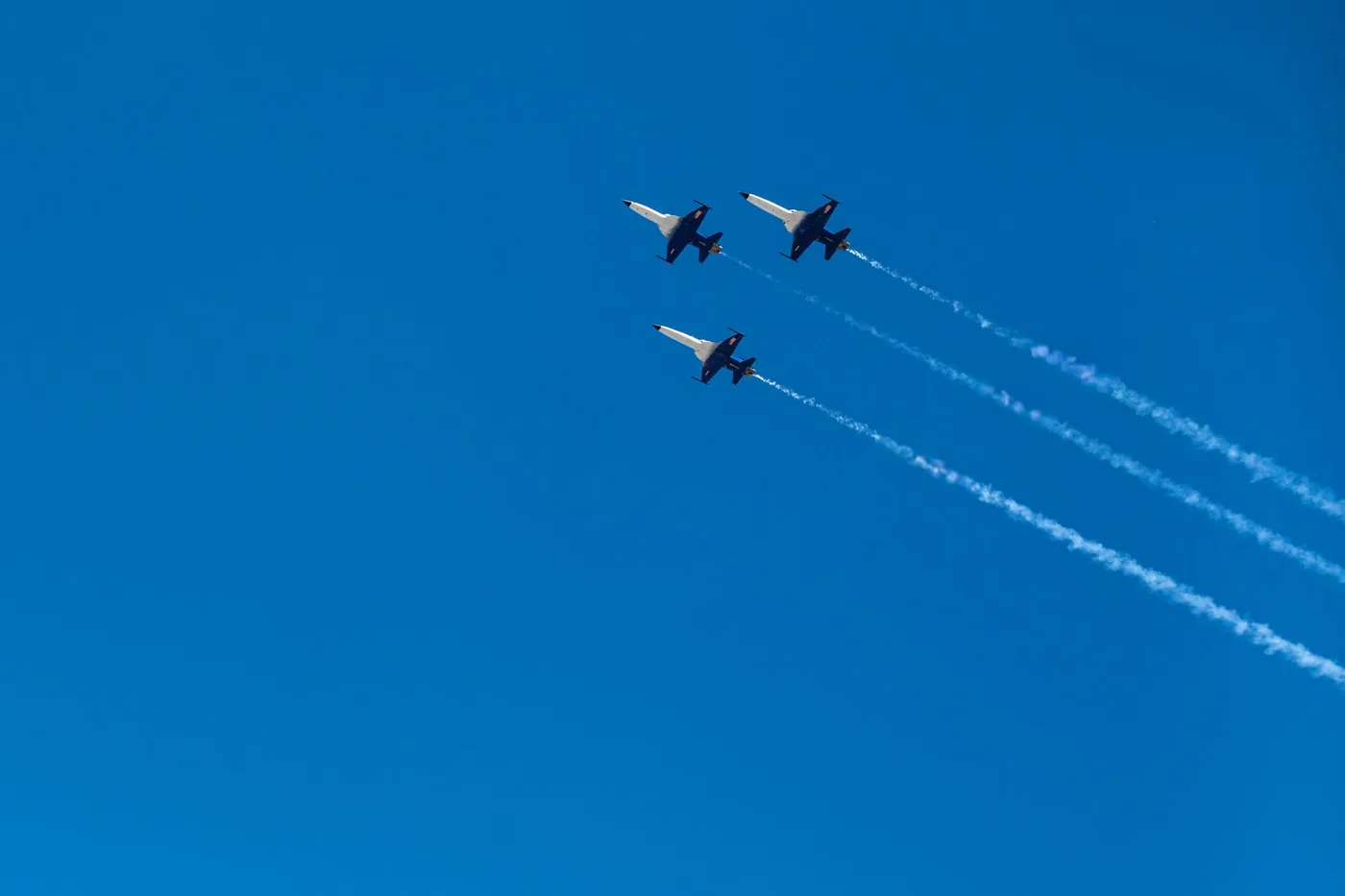
NASA will stage an aerial flight demonstration over Tuscaloosa on Saturday, Oct. 24, as part of the agency’s nationwide Inspiration Tour. The public event brings NASA Administrator Jared Isaacman into the cockpit of an F-5 fighter jet to lead a three-aircraft formation before the matchup between Alabama and Texas A&M. This public appearance links University of Alabama football with federal aeronautics outreach, presenting dynamic flight operations with ground exhibits designed to introduce college sports audiences to current space exploration programs [1].
NASA Flight Operations Over Tuscaloosa
The scheduled flyover places agency leadership directly in the cockpit during pregame festivities in Tuscaloosa. NASA Administrator Jared Isaacman will pilot one of three tactical F-5 fighter jets soaring above the athletic venue, an aerial appearance that displays the agency’s long-standing role in aeronautics research and practical aviation development. While space exploration missions capture frequent public notice, high-performance jet operations remain a steady component of testing aerodynamic models and training crews for demanding flight tasks. Isaacman’s flight over the stadium gives spectators an immediate view of high-performance aircraft maneuvers that support broader agency research programs [1].
Live flight demonstrations create a different engagement model than stadium visits where astronauts address crowds from the field. Earlier sports outreach saw how NASA astronaut Christina Koch shared her lunar journey with NFL fans in Philadelphia through conversations and stadium screen videos. The Tuscaloosa event shifts that dynamic toward active aviation, sending twin-engine tactical jets into local airspace to demonstrate flight capabilities before thousands of college football spectators [1].
Public Exhibits on Champions Lane
Beyond the aerial flyover, NASA is setting up an expansive outreach footprint on the ground. Supported by NASA’s Marshall Space Flight Center in Huntsville, Alabama, the agency will operate an interactive Experience Zone on Champions Lane from 10:30 a.m. to 2:30 p.m. Central Daylight Time (CDT) on game day. The venue requires no game ticket, letting local residents and traveling fans explore agency hardware free of charge. Accredited news media representatives will have a designated media opportunity with Isaacman at 11 a.m. CDT, coordinated through NASA media contact Lance D. Davis. Journalists planning to cover the briefing must confirm attendance by email with Davis to obtain credential details before the Friday noon deadline [1].
Visitors walking through the Champions Lane displays can inspect an inflatable model of the Space Launch System (SLS), which serves as the heavy-lift rocket for returning astronauts to the Moon. Exhibits also feature detailed representations of the Starship and Blue Moon human landing systems developed for lunar exploration. Students can examine educational pathways and application details for agency internships, discovering technical programs like how the NASA ORBIT challenge opens space patents to students seeking practical aerospace experience [1].
Engaging University of Alabama Football Crowds
The Tuscaloosa event serves as a central stop on the agency’s wider Inspiration Tour, an initiative designed to connect federal aerospace teams with academic institutions, industrial partners, and local communities. Sports gatherings provide massive audiences for science communication, following previous stops such as when the NASA Inspiration Tour reached Acrisure Stadium during professional football games. By bringing aerospace hardware to University of Alabama football festivities, the agency engages fans in informal settings where family members and students gather before kickoff. The tour builds public awareness for space missions before concluding with the MAX POWER exposition on Nov. 7 and Nov. 8 near Kennedy Space Center in Florida [1].
The MAX POWER exposition marks a multi-day public gathering honoring the 250th anniversary of the United States. That Florida event will showcase advanced spacecraft, next-generation aircraft, and autonomous transportation systems that will define future travel in air and orbit. By staging demonstrations at university athletic contests first, NASA establishes early connections with prospective engineers and scientists across the country [1].


What Formed the Campus at Tuscaloosa?
Federal lawmakers initiated the school’s origins in 1818 when Congress granted land across the Alabama Territory for higher learning. After Alabama achieved statehood in 1819, a second grant expanded that federal gift to 46,000 acres (186 km2) to support the planned institution. State legislators formally chartered the school on December 18, 1820, under the name “The University of the State of Alabama”, selecting trustees to direct construction on grounds positioned just beyond the town borders of Tuscaloosa [2].
Campus planning fell to William Nichols, the architect behind the state capitol building in Tuscaloosa. Taking structural cues from Thomas Jefferson’s rotunda concept at the University of Virginia, Nichols designed a circular domed building measuring 70 feet in both width and height to house books and anchor student activity. Campus officials received their founding charter inside Christ Episcopal Church, eventually welcoming an initial class under president Alva Woods on April 18, 1831. During the 1830s, the institution operated as an academy emphasizing classical languages with social and natural sciences, averaging around 100 enrolled students each year [2].
Antebellum Studies and Campus Destruction
Before the Civil War, the Tuscaloosa institution maintained an extensive book collection that exceeded 7,000 volumes, ranking among the largest collegiate libraries in the country. Intellectual life thrived through active student groups like the Erosophic and Phi Beta Kappa societies, whose podiums welcomed talks by writer William Gilmore Simms, scholar Frederick Barnard, and jurist John Archibald Campbell. Behavioral infractions caused persistent trouble for early presidents, who barred drinking, swearing, off-campus travel, and playing musical instruments for over an hour at a time. After recurring riots and armed gunfights disrupted campus order, president Landon Garland restructured collegiate life in 1860 by transforming the school into a military training academy where cadets prepared for military commissions [2].
This military realignment turned the grounds into an active target during the war’s closing phase. Union cavalry set fire to the campus on April 4, 1865, arriving barely five days prior to the Confederate surrender at Appomattox. Even though enrolled cadets mounted an armed stand, flames destroyed nearly all nineteenth-century facilities, sparing only four properties: the 1841 President’s Mansion, the 1829 Gorgas House, the 1860 Little Round House, and the 1844 Old Observatory [2].
How Alabama Football Fits Campus Research
Postwar reconstruction enabled the university to establish its renowned athletics tradition with classroom instruction. Organized collegiate football launched in 1892, giving rise to the Crimson Tide moniker and building an athletic program ranked among the top ten in national history. Speaking to an audience in 1913, university president George H. Denny referred to the school as the “capstone of the public school system in the state”, providing the origin for its enduring title, The Capstone. Today, Alabama football matchups draw enormous crowds, turning autumn game days into high-profile civic events [2].
Campus development extends far beyond athletics into advanced scientific and professional fields. Designated an institution with very high research activity under the “R1: Doctoral Universities – Very high research activity” classification, the school operates 12 distinct academic divisions and hosts the state’s sole public law program. Institutional records through fall 2025 document 16 Truman Scholars, 45 Hollings Scholars, 21 Boren Scholars, and 69 Goldwater Scholars [2]. That academic setting offers a strong backdrop for national outreach as NASA presents modern aerospace technology to students and visiting families [1].
- PRESS RELEASE Davis, L. D. (2026, October 21). NASA to Conduct NCAA Flyover, Engage Fans at University of Alabama. NASA. [Article Link]
- WEBSITE University of Alabama. (n.d.). In Wikipedia. [Article Link]
APA 7: PerEXP Teamworks. (2026, October 22). NASA Plans Jet Flyover for University of Alabama Football. PerEXP Teamworks. https://perexpteamworks.com/en/university-of-alabama-football-nasa-flyover/


