




Routine space cargo missions keep the International Space Station operational by ferrying provisions, experimental gear, and propellant across low Earth orbit. Can these relentless supply runs match the pace of accelerating microgravity research? As long-duration orbital expeditions expand, regular flights must deliver replacement hardware before failures halt daily schedules. On Wednesday, September 16, 2026, an unpiloted Progress 96 spacecraft launched from Kazakhstan carrying essential consumables, propellant reserves, and scientific equipment to replenish the Expedition 75 crew [1, 3].
How Space Cargo Missions Replenish the Station
Roscosmos launched the unpiloted Progress 96 freighter at 9:33 a.m. EDT on Wednesday from the Baikonur Cosmodrome in Kazakhstan aboard a Soyuz booster rocket. Ground controllers verified stable orbital insertion shortly after liftoff as the uncrewed spacecraft began its two-day pursuit of the orbiting complex [1, 3]. Automated docking is scheduled for Saturday at 9:46 a.m. EDT at the Poisk Module, delivering fresh propellant, food, water, and research gear to the crew [1]. This arrival follows Progress 94, which undocked earlier in September after completing its mission [6]. Regular space cargo missions ensure that orbital facilities never exhaust vital consumables during complex handovers [1].
Inside the station, cargo management requires continuous physical labor from the orbital crew. Station commander Jessica Meir spent Wednesday transferring research hardware in and out of Northrop Grumman’s Cygnus XL resupply craft. Northrop Grumman’s cargo vessel has remained secured to the Earth-facing nadir berth of the Unity Module since April 14, following its robotic capture by Canadarm2 [1, 5]. Over 11,000 pounds of scientific gear arrived aboard Cygnus XL [5]. Unpacking takes weeks.
Managing arriving freight demands precise stowage planning. Jessica Meir inspected Harmony Module equipment racks to organize storage space ahead of arriving payloads. While earlier reports examined how astronaut exercise aboard the ISS documents crew conditioning during lighter duty shifts, active cargo handling requires strenuous labor across the International Space Station [1, 5]. Earlier resupply flights, such as Progress 93 delivering 2.8 tons of sustenance and propellant to Zvezda Service Module docking ports, proved that disciplined stowage keeps pathways clear [5]. Unpacking continues daily.
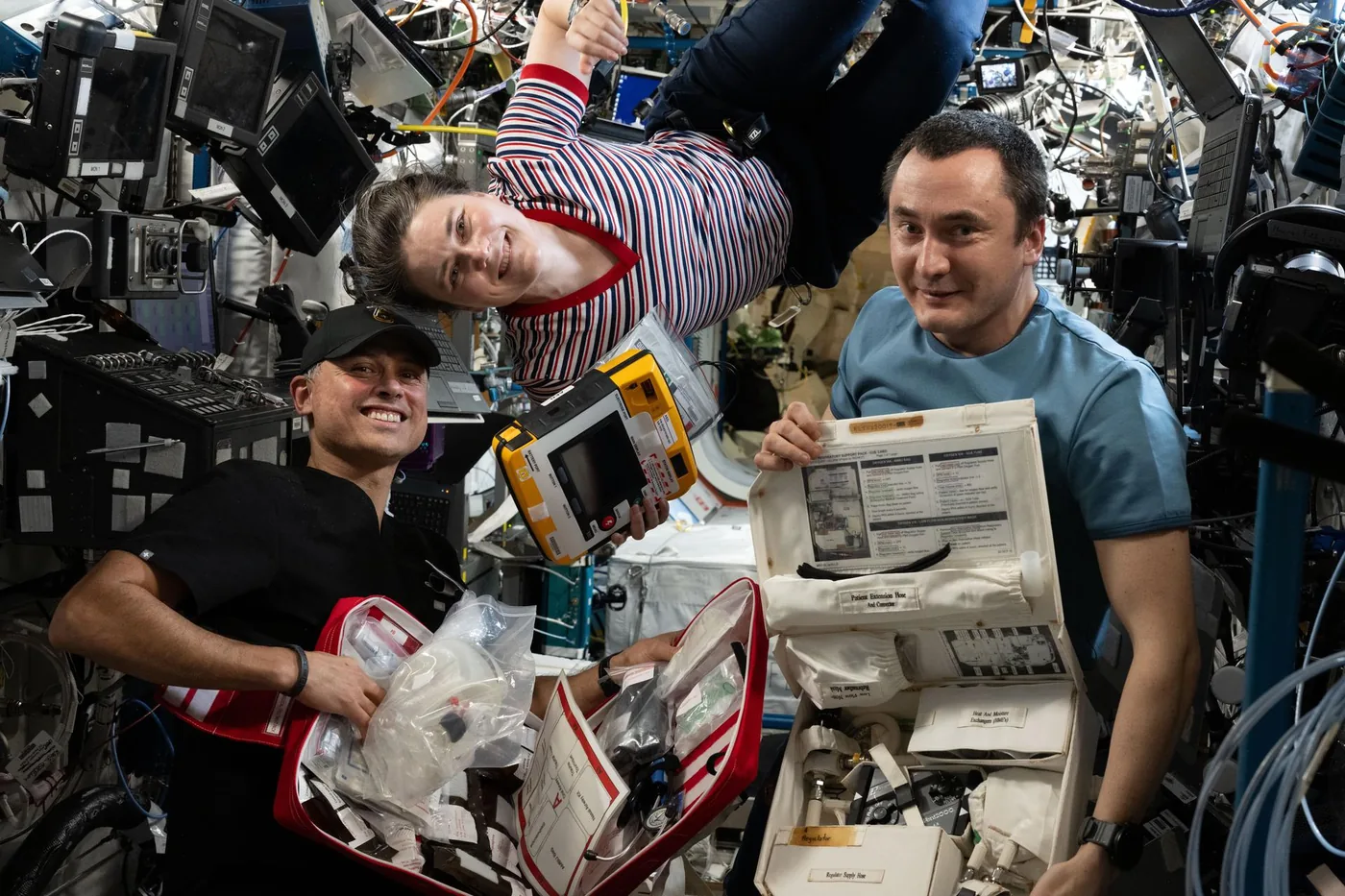
Solving Dragon Propulsion Issues for Crew-13
While cargo ships deliver passive freight, crewed capsules face stringent qualification hurdles before launch. NASA managers and SpaceX mission planners now aim for an early October liftoff of Crew-13 toward the International Space Station. The schedule adjustment allows joint engineering teams to complete thorough prelaunch checkouts, flight readiness reviews, and operational coordination across several international ground control centers [1, 4]. Processing teams detected an oxidizer leak in Dragon’s propulsion system during prelaunch testing [4]. Flawless valves matter.
Crew-13 will send four crew members representing three space agencies into orbit for a long-duration expedition. Spacecraft commander Jessica Watkins and pilot Luke Delaney lead the four-person Crew-13 flight complement with mission specialist Joshua Kutryk from the Canadian Space Agency and an assigned Roscosmos flight specialist [4]. Their upcoming arrival will relieve the four SpaceX Crew-12 residents—Jessica Meir, Jack Hathaway, Sophie Adenot, and Andrey Fedyaev—who have lived aboard the station since February 14 [1]. The incoming team introduced their expedition goals during a prelaunch briefing held at Johnson Space Center in Houston Texas [4]. Details outlined during the NASA SpaceX Crew-12 briefing highlighted the extensive turnover preparations required before the spacecraft undocks [1]. Research continues unbroken.
Propulsion valves demand zero margin. Engineering teams at Cape Canaveral replaced the leaking oxidizer valve to ensure the SpaceX Dragon spacecraft performs flawlessly during high-stakes orbital rendezvous and autonomous docking maneuvers [1, 4].
Manufacturing Electronics with Lead-Free Soldering in Orbit
In-space manufacturing could soon transform how orbital outposts handle component breakdowns without waiting for emergency space cargo missions. NASA flight engineer Anil Menon conducted critical manufacturing trials inside the Harmony Module using lead-free soldering techniques. Working within Harmony’s maintenance work area, Menon installed experiment hardware, tested electrical connections, and deployed containment gear designed to capture toxic soldering fumes during microgravity operations. He then soldered electronic components directly onto test circuit boards for the MIYOKA investigation [1, 2]. Demonstrating dependable circuit repair represents a vital step toward deep space exploration [2].
Engineers cannot easily predict molten solder behavior when gravity vanishes. The space-soldered circuit boards will return to terrestrial laboratories aboard a returning SpaceX Dragon capsule for structural microscopic inspection and comparative mechanical stress tests [1, 2]. Space manufacturing reduces logistics burdens [1]. Repairs save missions.

Autonomous maintenance relies on versatile science hardware distributed across international modules. In the Columbus Laboratory Module, ESA flight engineer Sophie Adenot configured the Kubik incubator and centrifuge system for remote-controlled operations managed by ground scientists. Station commander Jessica Meir supported parallel research by swapping modular payload containers inside an EXPRESS rack (an automated enclosure that provides power, data, and active cooling for diverse microgravity experiments) in the Destiny Laboratory Module. Routine space cargo missions replenish these modular locker inserts to sustain dozens of ongoing investigations across multiple scientific fields [1, 2]. Power cycles matter.


Tracking Crew Stress, Sleep, and Cardiovascular Shifts
Human physiology alters rapidly in weightlessness, requiring continuous medical surveillance throughout long orbital tours. Station commander Jessica Meir initiated her Wednesday shift by recording personal sleep quality ratings, collecting a saliva sample, and downloading biometric data from her smartwatch to a tablet computer. Ground scientists analyze these daily physiological metrics for the RelaxPro investigation to identify early stress indicators [1]. Can targeted sleep protocols prevent chronic cognitive fatigue during six-month missions? Biomedical tracking helps flight surgeons safeguard crew psychological well-being during intense orbital workloads.
Physical conditioning counteracts muscle atrophy in microgravity. Inside the Columbus Laboratory Module, Sophie Adenot exercised on the European Enhanced Exploration Exercise Device (E4D), while controller software monitored her power output [1, 2]. Adenot also restocked Columbus Human Research Facility kits with blood collection tubes, needles, and medical supplies. Broad physiological investigations confirm that scheduled resistance exercise significantly mitigates musculoskeletal degradation during prolonged orbital exposure [2]. Conditioning protects vitality.

Cosmonauts evaluate complementary physical countermeasures to protect cardiovascular and neurosensory stability. Andrey Fedyaev tested a specialized lower body negative pressure suit (a pressurized garment that draws body fluids from the upper torso toward the feet) with assistance from Anna Kikina. The negative pressure countermeasure helps prevent cephalic fluid congestion and eases cardiovascular readaptation to Earth’s gravitational field following prolonged spaceflight. Meanwhile, Pyotr Dubrov and Kikina performed the Virtual experiment wearing virtual reality goggles to track vestibular adaptation. Dubrov, Kikina, and Menon also completed computerized hearing evaluations inside the Quest Airlock to identify operational noise impacts [2]. Daily countermeasures protect sensory coordination.
Maintaining Life Support and Clean Water in Orbit
Life support machinery requires constant preventative care to keep the orbiting outpost habitable. NASA flight engineer Jack Hathaway spent a major portion of his shift inside the Destiny Laboratory Module servicing and replacing key fluid components within the environmental oxygen generation system [1]. Hathaway installed newly delivered water filter cartridges designed to remove abrasive fluoride ions from recycled station water. Pure water matters. Clean loops work.
Station upkeep also extends into biological facility management and thermal loop diagnostics. In the Kibo Laboratory Module (the Japanese Experiment Module), Hathaway dismantled plant growth modules and positioned biological incubators onto the Saibo research rack. These plant facilities connect directly with broader crop health monitoring strategies aimed at growing fresh vegetables on multi-year interplanetary voyages [2]. Earlier biological studies inside the Kibo Laboratory Module utilized the Life Science Glovebox to evaluate cellular preservation during deep space voyages [5]. Hathaway later extracted fluid samples from the U.S. segment’s internal thermal control system to detect early signs of chemical corrosion or microbial growth [2]. Thermal loops matter.

The three Roscosmos flight engineers concentrated their Wednesday working hours on Russian segment life support upkeep. Pyotr Dubrov inspected main electrical power distribution networks and cleared accumulated particulate debris from ventilation ducts inside the Zvezda Service Module. Cosmonaut Anna Kikina serviced Zvezda’s Elektron oxygen generator and washed mesh fan filter screens throughout the Rassvet Module [1]. Clean vents work.
What Long Stays Teach Astronauts About Gravity
Six months in microgravity reshapes how astronauts perceive both Earth and the mechanics of orbital labor. On Wednesday, SpaceX Crew-12 crewmates Jessica Meir, Jack Hathaway, Sophie Adenot, and Andrey Fedyaev gathered in the station’s forward cabin for a live news conference with terrestrial media. Meir reflected on a recent spacewalk where she was anchored to the end of the robotic arm high above the atmosphere. She vividly described the unforgettable sensation of floating suspended above the planet during Canadarm2 maneuvers as “the biggest eureka moment” of her orbital mission [1]. Cosmic views inspire.
Observing terrestrial landforms provides crucial environmental baseline data while offering astronauts a rare aesthetic vantage point. Andrey Fedyaev configured automated multispectral cameras mounted in the Russian segment to photograph mountain ranges, inland drainage basins, and dynamic desert dunes across the vast African continent [2]. Flight engineer Oleg Platonov similarly photographed dynamic landmarks and geological formations across South America during previous missions to track global ecological patterns [5]. Orbital surveys continue.
The arrival of fresh supplies aboard Progress 96 and the upcoming handover to Crew-13 reaffirm that orbital stations cannot survive without continuous logistical replenishment. Unbroken space cargo missions remain the essential bridge that sustains scientific experiments, operational safety, and crew life support in low Earth orbit. A recent space exploration preprint—which has not yet undergone formal peer review—examines autonomous frameworks like DewTwin-Coin for lunar resource prospecting, illustrating how future interplanetary architectures must rely on automated analytical systems rather than immediate supply lines from Earth [7]. Ground controllers and flight engineers will continue monitoring spacecraft approach telemetry as the Poisk Module prepares for automated docking on Saturday morning following the successful orbital journey from the Baikonur Cosmodrome [1]. Exploration endures unbroken.
- PRESS RELEASE Garcia, M. A. (2026, September 16). Cargo mission and Crew-13 updates; station research, maintenance continue. NASA. [Article Link]
- PRESS RELEASE Garcia, M. A. (2026, September 14). Research for space manufacturing, crew health begins week aboard station. NASA. [Article Link]
- WEBSITE Cermak, A., & NASA Science Editorial Team. (2023, April 24). Latest news, missions and discoveries from NASA Science. NASA Science. [Article Link]
- PRESS RELEASE NASA. (2026, May 1). NASA’s SpaceX Crew-13 mission. NASA. [Article Link]
- PRESS RELEASE Howren, K. N. (2025, September 15). Crew awaits second cargo mission in less than a week; keeps up biotech research. NASA. [Article Link]
- WEBSITE Issinfo Net. (2026, September 8). Space station news. issinfo.net. [Article Link]
- PREPRINT DewTwin-Coin: An onboard autonomous framework for lunar water-ice prospecting using Chandrayaan-3 LIBS and ChaSTE data. (2026). arXiv [Preprint – not yet peer-reviewed]. [Article Link]
APA 7: Garcia, M. A. (2026, September 16). How space cargo missions fuel Expedition 75 science in orbit. https://perexpteamworks.com/en/space-cargo-missions-station-research-updates/


1 comment