



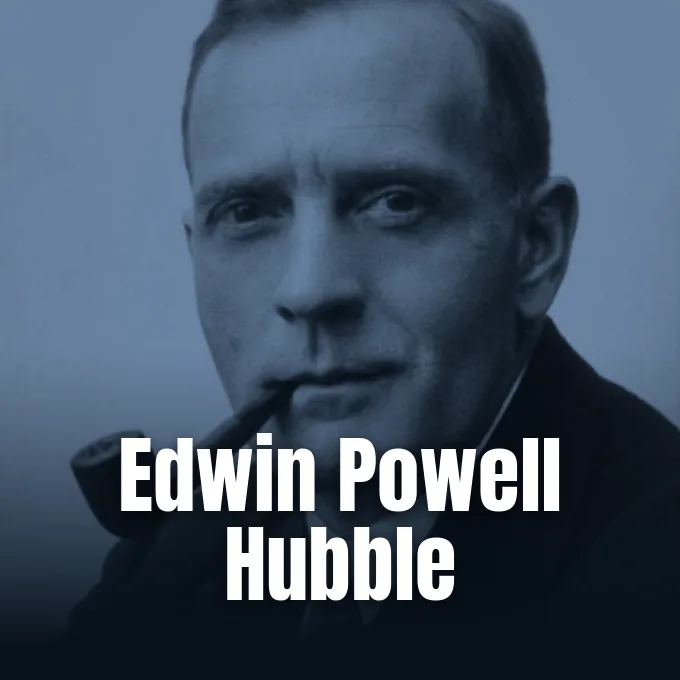
Did human understanding of the cosmos truly end at the edge of the Milky Way before the twentieth century? American astronomer Edwin Powell Hubble (1889–1953) dismantled that long-held assumption through groundbreaking telescopic observations at Mount Wilson Observatory [1]. Widely celebrated today for inspiring the namesake NASA space observatory, Hubble transformed observational cosmology from philosophical conjecture into an empirical discipline [2]. His discoveries established that spiral nebulae were external galaxies and that the universe was actively expanding [4].
- How Did Edwin Hubble Transition from Law to Astronomy?
- What Did Edwin Powell Hubble Discover Beyond the Milky Way?
- Hooker Telescope Observations and Cepheid Distance Scales
- How Did Edwin Hubble Prove Cosmic Expansion?
- Ballistics Research and Honors During World War II
- The 200-Inch Hale Telescope and Cosmological Legacy
How Did Edwin Hubble Transition from Law to Astronomy?
Edwin Powell Hubble transitioned toward astronomical research only after honoring a promise to his father to complete a formal legal education [4]. Born in Marshfield, Missouri, on November 20, 1889, to Virginia Lee James of Virginia City, Nevada, and insurance executive John Powell Hubble, Edwin moved with his family to Wheaton, Illinois, in 1900 [1]. A gifted athlete at Wheaton High School, Hubble won seven first places in a 1906 track meet [4]. He loved novels by Jules Verne and H. Rider Haggard, particularly King Solomon’s Mines. At his 1906 high school commencement, the principal paused before presenting him a scholarship to the University of Chicago. Because the award was mistakenly halved between two students, Hubble worked as a tutor and assistant to physicist Robert Millikan to pay college tuition [1].
After earning his Bachelor of Science in 1910 and helping Chicago’s basketball team win a Big Ten Conference title in 1907, Hubble traveled to Queen’s College at Oxford University as a Rhodes Scholar [4]. He read Roman and English law, receiving a degree in jurisprudence in 1912 [3]. John Powell Hubble passed away late in 1913 during Edwin’s stay in England. Returning to Louisville, Kentucky, Hubble passed the bar examination on September 2, 1913, but abandoned legal practice after teaching Spanish and physics at New Albany High School in Indiana [4]. He acknowledged that he ‘chucked the law for astronomy’ because scientific investigation was what genuinely mattered [1].
In 1914, Hubble entered Yerkes Observatory. He worked under Edwin Brant Frost. Astronomy became his lifelong focus [3].
What Did Edwin Powell Hubble Discover Beyond the Milky Way?
Edwin Powell Hubble discovered that spiral nebulae were independent galaxies located far outside our own Milky Way system. Arriving at Mount Wilson Observatory in California in 1919 after military service, Hubble gained access to the newly completed 100-inch Hooker Telescope. At the time, astronomers assumed that our galaxy constituted the entire physical universe. Hubble focused the 100-inch reflector on faint nebulae, systematically tracking Cepheid variable stars whose pulsating brightness functioned as reliable standard candles [4].
To calculate cosmic distances, Hubble utilized the period-luminosity relation discovered in 1908 by astronomer Henrietta Swan Leavitt. By comparing the apparent brightness of Cepheids in the Andromeda Nebula and Triangulum Nebula with their intrinsic luminosity, Hubble calculated that Andromeda lay hundreds of thousands of light-years away, far beyond the Milky Way. His observations proved that these spiral clouds were independent star systems. Harlow Shapley had vigorously contested that interpretation [4]. Hubble’s photographic plates resolved the dispute with definitive empirical data [1].
Opposition gradually faded. Hubble published his findings in The New York Times on November 23, 1924, before delivering a formal presentation to the American Astronomical Society on January 1, 1925. The society awarded him the American Association Prize along with a 500-dollar award from Burton E. Livingston [4]. Observations on Mount Wilson had permanently enlarged the known universe [1].
Hooker Telescope Observations and Cepheid Distance Scales
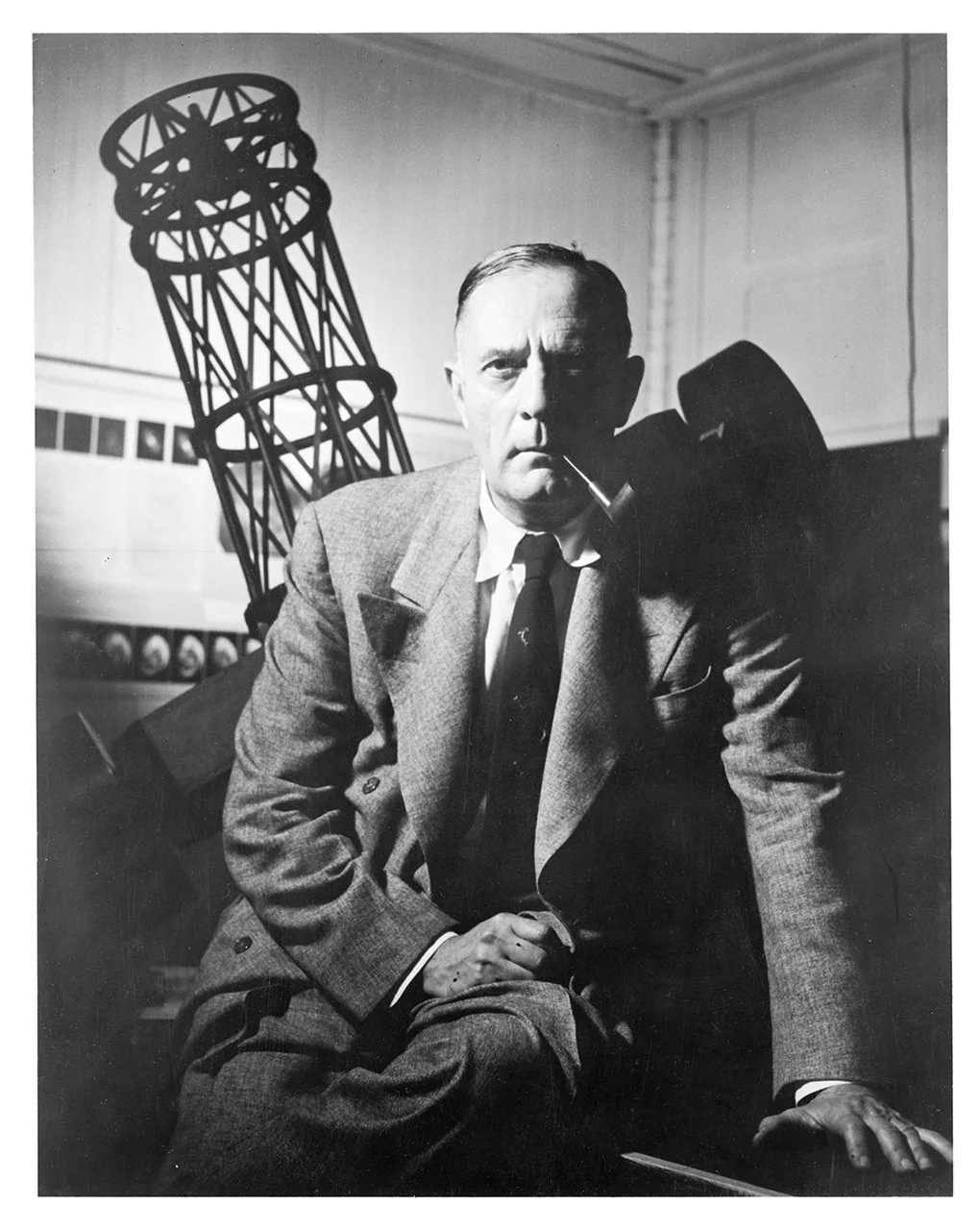
Observing extragalactic nebulae with the 100-inch reflector required meticulous photographic documentation and systematic taxonomy. In 1926, Hubble published an influential classification scheme that grouped galaxies into elliptical, spiral, barred spiral, and irregular morphologies [3]. Known as the Hubble sequence, this structural framework remains the foundational taxonomic scheme utilized by astronomers to categorize galactic formations [4]. His landmark 1924 paper, Cepheids in Spiral Nebulae, had already set the standard for empirical clarity [3].
By the late 1920s, Hubble focused on establishing an extragalactic distance scale [3]. He estimated distances to 24 extra-galactic nebulae using multiple observational techniques. Although his calculated distances were later shown to be underestimated by a factor of roughly seven due to unrecognized differences between distinct classes of Cepheids, the relative distances remained proportional [4]. These pioneering measurements provided the observational scaffolding for modern extragalactic astrophysics [3].
Photographic logbooks preserved at the Huntington Library record the cold nights Hubble spent guiding telescope exposures on Mount Wilson [3]. His empirical methods inspired subsequent generations of orbital observatories, including modern Hubble Space Telescope planetary observations that track dynamic weather across distant worlds [4]. Hubble advanced cosmological horizons as decisively as Galileo did for the solar system and the Herschels did for the Milky Way [1].


How Did Edwin Hubble Prove Cosmic Expansion?
Edwin Hubble proved cosmic expansion by correlating galaxy distances with spectroscopic redshifts to reveal that distant galaxies recede at speeds proportional to their distance [5]. In his landmark 1929 paper published in the Proceedings of the National Academy of Sciences, Hubble combined his calculated distances with radial velocity measurements obtained by Vesto Slipher and Milton L. Humason [4]. The resulting velocity-distance graph demonstrated a linear relationship, proving that more distant galaxies moved away from Earth at progressively faster rates [5]. This empirical discovery became universally recognized as Hubble’s Law [4].
Hubble derived an initial expansion rate of roughly 500 kilometers per second per megaparsec. Theoretical cosmologist Georges Lemaître had predicted a similar expansion dynamic two years earlier using Albert Einstein’s general relativity equations. While calibration revisions eventually reduced the expansion figure to between 68 and 74 kilometers per second per megaparsec, modern researchers continue to resolve discrepancies through ongoing Hubble tension investigations [4]. Observational determinations documented in preprint research by astronomers Freedman and Madore demonstrated how calibration errors affect cosmological parameters, though preprints require subsequent peer-reviewed confirmation [6].
Hubble remained cautious about theoretical interpretations. In a 1931 letter to Dutch cosmologist Willem de Sitter, Hubble emphasized that he regarded galactic displacements as ‘apparent’ radial velocities rather than definitive physical velocities through static space. He maintained that establishing the empirical correlation was the primary duty of observational astronomy, leaving theoretical models to mathematical physicists [4].
Ballistics Research and Honors During World War II
Hubble’s astronomical career was twice interrupted by global conflict [3]. In early 1917, after completing his doctoral thesis overnight and passing his oral examination the next morning, Hubble declined George Ellery Hale’s initial Mount Wilson invitation to enlist in the infantry. He served as a captain and later major in the 343rd Infantry Regiment of the 86th Division in France. Mustered out in San Francisco in 1919, he reported immediately to Mount Wilson [1].
When World War II escalated, Hubble left Mount Wilson in 1942 to direct ballistics research [1]. Serving as Chief of the External Ballistics Branch and Director of the Supersonic Wind Tunnels Laboratory at Aberdeen Proving Ground in Maryland, he increased the effective firepower of bombs and projectiles. Hubble developed a high-speed clock camera that analyzed bombs in flight [4]. For these distinguished wartime contributions, he received the Medal of Merit in 1946 [1].
Away from military and astronomical duties, Hubble enjoyed a rich intellectual life. On February 26, 1924, he married Grace Burke, a Stanford graduate whose memoirs preserve intimate accounts of his career [3]. When astronomer W.H. Wright of Lick Observatory first described Hubble to Grace, he noted that Hubble was a hard worker who wanted to find out about the universe [1]. Following the death of George Ellery Hale in 1938, Hubble was elected a Trustee of the Henry E. Huntington Library in San Marino [3].
The 200-Inch Hale Telescope and Cosmological Legacy
Returning to Mount Wilson after the war, Hubble served as Chairman of the Mount Wilson and Palomar Observatories Research Committee [3]. Having demonstrated that the 100-inch Hooker reflector had reached its limits for distant cosmology, he assisted in designing the 200-inch Hale Telescope at Palomar Observatory. In a London broadcast on the BBC, Hubble remarked that the 200-inch mirror would allow astronomers to grasp what previously could scarcely be brushed with fingertips. When asked what he expected to find, Hubble replied that he hoped to discover ‘something we hadn’t expected’ [1].
Hubble operated the 200-inch Hale Telescope. He was the first astronomer to use the giant instrument [4]. He continued active observational research until September 28, 1953, when he died suddenly from a cerebral thrombosis at age 63 in San Marino, California [1]. Grace Burke Hubble preserved his extensive working papers and correspondence, donating 1300 items and ephemera across 34 archival boxes to the Huntington Library in 1980 [3].
In his native hometown of Marshfield, Missouri, a scale model of the Hubble Space Telescope honors the astronomer who widened human knowledge [4]. Edwin Powell Hubble replaced philosophical speculation with rigorous photographic measurement, demonstrating that humanity occupies a single spiral system within a vast sea of receding galaxies [1]. His observational legacy laid the empirical foundation that guides physical cosmology today [3].
- WEBSITE Stoltz, J. (2026, September 25). Edwin Powell Hubble, Biographical Memoirs. NASA Science. [Article Link]
- WEBSITE National Academy of Sciences. (1996, January 1). Edwin Powell Hubble. APOD NASA. [Article Link]
- WEBSITE Huntington Library. (2025, December 10). Hubble (Edwin Powell) Papers, 1900-1989. Online Archive of California. [Article Link]
- WEBSITE Wikimedia Foundation, Inc. (2002, January 18). Edwin Hubble. Wikipedia. [Article Link]
- ACADEMIC JOURNAL Hubble, E. (1929). A RELATION BETWEEN DISTANCE AND RADIAL VELOCITY AMONG EXTRA-GALACTIC NEBULAE. Proceedings of the National Academy of Sciences of the United States of America, 15(3), 168-73. [Article Link]
- PREPRINT Freedman, W. L., & Madore, B. F. (2010). The Hubble Constant. arXiv:1004.1856. [Article Link]
APA 7: PerEXP Teamworks. (2026, September 26). How Edwin Powell Hubble Expanded the Known Universe. PerEXP Teamworks. https://perexpteamworks.com/en/edwin-powell-hubble-biography-memoirs/


