



The NASA ORBIT Challenge represents a nationwide competition that connects undergraduate and community college students directly with patented federal aerospace technology [1]. Launched by NASA to foster practical workforce capabilities, the initiative invites academic teams to transform agency intellectual property into viable commercial enterprises or pioneering exploration hardware. How does this collegiate initiative bridge laboratory research with commercial industry? By offering up to $500,000 in total prizes, direct technical mentorship, and business accelerator access, the program establishes an unprecedented bridge between academic coursework and federal mission demands [2].
What Is NASA ORBIT?
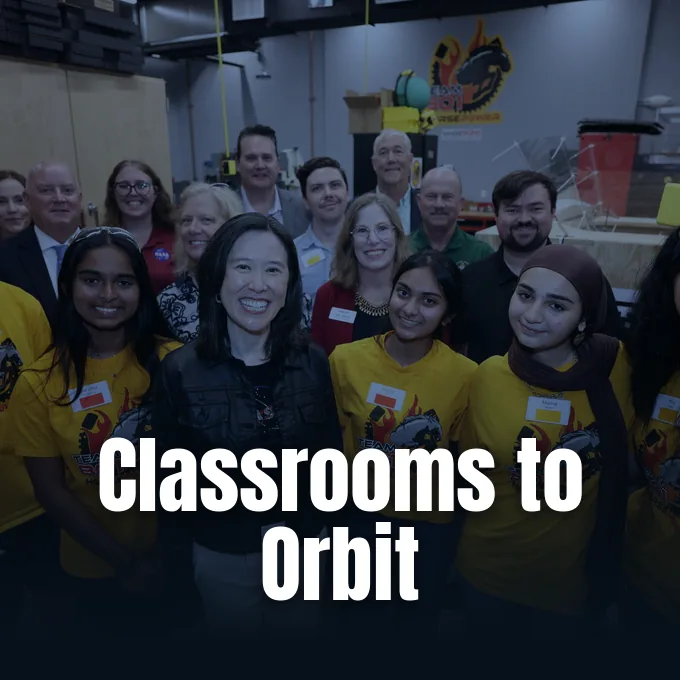
The NASA ORBIT challenge—formally designated as Opportunities in Research, Business, Innovation, and Technology for the Workforce—is an applied innovation program that pairs collegiate researchers with active federal patents [1]. While earlier instructional efforts emphasized local demonstrations, such as how NASA opportunities for students engaged regional classrooms through elementary curriculum outreach, this program prioritizes genuine technology commercialization across higher education institutions nationwide. The official competition portal encourages participants with the operational motto: “Explore big ideas. Build bold futures.” [2]
Administered under the NASA Space Technology Mission Directorate through the Center of Excellence for Collaborative Innovation, the competition specifically targets students enrolled at accredited community colleges and four-year universities. Agency coordinator Bailey G. Light outlined that participating cohorts receive opportunities to study specialized inventions that address complex technical hurdles across both terrestrial and spaceflight settings [1]. Federal laboratories produce thousands of patented systems [3]. The NASA ORBIT Challenge provides an authentic bridge into federal research environments [4].
Collegiate teams analyze federal patent portfolios to translate specialized aerospace discoveries into viable civilian applications [1].
How Does the NASA ORBIT Challenge Function?
The NASA ORBIT Challenge functions by providing collegiate teams with direct access to federal patent portfolios, challenging students to formulate technically sound and economically viable applications for active mission technologies [2]. Rather than designing theoretical space systems without operational constraints, participating students examine genuine patents created by agency inventors to resolve specific aerospace challenges. This structured framework encourages multidisciplinary student groups to evaluate engineering mechanics, model production costs, and craft thorough commercialization roadmaps [3].
Participating colleges assemble collaborative teams combining engineering, software, and physical science undergraduates with business, finance, and marketing scholars to evaluate whether a selected aerospace innovation can address pressing earthly needs or support sustained planetary exploration [1]. Because federal intellectual property encompasses diverse disciplines (ranging from advanced thermal barrier coatings and autonomous robotic navigation to high-efficiency water recovery systems and ultra-sensitive radiation sensors), students investigate an expansive landscape of commercial opportunities. As modern aerospace architectures expand through commercial spaceflight missions and private contracting, developing a workforce well-versed in technology transfer and federal intellectual property has become an essential priority for future mission success [4].
Student teams formulate comprehensive technical dossiers detailing mechanical feasibility, market demand, regulatory hurdles, and scalable manufacturing strategies [5]. Expert evaluation panels assembled by NASA evaluate each proposal according to scientific merit, commercial viability, and team execution strategy. Experienced researchers guide student cohorts [2]. High-scoring submissions advance to formal development rounds [6].
Two Specialized Tracks and the Integration Bonus
Participants entering the NASA ORBIT Challenge must choose between two distinct operational tracks designed to direct technological innovation toward targeted application areas [1]. The first track, designated ORBIT Earth, tasks collegiate inventors with adapting NASA patents to solve urgent commercial, industrial, or ecological challenges on our home planet. Student teams analyze how specialized aerospace materials, novel power systems, or sensor arrays can improve terrestrial medical care, enhance agricultural efficiency, or upgrade renewable energy distribution networks [3]. Both pathways offer distinct merits [1].
The complementary track, designated ORBIT Space, focuses on architecting next-generation hardware and software solutions destined for off-planet space exploration [1]. Collegiate inventors working within this domain address critical exploration priorities, including deep-space life support architectures, autonomous lunar excavation robotics, orbital satellite servicing, and high-reliability planetary communications [2]. Teams evaluate technical specifications from active mission challenges to verify that their proposed concepts satisfy agency flight requirements [5].
For ambitious collegiate cohorts seeking greater technical scope, program organizers created the optional Integration Bonus to reward submissions that unite both competitive pathways simultaneously [1]. Teams pursuing this supplementary incentive must demonstrate that their chosen NASA patent resolves an acute terrestrial commercial need while concurrently providing a decisive technical capability for off-planet exploration missions. Dual-track proposals undergo rigorous scrutiny from both commercial venture specialists and agency flight engineers to confirm that design claims operate reliably across terrestrial and space environments [6].
Why Does NASA Explore Space?
NASA explores space to expand human knowledge through scientific discovery, develop innovative technologies that stimulate economic vitality, and inspire the upcoming generation of researchers, engineers, and industrial leaders [1]. By confronting the demanding conditions of orbital flight and planetary environments, researchers pioneer novel materials, robust software frameworks, and precision manufacturing methods that frequently yield transformative consumer applications across civilian industry [4]. Space exploration serves as a powerful catalyst for technological progress across modern society [5].
The NASA ORBIT Challenge directly reinforces this exploratory mandate by converting federal research discoveries into active learning platforms for collegiate problem-solvers. When undergraduate engineers study patents originally designed for lunar landers or deep-space probes, they learn to navigate complex systems-engineering constraints under demanding operational requirements. Through the official NASA ORBIT portal, student innovators connect directly with agency program coordinators to access necessary technical literature [2].
Expanding collaborative student programs ensures that technological capabilities flourish outside traditional aerospace hubs, reaching diverse collegiate communities across every state [1]. As student researchers collaborate with agency technical mentors, they gain invaluable familiarity with rigorous testing methodologies and federal documentation standards. This educational bridge prepares talented graduates to sustain American technical leadership across forthcoming exploratory missions throughout the solar system [6].
Mentorship, Seed Funding, and the National Accelerator
To empower student teams to progress from theoretical models to physical prototypes, the NASA ORBIT Challenge provides up to $500,000 in prizes alongside structured guidance from agency professionals. Finalist teams receive individualized technical mentorship from NASA researchers and patent specialists who help participants navigate technical obstacles and refine commercialization strategies. Awards reach $500,000 [1]. Mentorship accelerates prototype development [2].
Finalist cohorts secure an invitation to present their operational models and commercial pitches during an in-person showcase attended by agency administrators, academic mentors, and private aerospace investors [1]. Beyond competitive prize distributions, qualifying finalists gain exclusive access to an accelerator program specifically designed to launch careers in science, technology, engineering, and mathematics (STEM) disciplines as well as technological entrepreneurship [3]. The accelerator curriculum provides targeted instruction covering venture capital financing, patent licensing agreements, regulatory compliance, and scalable manufacturing [5].
This structured support system ensures that promising collegiate concepts continue maturing into commercial ventures well after competition ceremonies conclude [1]. By bridging the financial and operational divide between academic coursework and early-stage startup launch, the accelerator curriculum helps student inventors establish formal corporate entities and pursue non-dilutive research grants. Many student teams successfully establish commercial enterprises [6].
Key Milestones for the NASA ORBIT Challenge 2027
Collegiate teams preparing for the NASA ORBIT Challenge 2027 must coordinate their internal research calendars around critical milestone deadlines established by program officials within the Space Technology Mission Directorate (STMD) [1]. The formal competition cycle opened on September 14, 2026, granting registered students immediate access to specialized patent catalogs, competition handbooks, and mission challenge briefs. The challenge opened September 14, 2026 [3]. Early preparation enables academic departments to organize effective multidisciplinary partnerships between engineering and business faculties [5].
Participating cohorts must complete their formal registration and submit preliminary concept materials before the registration portal closes on November 16, 2026 [1]. Registration closes November 16, 2026 [3]. Following this critical deadline, expert review panels evaluate all submissions according to technical rigor, innovation quality, and commercial promise to identify the finalist cohorts eligible for awards and accelerator entry. Preliminary judging concludes during late autumn [4].
Cohorts selected to advance beyond the autumn evaluation phase will participate in Phase 2 development activities, leading directly to the in-person presentation showcase scheduled for 2027 [1]. The culminating showcase provides a national stage for collegiate inventors to demonstrate how federal space patents can generate viable businesses and advance exploration technologies for the nation. Teams can access comprehensive submission forms and technical rules through official agency channels as programmatic milestones proceed [2].
- PRESS RELEASE Light, B. G. (2026, September 28). NASA ORBIT Challenge 2027. NASA. [Article Link]
- WEBSITE NASA ORBIT. (2026). NASA ORBIT Challenge: Student Innovation Competition. [Article Link]
- ONLINE NEWS Mirage News. (2026, September 29). NASA ORBIT Challenge 2027. [Article Link]
- ONLINE NEWS World News Network. (2026, September 28). NASA ORBIT Challenge 2027 (NASA – The National Aeronautics and Space Administration). [Article Link]
- ONLINE NEWS PressBee. (2026, September 28). NASA ORBIT Challenge 2027. [Article Link]
- ONLINE NEWS Space Rocket Launch Schedule. (2026, September 29). NASA ORBIT Challenge 2027. [Article Link]
APA 7: TWs Editor. (2026, September 29). How the NASA ORBIT Challenge Opens Space Patents to Students. PerEXP Teamworks.


