



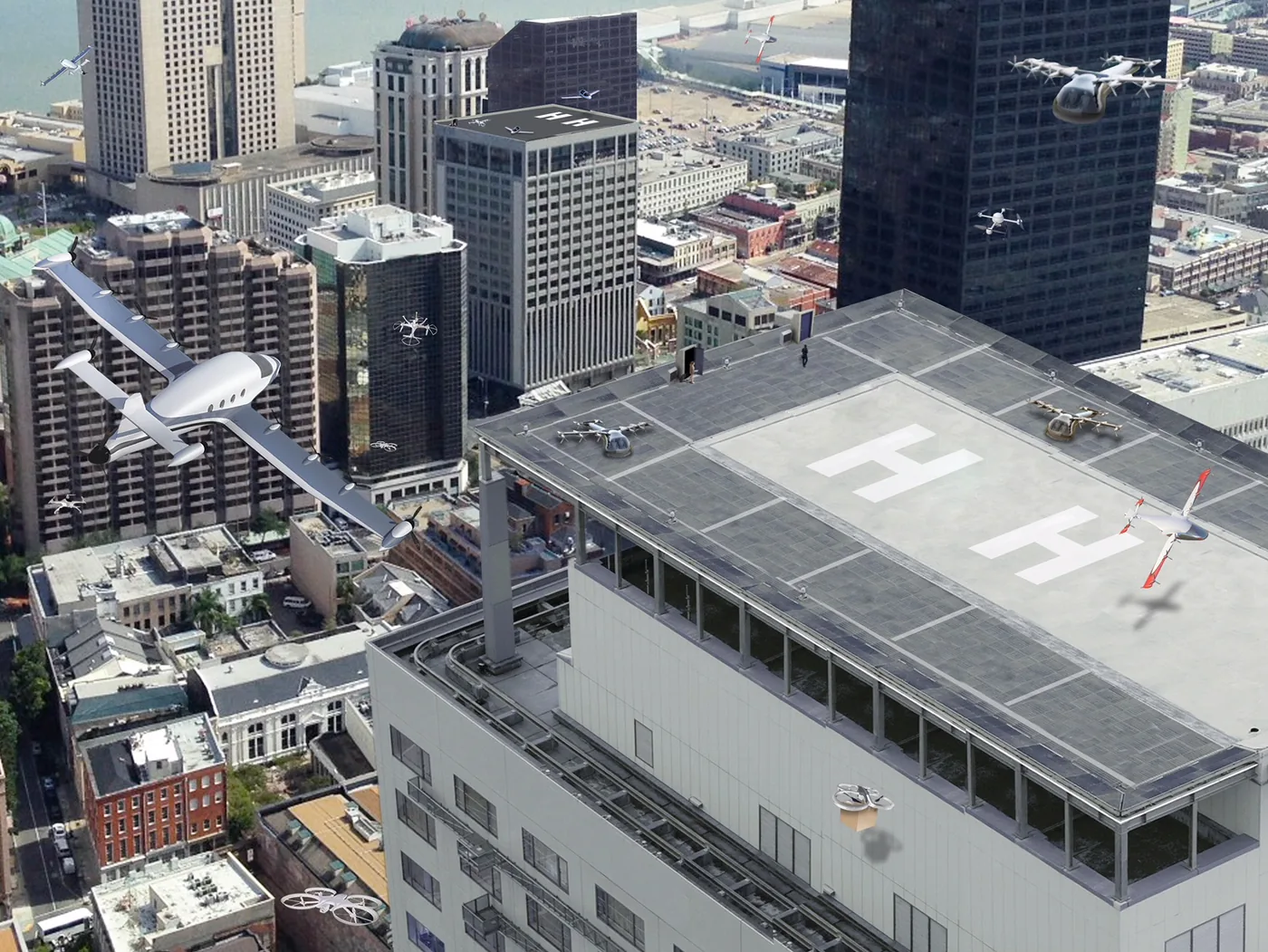
Urban air mobility puts a coordination problem above the city: flights at several landing sites can depend on one another. NASA’s High Density Vertiplex (HDV) subproject investigates how to connect aircraft, airspace management and ground facilities within that shared environment. The agency describes an Urban Air Mobility (UAM) research sequence moving from simulation to small uncrewed aircraft at Langley Research Center. Its overview specifies three automation tasks: landing, merging and spacing, and contingency decisions. [1]
Urban Air Mobility Across Connected Sites
NASA defines a vertiplex as a geographic area containing multiple vertiports whose arrivals and departures are ‘highly interdependent.’ The relationship between sites gives the term its meaning. A vertiplex concerns operations across a network. Studying an individual arrival or departure alone would leave out the dependencies that NASA explicitly places at the center of this research. The project brings those dependencies into the same operational environment. [1]
NASA places High Density Vertiplex within its Advanced Air Mobility project, which belongs to the Integrated Aviation Systems Program. Urban Air Mobility (UAM) supplies the operational focus. The subproject’s remit spans aircraft operations, flight and airspace management procedures, and vertiport operations. NASA brings together activities that the agency wants its automation architecture to support efficiently as operations scale. NASA does not give a numerical definition of high density in this overview. [1] Why study several sites together? NASA’s definition points to the answer: arrivals and departures depend on one another. The research consequently treats their coordination as part of the system under investigation, with aircraft, airspace and vertiport automation all included in the development work. [1]
What Is NASA Building?
NASA describes the central product as a reference automation architecture (a framework connecting the system’s automation functions). Researchers develop and evaluate that framework to support scalable, efficient operations across aircraft, airspace and vertiports. They also investigate the procedures needed to make those components work together. Software is one part. NASA also includes operational concepts, and the overview identifies research and development as the purpose of the representative system. [1, 2]
Aircraft automation is one component. Airspace management is another. NASA also includes vertiport operations in the architecture. Its stated approach requires researchers to integrate and mature automation across all three domains before those functions can support the selected use cases. The page names the functions researchers will explore. It does not publish detailed rules for exchanging information or resolving competing operational demands. [1]
NASA’s stated goal is to create a representative UAM system that reduces risk for future research and development. The agency proposes a research environment for investigating connected operations. Its overview supplies no evidence that this environment reproduces every condition of a future urban air mobility service. The page also gives no commercial capacity estimate. [1] In a separate Air Mobility Pathfinders demonstration at Ames, NASA tested Strategic Deconfliction Simulation using Dallas-Fort Worth drone scenarios. ANRA Technologies demonstrated fleet and vertiport management systems. NASA engineer Hanbong Lee described the work as supporting airspace integration; it supplies context for coordination research, without establishing HDV performance. [3]
Why Begin With Small Aircraft?
NASA plans to use small Unmanned Aerial Systems (sUAS) as surrogates for UAM aircraft. A surrogate (a stand-in for the aircraft of interest) supports testing. By specifying subscale tests, the agency makes clear that the planned flying vehicles and the future urban operations they represent are different parts of the research design. The overview does not identify a particular aircraft model or describe how closely its flight characteristics match a larger vehicle. [1] PerEXP Teamworks also covers NASA’s testing of Mars helicopter designs, a separate rotorcraft research setting.
Researchers will begin each testing cycle in simulation and progress toward live flights with small UAS at Langley Research Center. They will gradually increase complexity in the operational environment as the series advances. Simulation comes first. NASA will use the results from each cycle to inform subsequent risk assessments, creating a sequence in which earlier tests help researchers assess the risks associated with later work. The page describes this progression without listing completed cycles or reporting the results of any particular flight campaign. It also leaves the precise changes in complexity between cycles unspecified. The overview cannot establish which operational conditions researchers have already examined. [1]
Langley Research Center is the named live-flight location. NASA’s overview provides no flight-test timetable. [1]


Which Decisions Will Automation Handle?
NASA identifies three main use cases: automated landing, automated merging and spacing, and automated contingency decision making (choosing an alternative course of action). Landing is only one of the research tasks. By including merging and spacing, the agency also brings the relationship between flights into scope. By including contingency decisions, it extends the investigation to responses when operations require an alternative course of action. The overview names these categories without describing individual test scenarios. [1]
Researchers must integrate aircraft, airspace and vertiport automation to support those use cases, according to NASA. The agency links the maturity of the combined technology to the operations it intends to investigate. No landing accuracy is reported. The source likewise provides no spacing interval, traffic throughput or contingency success rate. Those omissions limit what can be said about performance: the categories identify the intended work, but they do not supply evidence of how reliably the automation performs it. [1]
Urban air mobility research in HDV covers several connected decisions rather than a single isolated maneuver. NASA presents integration as a development requirement. Its overview does not say that the three use cases have passed a common evaluation, and it offers no comparison between automated decisions and decisions made by human operators under the same conditions. [1] NASA Advanced Supercomputing researchers Denis-Gabriel Caprace and Patricia Ventura Diaz examine another landing constraint: rotor outwash (wind driven outward near the ground). Their ground-effect simulations compare flat ground and rooftop settings, where aerodynamic forces can change during arrival. These are separate aerodynamic studies. [4]
Who Connects the Research Systems?
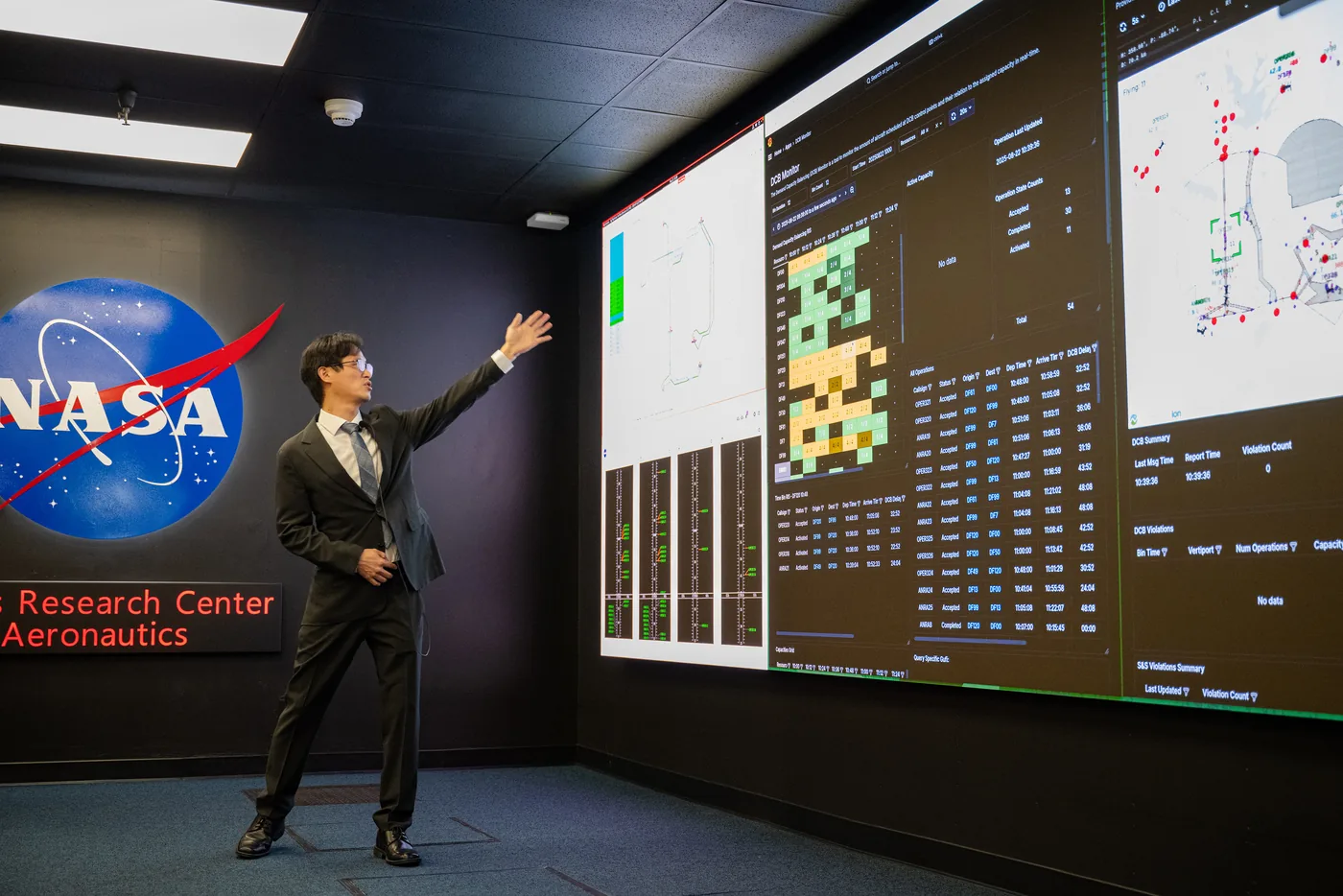
NASA assigns the Airspace Operations Laboratory (AOL) and the Autonomous Vehicle Applications Laboratory (AVAL) a shared role as bases of operations during simulations and flight tests. They will support Airspace Systems Integration, which brings systems and software from Unmanned Aerial Systems Traffic Management into HDV. The source describes integration of existing systems and software as part of the effort. Individual software components and interfaces remain unnamed. [1]
AVAL belongs to NASA Ames’ Human Systems Integration Division. Langley contributes the Air Traffic Operations Laboratory. NASA names these laboratories as participants in the flight-testing effort, giving the project an institutional structure that links the operational support environment with the center designated for live tests. The overview does not allocate every experiment or automation function to a particular laboratory. More detailed responsibilities cannot be reconstructed from the published description. [1]
NASA includes human factors evaluation among the work’s outcomes. People remain within the evaluation scope. However, the overview does not identify participants, evaluation methods or findings about workload. The source cannot establish how operators respond to the proposed automation. [1] NASA’s earlier UAM planning also involved the Federal Aviation Administration (FAA), industry and academia. Parimal Kopardekar linked this effort to UAS Traffic Management research; Rich Wahls emphasized collaboration on safe, efficient and quiet operations. [5]
What Does the Overview Establish?
NASA’s High Density Vertiplex page establishes the project’s purpose, institutional setting, main automation use cases and planned progression from simulation to subscale flight. It is an agency project description. Readers can use it to understand the intended research design, but the supplied text contains no experimental dataset or quantitative results against which to assess the benefits of the proposed urban air mobility architecture. [1]
NASA lists prototype airspace management automation technology and human factors evaluation among the outcomes of this work. Prototype development does not establish operational readiness. The overview does not attach performance results to those outcomes, identify an independent evaluation or state that the system has met a commercial service requirement. Its account supports an explanation of what HDV investigates. Stronger conclusions about safety, efficiency or capacity would require evidence beyond this project description. [1] A separate example of flight experience appears in PerEXP Teamworks’ coverage of Ingenuity’s three-year Mars mission.
Researchers’ cycle-by-cycle risk assessments are the next evidence to look for when assessing how the approach develops. Which conditions did a test represent, how did the automation behave, and what did the team change before proceeding? NASA’s overview leaves those questions open. It also leaves open how small-aircraft results relate to the demands of future urban air mobility operations. [1]
- WEBSITE So, P. (2026, September 10). High density vertiplex. NASA. [Article Link]
- CONFERENCE PAPER Katsaduros, D. (2024, July 29–August 2). MBSE execution of scalable autonomous operations for a high density vertiplex [Conference paper]. AIAA Aviation Forum, Las Vegas, NV, United States. NASA Technical Reports Server. [Article Link]
- WEBSITE Friesen, T. (2025, December 9). NASA demonstrates safer skies for future urban air travel. NASA. [Article Link]
- WEBSITE Dunbar, J. (2024, March 5). NASA experts break ground in simulations for urban air mobility safety. NASA Advanced Supercomputing Division. [Article Link]
- WEBSITE Gipson, L. (2017, November 8). NASA embraces urban air mobility, calls for market study. NASA. [Article Link]
APA 7: TWs Editor. (2026, September 11). Shared skies: NASA’s urban air mobility research plan. PerEXP Teamworks.


1 comment