





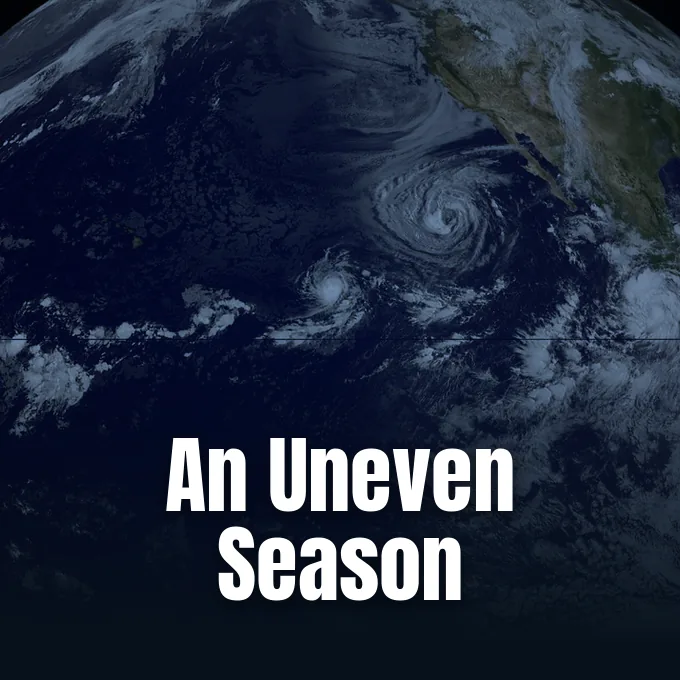
Hurricane season records usually draw attention when storms multiply; in September 2026, the Atlantic is approaching a milestone because hurricanes are absent. BBC Weather and Scientific American reported on September 10 that no Atlantic hurricane had formed, despite the season reaching its usual peak. Their accounts put Atlantic hurricane season records within reach as El Niño strengthens. Five named tropical storms had developed, but none had become a hurricane. [1, 2]
Hurricane Season Records: Which Milestone?
BBC Weather meteorologist Simon King identifies the prospective record as the latest first Atlantic hurricane in the satellite era (the period beginning in the 1960s). He gives September 11 as the existing benchmark, shared by Hurricane Gustav in 2002 and Hurricane Humberto in 2013, and reports little indication of development over the following week. The record was still prospective in his September 10 account. A forecast of continued quiet cannot establish that the threshold has already passed. [1, 4]
Scientific American journalist Jackie Flynn Mogensen places the threshold after September 12. Her comparison period begins in 1966. The two reports do not supply an identical cutoff. Both describe an unusually late wait. Neither supplies the underlying historical series needed to reconcile those dates. The reporting supports an approaching milestone more firmly than a declaration that a new record already exists. [2]
Hurricane season records also depend on the event under discussion. The first hurricane’s arrival, the number of named storms and the season’s eventual impacts describe different things. Neither report establishes which year was the worst hurricane season on record; answering that question would require a specified measure and a historical comparison. Here, the relevant measure is how far the calendar advances before the Atlantic produces its first hurricane. PerEXP Teamworks examines long-term warming in Rising Global Warming Crisis: What the Human Surge?!. Here, the focus is the delayed first hurricane and the seasonal conditions behind it.
How Quiet Is the Atlantic?
King lists five Atlantic tropical storms: Arthur, Bertha, Cristobal, Dolly and Edouard. By this stage, an average season would have produced eight named storms and three hurricanes, according to BBC Weather. Named storms and hurricanes are separate counts. The five names establish that tropical activity has occurred; they do not contradict the absence of hurricanes in the September 10 reports. September’s usual seasonal peak makes that absence particularly conspicuous. The National Hurricane Center lists the same five systems as tropical storms in its 2026 Atlantic Hurricane Season table. NOAA’s table is the primary observational source here; the supplied reporting does not identify an underlying academic paper. [1, 3]
Dolly developed in August. The University of Tampa’s Nicholas Grondin teaches environmental studies as an assistant professor. He points to Dolly as an example of the Atlantic’s difficulties sustaining storms. He tells Scientific American that cyclones encountering the unfavorable conditions can remain weak and dissipate rapidly. Dolly connects a named system with the larger atmospheric pattern. His explanation addresses why a storm can form without developing into a hurricane. [2]
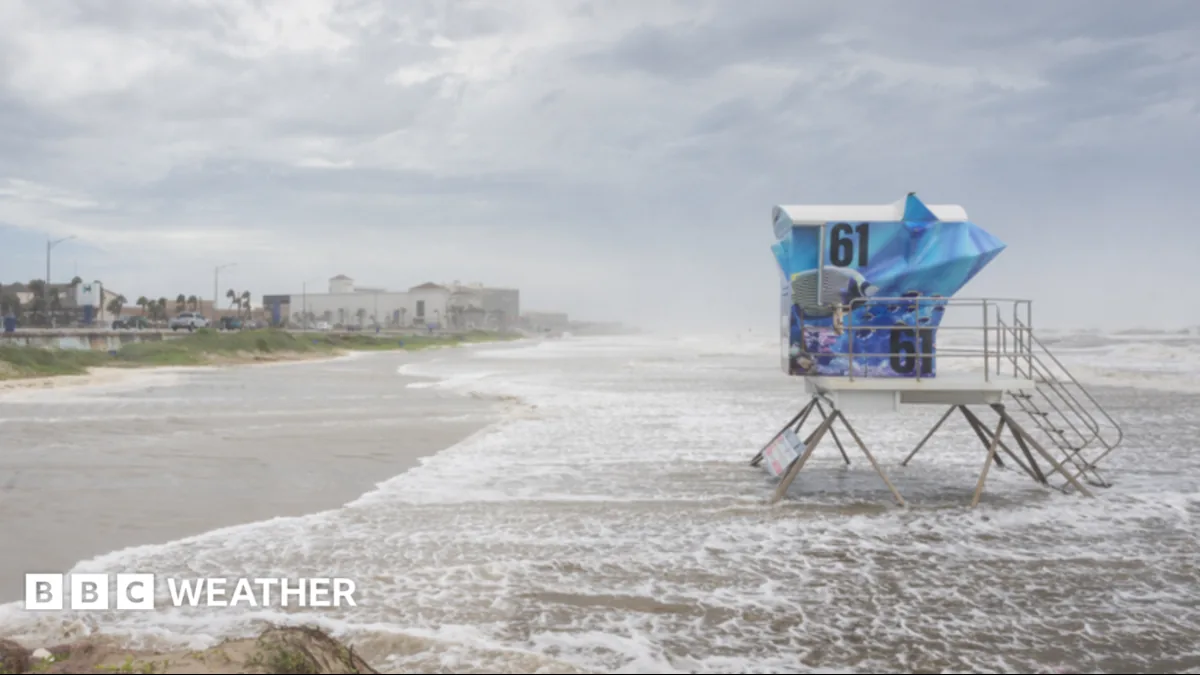
The Atlantic season ends on November 30. September’s peak leaves substantial time for the first hurricane to develop. [1, 2]
Why Does El Niño Suppress Hurricanes?
El Niño describes unusually warm water in the tropical Pacific. Its effects extend into the atmosphere over other ocean basins. Matthew Rosencrans leads hurricane season forecasting at the National Weather Service. He locates its characteristic equatorial warming between five degrees south and five degrees north. Grondin explains that the pattern generally limits Atlantic hurricane development while helping create favorable conditions in the eastern and central Pacific. The same climate pattern can favor different outcomes across the two basins. [2]
Wind changes with height. Meteorologists call changes in wind speed and direction with altitude vertical wind shear. BBC Weather’s Simon King explains that stronger upper winds over the Atlantic increase this shear during El Niño. The shear disrupts thunderstorms that can develop into tropical storms or hurricanes. Strong shear interferes with storm development even when a tropical disturbance exists. Lower shear gives cyclones a better opportunity to persist and strengthen. Grondin describes conditions in parts of the Atlantic as “hostile.” [1, 2]
King reports that forecasters expect El Niño to peak in November or December and attributes the possibility of a “historic” event to NOAA. Its eventual strength remains a forecast. PerEXP Teamworks’ coverage of deforestation and El Niño–Southern Oscillation predictability addresses a related research question; the immediate issue here is how the current ocean and wind pattern affects hurricane development. [1]


Why Is Hawaii Seeing More Storms?
Rosencrans tells Scientific American that unusually warm East Pacific surface waters extend to around 20 degrees north, approximately Hawaii’s latitude. The warmth extends beyond El Niño’s equatorial band. Warm water supplies hurricane energy. Phil Klotzbach, a senior research scientist at Colorado State University, adds that vertical wind shear near Hawaii has been “well below normal.” Warm water and weak shear together help explain the Pacific’s greater activity. Stronger shear limits development in parts of the Atlantic. Hawaii ordinarily benefits from cooler water and strong trade winds, according to the report, making the season’s storm encounters especially unusual. [2]
Mogensen traces Hawaii’s encounters through Hurricane Fausto in July, Hurricane Lala and Tropical Storm Moke in August, and Hurricane Lowell in September. Lowell grazed the western archipelago. King reports damaging winds, flooding rain and high waves, but the supplied accounts do not establish a direct landfall. King’s eastern Pacific tally reaches 13 named storms, including five hurricanes and three major hurricanes. The named-storm count already approaches an average full season’s total. [1, 2]
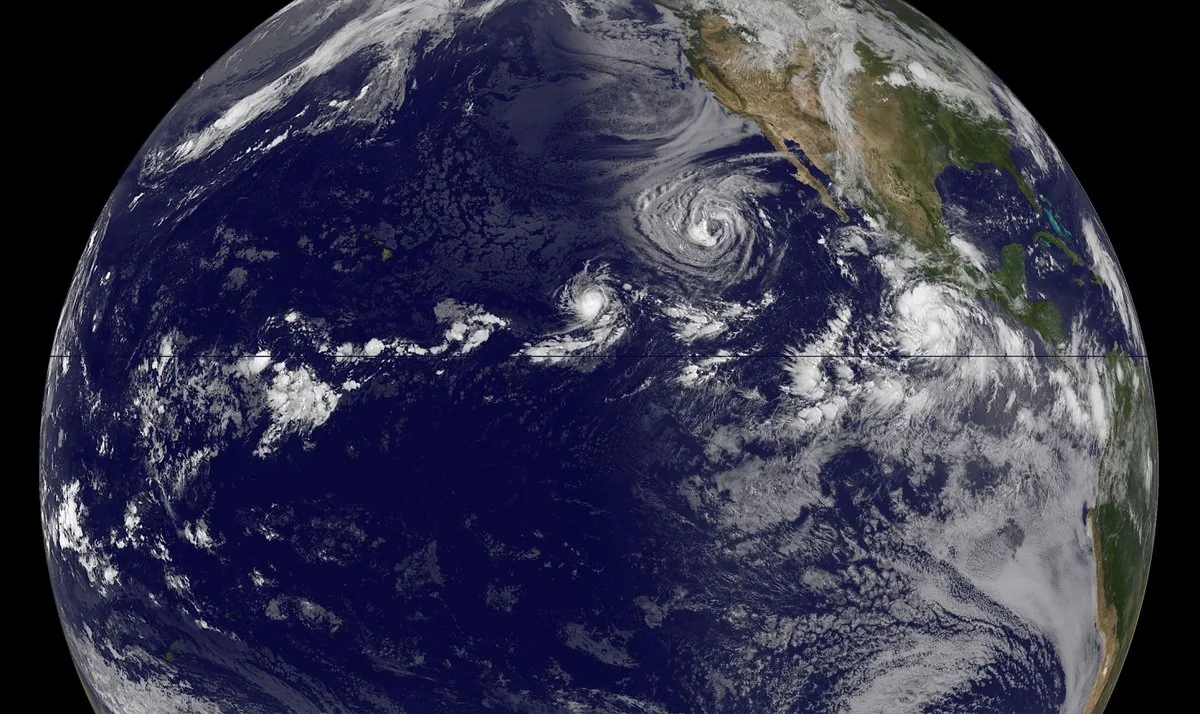
Hurricane specialist Michael Lowry provides the historical context: before this season, only six hurricanes had passed within 50 miles of the main Hawaiian Islands over more than 75 years. Two made direct hits. Lowry names Dot in 1959 and Iniki in 1992, distinguishing close approaches from direct strikes rather than treating every encounter as a landfall. [2]
What Role Does Saharan Dust Play?
Winds over the Sahara have carried dust and sand thousands of miles from Africa, King reports. Dust added another obstacle to Atlantic storm growth during the preceding week. Dry, dusty air suppresses development when it spreads across the basin. BBC Weather expects that influence to help maintain quieter conditions for at least the following week. The report does not quantify how much suppression comes from dust compared with wind shear. [1] Benjamin Kirtman, dean of the University of Miami’s Rosenstiel School of Marine, Atmospheric, and Earth Science, also identifies Saharan dust as a possible early-season influence in The Philadelphia Inquirer. [5]
Ocean temperatures alone cannot explain the contrast described by the meteorologists. Rosencrans emphasizes warmth, Klotzbach emphasizes shear, and King adds the dry air arriving from Africa. Each addresses a different part of the environment in which storms develop. For a separate view of the ocean’s climate role, PerEXP Teamworks examines North Atlantic heat transfer and historical climate fluctuations. That longer-term topic differs from explaining this season’s immediate atmospheric obstacles.
Could Hurricanes Still Form This Season?
Federal forecasters still anticipated Atlantic hurricanes in their August outlook. Mogensen reports a range of two to six for a season they expected to be below normal. King separately describes a May forecast of eight to 14 named storms. It includes three to six hurricanes and one to three major hurricanes. These are outlooks from different months, rather than observed totals. Neither predicts that the Atlantic must finish the season without a hurricane. [1, 2]
Grondin cautions that the absence of development now does not rule out development later. The remaining season extends through November. Hurricane season records may change if the wait continues. September’s reports cannot settle the final hurricane count or the eventual strength of El Niño; forecasters still have to track whether Atlantic conditions allow a disturbance to organize before November 30. [1, 2]
- ONLINE NEWS King, S. (2026, September 10). New hurricane season record as ‘historic’ El Niño leaves Atlantic eerily quiet. BBC Weather. [Article Link]
- ONLINE NEWS Mogensen, J. F. (2026, September 10). The Pacific is being beset by hurricane after hurricane—why is the Atlantic so quiet? Scientific American. [Article Link]
- REPORT National Hurricane Center. (2026, September 11). 2026 Atlantic Hurricane Season. National Oceanic and Atmospheric Administration. [Article Link]
- ONLINE NEWS Forecast Centre. (2026, September 8). Atlantic hurricane season nears record for quiet conditions. The Weather Network. [Article Link]
- ONLINE NEWS Wood, A. R. (2026, September 10). The ultra-quiet Atlantic hurricane season is setting records, thanks to El Niño. The Philadelphia Inquirer. [Article Link]
APA 7: TWs Editor. (2026, September 11). Hurricane season records near a quiet Atlantic milestone. PerEXP Teamworks. https://perexpteamworks.com/en/hurricane-season-records-quiet-atlantic/


1 comment