





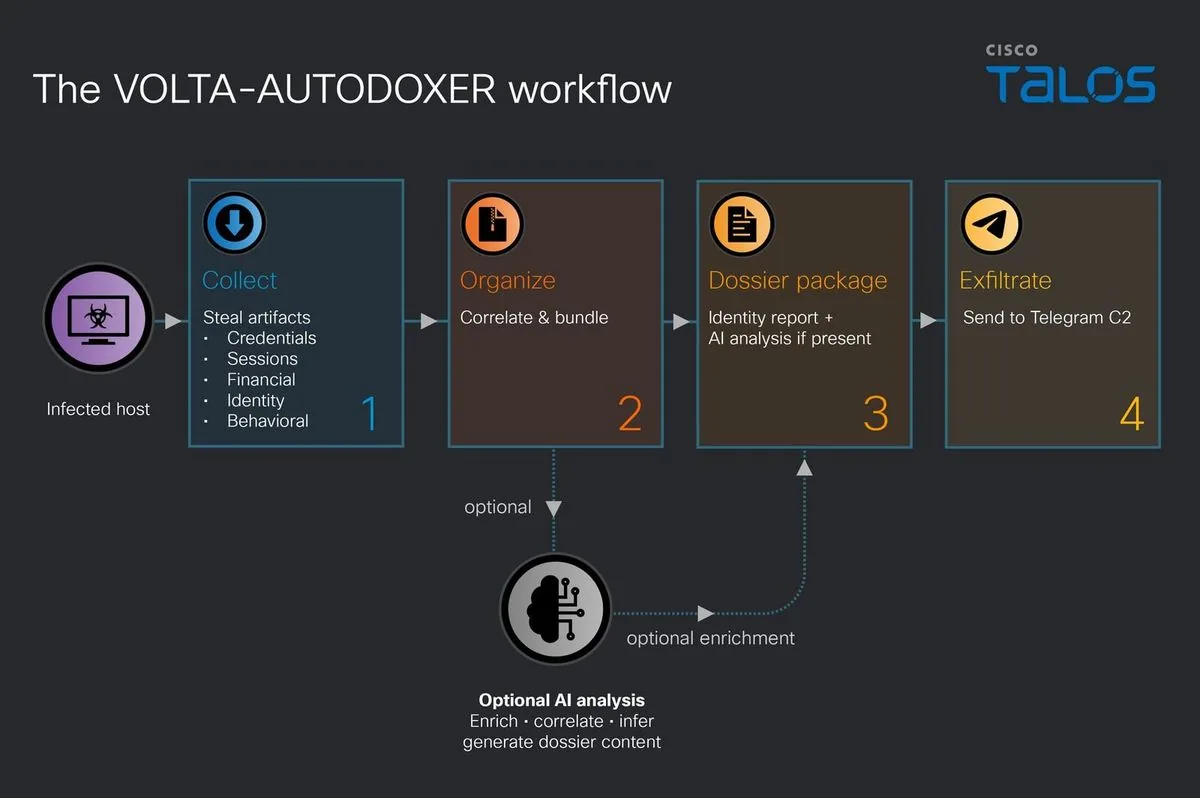
Cisco Talos researchers reported on November 1 that a new Windows infostealer called VOLTA-AUTODOXER malware steals personal records, feeds them to AI models to score victim value, and deletes its binary [2]. TechRadar security writer Sead Fadilpašić in Sarajevo reported that Talos uncovered the tool through the Cognitive Artificial Intelligence Research Network (CAIRN), an open source kit built to track AI-powered threats. Talos divided the threat into four steps: stealing files, sharing them with an AI, exfiltrating the dossier, and erasing the runner from disk [1].
How VOLTA-AUTODOXER Malware Gathers Evidence
VOLTA-AUTODOXER malware begins by pulling web logins, cookies, and credit cards from local storage. It grabs email profiles out of Thunderbird and Outlook, steals session tokens for Discord, Steam, and Roblox, and captures desktop screenshots. Every saved Wi-Fi password gets extracted in clear text. Inline cracking routines then attack cryptocurrency wallet vaults stored on disk [2].
The code does not stop at raw account dumps [1]. Instead, it builds a sorted evidence bundle by collecting geographic coordinates, home street addresses, employer domains, inferred birth years, Slack workspaces, document authorship metadata, and the last four digits of credit cards. It inspects Gmail next. Searching the inbox reveals order receipts from Amazon, Walmart, PayPal, Grubhub, DoorDash, and UberEats to verify where the target lives while uncovering linked iPhone backups. It also values Roblox items through Rolimons [2]. Sifting through these varied personal records turns basic web logins into an actionable dossier that pinpoints private wealth before extortionists demand a ransom payment. This thorough profile gives crooks clear guidance on how much money a victim can afford to pay [1].
Much of the token theft depends on bypassing Google Chrome’s App-Bound Encryption (ABE), which the script defeats by spawning Chrome in headless mode without a graphical window. Headless Chrome runs silently. Spawning Chrome without a user interface allows the malware process to read protected session cookies directly out of memory before the browser applies security locks. Admins can stop this path by blocking unapproved software from launching headless Chrome instances [2].
Dossier Assembly and the AI Prompt
Once file collection finishes, the script saves its findings locally as Identity_Report.txt and serializes the records into JSON format [2]. TechRadar observed that sifting through stolen databases is tedious work, making AI profiling an attractive shortcut for extortion crews. The malware bundles and serializes the data before POSTing it to OpenRouter, an online service that routes prompts to external language models through a single API [1]. Outgoing requests travel over the host internet connection rather than hacker servers, helping the traffic blend in with normal household browsing [2].
VOLTA sends the compiled evidence bundle with instructions ordering the model to behave as “a forensic intelligence analyst drafting a target assessment” [1]. The prompt tells the AI to be “blunt, specific, accurate” and rank assets by cash-out value. It also grades password hygiene [2].
The model reply becomes AI_Analysis.txt. The malware bundles this analysis alongside Identity_Report.txt into a zip archive named volta_dox.zip, exfiltrating both files before erasing its primary executable from the infected Windows host [2]. The runner disappears instantly. However, a debug log named volta_debug.txt stays behind in the folder, detailing every stolen account category and confirming whether the external language model completed its target valuation. That log helps analysts verify whether crooks received a completed target dossier [1]. Having that local trace gives victims clear visibility into which personal accounts were exposed while the script was running [2].

Model Fallbacks and Resilience
The malware targets Anthropic’s Claude Opus 4.6 by default, relying on an older model build released in February to handle the initial forensic analysis. The configuration sets the inference temperature to 0.2, far below the standard baseline of 1.0, because cybercriminals prioritize predictable formatting over creative variation. Baseline temperature sits at 1.0. Because safety guardrails might flag illicit requests, the script inspects incoming responses for refusal phrases [2].
When Claude rejects the prompt or returns a refusal message, VOLTA switches down an auto fallback chain [2]. It first queries Moonshot AI’s Kimi K2, and if that model also refuses, it tries Google’s Gemini 2.5 Flash [1]. The author designed this multi-step fallback system so safety filters in one model family do not derail the data extraction pipeline. If every language model fails to cooperate or if the buyer supplied no OpenRouter key, the script skips the analysis step and exfiltrates the raw stolen data over Telegram. Raw data exfiltration serves as the ultimate fallback [2].

Researchers compare this architecture with other emerging threats, such as RatHat Android malware and multi-model voting implants that automate execution steps. In this case, VOLTA limits language processing to post-theft evaluation, letting models handle analyst work [2]. It turns messy files into ranked leads within seconds [1].
Commercial Builder Model and Telegram Delivery
Cisco Talos concluded that VOLTA-AUTODOXER malware is designed as a commercial product sold on underground forums rather than a private tool built for one specific group [1]. The software template provides six swappable slots that customers populate with their own Telegram channels, API keys, and runtime settings at build time (API). Although slot credentials are encrypted inside the compiled file, investigators can still recover them during forensic analysis [2]. Buyers of any skill level can deploy custom payloads without writing a single line of backend code [1].
The modular layout lets low-skill buyers run profiling campaigns without maintaining their own server backends. “This suggests it’s a builder model: The author sells access, the customer provides their values, and the builder compiles a custom binary for each order,” Cisco Talos said [1]. Buyers receive ranked dossiers in their Telegram inbox [2].
Talos pointed out that the setup commoditizes cybercrime: “If VOLTA is indeed a commoditized malware, then the AI dossier capability isn’t something the author invented for their own operations. It is a feature which enables a customer of any level of sophistication to point it at victims and start receiving ranked target assessments in their Telegram inbox.” Attackers can focus on extortion while automated prompts evaluate each victim’s financial worth. By shifting the labor of target sorting onto public language models, criminal operators save hours that human analysts previously spent reading spreadsheets [1].
Defenses Against VOLTA-AUTODOXER Malware
Users who suspect an infection should check their drives for volta_debug.txt to see what information the malware collected and whether inference succeeded. Anyone hit by the intrusion must revoke and rotate all cloud API keys, update passwords, and invalidate active browser sessions across every connected device [1]. Stored cryptocurrency keys must be replaced, and funds should move to new seeds on offline computers [2].
System administrators can mitigate credential theft by enforcing policies that restrict Google Chrome’s headless mode. Because VOLTA relies on headless execution to bypass Chrome’s App-Bound Encryption, blocking unauthorized headless processes shuts down access to stored browser secrets. Endpoint monitoring tools should also alert on unexpected outbound traffic to model hosting hubs like OpenRouter. Restricting outbound API calls prevents the payload from completing its automated analysis phase, forcing attackers to sift through raw records manually if data escapes. Combining host application controls with network egress filtering stops both data enrichment and automated exfiltration [2].
Shane Downing at Tom’s Hardware and Fadilpašić at TechRadar pointed out that antivirus suites like Bitdefender Total Security and Norton 360 with LifeLock help detect malicious binaries before they run. The emergence of VOLTA-AUTODOXER malware shows a shift toward automated reconnaissance in consumer cybercrime. By turning scattered browser records, delivery receipts, and session cookies into neat financial dossiers, the tool reduces the labor needed to select high-value ransomware targets [1]. Defending against these attacks means treating personal session tokens and food delivery accounts with the same caution as enterprise passwords [2].
- ONLINE NEWS Fadilpašić, S. (2026, November 2). This new Windows malware steals all your data, then uses AI to rank how valuable you are as a victim. TechRadar. [Article Link]
- ONLINE NEWS Downing, S. (2026, November 1). New AI-driven Windows malware feeds stolen data to Claude to rank victims’ assets by value, then deletes itself. Tom’s Hardware. [Article Link]


