





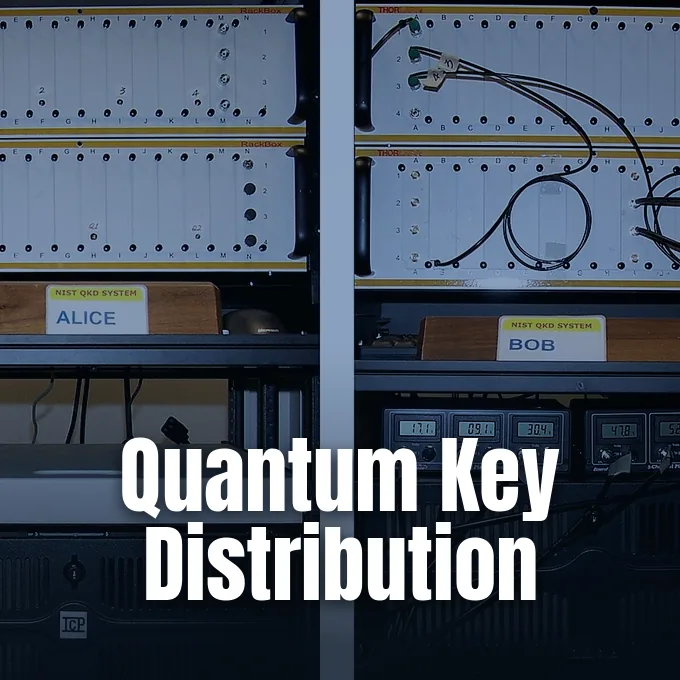
Quantum key distribution creates a shared secret key between two remote users by encoding individual bits onto quantum states of light so that legitimate communicators can spot any unauthorized third party attempting to intercept the channel. Observing a quantum system changes its state and introduces detectable anomalies, while older key setups depend on unproven mathematical problems that remain vulnerable to future computing advances [11]. The resulting random bits can feed symmetric ciphers like the Advanced Encryption Standard or one-time pad systems for lasting data privacy.
Origins of the First Protocols
Stephen Wiesner started the field of quantum cryptography while at Columbia University in New York during the early 1970s, introducing the foundational concept of conjugate coding to store and transmit messages in complementary observables. The IEEE Information Theory Society rejected the manuscript at first, but it was eventually published in 1983 in SIGACT News after years of delay [3]. Wiesner showed that quantum uncertainty sets hard limits on reading data, laying the path for protocols that rely on physics instead of math difficulty.
Charles H. Bennett of the IBM Thomas J. Watson Research Center and Gilles Brassard met in 1979 at the 20th IEEE Symposium on Foundations of Computer Science in Puerto Rico [3]. They saw that quantum states worked far better for sending data than for storing it in memory chips. In 1984, Bennett and Brassard introduced the BB84 protocol, creating the first practical scheme for quantum key distribution [1]. Brassard later said: “The main breakthrough came when we realized that photons were never meant to store information, but rather to transmit it.” Their system sent polarized light pulses over optical channels, letting users spot eavesdroppers by checking for bit errors caused by photon state changes. This work showed that quantum mechanics could protect communications without relying on unproven computational conjectures.
Artur Ekert expanded quantum cryptography in 1991 with the E91 protocol, using entangled photon pairs and Bell inequalities to test for eavesdropping. Dominic Mayers and Andrew Yao in 2004 subsequently proved that Ekert’s approach formed the basis for device-independent security, where users verify hardware with statistics instead of equipment checks [3].
Core Principles of Photon Polarization
Security in quantum channels rests on the no-cloning theorem, which establishes that no adversary can create an identical duplicate of an arbitrary unknown quantum state. If a spy attempts to measure a flying photon, the physical test alters the particle’s quantum superposition and exposes the intrusion before secret data travels over the line [2].
Alice prepares polarized photons in either the rectilinear basis (+) with 0° vertical and 90° horizontal states, or the diagonal basis (x) with 45° and 135° orientations. A vertical state or a 45° state stands for a binary 0, while a horizontal state or a 135° state represents a binary 1. Because rectilinear and diagonal bases are mutually conjugate, measuring a diagonal photon with a rectilinear filter yields a completely random outcome with equal probability [2].
When Bob tests a 45° photon with rectilinear filters, the particle falls into a horizontal or vertical state and erases all past orientation information. An intercept-resend attack conducted by an outside spy creates an average error rate of 25% on mismatched bases, leaving a distinct statistical footprint within the exchanged data [2].
How the BB84 Protocol Operates
To start key generation, Alice creates random bits with a hardware random number generator, picks the rectilinear basis or diagonal basis for each bit, and modulates individual single photons accordingly. She then sends the photons through an optical fiber or free space to Bob, logging the basis, bit value, and time for each pulse [2].
Bob catches the incoming light and tests each photon by picking between rectilinear and diagonal settings at random, matching Alice’s choice about half the time. After photon reception ends, Alice and Bob carry out sifting over a classical public channel, publishing the basis used for each event without revealing the underlying bit values. When their bases match, they keep the bit; when their bases differ, they drop the bit, keeping about half the total pulses as their raw sifted key [2]. This raw key provides the base string that Alice and Bob refine into secret key bits through error checks and privacy amplification.
Alice and Bob next test a random sample of their sifted bits over the public channel. How do they spot eavesdroppers? Any intercept attempt introduces state disturbances that push the error rate above natural link noise [2]. If the error rate stays below the safety threshold, they keep the rest of the key, but if it crosses that limit, they abort the session at once.
Post-Processing and Key Reconciliation
Raw sifted keys never match completely because detectors have dark counts, fiber cables cause polarization drift, and outside environmental variations induce optical noise along the transmission path. The users calculate the quantum bit error rate (abbreviated as QBER) during parameter estimation to measure noise on the link. If the measured QBER stays below the theoretical safety limit of roughly 11% for discrete-variable protocols, Alice and Bob start post-processing steps [4].
Interactive error correction fixes discrepancies between Alice’s and Bob’s strings over the classical link, allowing data centers to pair this step with algorithms from post-quantum cryptography to construct layered defense systems against future quantum attacks [4].
An attacker might still gain minor clues about bits during transit, so Alice and Bob run privacy amplification, applying universal hash functions to shrink the corrected string into a shorter, clean key [4]. The public discussion also needs defense against man-in-the-middle tampering, so the system uses symmetric authentication such as Wegman-Carter hash functions requiring a small pre-shared key that the new quantum key refills [7].


Vulnerabilities in Practical QKD Systems
Security proofs assume ideal hardware, but real equipment deviates from mathematical models in ways that introduce what researchers call implementation security risks. Hackers target physical component tolerances in optical transmitters and receivers rather than confronting the underlying laws of quantum mechanics [4].
Detector attacks showed clear vulnerabilities in early commercial hardware, as demonstrated in 2010 when L. Lydersen and fellow researchers proved that bright continuous light could blind avalanche photodiodes [6]. In 2008, Y. Zhao, C.-H. F. Fung, B. Qi, C. Chen, and H.-K. Lo documented time-shift attacks under paper number 042333 in Physical Review A volume 78, exploiting detector timing mismatches. H. Weier and colleagues also showed attacks that used detector dead times to read keys without intercepting pulses [5].
To block detector hacks, H.-K. Lo, M. Curty, and B. Qi proposed measurement-device-independent QKD in 2012, sending photons to an untrusted middle relay that conducts Bell measurements and announces clicks. Because the relay merely reports correlation events, Eve cannot steal keys even if she controls the detector station [6]. Twin-field protocols soon pushed this architecture across record fiber spans, though transmitter components must still be characterized carefully to prevent side-channel information leakage.

Device-Independent Quantum Key Distribution
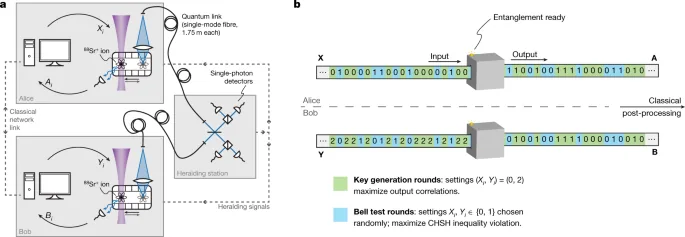
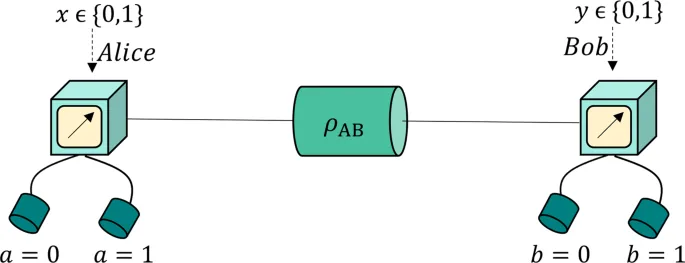
In device-independent setups, users treat all hardware as unmodeled black boxes where security rests solely on violating a Bell inequality. If experimental counts violate the Bell inequality, the measurement outcomes are mathematically certified to originate from genuine quantum entanglement, guaranteeing secrecy against an eavesdropper with unlimited computing power [6].
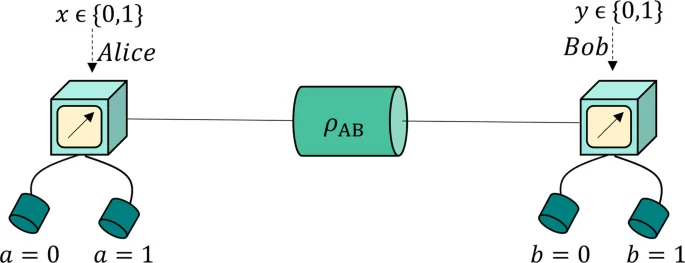
The Clauser-Horne-Shimony-Holt (CHSH) inequality offers the standard test for bipartite correlations when Alice and Bob input random binary settings into their stations and record binary outputs. Classical local models cannot beat a CHSH parameter of 2, which corresponds to a maximum winning chance of 3/4 in the non-local game. In contrast, quantum entanglement allows winning rates up to Tsirelson’s bound of 85.4% winning probability, certifying quantum secrecy directly from observed statistical distributions [6].
In 2022, David Nadlinger, Peter Drmota, Bethan Nichol, Gabriel Araneda, Daniel Main, Raghavendra Srinivas, David Lucas, and Colin Ballance at the University of Oxford achieved a device-independent protocol certified by Bell’s theorem. The team used trapped-ion qubits supplied by Sandia National Laboratories and linked them through optical fiber to generate 1.5 million Bell pairs and extract 95,628 secret key bits during an eight-hour run [5]. Oxford Ionics director Colin Ballance and colleagues confirmed that secure key distribution works on real physical devices without space-like separation.
Physical Limits of Optical Channels
Signal absorption in silica fiber limits key distribution ranges because optical fiber loses roughly 0.2 decibels per kilometer in the telecommunication C band. The no-cloning theorem bars classical amplifiers from boosting signals without destroying quantum states, so unassisted fiber links rarely exceed a few hundred kilometers [7].
High-dimensional quantum key distribution encodes information in spatial profiles like orbital angular momentum or Hermite-Gaussian spatial modes instead of simple two-level photon polarization. Free-space tests with Hermite-Gaussian modes reached 16 dimensions in Cartesian coordinates, yielding 1.55 bits per sifted photon at dimension 8 [8]. Multicore fibers also carry high-dimensional states with low crosstalk between cores, though keeping phase stability across fiber strands remains a demanding engineering challenge.
In an unreviewed preprint on arXiv, M. Masini, S. Pironio, and E. Woodhead calculated detection efficiency limits near 80.26% for device-independent key extraction [9]. In another preprint, E. Y.-Z. Tan, P. Sekatski, J.-D. Bancal, R. Schwonnek, R. Renner, N. Sangouard, and C. C.-W. Lim showed positive key rates under depolarizing noise up to 9.33% [10]. P. Brown, H. Fawzi, and O. Fawzi also found lower bounds on conditional von Neumann entropy using the Navascués-Pironio-Acín hierarchy and semidefinite programming [12]. These preprint papers on arXiv have not passed peer review, so researchers use them as theoretical guides while laboratory teams build matching hardware. Valerio Scarani, Helle Bechmann-Pasquinucci, Nicolas J. Cerf, Miloslav Dušek, Norbert Lütkenhaus, and Momtchil Peev reviewed practical security in Reviews of Modern Physics in 2008 and 2009, tracking how theoretical proofs translate to field experiments [4].
Quantum Key Distribution in Modern Networks
Rolling out quantum hardware requires smooth links with classical network protocols, as shown by early testbeds like the DARPA quantum network in the United States and the European SECOQC network in Vienna where trusted repeaters tied fiber segments together [7]. Commercial makers such as ID Quantique in Geneva, Toshiba in Tokyo, MagiQ Technologies in Boston, QuintessenceLabs in Canberra, and SeQureNet in Paris build turn-key appliances for banks and government data centers [3].
Network designs often blend quantum key distribution with public key algorithms, as seen in web certificate transparency logs that rely on Merkle tree certificates to provide auditable proofs for browser authentication. In a hybrid setup, quantum keys encrypt data traffic over the optical link, while public key tools authenticate the opening connection. Douglas Stebila, Michele Mosca, and Norbert Lütkenhaus showed that quantum key agreement delivers stronger confidentiality than classical key negotiation even when starting with public key authentication [7].
The central strength of physical key exchange is long-term confidentiality, called forward secrecy, meaning past ciphertexts stay secure even if private keys leak years later. Classical schemes face risks from store-now-decrypt-later tactics, where adversaries save encrypted files until quantum computers can crack their math. In healthcare, HIPAA rules in the United States protect electronic medical records for decades, and governments keep state files secret for over sixty years [3]. By using photon states and quantum rules, communicators build durable secrecy that survives future computing advances.
- ACADEMIC JOURNAL Bennett, C. H., & Brassard, G. (2014). Quantum cryptography: Public key distribution and coin tossing. Theoretical Computer Science, 560, 7–11. [Article Link]
- WEBSITE Wikipedia contributors. (2026). Quantum key distribution. Wikipedia, The Free Encyclopedia. [Article Link]
- WEBSITE Wikipedia contributors. (2026). Quantum cryptography. Wikipedia, The Free Encyclopedia. [Article Link]
- ACADEMIC JOURNAL Scarani, V., Bechmann-Pasquinucci, H., Cerf, N. J., Dušek, M., Lütkenhaus, N., & Peev, M. (2009). The security of practical quantum key distribution. Reviews of Modern Physics, 81(3), 1301–1350. [Article Link]
- ACADEMIC JOURNAL Nadlinger, D. P., Drmota, P., Nichol, B. C., Araneda, G., Main, D., Srinivas, R., Lucas, D. M., Ballance, C. J., et al. (2022). Experimental quantum key distribution certified by Bell’s theorem. Nature, 607, 682–686. [Article Link]
- ACADEMIC JOURNAL Zapatero, V., Van Leent, T., Arnon-Friedman, R., Liu, W.-Z., Zhang, Q., Weinfurter, H., & Curty, M. (2023). Advances in device-independent quantum key distribution. npj Quantum Information, 9, 35. [Article Link]
- BOOK CHAPTER Stebila, D., Mosca, M., & Lütkenhaus, N. (2010). The Case for Quantum Key Distribution. In Sergienko, A., Pascazio, S., & Villoresi, P. (Eds.), Quantum Communication and Quantum Networking. Springer, Berlin, Heidelberg. [Article Link]
- WEBSITE Wikipedia contributors. (2026). High-dimensional quantum key distribution. Wikipedia, The Free Encyclopedia. [Article Link]
- PREPRINT Masini, M., Pironio, S., & Woodhead, E. (2021). Simple and practical DIQKD security analysis via BB84-type uncertainty relations and Pauli correlation constraints. arXiv:2107.08894. [Article Link]
- PREPRINT Tan, E. Y.-Z., Sekatski, P., Bancal, J.-D., Schwonnek, R., Renner, R., Sangouard, N., & Lim, C. C.-W. (2020). Improved DIQKD protocols with finite-size analysis. arXiv:2012.08714. [Article Link]
- PREPRINT Portmann, C., & Renner, R. (2021). Security in Quantum Cryptography. arXiv:2102.00021. [Article Link]
- PREPRINT Brown, P., Fawzi, H., & Fawzi, O. (2021). Device-independent lower bounds on the conditional von Neumann entropy. arXiv:2106.13692. [Article Link]
Cover image: National Institute of Standards and Technology / Wikimedia Commons, Public domain


