




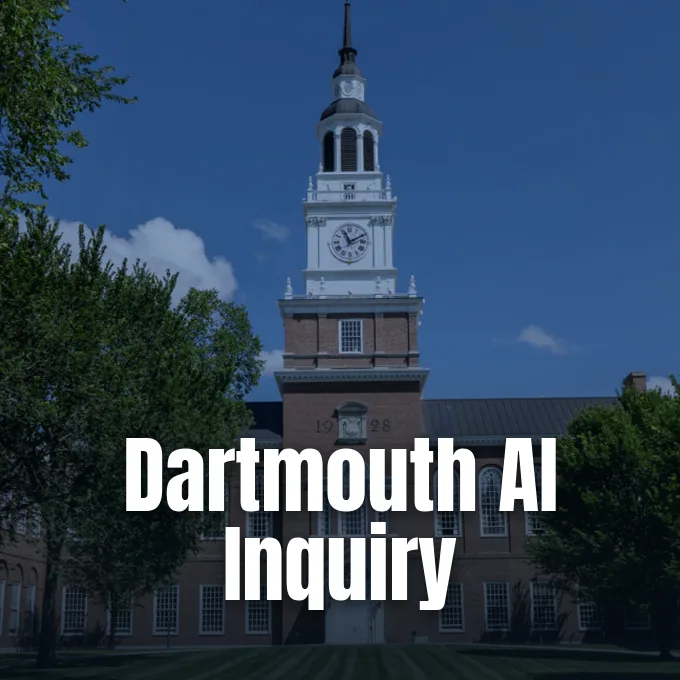
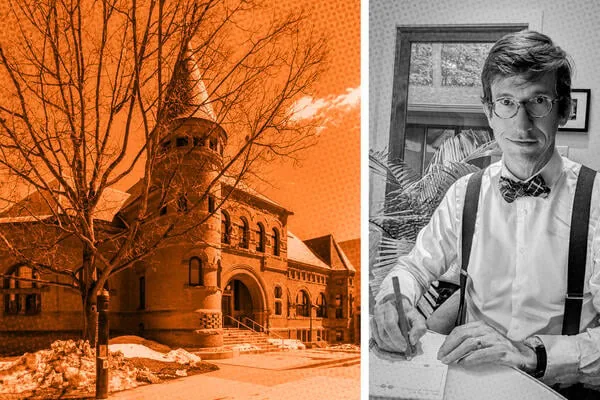
Dartmouth College Provost Santiago Schnell resigned after a faculty review found that he used AI to rewrite research papers and opinion essays without required credit. Dartmouth President Sian Leah Beilock announced the exit Wednesday in an email to students and faculty, writing that Schnell stepped down out of respect for the school. The move follows two months of campus debate over Dartmouth provost AI use, which began after software checkers flagged Schnell’s guest columns. History scholar Matthew Delmont will serve as interim provost through June 2028.
The Washington Post Op-Ed
The debate began in August after Schnell printed an op-ed in The Washington Post titled “Universities are fighting AI cheating. But there’s a deeper problem.” In the essay, Schnell argued that colleges should grant degrees that “distinguish what students can do independently from what they can accomplish with AI.” Soon after, Semafor editor Reed Albergotti tested guest essays across major news outlets with Pangram, a software checker built to spot machine text. Pangram flagged Schnell’s essay as at least 80 percent machine-generated, and later runs marked it “100% AI-written.” The newspaper asks guest writers to confirm their submissions are “not created or manipulated with artificial intelligence or editing software.” [5]
Following that report, student paper The Dartmouth evaluated Schnell’s wider writing record. Across nine papers Schnell produced in 2026, Pangram found a median score of 96 percent machine text. But five papers written before ChatGPT launched in November 2022 scored as “100% human-written.” Essays in the National Catholic Register and Public Discourse also drew high flags. Schnell told student reporters that large language models served only as assistive tools that did not replace his research, intellectual judgment, or authorship. [5]
Doubts grew when Schnell’s own September 18 email explanation to student reporters tested as “100% AI-written.” Schnell said he drafted the ideas himself before using software to refine phrasing. But Dartmouth economics professor Paul Novosad told the student paper that correcting grammar does not trigger false flags on Pangram. Novosad tested hundreds of student papers from before 2022 and found zero false positives. Pangram reported a false positive rate of 0.009 percent on text polished by software, matching an audit by the University of Chicago. [5]
Findings on Dartmouth Provost AI Accounts
With campus tension rising, President Beilock set up an independent review panel on September 25 to check the provost’s work against journal rules. The panel included five members: former provost and computer science professor David Kotz, computer science professor Hany Farid, English professor Peter Orner, linguistics professor Lindsay Whaley, and Dartmouth trustee Odette Harris. Instead of relying on commercial AI checkers, the team examined written drafts, email records, and internal accounts. In an eight-page report delivered on October 27, investigators concluded that Dartmouth provost AI use altered text heavily and fell short of campus integrity rules. [4]
Schnell gave his campus-issued laptop to the team but showed what the report called “insufficient cooperation.” He declined to hand over logs from personal accounts and did not make himself available for interviews. Investigators obtained logs from his campus Claude account with Anthropic, which showed prompts used to rewrite text, fix code bugs, and make figures. [1]
The review covered four papers produced since Schnell arrived in Hanover in July 2025. While the panel cleared a paper co-written with peers, it found violations in two solo papers and his Washington Post column. The report stated that Schnell’s public statements downplayed his reliance on machine drafts. Although the panel did not recommend formal penalties, Schnell faced a faculty vote of no confidence set for mid-November. [2]


Prompts Found in Claude Logs
Claude chat logs revealed how Schnell handled reviewer comments for a paper in ChemSystemsChem titled “Reaction Acceleration: Reviving the Second Derivative in Chemical Kinetics” [6]. Schnell asked Claude if the system saw any scientific flaw, problem, or contradiction that would prevent submission. He also pasted in a draft from ChatGPT and asked Claude if it would change anything based on that text. The journal has required AI disclosure since 2023, refuting Schnell’s claim that he followed older guidelines that lacked clear rules. The review panel said using tools to answer peer critiques required explicit notice. [2]
Investigators found a similar pattern in a forthcoming paper on university governance titled “Academic Freedom and Catholic Mission: The Procedural Overlap Zone in University Governance.” Schnell uploaded the draft and asked Claude whether the text contained signatures of AI writing. He then adopted changes suggested by the model before sending the revised text to editors. When the public debate broke out, Schnell asked to pause publication, claiming he used AI only to polish sentences. The panel ruled that this claim understated his actual tool use. [2]
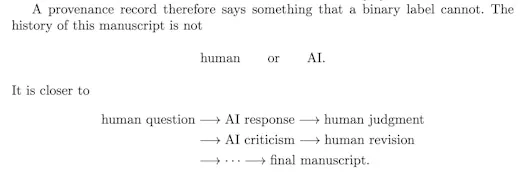
Schnell explored detection theory directly in a mathematical preprint titled “Who Wrote This? Turing, Total Variation, and the Mathematics of AI-Text Detection” [8]. In that preprint, which has not undergone peer review, he acknowledged using language models for editorial support. The paper included a diagram mapping human and machine interaction during drafting. But panel members pointed out that the chart showed no step where a human wrote prose directly, showing instead a loop of machine output. [5]
Campus Backlash and Faculty Petitions
News of the report sparked anger among teachers and students who cited Dartmouth’s academic honor code, which requires students to acknowledge AI tools in coursework or face suspension. The Dartmouth chapter of the American Association of University Professors (AAUP) circulated a petition demanding Schnell’s removal to restore campus trust. In the petition, the faculty group asked: “How do we ask our students and colleagues to follow the rules when the academic leader of Dartmouth is allowed to break them?” Students argued that campus leaders held undergraduates to strict rules while excusing undisclosed machine writing by top officials. [3]
Government student Eli Moyse wrote an op-ed for The Dartmouth calling for Schnell’s firing over what he termed administrative “AI dependency.” Dartmouth had promoted campus technology adoption, partnering with Amazon Web Services and Anthropic, the lab where safety researcher Jacob Coxon quit Anthropic after warning of a superintelligence race. Moyse wrote that administrative hype around AI created resentment among students facing workforce automation. [3]
The debate highlighted broader questions across higher education. A survey of chief academic officers by Inside Higher Ed revealed that 65 percent used AI to draft communications, while 71 percent used generative tools weekly. Education consultant Tawnya Means said colleges must distinguish between helpful editorial feedback and uncredited text substitution. At Dartmouth, known as the birthplace of AI after hosting the summer research workshop that launched the field, the Dartmouth provost AI controversy forced a swift institutional reckoning. [3]
Debate Over Santiago Schnell AI Disclosures
In his defense, Schnell argued that non-native English speakers rely on software tools to polish prose and that automated checkers harbor measurable bias against them. He cited a 2023 preprint study led by Stanford researcher W. Liang, which has not undergone peer review, showing that commercial GPT detectors regularly misclassify non-native writing as synthetic text [7]. Schnell maintained that using software for language refinement did not diminish his intellectual role or substitute for his scholarship. But faculty critics countered that his prompts went well beyond grammar corrections, generating substantive arguments and addressing peer review critiques directly without informing editors. [5]
The Santiago Schnell AI debate ultimately centered on candor with editors and readers. In a column in the student newspaper, Schnell conceded that he should have disclosed his tool use openly. President Beilock echoed that standard when accepting his resignation, writing that academic leaders must model the transparency expected of scholars. The Dartmouth provost AI review showed that institutional trust requires clear boundaries. [2]
With Schnell stepping down, history professor Matthew Delmont will serve as interim provost through June 2028 while Dartmouth re-evaluates leadership rules. The college is preparing to host an academic conference titled AI at 70 later this week, confronting the practical boundaries of generative tools on campus. Former provost David Kotz and faculty leaders emphasized that clear disclosure rules protect scholarly integrity as universities integrate machine assistance. For academic executives nationwide, Schnell’s exit demonstrated that undisclosed AI writing carries severe professional costs. [4]
- ONLINE NEWS Ars Technica. (2026). Dartmouth’s provost warned us about AI cheating—but his own AI use cost him his job. [Article Link]
- ONLINE NEWS Palmer, K. (2026). Dartmouth Provost Resigns Over AI Use. Inside Higher Ed. [Article Link]
- ONLINE NEWS Palmer, K. (2026). Dartmouth Provost’s “AI Dependency” Sparks Backlash. Inside Higher Ed. [Article Link]
- ONLINE NEWS Hughes, M. (2026). Dartmouth provost resigns after review finds undisclosed AI use. NHPR. [Article Link]
- ONLINE NEWS Klee, A., & Pierry, I. (2026). Op-eds, academic articles by Provost Santiago Schnell flagged as ‘AI-written’ by ‘near-zero error’ AI detector Pangram. The Dartmouth. [Article Link]
- ACADEMIC JOURNAL Schnell, S. (2026). Reaction Acceleration: Reviving the Second Derivative in Chemical Kinetics. ChemSystemsChem, 8(5). [Article Link]
- PREPRINT Liang, W., Yuksekgonul, M., Mao, Y., Wu, E., & Zou, J. (2023). GPT detectors are biased against non-native English writers. arXiv:2304.02819. [Article Link]
- PREPRINT Schnell, S. D. (2026). Who Wrote This? Turing, Total Variation, and the Mathematics of AI-Text Detection. arXiv (Cornell University). [Article Link]


