





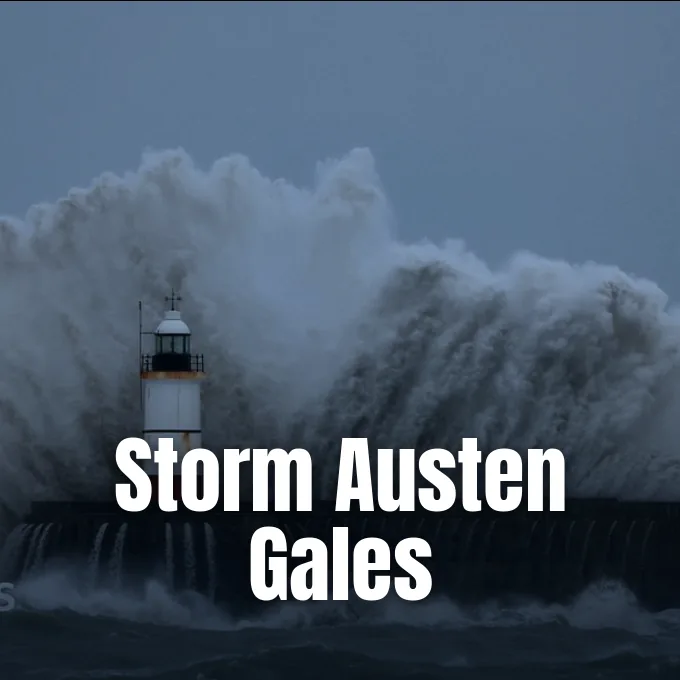
High winds and heavy rain swept into southern Britain overnight as Storm Austen made landfall, knocking out electricity to thousands of properties and stalling morning travel on coastal routes. The weather system tracked eastward through the day, closing schools on Jersey and Guernsey while grounding flights at airports in the southwest [1]. Forecasters at the Met Office cautioned that another low-pressure system named Storm Boelo would follow within hours, bringing wet and windy conditions across the country into the weekend [2].
Power Cuts Hit Southern Counties
Fierce winds tore down cables and brought trees crashing onto roads in Devon, Cornwall, and neighboring counties as the system swept inland during the night. The National Grid reported that more than 10,000 homes lost electricity during the height of the gale, although repair teams reconnected over 60,000 properties since Storm Austen began. In coastal Perranporth, emergency teams evacuated families from a holiday caravan park on Thursday afternoon before the worst surge arrived. Hannah Dawson-Turk, who took shelter with her relatives at a hotel, told the BBC that “the night before last, it sounded like our caravan was going to be ripped apart”. Perranporth holidaymakers fled inland [1].
Dawson-Turk described how large waves surged outside her hotel window while gusts rattled the shoreline. “The storm is very loud outside now, and the waves look huge from our windows,” she said. Several schools in Cornwall either closed for the day or opened later than normal so that pupils could avoid early morning road dangers [1]. In South West England, where Met Office warnings remained active until 17:00 BST, transport officials urged drivers in Devon to stay off exposed coastal roads until maintenance crews finished clearing fallen timber [2].
Gale Damage Along the Coast
Heavy surf caused visible damage on the southern shoreline, where violent waves struck the seafront in Brighton and tore away part of the Victorian West Pier. The structure first opened in 1866 and closed to the public in 1975, yet its surviving iron skeleton stood as a well-known symbol of the resort before waves collapsed large sections into the sea. Stephen Royle, who lives opposite the promenade, watched the destruction from his window and said the incoming waves were “enormous”. Royle added that he was “shocked” by how much of the ruined pier vanished into the water during the morning tide [1].
In the Channel Islands, wind speeds climbed higher as the centre of Storm Austen tracked eastward into the English Channel, with Paul Aked at Jersey Met reporting gusts on Guernsey reaching 76mph (122km/h). That matches force nine. Jersey recorded peak gusts of 84mph (135km/h), which shook houses violently and prompted authorities to close every school on both islands for the day. Residents told BBC Radio Guernsey that gale-force winds whistled loudly through their roofs as the storm passed [1].

Transport Disruptions by Rail, Air, and Sea
Travel delays from Storm Austen spread through southern transit networks as fallen trees blocked railway lines in Devon and Cornwall, forcing National Rail to reduce speeds on main coastal routes. Train operators warned passengers that disruptions would likely continue into the weekend because maintenance teams needed time to clear debris and check signaling equipment. Several ferry crossings between the UK and France were cancelled because rough seas made harbor docking unsafe [1]. Yellow weather warnings also covered wider regions, where gusts between 45-55mph prompted ferry cancellations between Pembrokeshire and Ireland as heavy swells entered the Irish Sea. Irish Sea sailings stopped [2].
Airports in the southwest also faced disruption as crosswinds blew over coastal runways. Exeter Airport departure boards showed multiple flight cancellations, while Cornwall Airport Newquay warned travelers to check departure times with their airline. Jersey Airport suspended all commercial flights until at least 17:00 because wind speeds exceeded safe limits for incoming planes. Flight boards cleared fast [1].
Ferry cancellations threatened supply links for the Channel Islands, where supermarkets rely on daily cargo shipments from ports in southern England. Mark Cox, the head of the island Co-op, warned that fresh food shortages could arise if supply boats could not sail over coming days. “It’s rare we get this level of disruption to storms backing up so quickly and probably a little bit more heavier than what we’ve had to deal with in the past,” Cox said. Retail staff monitored pantry stocks while transport managers planned alternative freight schedules [1].


How Storm Austen Formed Over the Atlantic
Atmospheric conditions over the North Atlantic created an environment that allowed Storm Austen to strengthen quickly before hitting the English coast, driven by a fast-moving jet stream that functioned as an atmospheric conveyor belt. Sharp temperature contrasts fueled this growth. When warm air shifts north from subtropical waters and meets cold polar air pushing south, central atmospheric pressure drops swiftly beneath the steering currents to produce damaging surface winds and broad rain bands. These gales organized heavily along the southern flank of the system as it tracked toward Britain [2].
The strongest winds formed south of the low-pressure centre, which placed northwest France in line for damaging weather. Coastal areas in Brittany faced gusts close to 90mph, while the Channel Islands recorded gusts up to 80mph [2]. Forecasters at the Met Office explained that Austen made landfall in the southwest overnight before tracking steadily east throughout Friday [1]. BBC Weather forecaster Chris Fawkes noted that less severe yellow warnings remained in force until 21:00 BST across most of England and Wales [2].
Storm Boelo Follows in Quick Succession
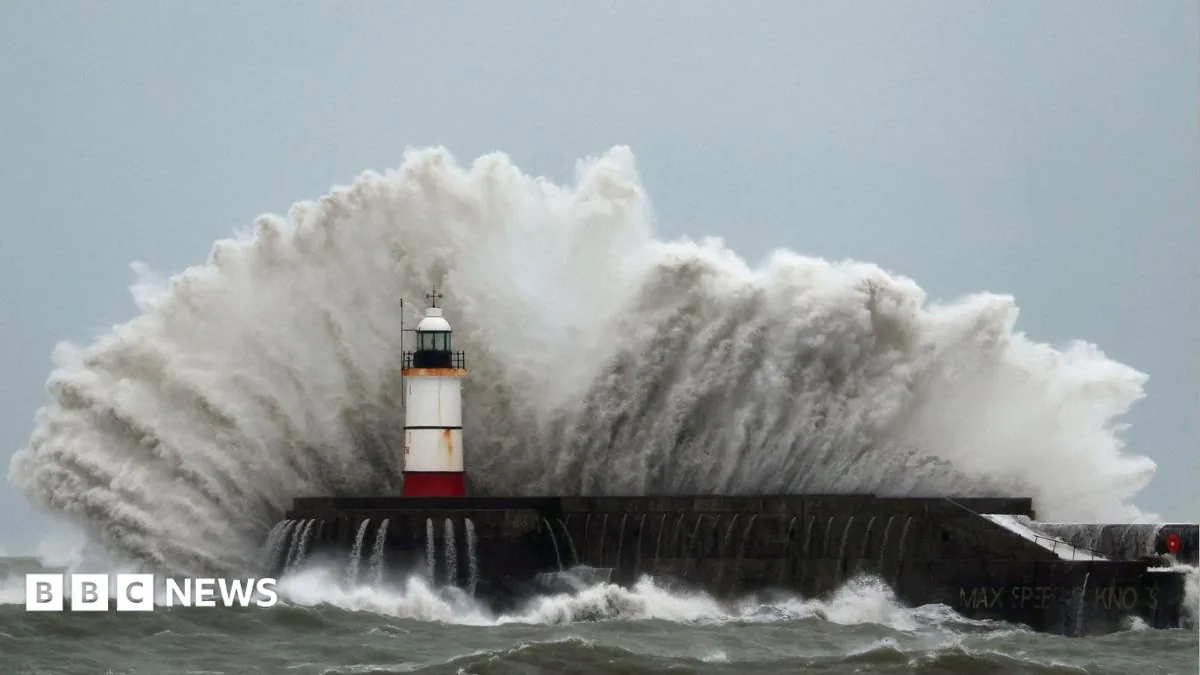
Calm weather will not last long for Britain because a second low-pressure system, named Storm Boelo by the Met Office on Thursday, is following right behind Storm Austen over the weekend. Met Office meteorologists issued an amber warning for wind that encompasses the Scottish mainland while excluding the Northern Isles, while also stretching into border regions of northern England and the northernmost tip of Northern Ireland. Forecasters expect amber zone gusts to range from 60mph to 70mph, with exposed headlands potentially seeing speeds of 80mph [2]. Strong gusts could bring down more power lines [1].
Local disruption is also expected in the Central Lowlands of Scotland, where strong winds will funnel between hills and raise the risk of transport delays [2]. Heavy and persistent rainfall will accompany the winds, creating spray and surface water that makes driving conditions hazardous on motorways. The Met Office advised motorists to drive with caution and urged residents to secure outdoor items such as garden bins and trampolines. People living near the coast were advised to stay indoors as much as possible [1].
Rain warnings add to flooding risks because soils in parts of Scotland are already wet from previous autumn storms. A yellow warning covers Glasgow and Edinburgh, where forecasters project 20mm to 40mm of rain with localized accumulations reaching 80mm on high ground. Yellow wind warnings also cover Orkney and northern England, where gusts could reach 55mph to 75mph. Weather conditions will slowly improve late on Sunday as rain retreats into northeast Scotland, giving way to sunshine and blustery showers elsewhere [2].
Why Storm Austen Fits Autumn Weather Patterns
Climatological records show that back-to-back systems like Storm Austen and Storm Boelo are a familiar feature of British autumn weather, as low-pressure storms frequently arrive in clusters when steering currents stay energetic over the Atlantic basin. The storm-naming season begins each September. Disturbances build steadily from late summer into autumn before reaching peak frequency during winter, making multiple autumn gale warnings typical for the United Kingdom. May remains the only month without any named storms. In roughly half of the seasons since 2015, the first named storm did not arrive until after 1 November [2].
The arrival of these early autumn gales coincided with government guidance advising households to prepare for emergency disruptions. Official advice recommended that families store three days of bottled water and tinned food to deal with potential crises such as utility outages, natural disasters, or supply issues. Prime Minister Andy Burnham said: “It’s not about panic buying… It’s about just taking sensible measures to have enough in the house to tide you over should there be a difficult situation.” [1]
Food supply vulnerabilities also drew attention following recent warnings from public auditors. The National Audit Office warned that Britain’s food supply chain faces increasing strain from climate disruption and external risks. In its published findings, the audit team observed that the Department for Food, the Environment and Rural Affairs (Defra) fell short in previous seasons regarding efforts to fortify national grocery distribution channels. With ferry and rail routes vulnerable to consecutive gales, local authorities face ongoing challenges in maintaining stable transport links during stormy autumn weeks [1].
- ONLINE NEWS Moreau, E., & Danaos, S. (2026, October 23). Storm Austen: Strong winds and heavy rain batter southern UK. BBC News. [Article Link]
- ONLINE NEWS Fawkes, C. (2026, October 23). UK weather: Yellow warnings in effect as Storm Austen hits parts of UK. BBC Weather. [Article Link]
APA 7: PerEXP Teamworks. (2026, October 24). Storm Austen Cuts Power and Grounds Flights in Southern UK. PerEXP Teamworks. https://perexpteamworks.com/en/storm-austen-power-cuts-uk/


