





Zero knowledge proofs allow one party to prove that a mathematical claim is true without revealing any secret data beyond the validity of the assertion itself. In this crypto framework, the party proving the claim is called the prover, and the party checking it acts as the verifier. The concept first emerged in a 1985 paper titled The Knowledge Complexity of Interactive Proof Systems by Shafi Goldwasser, Silvio Micali, and Charles Rackoff at MIT. Goldwasser and Micali later won the 2012 Turing Award for this pioneering work in computational complexity theory. Standard web systems check sensitive records by opening raw files or comparing hashes on central servers. In contrast, zero-knowledge tools build a compact proof from a private witness and public inputs. This math proof lets an outside service confirm account balances or age limits without leaking personal identifiers [11].
- Circuit Logic Behind the Protocol
- Everyday Analogies for Concealed Information
- Three Core Rules for Every Proof
- Zero Knowledge Proofs in SNARK and STARK Systems
- From Interactive Proofs to Fiat-Shamir Heuristics
- How Zero Knowledge Proofs Scale Blockchains
- Applying Zero Knowledge Proofs to Digital Identity
- Security Vulnerabilities in Real Deployments
Circuit Logic Behind the Protocol
A proof system relies on three parts: the secret witness, the public inputs, and an arithmetic circuit. The witness holds the private data that only the prover knows, such as a secret key, a hidden coin balance, or a government record. The circuit acts as a set of algebraic gates that turn computational tasks into polynomial constraints. To build a valid proof, the prover runs the witness through the circuit and locks the values in mathematical commitments. Commitments work like sealed envelopes. They keep secret values fixed. This prevents any tampering after creation [12].
Many people confuse zero knowledge verification with standard data encryption, but the two tools solve different security problems. Encryption scrambles text so that authorized users can read it later with a key. Zero knowledge proofs never store or share the raw text during the check. As cryptographer Matthew Green from Johns Hopkins University said, verifying a compact mathematical proof takes far less time than re-evaluating an entire program from scratch [9].
The core math appears in the Schnorr identification scheme over cyclic prime groups, created by Claus Schnorr. In this scheme, a prover shows they know a discrete logarithm without showing the secret number. The prover sends a random commitment value to the verifier. The verifier sends back a random numeric challenge. The prover then returns a combined scalar answer, allowing the verifier to check the discrete logarithm equation without revealing the exponent [1].
Everyday Analogies for Concealed Information
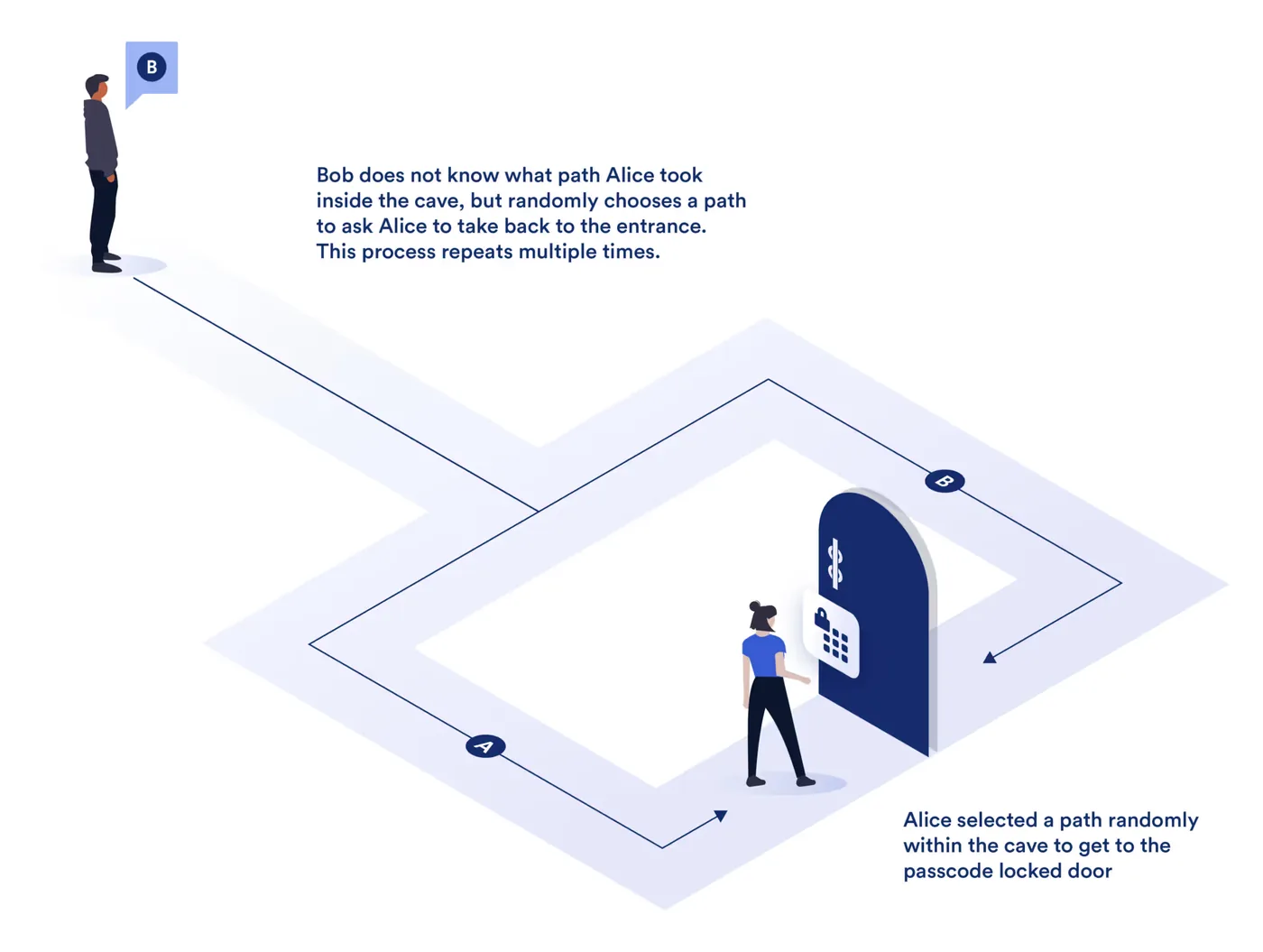
Researchers explain zero knowledge concepts with physical models. The best known is the Ali Baba cave story, published in 1990 by Jean-Jacques Quisquater and fellow computer scientists in their paper How to Explain Zero-Knowledge Protocols to Your Children. In this story, a circular cave branches into paths A and B, blocked by a secret door. Peggy knows the magic word to open the door, but she refuses to tell Victor. Victor waits outside. Victor shouts which path she must take to exit. Peggy unlocks the door if needed to return along the requested route [14].
If she is bluffing, she has only a 50% chance of guessing right. By repeating the test 20 times in a row, Victor reduces her chance of lucky guessing to roughly one in a million. Peggy proves her claim completely, but Victor never learns the secret word [15].
Another classic model uses two colored balls and a color-blind friend. Victor cannot tell a red ball from a green ball, but Peggy sees the colors clearly. Victor puts both balls behind his back, swaps them at random, and brings one out for Peggy to inspect. Peggy is right every time. After repeated rounds, Victor knows the balls are different colors, yet he never learns which ball is red [10].
Three Core Rules for Every Proof
In modern cryptography, zero knowledge proofs must satisfy three mathematical rules: completeness, soundness, and zero knowledge. Completeness means that when a claim is valid, an honest verifier will always accept the proof from an honest prover. Soundness means that when a claim is false, a dishonest prover cannot trick an honest verifier, except with an extremely small probability that cryptographers consider negligible. These two rules guarantee that valid claims pass and false claims fail [14].
The third rule, zero knowledge, requires that the verifier learns nothing beyond the fact that the statement is true. In complexity theory, researchers show this by building a program called a simulator. The simulator produces a mock record of the proof without knowing the secret witness. If an outside observer cannot distinguish the real interaction from the mock run, the proof leaks zero secret data [1].
These rules apply to decision problems and proofs of knowledge. In a decision problem, the protocol confirms whether a mathematical statement is true. In a proof of knowledge, the prover shows they possess a specific secret witness, such as a private key, without leaking that secret to the verifier [18].
Zero Knowledge Proofs in SNARK and STARK Systems
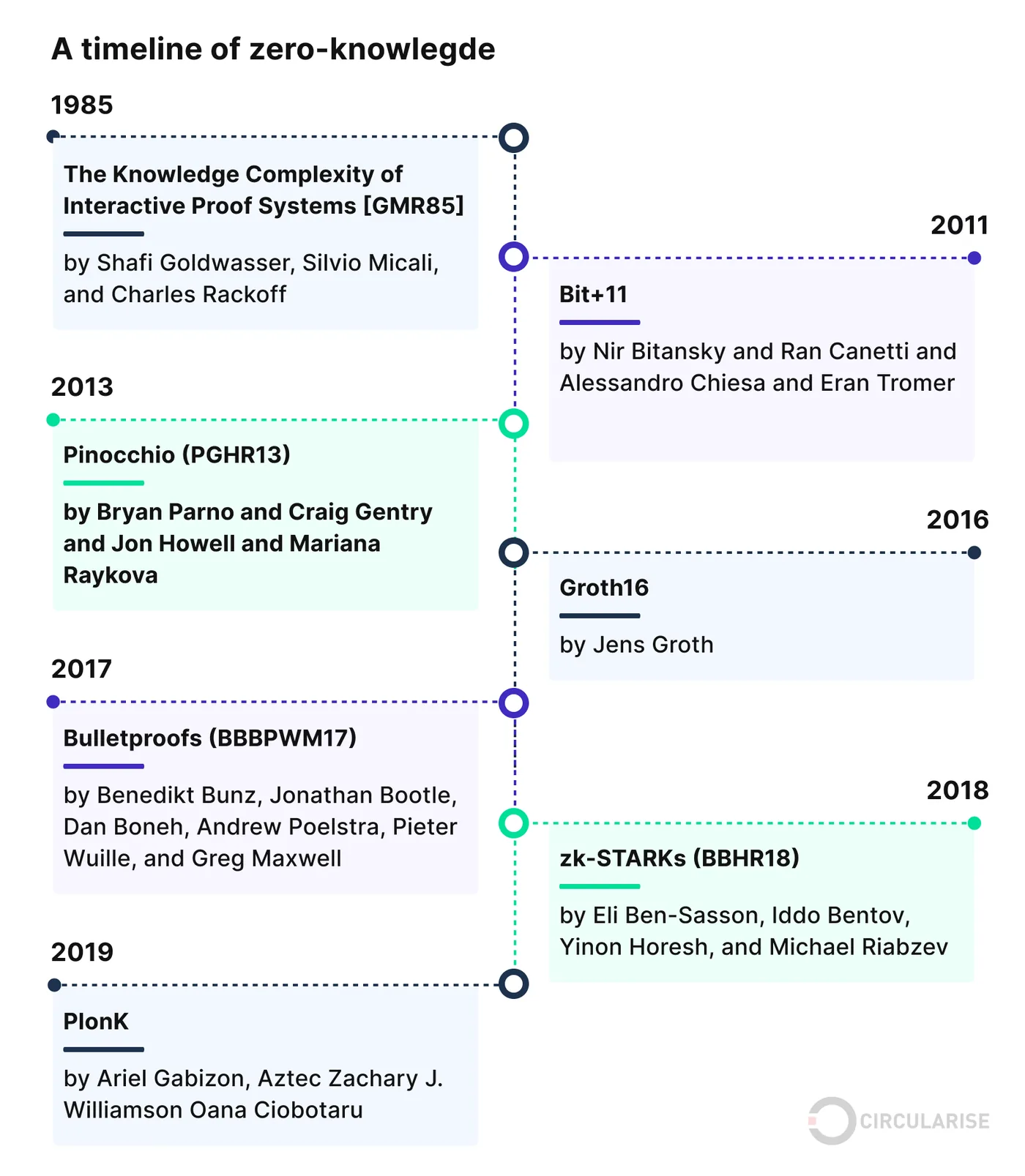
Cryptographers group proof models by size, speed, and setup needs. The most common scheme is the zk-SNARK, coined in a 2011 paper by Nir Bitansky, Alessandro Chiesa, and co-authors to describe succinct non-interactive arguments of knowledge. SNARKs make tiny proofs of a few hundred bytes that verify in milliseconds. The Groth16 system, created by Jens Groth at University College London and presented in EUROCRYPT 2016, remains the fastest proof scheme in production [14].
Early SNARK systems needed a trusted setup ceremony to build structured reference strings. If creators kept the secret random seeds, they could print fake tokens. In the 34th Annual International Conference on the Theory and Applications of Cryptographic Techniques, known as EUROCRYPT 2015, Jens Groth and Markulf Kohlweiss presented their One-Out-of-Many proof in Sofia, Bulgaria, published in the Springer Proceedings with ISBN Electronic 978-3-662-46803-6 during the April conference event period. In 2019, Mary Maller, Sean Bowe, Markulf Kohlweiss, and Sarah Meiklejohn introduced Sonic at the ACM CCS conference in London, providing universal, updatable reference strings [3], [5]. Later systems like PLONK expanded this flexibility, while Zcash eliminated trusted setups entirely in its May 2022 NU5 network upgrade using the Halo 2 system [18].
In 2018, Eli Ben-Sasson, Iddo Bentov, Yinon Horesh, and Michael Riabzev launched zk-STARKs at StarkWare. STARKs replace elliptic curves with hash functions, offering post-quantum security and transparent setups without ceremonies, although proof files are larger. In 2017, Benedikt Bünz and Dan Boneh created Bulletproofs at Stanford, delivering short range proofs without trusted setups for privacy networks like Monero [12], [14].
From Interactive Proofs to Fiat-Shamir Heuristics
Early zero knowledge proofs were interactive conversations between two computers. While that worked for private calls, decentralized blockchains cannot hold two-way chats with thousands of validating nodes. In 1986, Amos Fiat and Adi Shamir introduced the Fiat-Shamir heuristic. This formula replaces the verifier’s live challenge with a cryptographic hash of the prover’s commitment, turning interactive protocols into non-interactive proofs that any network node can check on its own [10].
In 1988, Manuel Blum, Paul Feldman, and Silvio Micali showed that a common reference string enables non-interactive proofs in computational models. In 2014, Eli Ben-Sasson, Alessandro Chiesa, Eran Tromer, and Madars Virza presented succinct proofs for von Neumann computer architectures at the USENIX Security Symposium in San Diego. Their C-compiler system executed programs under bounded running times and produced proofs of only 288 bytes at 128 bits of security, verifying execution in 5 milliseconds [17].
Technical accuracy remains vital because tech companies often misuse the zero knowledge label to describe ordinary client-side encryption where servers do not hold user keys. As Jean-Philippe Aumasson, head of Swiss firm Teserakt AG, explained, real zero knowledge protocols must feature formal mathematical proofs that verify facts without disclosing underlying secret witness data [9].
How Zero Knowledge Proofs Scale Blockchains
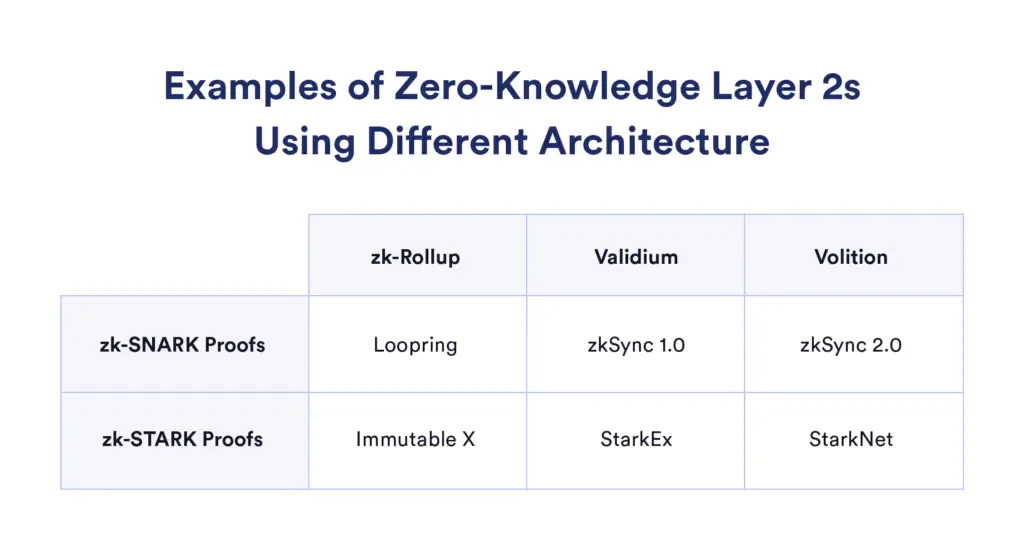
Every node on Ethereum processes every trade on the network. This design guarantees security, but it slows transaction throughput and raises user fees. Layer 2 networks called zk-rollups solve this bottleneck. An off-chain sequencer bundles thousands of transfers, computes them off the main ledger, and creates a single succinct validity proof. Ethereum validators check that single proof in milliseconds, updating ledger state without replaying all transactions [11].
Validity proofs give mathematical certainty on the spot. Unlike optimistic rollups, zk-rollups do not make users wait seven days for fraud challenges. Networks like Starknet, zkSync, and Loopring cut gas fees dramatically with this approach. In enterprise finance, JP Morgan Chase deployed zero knowledge proofs in its Quorum blockchain to protect bank payments. Developers are also testing zero-knowledge virtual machines to verify Ethereum Layer 1 blocks directly, expanding node throughput without requiring massive validator hardware [11], [13].
Beyond scaling speed, zero knowledge proofs protect user privacy on public blockchains. On transparent chains, wallet balances and transfer records sit open to the public. Zcash solved this by creating shielded pools that hide sender, receiver, and sum details with zk-SNARKs. In decentralized finance, Manta Network launched MantaPay to let users swap digital tokens privately without leaking trade volumes to market trackers [13], [18].
Applying Zero Knowledge Proofs to Digital Identity
Legacy identity checks force users to upload passport photos, tax papers, and utility bills to corporate databases. When those servers suffer hacks, personal data spills across the web. Central databases create attractive targets for online theft. Zero knowledge systems let citizens prove personal attributes without handing over raw paperwork. A person can prove they are at least 18 years old or hold legal residency without revealing their name, home address, or exact birth date [11].
Several countries and protocols now use zero knowledge credentials in active production. The Kingdom of Bhutan launched its National Digital ID on Ethereum, letting citizens authenticate state services while storing records securely on phones. Globally, the World ID system uses the Orb iris camera to verify unique human personhood. World ID runs on the Semaphore protocol, designed by the Ethereum Foundation PSE team, enabling users to prove group membership without identifying their personal account [11].
Zero knowledge password proofs, defined in IEEE P1363.2 and IETF RFC 2945, let apps verify logins without storing passwords that hackers could target in dictionary attacks. The first password-authenticated key exchange was built by Steven M. Bellovin and Michael Merritt in 1992. In web security, Cloudflare tested zero knowledge attestation with YubiKey hardware to verify human visitors without tracking device models [8], [11].
Security Vulnerabilities in Real Deployments
Mathematical purity does not guarantee bug-free software. A study by Stefanos Chaliasos, Jens Ernstberger, David Theodore, Jahanara Mohammad, and Benjamin Livshits examined 141 real vulnerabilities across deployed SNARK systems. Software flaws remain common. Their paper showed that bugs stem from missing circuit constraints and software errors rather than broken cryptographic math. If an arithmetic circuit forgets a single numeric check, an attacker can generate a valid proof for a completely fraudulent claim [7].
Generating zero knowledge proofs takes significant processing power and memory on mobile phones. In an unreviewed preprint survey, Ryan Lavin, Xuekai Liu, Hardhik Mohanty, Logan Norman, Giovanni Zaarour, and Bhaskar Krishnamachari at Cornell University noted that while zero knowledge proofs offer strong computational integrity, engineers face steep tradeoffs between proof size, prover time, and parameter memory [4].
Finally, privacy tools face intense regulatory scrutiny worldwide. Because private tokens can shield illicit transfers, teams are building compliant privacy frameworks. Systems like Chainlink DECO, created by cryptographers at Cornell Tech, extend TLS protocols to prove credit scores from banking portals without exposing financial records. Proving compliance without surrendering user privacy remains the chief engineering challenge for zero knowledge adoption [16].
- WEBSITE Code the Change. (2018). Zero Knowledge What? An Introduction to Zero Knowledge. [Article Link]
- BOOK Goldreich, O. (2001). Foundations of Cryptography: Basic Tools. [Article Link]
- CONFERENCE PAPER Groth, J., & Kohlweiss, M. (2015). One-Out-of-Many Proofs: Or How to Leak a Secret and Spend a Coin. Advances in Cryptology – EUROCRYPT 2015, Part II. [Article Link]
- PREPRINT Lavin, R., Liu, X., Mohanty, H., Logan, N., Zaarour, G., & Krishnamachari, B. (2024). A Survey on the Applications of Zero-Knowledge Proofs. [Article Link]
- CONFERENCE PAPER Maller, M., Bowe, S., Kohlweiss, M., & Meiklejohn, S. (2019). Sonic: Zero-Knowledge SNARKs from Linear-Size Universal and Updateable Structured Reference Strings. Proceedings of the 2019 ACM SIGSAC Conference on Computer and Communications Security. [Article Link]
- BOOK CHAPTER Ben-Sasson, E., Chiesa, A., Riabzev, M., Spooner, N., Virza, M., & Ward, N. P. (2022). Aurora: Transparent Succinct Arguments for R1CS. [Article Link]
- PREPRINT Chaliasos, S., Ernstberger, J., Theodore, D., Wong, J., Mohammad, M., & Livshits, B. (2024). SoK: What Don’t We Know? Understanding Security Vulnerabilities in SNARKs. [Article Link]
- ONLINE NEWS Cloudflare. (2021). Introducing Zero-Knowledge Proofs for Private Web Attestation with Cross/Multi-Vendor Hardware. [Article Link]
- ONLINE NEWS Newman, L. H. (2019). What Are Zero-Knowledge Proofs? WIRED. [Article Link]
- WEBSITE GeeksforGeeks. (2020). Zero Knowledge Proof. [Article Link]
- WEBSITE Ethereum Foundation. (2026). Zero-Knowledge Proofs. [Article Link]
- WEBSITE Chakos, H. (2026). What Are Zero-Knowledge Proofs? ZK Proofs Explained Simply. Learning Crypto. [Article Link]
- WEBSITE Gate Web3. (2026). What Is Zero-Knowledge Proof and How Does It Impact Blockchain? Gate Wiki. [Article Link]
- WEBSITE Tian, D. (2022). Zero-Knowledge Proofs Explained in 3 Examples. Circularise. [Article Link]
- WEBSITE Gate Learn. (2023). Zero-Knowledge Proofs Explained. [Article Link]
- WEBSITE Chainlink. (2024). Zero-Knowledge Proof (ZKP) — Explained. [Article Link]
- CONFERENCE PAPER Ben-Sasson, E., Chiesa, A., Tromer, E., & Virza, M. (2014). Succinct Non-Interactive Zero Knowledge for a von Neumann Architecture. 23rd USENIX Security Symposium. [Article Link]
- WEBSITE Electric Coin Company. (2023). What Are zk-SNARKs? Zcash. [Article Link]


