





Tesla launched its autonomous ride-hailing service in San Antonio on Monday, posting a launch map that covers 274 square miles. The new Tesla Robotaxi San Antonio rollout makes San Antonio the company’s eighth operating market and its fourth territory in Texas. The official announcement on X arrived just after midnight local time, stating that passenger trips would open at 5 a.m. While the published boundary is the largest day-one zone the company has ever posted, independent tracking data shows that riders can’t book trips throughout that entire area [1].
Coverage of the 274-Square-Mile Map
The published boundary traces a large polygon running from Loop 1604 on the north side of the metropolitan area down to just south of downtown San Antonio. It covers about 1.0 million residents, representing 51% of the metro area. Local jobs in the zone reach 721,000 [1].
San Antonio International Airport sits inside the perimeter, but Tesla does not serve airport terminals. Alphabet subsidiary Waymo takes a noticeably different approach in the city, running driverless rides over 59 square miles and including airport trips for local riders. Waymo launched unmanned trips across the metro area in February with initial routes covering over 60 square miles, welcoming the general public eight months later in October. Tesla gave no vehicle count for its 274-square-mile zone. On the same day that Tesla posted its San Antonio polygon, it expanded its Austin zone to 443 square miles, adding 178 square miles since mid-September [1].
A large map does not mean cars are waiting on the street. As of Monday morning, Robotaxi Tracker had not logged a single Tesla Robotaxi in San Antonio. Electrek reporter Fred Lambert said that drawing a map costs nothing, but supplying enough vehicles to keep wait times reasonable is much harder. Tesla now runs unsupervised rides in eight cities, but early app checks suggest that actual availability will cover a fraction of the published map [1].
Where Tesla Robotaxi San Antonio Bookings Fail
Similar gaps between maps and booking reality appeared during earlier Tesla expansions. In Houston, Tesla expanded its territory into a shape resembling a rocket, but the app quickly refused downtown pickups. Independent researcher Koby Pierce soon began testing address requests using an emulator across thousands of real street locations to measure where trips actually work [1].
Pierce searched thousands of real street addresses inside the Robotaxi app on an emulator and mapped only the spots that accepted a pickup or drop-off. In Austin, Tesla’s main testing market with 453 unsupervised vehicles, the app accepted rides in only about 59% of the advertised zone, though that territory reached 83% of local residents. Dallas showed the highest working share at 78% of its land area and 89% of residents, followed by Houston at 74%, Fort Worth at 72%, Orlando at about 70%, and Miami at 61%. Pierce said railroad crossings create routing problems in several cities, leaving unserviceable pockets on the east side of Austin [1].
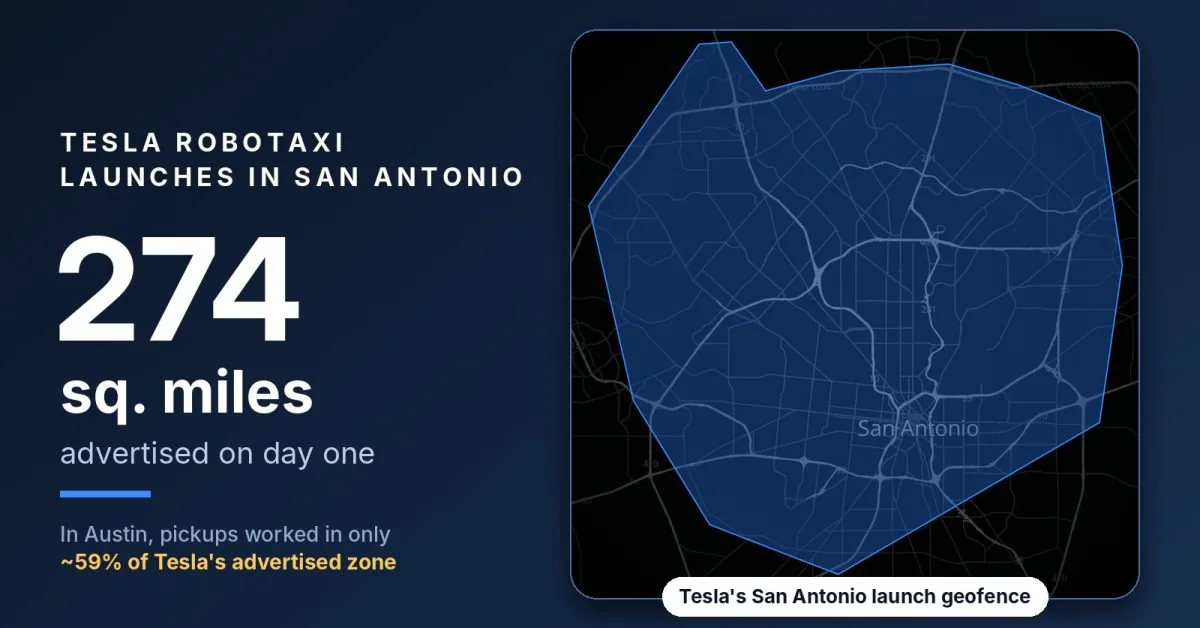
Because every tested market showed working coverage between 59% and 78%, the new San Antonio territory will likely function between 160 and 210 square miles in real passenger service. The Tesla Robotaxi San Antonio rollout fits this pattern of wide boundary maps that shrink when riders try to book real trips. Pierce expects similar restrictions when he begins auditing Waymo’s advertised maps in Orlando and other cities [1].
Fleet Sightings and Vehicle Types
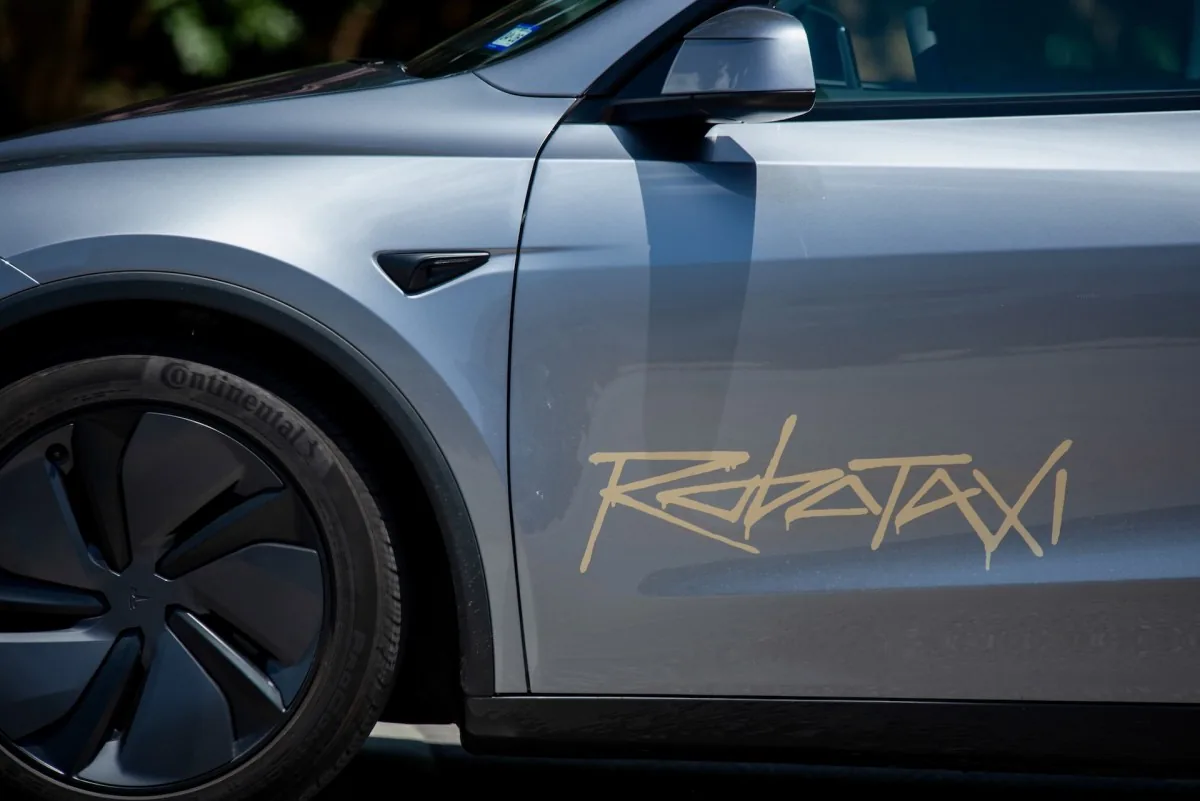
Tesla shared few operating details in its social media post. It did not clarify daily service hours, whether human safety drivers will accompany early trips, or whether riders will board modified Model Y vehicles or the gold, two-seater Cybercab [2].
Tesla CEO Elon Musk promised self-driving cars for a decade. He finally delivered an initial service in Austin in June 2025, operating with human safety drivers until Tesla removed onboard monitors in January 2026 to initiate driverless trips before spending the next 11 months expanding into Florida and Texas. Registration records in Texas and Robotaxi Tracker database logs show that while Austin counts over 400 autonomous vehicles, other fleets stay small. Fort Worth lists just 24 cars. Miami has five [2].
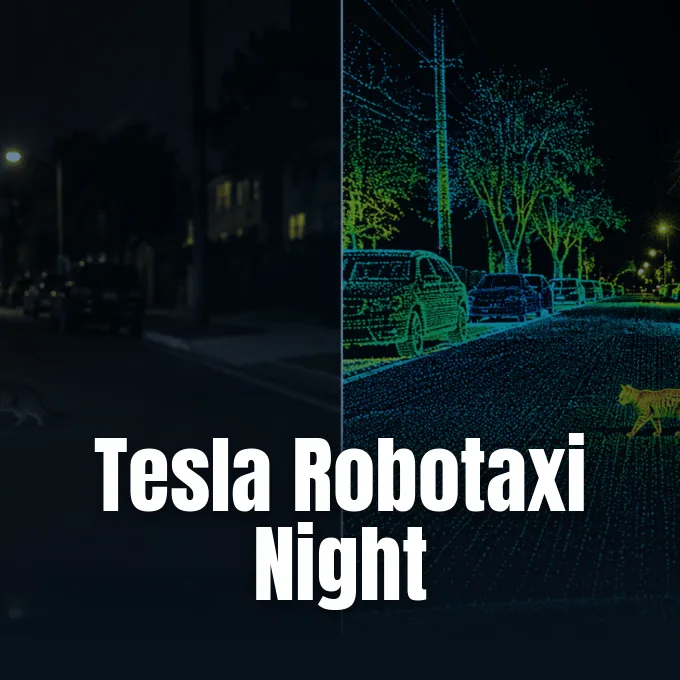
Musk insists that camera-based artificial intelligence can guide vehicles without expensive lidar sensors. Yet nighttime driving still poses unique challenges, particularly after tests showed how Tesla robotaxis struggle to spot pets at night on dimly lit neighborhood streets. TechCrunch reporter Kirsten Korosec reported that Tesla seeks to compete with Waymo while positioning itself as more than an automaker, though the company’s network drove fewer paying customer miles in the second quarter than in the first [2].
Waymo Competition in Central Texas
Alphabet subsidiary Waymo is Tesla’s main rival in urban Texas. Waymo serves passengers with driverless Jaguar I-Pace and Zeekr RT vehicles, which carry the brand name Ojai. The company operates in Austin, Dallas, Houston, and San Antonio [2].
Waymo recently restarted its San Antonio service after a five-month pause that began when multiple driverless vehicles entered flooded roadways and became immobilized during severe storms [2]. While Tesla announces wide geographic boundaries on paper, Waymo holds a heavy lead in active vehicles. Figures from Robotaxi Tracker show that Waymo operates over 4,000 driverless vehicles nationwide, compared to just 666 autonomous cars in Tesla’s nationwide fleet. Tesla may have 453 unsupervised vehicles in Austin, but its presence in other cities remains small. Waymo also serves San Antonio International Airport, offering travelers direct airport trips that Tesla’s new service can’t match [1].
Rider feedback shows that travel experiences differ between both platforms. Commenters on Electrek pointed out that Waymo cars arrive reliably in dense neighborhoods, while Tesla routing software often takes hour-long detours on short trips to avoid areas that cars can’t safely navigate alone. Robotaxi Tracker had to trim Waymo’s Orlando boundary because the local airport was not selectable, but Waymo continues to provide more predictable service throughout Central Texas [1].
Regulatory Limits for Tesla Robotaxi San Antonio
State regulations shape where Tesla can deploy driverless fleets. In California, Tesla operates an app-based ride service in the San Francisco Bay Area under a transportation charter permit, but those vehicles carry a human safety driver behind the wheel. California authorities have not granted Tesla the permits required to run commercial driverless trips. Texas takes a much lighter regulatory stance, giving companies wide latitude to test autonomous vehicles on public streets with minimal state oversight. That permissive environment explains why Tesla launched robotaxi operations in Austin, Houston, Dallas, Fort Worth, and now San Antonio, prioritizing regions where regulatory approval moves fastest [2].
The new Tesla Robotaxi San Antonio expansion brings the automaker to eight unsupervised markets, a jump from zero at the start of the year. Yet drawing a 274-square-mile polygon on social media does not translate into immediate neighborhood rides [1].
Without active cars stationed near Loop 1604 and downtown, San Antonio riders will encounter unserviceable address errors. Austin and Houston faced those same app refusals for weeks. Closing the wide distance between promotional boundary polygons and reliable street pickups is Tesla’s primary challenge as it attempts to transform paper service areas into actual transportation for daily commuters [1].
- ONLINE NEWS Lambert, F. (2026, November 9). Tesla launches Robotaxi in San Antonio with a 274 sq mi geofence on paper. Electrek. [Article Link]
- ONLINE NEWS Korosec, K. (2026, November 9). Tesla expands robotaxi service to San Antonio. TechCrunch. [Article Link]


