




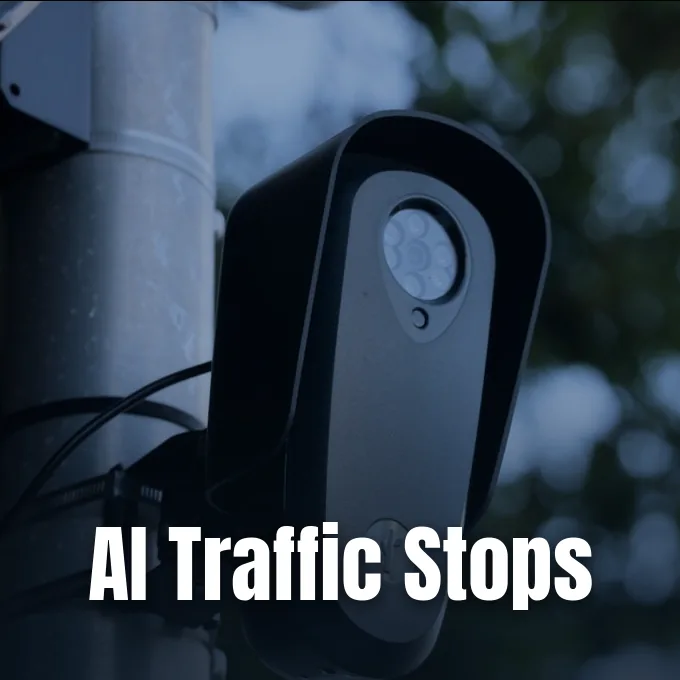
On October 26, 2026, the American Civil Liberties Union warned that police departments nationwide are using automated camera algorithms to conduct AI traffic stops based on travel histories that software labels as suspicious. Jay Stanley, a senior policy analyst with the ACLU Speech, Privacy, and Technology Project, reported that officers receive alerts about travel patterns and then find minor roadside infractions to pull motorists over. The civil liberties organization cautioned that this method replaces reasonable suspicion with automated scoring and ensnares innocent motorists on public highways [2].
A Roadside Encounter in Louisiana
The ACLU report opened with the experience of Grace Knowles, a northern Virginia resident in her 20s who embarked on a road trip in September 2025 across Oregon, Texas, and Louisiana [1]. While driving from New Orleans toward Florida, a patrol officer pulled her over after claiming she had stayed in the left lane too long [2]. His questions quickly turned away from driving behavior [1]. The officer demanded to know her itinerary and asked for proof that she had stayed in New Orleans [2]. When Knowles produced a brochure from a local whiskey museum, the officer relaxed and identified himself as a special agent with the Federal Bureau of Investigation (FBI) assigned to human and drug trafficking enforcement [1].
The agent told Knowles that automated systems had flagged her license plate for suspicious travel patterns, admitting he initially doubted her story because his software showed no camera hits in New Orleans. He invited Knowles into his cruiser to view his computer screen [2]. Knowles saw a digital map of the United States displaying circles around locations where cameras had photographed her vehicle. Each circle linked to a timestamped photo of her license plate. When Knowles asked how federal authorities gathered these records, the agent explained that cameras were positioned along routes everywhere, including on the backs of overhead highway signs [1].
The agent released Knowles without a citation once she proved her museum visit. Stanley noted that her calm roadside outcome was unusual. For many motorists, such police encounters will be “far more fraught, frightening and dangerous” than what Knowles encountered on the highway [2].

How AI Traffic Stops Rely on Camera Data
Automated license plate readers take high-speed photographs of passing vehicles, logging license plates, geographic coordinates, and precise timestamps [1]. Police agencies link camera feeds from multiple locations to reconstruct where a car has driven, which roads it took, and how often it stopped at specific sites [5]. As documented in PerEXP Teamworks coverage of how optical cameras read vehicle plates in automated networks, roadside optical cameras traditionally functioned to help police locate stolen cars or track vehicles tied to active arrest warrants [1]. The shift toward modern algorithmic surveillance occurred when vendors added machine learning models to analyze travel patterns directly [3]. Instead of searching for known criminal suspects, software actively generates suspicion from ordinary vehicular movement [2].
Flock Safety marketed tools in July 2025 capable of alerting police to travel patterns deemed suspicious, along with software to identify vehicles that travel together [2]. Files obtained by Wired revealed that Flock built an investigative search system that lets officers run open-ended queries across license plate captures, police case records, and commercial data broker databases [4]. Flock also promoted a tool called Multi-State Insights, which detects vehicle travel across state lines to assist investigations into retail crime and trafficking. The company said its technology supported over 1 million criminal investigations in 2025 [3].
Surveillance cameras have proliferated through small towns and major cities [3]. LavX News reported that security researchers mapped more than 335,000 Flock cameras across the country [6]. The ACLU noted that less than 1 percent of scanned vehicles have any connection to criminal wrongdoing [3].



Court Rejections and Pretext Detentions
Police officers use alleged traffic infractions as legal justification to detain motorists when an algorithm is the true trigger. Law enforcement agencies refer to these detentions as whisper stops or intel stops because officers conceal the surveillance database that prompted the encounter. By citing a driver for minor lane drifting, officers initiate pretextual stops without having to establish reasonable suspicion of an actual crime [2].
Legal challenges to these automated stops have started prevailing in federal court. Earlier this month in Texas, a federal jury ruled in favor of an oilfield supply salesman named Schott, who sued local deputies over an unconstitutional traffic stop scheme [1]. Schott was pulled over after driving from Houston to Carrizo Springs, staying one night, and returning home the next day. A federal fusion center flagged his overnight itinerary as suspicious and alerted local police. Although deputies claimed Schott drifted across a lane line, dashcam video showed no lane violation, and the officer later admitted under oath that the traffic infraction was fabricated [2].
The Institute for Justice, which represented Schott, pointed out that local deputies had subjected thousands of motorists to identical pretext routines. Federal agencies also share pattern alerts with municipal police. In November 2025, the Associated Press reported that Border Patrol agents monitored drivers across the United States, prompting local police to pull over a South Carolina furniture mover 100 miles from the Mexican border. Officers searched his truck, found nothing illegal, but seized his cash savings under suspicion of money laundering [2]. In March 2026, The Markup reported that customs officers questioned a California grandmother about casino visits after tracking her vehicle [1].

Algorithmic Flaws in AI Traffic Stops
Technical analysts warn that scoring driver movements produces high rates of wrongful police encounters. The fundamental problem stems from the base-rate fallacy: millions of lawful motorists take long highway trips, visit entertainment venues, or commute across regional borders every week [4]. Because the vast majority of motorists are completely law-abiding, algorithms designed to flag anomalous travel will inevitably sweep up innocent travelers [2]. In April 2025, police targeted a Wisconsin driver simply for commuting back and forth across the border with Michigan, which local police labeled a “known source State for Marijuana” because cannabis is legal there [1]. An entire neighboring state was treated as inherently suspicious [2].
Algorithmic scoring also produces unfalsifiable evidence against drivers [4]. In Knowles’s case, the absence of camera records in New Orleans was treated as evidence that she lied about her road trip [2]. Missing data points became incriminating proof. Drivers cannot easily inspect or challenge an automated heat map during a roadside stop [4].
A 2024 Department of Justice report on artificial intelligence and policing noted that automated reader tools can improve investigation response times, but warned that deploying technology without strict safeguards harms public trust [3]. The ACLU warned that pattern scoring opens avenues for mission creep, enabling surveillance of political demonstrations and travel associations. Drivers who realize their journeys are continuously scored must navigate roads with pervasive self-consciousness [2].

Community Backlash and Contract Cancellations
Public opposition to mass license plate surveillance has intensified as details of algorithmic stops emerge. An August YouGov survey revealed that 46 percent of respondents opposed law enforcement using license plate reader technology in their communities, while 38 percent supported it. Municipal backlash has led to immediate operational shifts. The Los Angeles Police Department suspended its contract with Flock Safety amid community privacy concerns [1]. Elsewhere, several police officers were fired after internal department audits revealed they misused camera networks to track individuals without legal cause [5].
Market and legislative pressures are mounting against surveillance vendors. Flock Safety cut 18 percent of its staff amid growing public backlash and municipal contract disputes. In the United States Congress, Representative Rashida Tlaib introduced a bill to prohibit federal funds from supporting Flock-style automated surveillance tools [4]. Flock has defended its product line, maintaining that its network aided more than 1 million criminal investigations in 2025. The company noted that over 40 percent of surveyed law enforcement agencies credited Flock tools with helping recover at least half of the stolen vehicles in their jurisdictions [3].
Legal battles will determine whether pattern-matching alerts can withstand Fourth Amendment review [4]. While courts historically permitted cameras along public roads, civil liberties groups maintain that automated travel scoring subverts constitutional protections against unreasonable seizures [2]. Judges and lawmakers must now decide how much suspicion algorithms can fabricate [4].
- ONLINE NEWS Gil, B. (2026, October 27). Police Are Using AI to Pull Over Drivers for ‘Suspicious’ Behavior. Gizmodo. [Article Link]
- REPORT Stanley, J. (2026, October 26). Police Are Increasingly Pulling People Over Because AI Deems Their Driving Patterns “Suspicious”. American Civil Liberties Union. [Article Link]
- ONLINE NEWS Greenwood, A. (2026, October 27). Police using AI to flag ‘suspicious’ drivers who haven’t broken law: report. Newsweek. [Article Link]
- WEBSITE Thakker, Y. (2026, October 26). AI Police Stops: ACLU on “Suspicious” Driving Patterns. AISOLO Technologies Private Limited. [Article Link]
- ONLINE NEWS Navi. (2026, October 27). Police Using AI Surveillance to Pull Over Drivers. TheOutpost.ai. [Article Link]
- ONLINE NEWS Brandt, L. (2026, October 27). Police use AI to flag drivers as suspicious, ACLU warns of pretextual stops. LavX News. [Article Link]
- ONLINE NEWS Dufresne, A. (2026, October 27). FBI Pulls Over Driver Over AI-Flagged Travel Patterns. AI Weekly. [Article Link]


