





Anycast routing lets multiple server nodes in separate locations share an identical IP address. When a client computer transmits data packets to that shared IP address, core internet routers steer each transmission to the topologically nearest live server node using Border Gateway Protocol (BGP) routing tables. Exploring how anycast works reveals how global online networks balance server loads, cut round-trip latency, and absorb large denial-of-service floods without needing configuration changes on client devices. First tested in 1989 and documented by the IETF in 1993, this routing methodology powers internet systems like the Domain Name System and high-capacity content delivery networks [19].
Early History of Shared Addressing
Engineers first tested shared IP addresses on internet-connected services in 1989 to balance topological traffic loads [19]. In November 1993, researchers C. Partridge, T. Mendez, and W. Milliken wrote RFC 1546 through the Internet Research Task Force (IRTF) under the title Host Anycasting Service [1]. Their foundational memo defined anycast as a stateless internetwork service that delivers an IP packet to a single open host chosen from a group of server nodes sharing that exact same virtual network address. Early architectural discussions questioned whether shifting routes would disrupt live links like FTP file transfers. But real deployment data soon proved those fears unfounded, as routing switches caused dropped sessions in less than 0.017% of long-term internet flows measured on live networks [19]. Organizations quickly adopted shared addresses for directory services [1].
Network downtime causes severe financial loss. A 2020 market research report from Statista showed that an hour of enterprise network downtime costs between $300,000 and upwards of $5 million. Unplanned service halts cost roughly $9,000 per minute. Teams like NetActuate configure peered autonomous systems with global BGP anycast to keep web portals accessible during hardware failures [12].
Global network measurements confirm how anycast works to spread service nodes over the internet. In an empirical study, computer scientists D. Cicalese and D. Rossi tracked IP anycast adoption by conducting regular monthly censuses using measurement vantage points on PlanetLab and RIPE Atlas. Their findings proved that thousands of geolocated prefix replicas operate on global IP prefixes, showing how anycast works to place replicated digital resources close to requesting end users [4].
How Anycast Works in BGP Networks
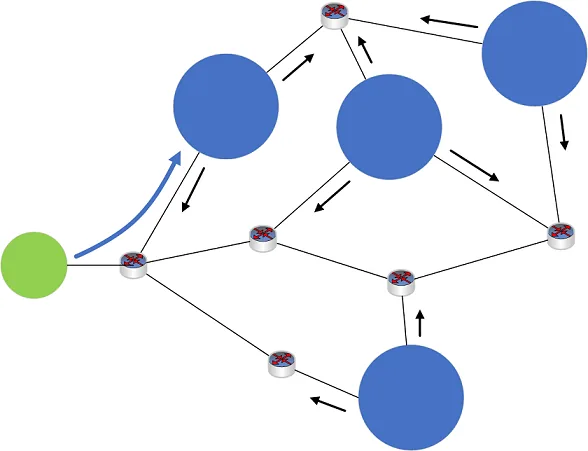
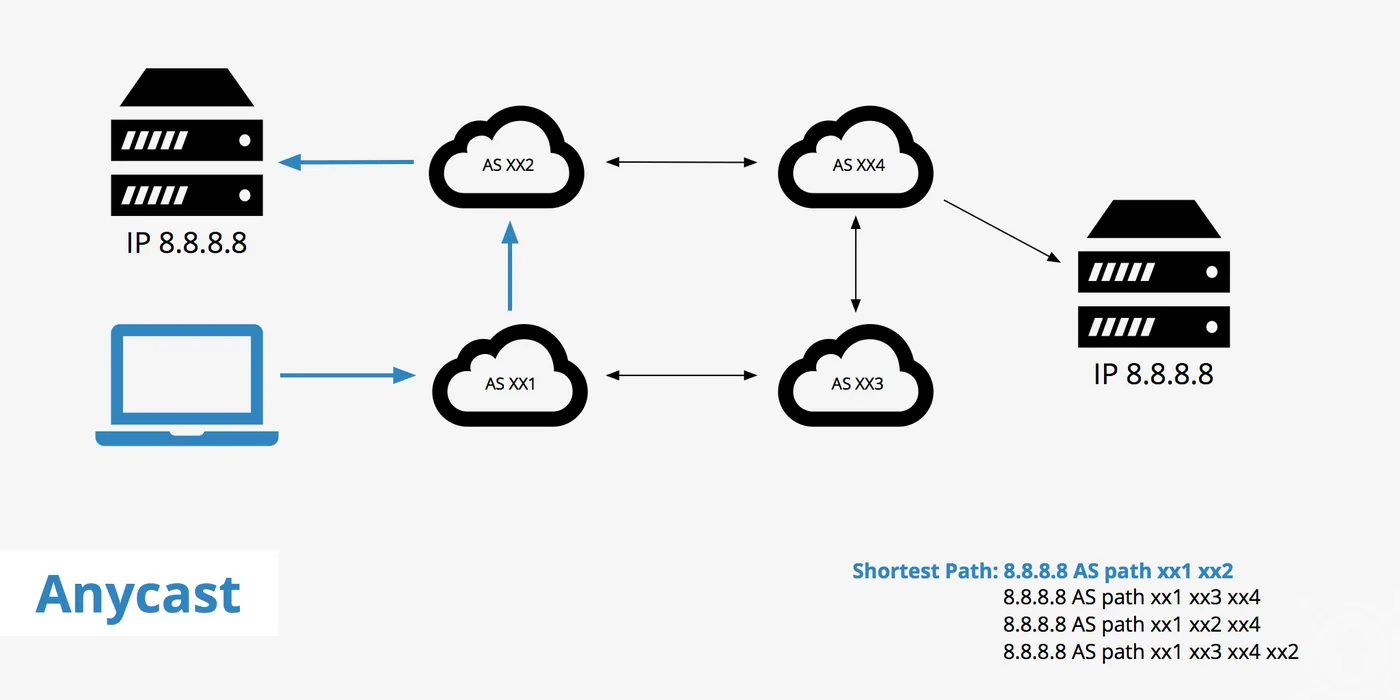
Production anycast setups begin by assigning an identical IP prefix to servers in multiple data centers. Network teams assign a /24 prefix block in IPv4 or a /48 prefix in IPv6 to facilities located in cities like Tokyo, London, and New York [13]. Edge routers announce this shared prefix to upstream transit carriers using Border Gateway Protocol (BGP). Intermediate carriers receive multiple route advertisements for the same address prefix and store them in local routing tables. When observing how anycast works in live environments, border routers treat these separate BGP announcements as alternate paths to one virtual host, forwarding incoming packets along the shortest autonomous system path. Packets simply travel along the lowest-cost route [16].
Route selection follows standard BGP routing decision algorithms without needing custom protocol modifications. Internet routers evaluate available paths using a strict sequence of BGP attributes: LOCAL_PREF values take first priority, followed by Autonomous System path length, origin type codes, MED values, and interior gateway protocol link metrics. Carrier links from paying customers outrank peer links even when the peer path covers fewer miles [16].
Carriers also apply hot-potato routing rules, which push incoming data toward the nearest network exit point to save transit costs on the carrier’s own fiber backbone [16]. Automation teams deploy open-source tools like ExaBGP to convert BGP route announcements into structured JSON text, allowing automated monitoring scripts to control neighbor peering sessions dynamically. This setup illustrates how anycast works when managing transit links: if an individual server fails health checks, monitoring scripts withdraw the local BGP route advertisement, prompting neighboring routers to reroute incoming traffic [14].
Differences in Anycast Routing and Unicast
Different network routing methods address distinct communication needs on the internet. In standard unicast routing, one unique IP address maps directly to one server, creating a strict one-to-one setup that forms the base of standard web hosting and database links. However, unicast lacks built-in fault tolerance at Layer 3. If a unicast server located in Frankfurt experiences an outage, connected clients in Chicago and Tokyo lose access completely until network engineers manually update DNS records or reconfigure external routing gear. Examining differences in anycast routing and unicast shows how distributed clusters maintain continuous availability: client requests automatically land on mirror servers in London or Mumbai without manual operator intervention or DNS changes [10, 14].
Other transmission methods serve distinct communication scenarios. Multicast architecture transmits a single data stream from one sender to a designated group of subscribed receiver hosts, making it suitable for live video streams and multi-party voice conferences. Broadcast delivery sends packets to every host connected to a local subnet [15]. A related method called geocast steers datagrams to recipients located within a specific territory [14]. None of these replace standard point-to-point web browsing [15].

In contrast, anycast operates on a one-to-one-of-many basis where each query sent by a client reaches a single operational node selected from multiple candidate servers [15]. In an IEEE Systems Journal paper, authors X. Wang and X. Zhu showed how anycast works to lower data acquisition costs and improve retrieval success rates in mobile ad-hoc networks. By allowing mobile nodes to download cached content from the nearest available neighbor, anycast routing balances traffic loads across network nodes while avoiding route disruptions caused by mobile node movement [8].
Network Catchment Boundaries
In an anycast network, the zone from which traffic flows to a specific point of presence is called its catchment [16]. Catchment boundaries do not follow national borders; they reflect Autonomous System topologies and peering relationships. For example, a client in New Delhi sending queries to the IP address 203.0.113.1 might connect to Mumbai or route to London if their local ISP maintains faster upstream transit through Europe [10]. Analyzing how anycast works in global routing tables shows that catchments shift dynamically whenever inter-domain links fail, border routers reboot, or transit carriers update commercial peering agreements. Network operators publish RPKI Route Origin Authorizations to protect their advertised anycast prefixes from accidental route leaks or malicious Border Gateway Protocol hijacking attempts in the global routing table [16].
Catchments display high stability under normal conditions. In a research study, computer scientists K. Schomp and R. Al-Dalky partitioned internet traffic using passive measurement logs collected from authoritative DNS clusters running on a major CDN. Their experimental findings confirmed that anycast catchment maps remain consistent with minimal routing error for up to two weeks after initial measurement, showing strong underlying route stability [5].
Traffic does not divide evenly among neighboring sites when an anycast facility fails. If site A handles 30 Gb/s of peak throughput and withdraws its routes, historical telemetry might show its catchment splitting in a 70/30 ratio between nearby facilities B and C. Under that traffic distribution, site B must maintain at least 21 Gb/s of reserve headroom capacity to absorb the displaced traffic volume without experiencing server congestion or packet loss. Network engineers plan reserve capacity based on empirical failover measurements rather than assuming equal distribution among surviving sites [16].


DNS Resolution at the Edge
The Domain Name System is the primary deployment of anycast addressing on the internet. Because DNS queries rely on lightweight UDP datagrams over port 53, lookups finish in a single round-trip exchange without needing transport session state [10, 11]. Standard unicast DNS lookups frequently force client resolvers to query distant servers on other continents, adding 150 to 300 ms of latency. Anycast routing eliminates that penalty by answering queries at local edge points of presence in under 10 ms. This distributed setup demonstrates how anycast works to accelerate domain name lookups for millions of consumer devices simultaneously while keeping name resolution fast and resilient [13].
Root nameservers rely entirely on distributed anycast clusters. The global system maintains 13 official root identities labeled A through M, distributed across well over 1,000 server instances worldwide [16, 19]. Anycast adoption for root nameservers began in 2001 with the I-root nameserver [19]. Research from the National Science Foundation showed that 93% of top-level domains operated on anycast infrastructure by 2021 [12].
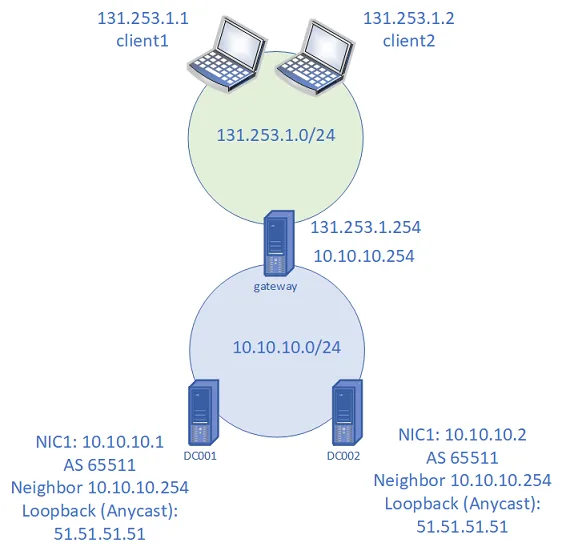
Enterprises also deploy native anycast on internal networks. In an official guide, Microsoft details how administrators configure native BGP Anycast DNS on Windows Server using Hyper-V and PowerShell. Domain controllers DC001 and DC002 assign a 32-bit loopback address 51.51.51.51 on intranet subnet 10.10.10.0/24 with mask 255.255.255.0, peering with a gateway router at ASN 8075. When virtual machines query 51.51.51.51, the gateway routes packets to the closest domain controller; if an administrator disables Ethernet 2 on DC001, sessions terminate and client DNS queries fail over to DC002 without interruption [9].
DDoS Attack Absorption
Distributed denial-of-service attacks threaten web platforms by flooding targeted servers with massive volumes of traffic. Under a standard unicast model, botnets across multiple continents concentrate all attack traffic onto a single destination IP address, quickly saturating upstream bandwidth links [14]. Anycast mitigates volumetric denial-of-service attacks by dispersing flood packets to dozens of points of presence worldwide, preventing traffic from converging on a single network point. For example, a 100 Gb/s volumetric attack sent toward 30 PoPs divides into roughly 3.3 Gb/s per site, allowing scrubbing hardware to inspect and filter packets without crashing central web infrastructure. Attackers cannot target an individual facility unless they discover its secret unicast address [13].
Academic research confirms the defensive benefits of distributed addressing. In a study in Telecommunication Systems, authors J. Rak and K. M. Walkowiak evaluated optimization models to protect anycast and unicast network flows against attacks on irregular network layouts. Their analysis demonstrated that positioning anycast replica servers at low-degree network nodes cuts packet loss after link cuts, boosting resilience against targeted attacks [6].
Content delivery networks combine anycast ingress with edge caching layers to accelerate web delivery. In ACM Transactions on the Web, computer scientist H. A. Alzoubi and colleagues presented load-aware CDN architectures that dynamically steer anycast traffic using real-time server load measurements rather than static hop counts alone [3]. In live tests in June 2026 on a 100 MB HTTPS download, BlazingCDN measured average latency figures of 27 ms in Europe, 24 ms in North America, and 47 ms in Asia using NVMe SSD edge caches [16]. Edge providers like Cloudflare and KeyCDN use comparable architectures to terminate TLS handshakes and serve cached static media locally [11, 14].
Route Withdrawal and Failover Speed
When an anycast server node fails, traffic recovery occurs at the network routing layer through standard BGP route withdrawal. Traditional GeoDNS routing relies on altering authoritative DNS records and waiting for recursive resolvers to flush cached IP entries, but resolvers that ignore short Time to Live (TTL) values leave end users stranded for minutes [16]. In contrast, anycast failover requires no client-side reconfiguration: when a damaged node ceases advertising its prefix, upstream routers automatically drop that path and redirect subsequent packets to the next best site. Observing how anycast works during unexpected link failures highlights why edge providers prefer Layer 3 routing over application-layer DNS steering to maintain continuous availability for web applications [13, 16].
Failover speed depends on three primary intervals: fault detection time, local route withdrawal time, and global internet routing convergence. Enabling Bidirectional Forwarding Detection (BFD) on edge BGP peering sessions allows routers to detect link failures within milliseconds, completing global traffic failover in roughly 6 to 70 seconds. Without BFD enabled, router sessions must wait for standard BGP hold timers lasting between 90 and 180 seconds before edge devices recognize the failure and begin advertising route withdrawals [16].

Planned server maintenance uses controlled routing policies to drain traffic gracefully. Network administrators often prepend their Autonomous System number to outgoing BGP announcements to make that specific path appear longer to neighbor routers. However, AS path prepending has a known limitation: because upstream networks prioritize LOCAL_PREF attributes above AS path length, customer links continue sending traffic to the prepended node despite multiple added hops. Achieving complete traffic isolation before performing server maintenance requires running health-checking daemons like BIRD or FRR that withdraw the BGP prefix announcement entirely once local services stop [16].
Stateful IP Anycast Traffic Management
While stateless UDP protocols operate naturally over anycast, stateful protocols like TCP introduce distinct operational complexities. Transmission Control Protocol connections maintain state across sequence numbers, socket pairs, and window buffers established during the initial three-way handshake between client and server. If an intermediate routing flap suddenly shifts packets mid-stream to an alternate anycast node holding no record of that connection, the receiving server responds with a TCP RST packet that immediately terminates the session [17]. In practice, long-term flow studies reveal that mid-connection switches occur in less than 0.017% of live flows, dropping fewer than one session per ten thousand active connections in any given hour. Short-lived HTTP transactions and API queries complete quickly enough that underlying internet routing paths remain stable for the duration [16, 19].
Network engineer Bill Herrin designed semi-stateless mechanisms to support long-lived TCP connections over anycast. Herrin observed that in more than 99% of cases, anycast traffic patterns naturally devolve to consistent unicast behavior between endpoints. To handle corner cases like split-path routing or topology shifts, Herrin proposed assigning non-overlapping TCP sequence number home ranges to each cluster node and using stateless GRE tunnels to forward misplaced packets to the owning server [17].
Internet engineering standards define specialized anycast roles in different protocols. In RFC 2526, authors D. Johnson and S. Deering specified reserved IPv6 subnet anycast addresses, allocating the highest 128 interface identifiers in EUI-64 subnets for administrative anycast while reserving interface identifier zero as the Subnet Router address [2]. In multicast networking, Cisco documentation outlines Anycast RP within PIM-SM, where multiple rendezvous points share active source registrations via Multicast Source Discovery Protocol (MSDP) peering across loopback interfaces without creating single points of failure [18]. In vehicular communications, researchers M. Báguena and team created adaptive anycasting solutions for crowd sensing, routing telemetry from moving vehicles to nearby roadside units to improve data delivery [7].
- REPORT Partridge, C., Mendez, T., & Milliken, W. (1993). Host Anycasting Service (RFC 1546). Internet Engineering Task Force. [Article Link]
- REPORT Johnson, D., & Deering, S. (1999). Reserved IPv6 Subnet Anycast Addresses (RFC 2526). Internet Engineering Task Force. [Article Link]
- ACADEMIC JOURNAL Alzoubi, H. A., Lee, S., Rabinovich, M., Spatscheck, O., & Merwe, J. V. d. (2011). A Practical Architecture for an Anycast CDN. ACM Transactions on the Web, 5(4), 1-29. [Article Link]
- ACADEMIC JOURNAL Cicalese, D., & Rossi, D. (2018). A longitudinal study of IP Anycast. ACM SIGCOMM Computer Communication Review, 48(1), 10-18. [Article Link]
- ACADEMIC JOURNAL Schomp, K., & Al-Dalky, R. (2020). Partitioning the internet using Anycast catchments. ACM SIGCOMM Computer Communication Review, 50(4), 3-9. [Article Link]
- ACADEMIC JOURNAL Rak, J., & Walkowiak, K. M. (2011). Reliable anycast and unicast routing: protection against attacks. Telecommunication Systems. [Article Link]
- ACADEMIC JOURNAL Báguena, M., Calafate, C. T., Cano, J., & Manzoni, P. (2015). An Adaptive Anycasting Solution for Crowd Sensing in Vehicular Environments. IEEE Transactions on Industrial Electronics, 62(12), 7911-7919. [Article Link]
- ACADEMIC JOURNAL Wang, X., & Zhu, X. (2016). Anycast-Based Content-Centric MANET. IEEE Systems Journal, 12(2), 1679-1687. [Article Link]
- WEBSITE Microsoft. (2023). Anycast DNS overview. Microsoft Learn. [Article Link]
- WEBSITE GeeksforGeeks. (2023). Anycast Routing and its Applications. GeeksforGeeks. [Article Link]
- WEBSITE Anycast Guide. (n.d.). What is Anycast? How Anycast Routing Works. Anycast Guide. [Article Link]
- WEBSITE NetActuate. (2024). What is Anycast Networking and How Does it Work? Anycast.com. [Article Link]
- WEBSITE Enterno. (2026). Anycast DNS: How It Works, Benefits and Implementation. Enterno.io. [Article Link]
- WEBSITE KeyCDN. (2023). How Anycast Works: An Introduction to Networking. KeyCDN Support. [Article Link]
- WEBSITE DNSFilter. (2025). What Is Anycast? Definition, Uses & Benefits. DNSFilter Glossary. [Article Link]
- ONLINE NEWS Borovskyi, V. (2026). What Is Anycast? How Anycast Routing Speeds Up the Internet. BlazingCDN Blog. [Article Link]
- WEBSITE Herrin, B. (n.d.). Anycast TCP. Bill Herrin Network Notes. [Article Link]
- REPORT Cisco Systems. (2001). Anycast RP (White Paper). Cisco Technical Documentation. [Article Link]
- WEBSITE Wikipedia contributors. (n.d.). Anycast. Wikipedia, The Free Encyclopedia. [Article Link]


