



Amazon has retired its Fire branding after fifteen years of hardware releases, announcing a completely redesigned Amazon Alexa tablet family running standard Android instead of its custom Fire OS software [1]. The company introduced five models in three display sizes alongside upgraded kids editions, replacing plastic casings with thin aluminum unibody enclosures and placing an Alexa+ assistant widget on the main home screen. Shipments begin October 14 in North America. European deliveries start October 19 [3].
Moving from Fire OS to Android
The original Kindle Fire arrived in 2011 as a shopping gateway that paired digital reading with web browsing, but its restricted software ecosystem frustrated users who wanted standard mobile applications. Amazon maintained Fire OS for more than a decade as a heavily modified fork of Android without official Google Play access, pushing customers to its own digital catalog and Silk browser. That arrangement created persistent friction for daily workflows, because simple software updates often lagged behind mainstream mobile operating systems. Google Play replaces the previous catalog. Now, the new hardware drops Fire OS in favor of an open Android environment where standard tools like G Suite can run natively [1].
Switching to Android changes the fundamental purpose of these slates from retail storefronts into versatile personal computers. Users can download third-party software without sideloading workarounds, and the platform even allows Gemini to serve as the default voice assistant instead of Amazon’s own services. While earlier Fire tablets felt slow and constrained, the cleaner operating system removes unnecessary software layers that bogged down earlier models. Mike Prospero of Tom’s Guide tested the devices in person. He said that moving away from Fire OS resolves the main complaint buyers held against Amazon tablets for over ten years [3].
The change also aligns with wider adjustments in the retail giant’s hardware portfolio. Just as Amazon prepares to depart from Android on its streaming sticks, it embraces the Google system for mobile displays to compete with iPad Air alternatives. The shift follows recent adjustments in the company’s audio ecosystem, where the Echo speaker AUX input loses Alexa voice controls during manual playback configurations. Third-party apps run through Google Play. By adopting mainstream Android code, Amazon helps applications run without extra porting efforts [3].

Hardware Power in the Amazon Alexa Tablet 12 Pro
The centerpiece of the new family is the Amazon Alexa Tablet 12 Pro, which steps into premium territory with an aluminum chassis measuring 6.5mm at its thinnest edge. Amazon built the tablet around a 12-inch display running at 2800×1840 resolution with a 120Hz refresh rate and 280 ppi pixel density. The screen reaches 500 nits. It features a 3:2 aspect ratio that provides extra vertical room for documents and spreadsheets, while an 8-core processor built on a 4nm process handles demanding tasks with up to 16 hours of video playback on a single charge [3].
Processing speed increases thanks to the MediaTek Dimensity 8400 chipset. Amazon said that “with up to 16GB of RAM, Amazon Alexa Tablet 12 Pro delivers nearly three times faster processing and nine times faster graphics than any tablet we’ve ever shipped.” Base configurations start at $499.99 in the United States or £449.99 in the United Kingdom, pairing 8GB of RAM with 128GB of storage. That pricing puts the hardware in competition with midrange Android slates and Apple’s iPad Air [1].
Amazon also introduced modular productivity add-ons designed specifically for the 12-inch model. A magnetic indentation along the upper edge holds the optional Amazon Alexa Tablet Pro Pen, which sells separately for $89.99 and offers precise sketching input. The keyboard costs $149.99. Along the opposing edge, magnetic pogo pins connect to the keyboard accessory to create a portable workstation for typing reports during travel without carrying heavier laptop gear [3].


Display Choices and Kindle Mode
Beyond the standard glossy glass, Amazon offers an optional nanomatte display on the 12 Pro that starts at $549.99 or £599.99 [1],. The company worked with Corning to develop a photolithography etching process that cuts down harsh light reflections without washing out color richness or contrast. Side-by-side tests showed that while glossy glass produced slightly deeper black levels, the matte finish eliminated distracting reflections from overhead office bulbs. The textured surface adds tactile grip. It mimics the gentle friction of pencil on paper when drawing with the optional stylus [3].
Reading comfort sits at the center of Amazon’s tablet identity through an updated software feature called Kindle Mode. When a reader launches the Kindle reading application, the operating system silences incoming alerts and adjusts color saturation to mimic an electronic paper display. While frequent readers often look at color ereader choices ahead of Prime Day, the muted software profile here attempts to bridge the gap between media tablets and digital books. Battery life reaches 20 hours in this mode. That extended endurance gives users several extra hours of reading compared to standard video playback [3].
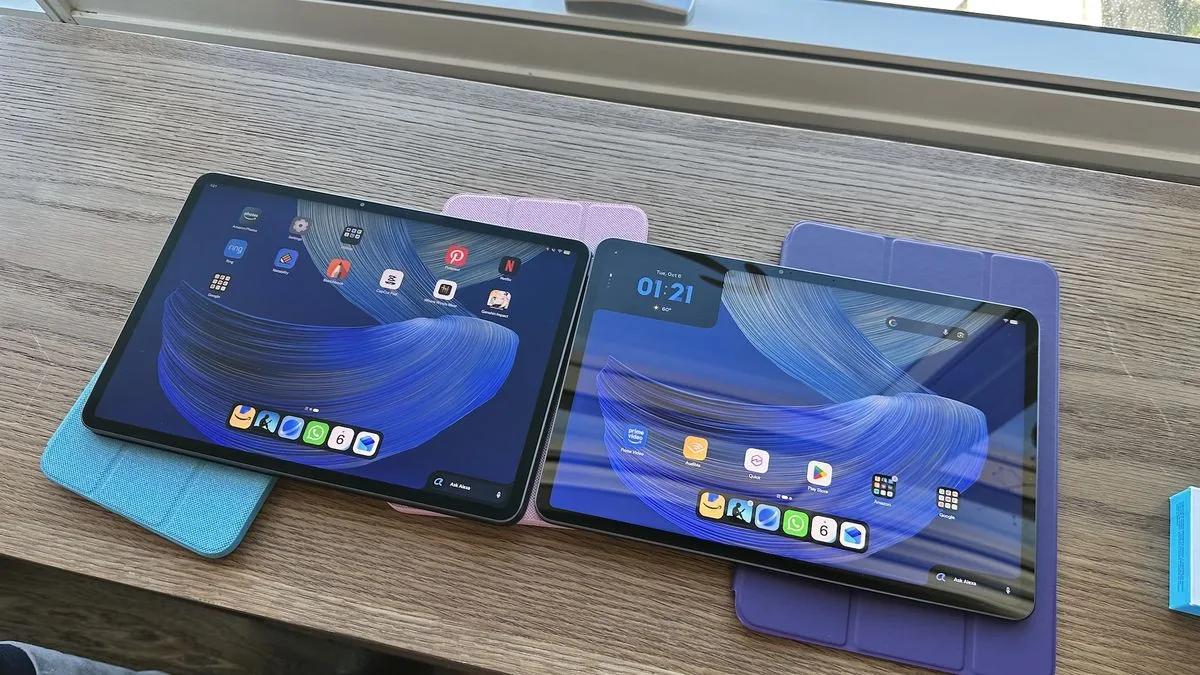
Audio capabilities complement the visual upgrades through built-in Dolby Atmos speakers tuned for streaming and voice calls. The 12 Pro also includes Wi-Fi 6E connectivity, providing fast data downloads and stable wireless streaming on home routers [3]. It isn’t just an e-reader or a shopping screen anymore; it’s a balanced media slate built for watching films and managing smart home appliances. Axel Metz of TechRadar evaluated the hardware during hands-on testing. He said the aluminum enclosure feels far better in the hand than any previous Fire release [1].
Smaller Alexa Tablet Options for Daily Entertainment
Shoppers who don’t need a massive twelve-inch workspace can choose the midrange Alexa Tablet 11, which focuses on casual video watching. It features an 11-inch aluminum unibody build with a 2.5K display running at 2560×1600 resolution, 276 ppi, and a 90Hz refresh rate. The panel uses a 16:10 aspect ratio. That wider shape suits movie streaming better than boxy document proportions. Starting at $329.99, the slate includes an 8-core processor, 8GB of RAM, 64GB of storage, and dual Dolby Atmos speakers that provide up to 15 hours of video battery life [3].
The 11-inch model comes in three finishes called Graphite, Amethyst, and Matcha, though it lacks the optional nanomatte screen upgrade found on the 12 Pro. For budget-minded buyers, the entry-level Alexa Tablet 8 offers a compact 8.7-inch screen with 1340×800 resolution and weighs just 11.6 ounces. It runs on an 8-core processor backed by 4GB of RAM, 64GB of storage, and Wi-Fi 6, lasting up to 14 hours on a single charge. The tablet costs $229.99. Available case colors include Graphite, Rosette, and Teal [3].

These entry prices represent an upward shift compared to older hardware generations from previous years. The former Fire HD 8 launched at $129, meaning the new starting price of $229.99 reflects substantial upgrades in materials and processing components. Plastic frames have disappeared in favor of sturdier aluminum, and modern wireless chips raise production expenses. The price jump is real. While some parents might hesitate at the higher price floor, the improved build quality helps prevent the wear that damaged older plastic models [3].
Software Features, Family Controls, and Release Dates
On the software side, Amazon embedded an Alexa+ widget in the lower right corner of the home screen, allowing owners to summon conversational AI assistance at any moment. The helper doesn’t just answer spoken questions; it can examine what is displayed on the screen to provide contextual suggestions [3]. If a user views a plant photo, Alexa+ identifies the botanical species. In smart kitchens, users can save a recipe seen on the tablet and beam the cooking steps to a nearby Echo Show smart display [1].
Access to advanced artificial intelligence tools is included at no additional cost for Amazon Prime subscribers, whereas non-members must pay $19.99, £19.99, or AU$29.99 per month for standalone Alexa+ tiers [1]. Families also receive updated Amazon Kids Tablets in 8.7-inch and 11-inch sizes, priced at $229.99 and $329.99 respectively. Protective bumpers guard both sizes. These cases feature themed artwork from popular franchises like Paw Patrol and Barbie, while parents can enforce screen time limits, restrict unauthorized websites, and rely on a kid-friendly version of Alexa+ [3].
The entire new tablet lineup launches first in the United States, Canada, and Mexico on October 14, 2026, before expanding to the United Kingdom, Germany, France, Italy, and Spain on October 19 [3]. Josephine Watson of TechRadar said that the shift to open Android software and higher-grade aluminum builds turns Amazon’s tablet line from cheap disposable e-readers into genuine daily workstations. Amazon targets faster speeds rather than bargain prices. Longtime Fire users must decide whether the new capabilities justify the higher cost, but the upgraded components deliver a noticeably different computing experience [1], [3].
- ONLINE NEWS Watson, J. (2026, October 8). It only took 15 years, but Amazon’s Alexa Tablet could be the slate to win me back after my disappointing experience with the first-ever Kindle Fire. TechRadar. [Article Link]
- ONLINE NEWS Ars Technica. (2026, October 8). Amazon’s new Alexa Tablets drop the Fire branding but are more Android than ever. Ars Technica. [Article Link]
- ONLINE NEWS Prospero, M. (2026, October 8). Fire Tablets are dead — Amazon announces new Alexa tablet lineup running Android. Tom’s Guide. [Article Link]


